
Fast explainability algorithms for tree ensembles

Project description
Understand trees. Decision trees.
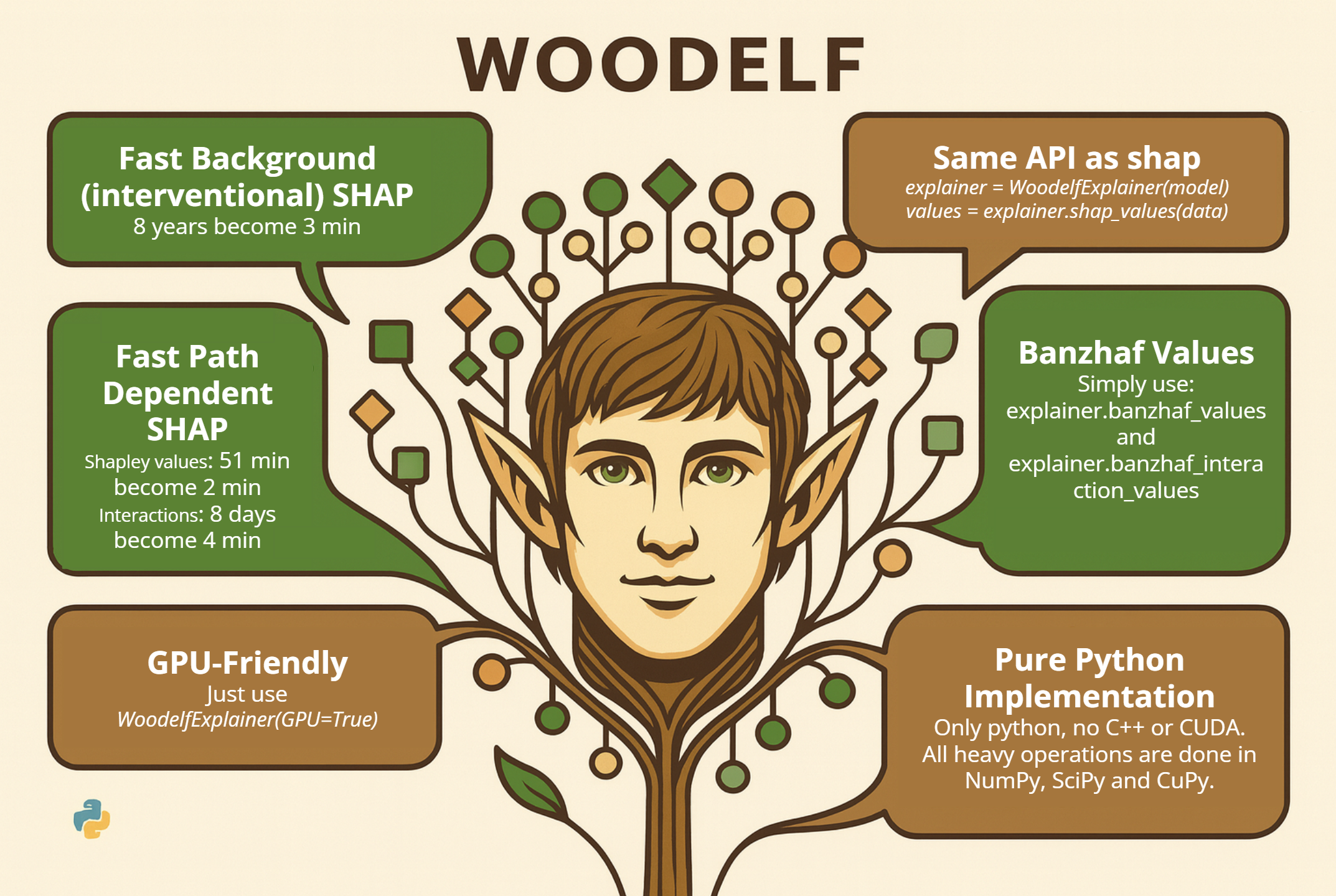
WOODELF is a unified and efficient algorithm for computing Shapley values on decision trees. It supports:
- CPU and GPU
- Path-Dependent and Background (Interventional) explanations
- Shapley and Banzhaf values
- First-order values and interaction values
All within a single algorithmic framework. The implementation is written in Python, with all performance-critical operations vectorized and optimized using NumPy and SciPy. GPU acceleration is supported via CuPy.
Our approach is significantly faster than the one used by the shap package.
In particular, the complexity of Interventional SHAP is dramatically reduced:
when explaining $n$ samples with a background dataset of size $m$,
the shap package requires $O(nm)$ time, while WOODELF requires only $O(n + m)$ time.
We also substantially accelerate Path-Dependent SHAP, especially on large datasets and when computing interaction values.
To demonstrate the speed-up, we computed Shapley values and interaction values for 3,000,000 samples with 127 features using a background dataset of 5,000,000 rows. We explained the predictions of an XGBoost model with 100 trees of depth 6, trained on this background data. The results are reported in the table below.
| Task | shap package CPU | WOODELF CPU | WOODELF GPU |
|---|---|---|---|
| Path Dependent SHAP | 51 min | 96 seconds | 3.3 seconds |
| Background SHAP | 8 year* | 162 seconds | 16 seconds |
| Path Dependent SHAP interactions | 8 days* | 193 seconds | 6 seconds |
| Background SHAP interactions | Not implemented | 262 seconds | 19 seconds |
Values marked with * are runtime estimates. WOODELF also outperforms other state-of-the-art approaches. In this task, it is an order of magnitude faster than PLTreeSHAP and approximately 4× faster than FastTreeSHAP.
Installations
A simple pip install:
pip install woodelf_explainer
The required dependencies are pandas, numpy, scipy, and shap.
The shap package is used for parsing decision trees and for minor auxiliary operations,
while the Shapley value computation is handled entirely by WOODELF.
An optional dependency is cupy, which enables GPU-accelerated execution.
Usage
Use the woodelf.explainer.WoodelfExplainer object!
Its API is identical to the API of shap.TreeExplainer. The functions inputs are the same, the output is the same, just the algorithm is different.
Background (interventional) SHAP and Shapley interaction values computation:
from woodelf import WoodelfExplainer

# Get X_train, y_train, X_test, y_test and train an XGBoost model

explainer = WoodelfExplainer(xgb_model, X_train)
background_values = explainer.shap_values(X_test)
background_iv = explainer.shap_interaction_values(X_test)
Good to know:
- The shap python package does not support Background SHAP interactions - WOODELF supports them!
- We extensively validate WOODELF against the
shappackage and confirm that both return identical Shapley values. Replacingshap.TreeExplainerwithWoodelfExplainerwill not change the output: both the format and the numerical values remain the same (up to minor floating-point differences - we test with a tolerance of 0.00001).
For visualization, pass the returned output to any of the shap plots:
import shap

shap.summary_plot(background_values, X_test)
Additional Usage Examples
Path Dependent SHAP
Same API as in the shap package:
explainer = WoodelfExplainer(xgb_model)
pd_values = explainer.shap_values(X_test)
pd_iv = explainer.shap_interaction_values(X_test)
Using GPU
Simply pass GPU=True in the WoodelfExplainer initialization:
explainer = WoodelfExplainer(xgb_model, X_train, GPU=True)
background_values_GPU = explainer.shap_values(X_test)
Banzhaf Values
Simply use explainer.banzhaf_values for banzhaf values and explainer.banzhaf_interaction_values for banzhaf interaction values.
explainer = WoodelfExplainer(xgb_model, X_train)
banzhaf_values = explainer.banzhaf_values(X_test)
banzhaf_iv = explainer.banzhaf_interaction_values(X_test)
Better Output Format
A memory-efficient output format that returns results as a DataFrame with feature pairs as columns. Feature pairs with zero interactions are automatically excluded to save RAM.
explainer = WoodelfExplainer(xgb_model, X_train)
background_iv_df = explainer.shap_interaction_values(X_test, as_df=True, exclude_zero_contribution_features=False)
Partial Dependence Plots (PDP)
WOODELF computes Partial Dependence Plots orders of magnitude faster than sklearn. On a 400,000-row dataset:
| Task | sklearn | WOODELF |
|---|---|---|
| PDP 5 points | 58 minutes | 15 seconds |
| PDP 100 points | 19 hours* | 15 seconds |
| Joint-PDP 5 points | 35 days* | 19 seconds |
For full algorithmic and theoretical details, see our paper on arXiv.
Low-level API: use woodelf.pdp.woodelf_pdp to get the PDP values and woodelf.pdp.woodelf_pdp_joint to get the joint PDPs values directly.
High-level API: WoodelfPartialDependenceDisplay is a drop-in replacement for sklearn's
PartialDependenceDisplay. The computation and plotting are
separated: from_estimator computes all PDP values upfront (for all features and/or all feature
pairs), and the plot_pdp and plot_joint_pdp methods let you render any subset of them on demand.
import matplotlib.pyplot as plt
from woodelf import WoodelfPartialDependenceDisplay

w_display = WoodelfPartialDependenceDisplay.from_estimator(
    model, X_train,
    compute_pdp=True,       # compute the PDP values for all features
    compute_joint_pdp=False, # compute the joint PDPs values for all feature pairs
    grid_resolution=100,    # number of grid points per feature axis
    method="brute",         # exact computation; use "recursion" for an approximation
    full_pdp=False,         # if True, use every tree split threshold as a grid point (and grid_resolution is ignored). These plots capture the full relation between the feature value and the average model prediciton.
    GPU=False,              # Use GPU=True to use GPU.
)

# Plot any subset on demand
fig, axes = plt.subplots(1, 2, figsize=(12, 4))
w_display.plot_pdp(["MedInc"], ax=axes[0])
w_display.plot_pdp(["AveRooms"], ax=axes[1])
...
Citations
To cite our package and algorithm, please refer to our AAAI 2026 paper.
@article{Nadel_Wettenstein_2026,
    author={Nadel, Alexander and Wettenstein, Ron},
    title={From Decision Trees to Boolean Logic: A Fast and Unified SHAP Algorithm},
    journal={Proceedings of the AAAI Conference on Artificial Intelligence},
    year={2026}, month={Mar.}, volume={40}, number={29}, pages={24476-24485}
    url={https://ojs.aaai.org/index.php/AAAI/article/view/39630},
    DOI={10.1609/aaai.v40i29.39630},
}}
Contact & Collaboration
If you have questions, are considering using WOODELF in your research, or would like to contribute, feel free to reach out:
Ron Wettenstein
Reichman University, Herzliya, Israel
📧 ron.wettenstein@post.runi.ac.il
Summary and Future Research
A strong explainability approach reveals what your models have learned, which features matter most for predicting your target, and which factors have the greatest influence on individual predictions. Accurate Shapley and Banzhaf values based on large background datasets are a meaningful step toward answering these questions. We will continue to explore new explainability methods and expand this framework with increasingly powerful tools for interpreting and understanding the behavior of decision tree ensembles—so you can not only observe their predictions, but understand what drives them.
"Trees much like this one date back 290 million years, around a thousand times longer than we've been here. To me, to sit beneath a Ginkgo tree and look up is to be reminded that we're a blip in the story of life. But also, what a blip. We are, after all, the only species that ever tried to name the Ginkgo. We are not observers of life on Earth, as much as it may sometimes feel that way. We are participants in that life. And so trees don't just remind me how astonishing they are, they also remind me how astonishing we are."
John Green, At Least There Are Trees
Release history Release notifications | RSS feed


Download files
Download the file for your platform. If you're not sure which to choose, learn more about installing packages.
Source Distribution
Built Distribution
Filter files by name, interpreter, ABI, and platform.
If you're not sure about the file name format, learn more about wheel file names.
Copy a direct link to the current filters
File details
Details for the file woodelf_explainer-0.4.4.tar.gz.
File metadata
- Download URL: woodelf_explainer-0.4.4.tar.gz
- Upload date:
- Size: 68.4 kB
- Tags: Source
- Uploaded using Trusted Publishing? No
- Uploaded via: twine/6.2.0 CPython/3.12.7
File hashes
| Algorithm | Hash digest | |
|---|---|---|
| SHA256 |
238f845d637cc211671c82474890045e18fc37915c82c3c24d94c8cadffd8cad
|
|
| MD5 |
aa84540ffc8502033edbf2e12bd69d2c
|
|
| BLAKE2b-256 |
9ac20d07826680f7fcb174970dbd0c08f0785c5484992553db6ba1b0e518b412
|
File details
Details for the file woodelf_explainer-0.4.4-py3-none-any.whl.
File metadata
- Download URL: woodelf_explainer-0.4.4-py3-none-any.whl
- Upload date:
- Size: 67.2 kB
- Tags: Python 3
- Uploaded using Trusted Publishing? No
- Uploaded via: twine/6.2.0 CPython/3.12.7
File hashes
| Algorithm | Hash digest | |
|---|---|---|
| SHA256 |
3007d8dad23953636eb7b5c3be1410b7f52161b00fb2c907c14751422cfb0495
|
|
| MD5 |
15b7a474381ecc47d56f24ca58b620dd
|
|
| BLAKE2b-256 |
de341508876014e70db2ad59b00d451a950dfd608b2229b3119983e09c87d6f9
|






