
woswoar
Your shell history, on every machine, encrypted, without a server.




Austrian for "Was war?" — "what was it again?" — which is exactly what you ask when you need that one command from last Tuesday, on the other machine.
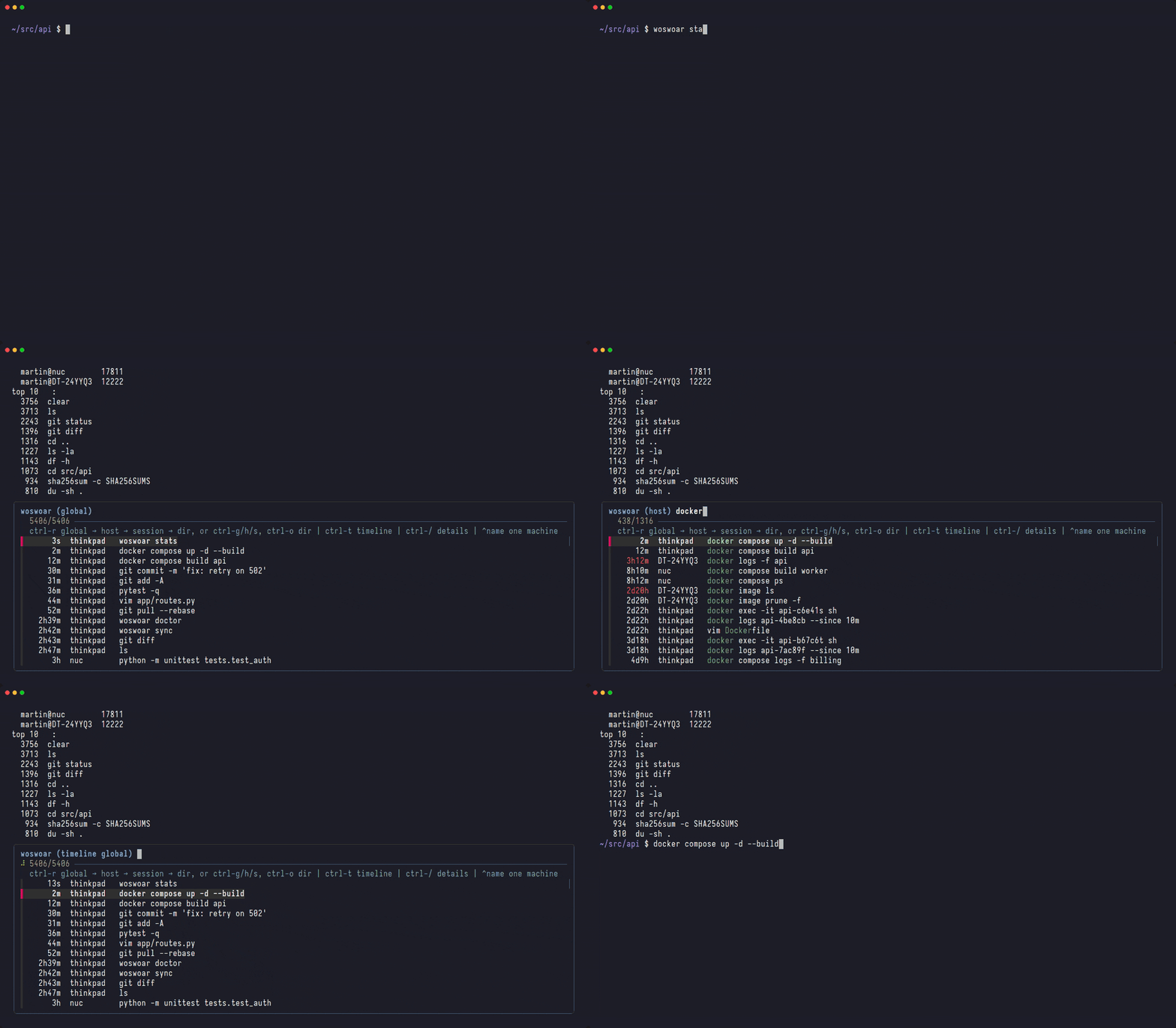
Re-record it with tools/demo/record.sh — the
tape is checked in, the history in it is
generated, and nobody's real commands are on screen.
What it is
Press Ctrl+R and fuzzy-search every command from every machine you own — deduplicated, newest first, with the working directory, exit code and duration recorded alongside. Pick one and it lands on your prompt for editing, never executed behind your back.
Machines exchange history through a git repository you already own. Nothing readable ever reaches it, there is no server and no account, and the thing that runs on your prompt is a fork-free bash hook that appends one line to a file. Half of what you want from history is the command after the one you remember, so Ctrl+T turns whatever you found into the timeline around it.
| woswoar | |
|---|---|
| 🔐 Encrypted end to end | commands, paths, hostnames — nothing readable reaches the remote |
| 🧩 No server, no database | a git repo and plain text files you can grep |
| 📦 Zero Python dependencies | standard library only — nothing to audit but this repo |
| ⚡ ~150 µs per command, zero forks | the hook is pure shell — bash or zsh; Python never runs on your prompt |
| 🔎 fzf as the UI | the fuzzy finder you already know, not a bespoke TUI |
| 🚚 Imports what you have | bash, zsh and atuin histories, idempotently |
| 🐚 Records from bash and zsh | one history per machine, whichever shell you are standing in |
| 🧱 ~4300 lines of implementation | small enough to read in an afternoon |
| 🐤 Verifiable on your machine | woswoar doctor --prove demonstrates, not asserts — see verify it yourself |
[!NOTE] woswoar is a lighter alternative to atuin. If you want a sync server, a rich TUI and cross-platform support, atuin is the better tool. woswoar trades those for a design you can hold in your head.
Install
pipx install woswoar
woswoar
Open a new shell, press Ctrl+R. That is the whole thing on
one machine. woswoar on its own is the only command you have to remember: it
sets up when there is nothing installed, and afterwards says where this machine
stands and names the one command to run next, if there is one.
Needs: bash 5.0+ or zsh 5.0+ · Linux or macOS · Python 3.10+ ·
fzf ·
age and git (sync only) — but not age
as a snap, which costs about 250 ms per call against 2 ms and turns a sync
into minutes. woswoar doctor measures it and says so.
📦 Upgrading, importing an existing history, uninstalling
More than one machine
Sync goes through an ordinary git repository you already own — no server, no
account, no daemon. Create an empty one (woswoar-history on GitHub, a bare repo
on a NAS, a folder on a USB stick), once, ever. Then on every machine:
# on the new machine — or just paste the URL when `woswoar` asks for it
woswoar init git@github.com:you/woswoar-history.git

# on each machine you already use
woswoar accept
accept is grant and trust at once — who may read your history, and whose
published history this machine believes. It prints both fingerprints and asks.
🔄 Enrolment, revoking, and keeping an idle machine current
Security
Everything that leaves your machine is encrypted with
age — commands, paths, hostnames, even the
directory names in the repo. Each machine keeps its own private key and no secret
is ever copied between them. There is no crypto code here at all: age does it,
and woswoar's wrapper is a few dozen lines of subprocess.
Your local history is plaintext, though, and metadata like "how many machines and how often they sync" is visible to anyone holding the repo.
None of that has to be taken on faith. woswoar doctor --prove records a
canary command in a throwaway sandbox, syncs it, and shows you that it reaches
the remote unreadable — and that is only the first of the checks you can run
yourself, decrypting a chunk with stock age and no woswoar in the pipeline
among them.
🔐 The full security model · 🐤 Verify it yourself
How it works
shell hook  ──►  plaintext TSV logs  ──►  parse cache  ──►  scope filter  ──►  fzf
                        │
                        └──►  age-encrypted chunks  ──►  git  ──►  remote
The hot path is a fork-free shell hook — one for bash built on bash 5 builtins, one for zsh built on zsh's — that appends one escaped line to a per-day TSV file. Both write into the same per-machine history. Nothing else touches your prompt. Everything expensive — parsing, caching, encrypting, git — happens when you search, or when the timer fires.
Documentation
| 🔎 Searching your history | the machine column, ^name, the Ctrl+T timeline, the details pane |
| 📦 Installing, upgrading, uninstalling | the first run, pipx upgrades, importing atuin, and removing every part of it again |
| 🔄 Adding another machine | enrolment, accept/grant/trust, background sync, a systemd timer |
| 🐚 Living in your shell | bash and zsh, how it coexists with ble.sh, atuin and prompt frameworks, what Ctrl+R costs, and what is never recorded |
| 🔐 Security model | threat model, guarantees, limits |
| 🐤 Verify it yourself | checks you run on your own machine, none of which ask you to believe a document |
| 📖 Reference | every command and environment variable |
| 📐 Design summary | architecture, record format, the sync and encryption design, with measured numbers and the mistakes that shaped them |
| 🛠️ Contributing | running the tests, what a patch needs, cutting a release |
License
1 maintainer

Release files for woswoar 0.10.0
For a detailed explanation of source distributions (sdists) and built distributions (wheels), please see the package formats documentation.
Source distribution (sdist)
| File | Size | Uploaded | |
|---|---|---|---|
| woswoar-0.10.0.tar.gz | 696.9 kB | Details |
Built distribution (wheel)
| File | Interpreter | ABI | Platform | Reset |
|---|---|---|---|---|
| woswoar-0.10.0-py3-none-any.whl | Python 3 | none | any | Details |
Total release size: 890.9 kB
Release files / woswoar-0.10.0.tar.gz
| Download URL | woswoar-0.10.0.tar.gz |
|---|---|
| Size | 696.9 kB |
| Tags | Source |
|
SHA-256 checksum How to use checksums |
4e9df4bab3cd1d1eb52e643feb50b0e9559aa0b2957ae767c0cd52ac1fd8e982
|
|
BLAKE2b-256 checksum How to use checksums |
39b3d47477b564a175fd0356b1883dc5bf30f9c416099a8f9d0024fea2aca608
|
| Upload date | |
|
Uploaded using Trusted Publishing? What is trusted publishing? |
Yes |
| Uploaded via |
twine/7.0.0 CPython/3.13.14
|
Provenance
Provenance describes where a file came from. On PyPI, provenance is shared via attestations, which provide a verifiable record of the build or publishing details. View details, limitations and caveats.


PyPI Publish Attestation
PyPI verified that this artifact, at this checksum, originated from the publisher listed below.
Signed by GitHub Actions, verified by PyPI on Aug 12, 2026.
Transparency logRelease files / woswoar-0.10.0-py3-none-any.whl
| Download URL | woswoar-0.10.0-py3-none-any.whl |
|---|---|
| Size | 194.0 kB |
| Tags | Python 3 |
|
SHA-256 checksum How to use checksums |
d0a11ff5fe532d6e8c06f6c1f3faf702e273a7f4569c86fcef9a18e90b10ed14
|
|
BLAKE2b-256 checksum How to use checksums |
8dd4067fa1d382d93dc3a75b656fba0651a49b0d99f75ad6f53bae9476e781a3
|
| Upload date | |
|
Uploaded using Trusted Publishing? What is trusted publishing? |
Yes |
| Uploaded via |
twine/7.0.0 CPython/3.13.14
|
Provenance
Provenance describes where a file came from. On PyPI, provenance is shared via attestations, which provide a verifiable record of the build or publishing details. View details, limitations and caveats.
PyPI Publish Attestation
PyPI verified that this artifact, at this checksum, originated from the publisher listed below.
Signed by GitHub Actions, verified by PyPI on Aug 12, 2026.
Transparency log













