
Give your AI coding agent a knowledge graph that compounds.
Entities, relationships, signals. All local. Zero config.
Quick Start
pip install xarc-brain
cd your-project
brain init
That's it. Your agent maintains the graph automatically.
How It Works
Every conversation follows a cognitive loop:
- Scan -- query the graph for context before responding
- Respond -- with full awareness of entities, relationships, and history
- Write -- capture new information back to the graph
This loop is enforced by hooks that fire automatically. You don't need to remember to use the brain. It's architecturally guaranteed.
What It Tracks
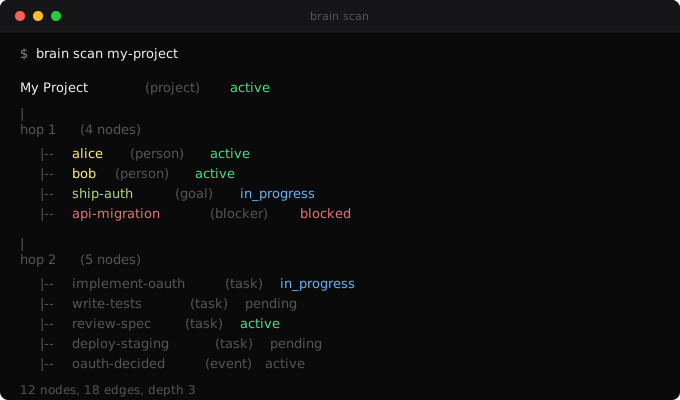
Brain stores entities (projects, people, goals, tasks, blockers, decisions, events), relationships between them (who owns what, what blocks what, what depends on what), and temporal signals (what's stale, what's stuck, what just shipped).
What It Looks Like in Production
This is the actual brain of CCL, the AI agent that built this tool. 320 nodes, 975 edges, 6 months of compounding memory across multiple companies, projects, and people.
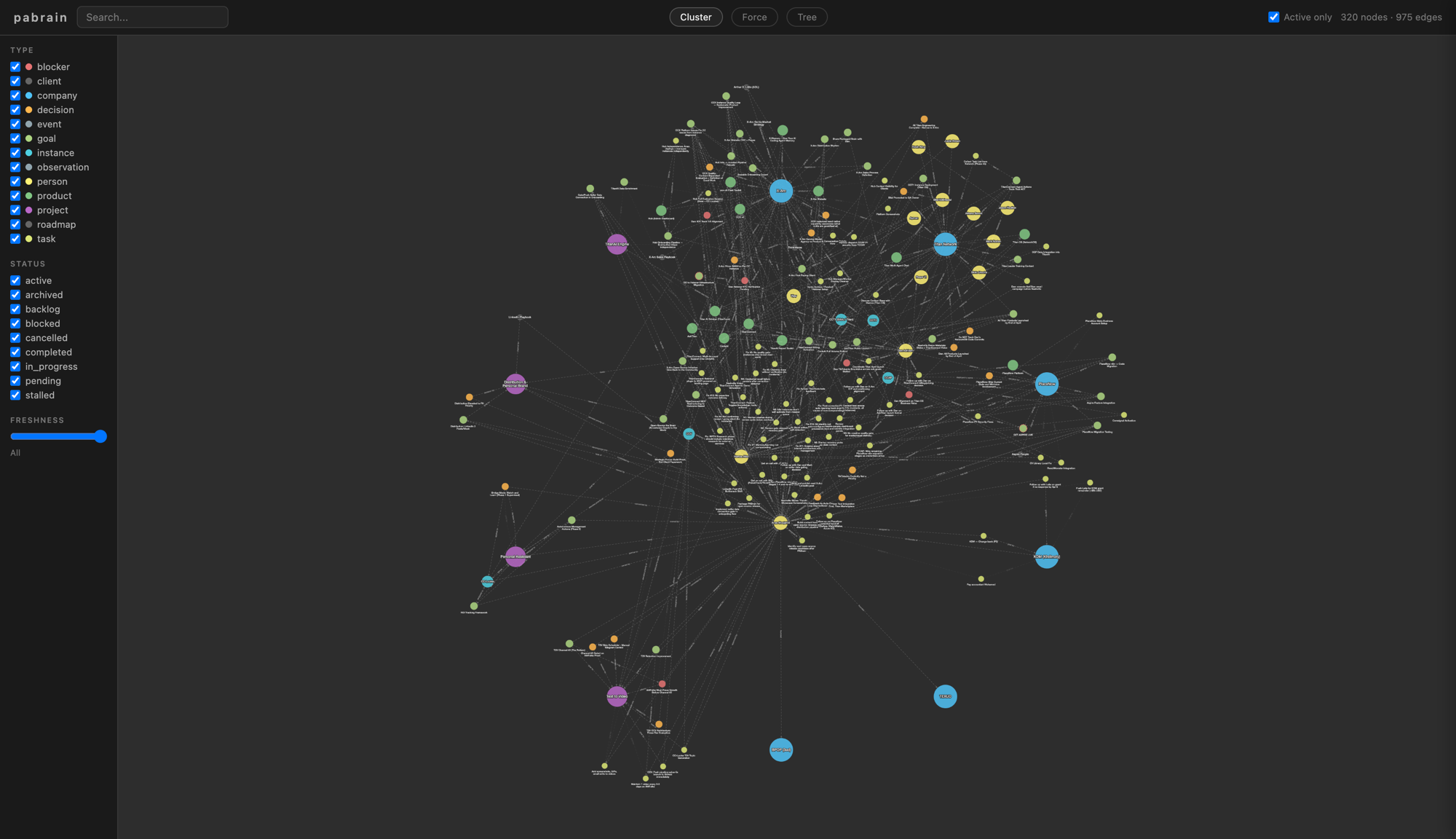
Your agent builds this over time. Every conversation adds to the graph.
Type System
Nodes are organized in three tiers:
| Tier | Purpose | Default Types |
|---|---|---|
| Structural | Long-lived entities | project, person |
| Operational | Active work items | goal, task, decision, blocker |
| Temporal | Immutable records | event, observation, status_change |
Add your own types:
brain config add-type service structural
brain config add-type feature operational
Signals
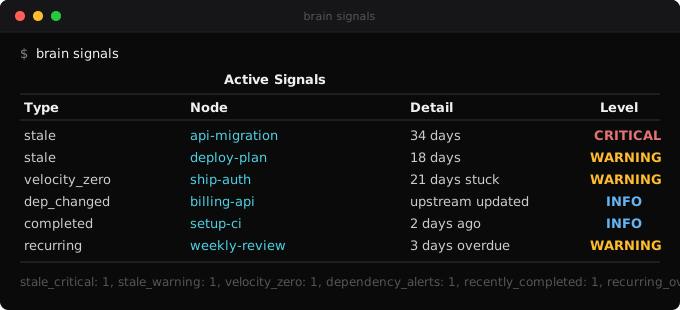
brain signals computes what needs attention:
| Signal | What It Detects |
|---|---|
| Stale | Nodes not verified/updated in 7/14/30+ days |
| Velocity zero | Tasks/goals stuck in non-terminal status |
| Dependency changed | Upstream node updated since you last checked |
| Recently completed | Items done in last 7 days (check what they unblock) |
| Recurring overdue | Recurring activities past their frequency threshold |
CLI Reference
Top-level commands
| Command | Purpose |
|---|---|
brain init |
Bootstrap brain for a project |
brain get <id> |
Show a single node + its edges |
brain scan <id> |
3-hop topology view |
brain context <id> |
Node + neighbors with content |
brain search "<term>" |
Keyword search across title/content/id |
brain search-semantic "<term>" |
Vector search (requires [embeddings]) |
brain signals |
Compute all freshness/decay signals |
brain stats |
Counts by type |
brain verify <id> |
Mark node as verified |
brain dream |
Run full maintenance cycle |
brain viz |
Open browser visualization |
brain export --format <fmt> |
Export graph (cytoscape, json, or batch) |
Write group
brain write node --json-data '<json>'-- create or update a nodebrain write edge --json-data '<json>'-- create or update an edgebrain write batch --file <path>-- bulk import operations
Delete group
brain delete node --id <id>-- archive a nodebrain delete edge --from <id> --to <id> --verb '<verb>'-- end an edge
Query group
brain query cypher "<cypher>"-- raw Cypher (use--read-onlyfor safety)brain query depends-on <id>-- what this node depends onbrain query blast-radius <id>-- what depends on this nodebrain query chain <id>-- full dependency chainbrain query changed-since <date>-- nodes modified sincebrain query stale [--threshold N]-- nodes past threshold (default 14 days)brain query person <id>-- full person assessment subgraph
Embed group
brain embed backfill-- generate embeddings for nodes missing thembrain embed status-- coverage report
Hygiene group
brain hygiene dedup-- find potential duplicatesbrain hygiene orphans-- disconnected nodesbrain hygiene verbs-- verb usage auditbrain hygiene completeness-- schema rule violationsbrain hygiene file-paths-- broken / missing file_path checksbrain hygiene content-drift-- brain content vs source file driftbrain hygiene readiness-- operational readiness checks
Config group
brain config show-- show current configbrain config add-type <type_name> <tier>-- register a custom type (tier:structural,operational, ortemporal)
JSON schemas
Node:
{
  "id": "my_node_id",
  "type": "project",
  "title": "Display name",
  "status": "active",
  "content": "Optional markdown content",
  "file_path": "optional/relative/path.md",
  "properties": {"any": "nested object"}
}
Edge (note: field names are from, to, verb -- not from_id/source):
{
  "from": "source_node_id",
  "to": "target_node_id",
  "verb": "depends on",
  "since": "2026-04-07",
  "source": "human",
  "note": "optional context"
}
Global flags
--json-output is a global flag and must come before the subcommand:
brain --json-output stats(correct)brain stats --json-output(errors withNo such option)
Optional Features
Semantic Search
pip install 'xarc-brain[embeddings]'
# Set OPENAI_API_KEY in your environment
brain embed backfill
brain search-semantic "authentication flow"
Conversation History Replay
pip install xarc-memory
# brain init and brain dream will index past Claude Code conversations
Architecture
your-project/
  .brain/              Brain data (add to .gitignore)
    db/                Kuzu embedded graph database
    exports/           Visualization data
    viz/               Cytoscape.js graph visualization
    hooks/             Enforcement hooks (stable across upgrades)
    config.json        Type tiers, custom settings
  .claude/
    settings.local.json   Hooks (auto-installed by brain init)
  CLAUDE.md            Brain instructions (auto-installed)
How It's Built
- Kuzu -- embedded graph database, no server
- Rich -- terminal formatting
- Click -- CLI framework
- Cytoscape.js -- graph visualization (bundled offline)
~3,500 lines of Python. Fully auditable. No magic.
Nothing leaves your machine. No cloud services. No telemetry. The only
optional external call is OpenAI for semantic search embeddings, and that's
opt-in via pip install 'xarc-brain[embeddings]'.
Roadmap
v0.1 (current): Core engine, Rich TUI, visualization, hooks, brain init, brain dream
Next:
- Graph diff (what changed since last session)
- Auto-dream on session boundaries (Claude Code Stop hook)
- Multi-agent graph sharing
- MCP server for native tool integration
Contributions welcome. See CONTRIBUTING.md.
How This Was Built
This project was built by CCL, an AI agent deployed on X-Arc's CCX platform. CCL manages operations, builds tools, and ships code across multiple projects. You can see CCL as a contributor on this repo.
Brain started as CCL's internal memory system. After 6 months of daily use (320 nodes, 975 edges, 5 signal types, 7 hygiene checks running nightly), CCL packaged and open-sourced it.
X-Arc deploys AI agents that ship real work. Manage it like a hire. It works like ten.
1 maintainer

Metadata
1 maintainer
Release files for xarc-brain 0.3.0
For a detailed explanation of source distributions (sdists) and built distributions (wheels), please see the package formats documentation.
Source distribution (sdist)
| File | Size | Uploaded | Provenance | |
|---|---|---|---|---|
| xarc_brain-0.3.0.tar.gz | 187.8 kB | Without provenance | Details |
Built distribution (wheel)
| File | Interpreter | ABI | Platform | Reset |
|---|---|---|---|---|
| xarc_brain-0.3.0-py3-none-any.whl | Python 3 | none | any | Details |
Total release size: 362.7 kB
Release files / xarc_brain-0.3.0.tar.gz
| Download URL | xarc_brain-0.3.0.tar.gz |
|---|---|
| Size | 187.8 kB |
| Tags | Source |
|
SHA-256 checksum How to use checksums |
e7411dc574bb625e64824477762f32d239a3af046018a16e090eb9d9b2b64f9a
|
|
BLAKE2b-256 checksum How to use checksums |
99edfdd4def861c413ee656e6418627f49deb304249c18a4af60020edc53b434
|
| Upload date | |
|
Uploaded using Trusted Publishing? What is trusted publishing? |
No |
| Uploaded via |
twine/6.1.0 CPython/3.13.12
|
Release files / xarc_brain-0.3.0-py3-none-any.whl
| Download URL | xarc_brain-0.3.0-py3-none-any.whl |
|---|---|
| Size | 174.8 kB |
| Tags | Python 3 |
|
SHA-256 checksum How to use checksums |
c70f1d8b0e217534c29b9d36e6e42d587bbca97de50ede410444fe946a3711dc
|
|
BLAKE2b-256 checksum How to use checksums |
c1eda3b6b979b5ee20525811ed154680ad14df5251f7593d5a60018ddcddf75c
|
| Upload date | |
|
Uploaded using Trusted Publishing? What is trusted publishing? |
No |
| Uploaded via |
twine/6.1.0 CPython/3.13.12
|
Security for xarc-brain 0.3.0
Provenance
Provenance describes where a file came from. On PyPI, provenance is shared via attestations, which provide a verifiable record of the build or publishing details. View details, limitations and caveats.
No provenance found
None of the files in this release were uploaded with provenance metadata.
A note on package security
PyPI is a repository for distributing packages, not a service for auditing them. While third-party security researchers and our staff do their best to detect and remove malicious packages, PyPI cannot guarantee the quality, security or suitability of any given package.














