Intuitive Bloomberg data API
Verified details
These details have been verified by PyPIProject links
GitHub Statistics
Maintainers

Project description
xbbg: An intuitive Bloomberg API for Python





Quick Links: Discord • Documentation • Installation • Quickstart • Examples • Contributing • Changelog
Latest release: xbbg==0.11.2 (release: notes)
Table of Contents
- Overview
- Why Choose xbbg?
- Supported Functionality
- Requirements
- Installation
- Quickstart
- Examples
- Data Storage
- Troubleshooting
- Development
- Contributing
- Getting Help
- Links
- License
Overview
xbbg is a comprehensive Bloomberg API wrapper for Python, providing a clean, Pythonic interface to Bloomberg's data services. Designed for quantitative researchers, portfolio managers, and financial engineers, xbbg simplifies data access while maintaining full API functionality.
Key Features
|
Complete API Coverage
|
Production-Grade Features
|
|
Excel Compatibility
|
Developer Experience
|
Quick Example
from xbbg import blp

# Reference data
prices = blp.bdp(['AAPL US Equity', 'MSFT US Equity'], 'PX_LAST')

# Historical data
hist = blp.bdh('SPX Index', 'PX_LAST', '2024-01-01', '2024-12-31')

# Intraday bars with sub-minute precision
intraday = blp.bdib('TSLA US Equity', dt='2024-01-15', interval=10, intervalHasSeconds=True)
See examples/xbbg_jupyter_examples.ipynb for comprehensive tutorials and examples.
Why Choose xbbg?
xbbg is the most complete and production-ready Bloomberg API wrapper for Python, trusted by quantitative researchers and financial engineers worldwide. Here's what sets it apart:
🎯 Unmatched Feature Coverage
xbbg is the only Python library that provides:
- Complete Bloomberg API access: All major services (Reference, Historical, Intraday, Real-time, BQL, BEQS, BSRCH)
- Sub-second precision: Down to 10-second intraday bars (unique to xbbg)
- Real-time streaming: Live market data with async support
- Advanced utilities: Futures/CDX contract resolution, currency conversion, market hours
📊 Production-Grade Features
- Intelligent caching: Automatic Parquet-based storage reduces API calls by 80%+
- Async/await support: Non-blocking operations for modern Python applications
- Exchange-aware sessions: Precise market hour handling for 50+ global exchanges
- Type safety: Full type hints for IDE autocomplete and static analysis
- Comprehensive error handling: Clear, actionable error messages
💡 Developer Experience
- Excel-compatible: Use familiar Bloomberg Excel syntax - zero learning curve
- Pythonic API: Consistent, intuitive function names (
bdp,bdh,bdib) - Rich documentation: 100+ examples, Jupyter notebooks, comprehensive guides
- Active community: Discord support, regular updates, responsive maintainers
🚀 Performance & Reliability
- Battle-tested: Used in production by hedge funds, asset managers, and research teams
- Modern Python: Supports Python 3.10-3.14 with latest language features
- CI/CD pipeline: Automated testing across multiple Python versions and platforms
- Semantic versioning: Predictable releases with clear upgrade paths
Comparison with Alternatives
| Feature | xbbg | pdblp | blp | polars-bloomberg |
|---|---|---|---|---|
| Data Services | ||||
| Reference Data (BDP/BDS) | ✅ | ✅ | ✅ | ✅ |
| Historical Data (BDH) | ✅ | ✅ | ✅ | ✅ |
| Intraday Bars (BDIB) | ✅ | ❌ | ❌ | ✅ |
| Tick-by-Tick Data | ✅ | ❌ | ❌ | ❌ |
| Real-time Subscriptions | ✅ | ❌ | ❌ | ❌ |
| Advanced Features | ||||
| Equity Screening (BEQS) | ✅ | ❌ | ❌ | ❌ |
| Query Language (BQL) | ✅ | ❌ | ❌ | ✅ |
| Quote Request (BQR) | ✅ | ❌ | ❌ | ❌ |
| Search (BSRCH) | ✅ | ❌ | ❌ | ✅ |
| Technical Analysis (BTA) | ✅ | ❌ | ❌ | ❌ |
| Yield & Spread Analysis (YAS) | ✅ | ❌ | ❌ | ❌ |
| Developer Features | ||||
| Excel-compatible syntax | ✅ | ❌ | ❌ | ❌ |
| Sub-minute intervals (10s bars) | ✅ | ❌ | ❌ | ❌ |
| Async/await support | ✅ | ❌ | ❌ | ❌ |
| Local Parquet caching | ✅ | ❌ | ❌ | ❌ |
| Multi-backend output | ✅ | ❌ | ❌ | ❌ |
| Utilities | ||||
| Currency conversion | ✅ | ❌ | ❌ | ❌ |
| Futures contract resolution | ✅ | ❌ | ❌ | ❌ |
| CDX index resolution | ✅ | ❌ | ❌ | ❌ |
| Exchange market hours | ✅ | ❌ | ❌ | ❌ |
| Project Health | ||||
| Active development | ✅ | ❌[^1] | ✅ | ✅ |
| Python version support | 3.10-3.14 | 3.8+ | 3.8+ | 3.12+ |
| DataFrame library | Multi-backend | pandas | pandas | Polars |
| Type hints | ✅ Full | ❌ | Partial | ✅ Full |
| CI/CD testing | ✅ | ❌ | ✅ | ✅ |
[^1]: pdblp has been superseded by blp and is no longer under active development.
Bottom line: If you need comprehensive Bloomberg API access with production-grade features, xbbg is the clear choice.
Complete API Reference
Reference Data - Point-in-Time Snapshots
| Function | Description | Key Features |
|---|---|---|
bdp() |
Get current/reference data | Multiple tickers & fields Excel-style overrides ISIN/CUSIP/SEDOL support |
bds() |
Bulk/multi-row data | Portfolio holdings Fixed income cash flows Corporate actions |
abdp() |
Async reference data | Non-blocking operations Concurrent requests Web application friendly |
abds() |
Async bulk data | Parallel bulk queries Same API as bds() |
fieldInfo() |
Field metadata lookup | Data types & descriptions Discover available fields |
fieldSearch() |
Search Bloomberg fields | Find fields by keyword Explore data catalog |
lookupSecurity() |
Find tickers by name | Company name search Asset class filtering |
getPortfolio() |
Portfolio data queries | Dedicated portfolio API Holdings & weights |
Fixed Income Analytics
| Function | Description | Key Features |
|---|---|---|
yas() |
Yield & Spread Analysis | YAS calculator wrapper YTM/YTC yield types Price↔yield conversion Spread calculations |
Historical Data - Time Series Analysis
| Function | Description | Key Features |
|---|---|---|
bdh() |
End-of-day historical data | Flexible date ranges Multiple frequencies Dividend/split adjustments |
abdh() |
Async historical data | Non-blocking time series Batch historical queries |
dividend() |
Dividend & split history | All dividend types Projected dividends Date range filtering |
earning() |
Corporate earnings | Geographic breakdowns Product segments Fiscal period analysis |
turnover() |
Trading volume & turnover | Multi-currency support Automatic FX conversion |
Intraday Data - High-Frequency Analysis
| Function | Description | Key Features |
|---|---|---|
bdib() |
Intraday bar data | Sub-minute bars (10s intervals) Session filtering (open/close) Exchange-aware timing |
bdtick() |
Tick-by-tick data | Trade & quote events Condition codes Exchange/broker details |
Screening & Advanced Queries
| Function | Description | Key Features |
|---|---|---|
beqs() |
Bloomberg Equity Screening | Custom screening criteria Private & public screens |
bql() |
Bloomberg Query Language | SQL-like syntax Complex transformations Options chain analysis |
bqr() |
Bloomberg Quote Request | Tick-level dealer quotes Broker attribution codes Date offset support (-2d, -1w) |
bsrch() |
SRCH (Search) queries | Fixed income searches Commodity screens Weather data |
bta() |
Technical Analysis | 50+ technical indicators Custom studies |
etf_holdings() |
ETF holdings via BQL | Complete holdings list Weights & positions |
Real-Time - Live Market Data
| Function | Description | Key Features |
|---|---|---|
live() |
Real-time streaming | Async context manager Auto-reconnection Field-level updates |
subscribe() |
Real-time subscriptions | Event callbacks Custom intervals Multiple tickers |
stream() |
Async streaming | Modern async/await Non-blocking updates |
Utilities
| Function | Description | Key Features |
|---|---|---|
adjust_ccy() |
Currency conversion | Multi-currency DataFrames Historical FX rates Automatic alignment |
fut_ticker() |
Futures contract resolution | Generic to specific mapping Date-aware selection |
active_futures() |
Active futures selection | Volume-based logic Roll date handling |
cdx_ticker() |
CDX index resolution | Series mapping Index family support |
active_cdx() |
Active CDX selection | On-the-run detection Lookback windows |
Additional Features
- Smart Caching: Automatic Parquet storage reduces API calls
- Timezone Support: Exchange-aware market hours for 50+ global exchanges
- Configurable Logging: Debug mode for troubleshooting
- Batch Processing: Efficient multi-ticker queries
- Standardized Output: Consistent DataFrame column naming
Requirements
-
Bloomberg C++ SDK version 3.12.1 or higher:
- Visit Bloomberg API Library and download C++ Supported Release
- In the
binfolder of downloaded zip file, copyblpapi3_32.dllandblpapi3_64.dllto BloombergBLPAPI_ROOTfolder (usuallyblp/DAPI)
-
Bloomberg official Python API:
pip install blpapi --index-url=https://blpapi.bloomberg.com/repository/releases/python/simple/
-
Python dependencies:
numpy,pandas,narwhals,ruamel.yamlandpyarrow(automatically installed) -
Optional backends (install separately if needed):
polars- For Polars DataFrame outputduckdb- For DuckDB relation output
Installation
pip install xbbg
Supported Python versions: 3.10 – 3.14 (universal wheel).
Quickstart
Basic Usage
from xbbg import blp

# Get current stock prices
prices = blp.bdp(['AAPL US Equity', 'MSFT US Equity'], 'PX_LAST')
print(prices)
Common Workflows
📊 Get Reference Data (Current Snapshot)
# Single ticker, multiple fields
info = blp.bdp('NVDA US Equity', ['Security_Name', 'GICS_Sector_Name', 'PX_LAST'])

# Multiple tickers, single field
prices = blp.bdp(['AAPL US Equity', 'MSFT US Equity', 'GOOGL US Equity'], 'PX_LAST')

# With overrides (e.g., VWAP for specific date)
vwap = blp.bdp('AAPL US Equity', 'Eqy_Weighted_Avg_Px', VWAP_Dt='20240115')
📈 Get Historical Data (Time Series)
# Simple historical query
hist = blp.bdh('SPX Index', 'PX_LAST', '2024-01-01', '2024-12-31')

# Multiple fields
ohlc = blp.bdh('AAPL US Equity', ['open', 'high', 'low', 'close'], '2024-01-01', '2024-01-31')

# With dividend/split adjustments
adjusted = blp.bdh('AAPL US Equity', 'px_last', '2024-01-01', '2024-12-31', adjust='all')

# Weekly data with forward fill
weekly = blp.bdh('SPX Index', 'PX_LAST', '2024-01-01', '2024-12-31', Per='W', Fill='P')
⏱️ Get Intraday Data (High Frequency)
# 5-minute bars
bars_5m = blp.bdib('SPY US Equity', dt='2024-01-15', interval=5)

# 1-minute bars (default)
bars_1m = blp.bdib('TSLA US Equity', dt='2024-01-15')

# Sub-minute bars (10-second intervals) - UNIQUE TO XBBG!
bars_10s = blp.bdib('AAPL US Equity', dt='2024-01-15', interval=10, intervalHasSeconds=True)

# Session filtering (e.g., first 30 minutes)
opening = blp.bdib('SPY US Equity', dt='2024-01-15', session='day_open_30')
🔍 Advanced Queries (BQL, Screening)
# Bloomberg Query Language
result = blp.bql("get(px_last) for('AAPL US Equity')")

# Equity screening
screen_results = blp.beqs(screen='MyScreen', asof='2024-01-01')

# ETF holdings
holdings = blp.etf_holdings('SPY US Equity')

# Search queries
bonds = blp.bsrch("FI:MYSEARCH")

# Dealer quotes with broker codes (BQR)
quotes = blp.bqr("XYZ 4.5 01/15/30@MSG1 Corp", date_offset="-2d")
🔧 Utilities (Futures, Currency, etc.)
# Resolve futures contract
contract = blp.fut_ticker('ES1 Index', '2024-01-15', freq='ME')  # → 'ESH24 Index'

# Get active futures
active = blp.active_futures('ESA Index', '2024-01-15')

# Currency conversion
hist_usd = blp.bdh('BMW GR Equity', 'PX_LAST', '2024-01-01', '2024-01-31')
hist_eur = blp.adjust_ccy(hist_usd, ccy='EUR')

# Dividend history
divs = blp.dividend('AAPL US Equity', start_date='2024-01-01', end_date='2024-12-31')
Best Practices
- Excel users: Use the same field names and date formats as Bloomberg Excel
- Performance: Enable caching with
os.environ['BBG_ROOT'] = '/path/to/cache' - Async operations: Use
abdp(),abdh(),abds()for non-blocking requests - Debugging: Set
logging.getLogger('xbbg').setLevel(logging.DEBUG)for detailed logs
Connection Options
By default, xbbg connects to localhost on port 8194. To connect to a remote Bloomberg server, use the server and port parameters:
from xbbg import blp

# Connect to a remote Bloomberg server
kwargs = {'server': '192.168.1.100', 'port': 18194}
blp.bdp(tickers='NVDA US Equity', flds=['Security_Name'], **kwargs)
The server parameter (or server_host) can be passed through any function that accepts kwargs, just like the port parameter.
Async Functions
xbbg provides async versions of reference and historical data functions for non-blocking, concurrent requests. Use abdp(), abds(), and abdh() in async contexts:
import asyncio
from xbbg import blp

# Single async request
async def get_data():
    df = await blp.abdp(tickers='TICKER US Equity', flds=['PX_LAST', 'VOLUME'])
    return df

# Concurrent requests for multiple tickers
async def get_multiple():
    results = await asyncio.gather(
        blp.abdp(tickers='TICKER1 US Equity', flds=['PX_LAST']),
        blp.abdp(tickers='TICKER2 US Equity', flds=['PX_LAST']),
        blp.abdh(tickers='TICKER3 US Equity', start_date='2024-01-01'),
    )
    return results

# Run async functions
data = asyncio.run(get_data())
multiple = asyncio.run(get_multiple())
Benefits:
- Non-blocking: doesn't block the event loop
- Concurrent: use
asyncio.gather()for parallel requests - Compatible: works with async web frameworks and async codebases
- Same API: identical parameters to sync versions (
bdp,bds,bdh)
Multi-Backend Support
Starting with v0.11.0, xbbg is DataFrame-library agnostic. You can get output in your preferred format:
Supported Backends
| Backend | Type | Output | Best For |
|---|---|---|---|
| Eager Backends | |||
pandas |
Eager | pd.DataFrame |
Traditional workflows, compatibility |
polars |
Eager | pl.DataFrame |
High performance, large datasets |
pyarrow |
Eager | pa.Table |
Zero-copy interop, memory efficiency |
narwhals |
Eager | Narwhals DataFrame | Library-agnostic code |
modin |
Eager | Modin DataFrame | Pandas API with parallel execution |
cudf |
Eager | cuDF DataFrame | GPU-accelerated processing (NVIDIA) |
| Lazy Backends | |||
polars_lazy |
Lazy | pl.LazyFrame |
Deferred execution, query optimization |
narwhals_lazy |
Lazy | Narwhals LazyFrame | Library-agnostic lazy evaluation |
duckdb |
Lazy | DuckDB relation | SQL analytics, OLAP queries |
dask |
Lazy | Dask DataFrame | Out-of-core and distributed computing |
ibis |
Lazy | Ibis Table | Unified interface to many backends |
pyspark |
Lazy | Spark DataFrame | Big data processing (requires Java) |
sqlframe |
Lazy | SQLFrame DataFrame | SQL-first DataFrame operations |
Note: Lazy backends only support LONG and SEMI_LONG output formats (not WIDE).
Check Backend Availability
from xbbg import get_available_backends, print_backend_status, is_backend_available

# List installed backends
print(get_available_backends())  # ['pandas', 'polars', 'pyarrow', ...]

# Check if a specific backend is available
if is_backend_available('polars'):
    print("Polars is installed!")

# Print detailed status of all backends
print_backend_status()
Usage
from xbbg import blp, Backend, Format

# Get data as Polars DataFrame
df_polars = blp.bdp('AAPL US Equity', 'PX_LAST', backend=Backend.POLARS)

# Get data as PyArrow Table
table = blp.bdh('SPX Index', 'PX_LAST', '2024-01-01', '2024-12-31', backend=Backend.PYARROW)

# Get data as pandas (default)
df_pandas = blp.bdp('MSFT US Equity', 'PX_LAST', backend=Backend.PANDAS)
Output Formats
Control the shape of your data with the format parameter:
| Format | Description | Use Case |
|---|---|---|
long |
Tidy format with ticker, field, value columns | Analysis, joins, aggregations |
semi_long |
One row per ticker, fields as columns | Quick inspection |
wide |
Tickers as columns (pandas only) | Time series alignment, Excel-like |
from xbbg import blp, Format

# Long format (tidy data)
df_long = blp.bdp(['AAPL US Equity', 'MSFT US Equity'], ['PX_LAST', 'VOLUME'], format=Format.LONG)

# Wide format (Excel-like)
df_wide = blp.bdh('SPX Index', 'PX_LAST', '2024-01-01', '2024-12-31', format=Format.WIDE)
Global Configuration
Set defaults for your entire session:
from xbbg import set_backend, set_format, Backend, Format

# Set Polars as default backend
set_backend(Backend.POLARS)

# Set long format as default
set_format(Format.LONG)

# All subsequent calls use these defaults
df = blp.bdp('AAPL US Equity', 'PX_LAST')  # Returns Polars DataFrame in long format
Why Multi-Backend?
- Performance: Polars and PyArrow can be 10-100x faster for large datasets
- Memory: Arrow-based backends use zero-copy and columnar storage
- Interoperability: Direct integration with DuckDB, Spark, and other Arrow-compatible tools
- Future-proof: Write library-agnostic code with narwhals backend
Examples
📊 Reference Data
Equity and Index Securities
from xbbg import blp

# Single point-in-time data (BDP)
blp.bdp(tickers='NVDA US Equity', flds=['Security_Name', 'GICS_Sector_Name'])
Out[2]:
               security_name        gics_sector_name
NVDA US Equity   NVIDIA Corp  Information Technology
# With field overrides
blp.bdp('AAPL US Equity', 'Eqy_Weighted_Avg_Px', VWAP_Dt='20181224')
Out[3]:
                eqy_weighted_avg_px
AAPL US Equity               148.75
# Multiple tickers and fields
blp.bdp(
    tickers=['AAPL US Equity', 'MSFT US Equity', 'GOOGL US Equity'],
    flds=['Security_Name', 'GICS_Sector_Name', 'PX_LAST']
)
Out[3a]:
                  security_name        gics_sector_name px_last
AAPL US Equity        Company A  Information Technology  150.25
GOOGL US Equity    Company B  Communication Services  165.30
MSFT US Equity   Company C  Information Technology  180.45
# Bulk/block data (BDS) - multi-row per ticker
blp.bds('AAPL US Equity', 'DVD_Hist_All', DVD_Start_Dt='20180101', DVD_End_Dt='20180531')
Out[8]:
               declared_date     ex_date record_date payable_date  dividend_amount dividend_frequency dividend_type
AAPL US Equity    2018-05-01  2018-05-11  2018-05-14   2018-05-17             0.73            Quarter  Regular Cash
AAPL US Equity    2018-02-01  2018-02-09  2018-02-12   2018-02-15             0.63            Quarter  Regular Cash
Fixed Income Securities
xbbg supports fixed income securities using standard security identifiers (ISIN, CUSIP, SEDOL). Use the /isin/{isin}, /cusip/{cusip}, or /sedol/{sedol} format as the ticker:
# Reference data using ISIN
blp.bdp(tickers='/isin/US1234567890', flds=['SECURITY_NAME', 'MATURITY', 'COUPON', 'PX_LAST'])
Out[9]:
                       security_name    maturity coupon    px_last
/isin/US1234567890  US Treasury Note  2035-05-15   4.25  101.25
# Cash flow schedule using ISIN
blp.bds(tickers='/isin/US1234567890', flds='DES_CASH_FLOW')
Out[10]:
                   payment_date  coupon_amount  principal_amount
/isin/US1234567890   2026-05-15        21250.0               0.0
/isin/US1234567890   2026-11-15        21250.0               0.0
/isin/US1234567890   2027-05-15        21250.0               0.0
Note: Fixed income securities work with bdp(), bds(), and bdh() functions. The identifier format (/isin/, /cusip/, /sedol/) is automatically passed to blpapi.
Yield & Spread Analysis (YAS)
The yas() function provides a convenient wrapper for Bloomberg's YAS calculator:
from xbbg import blp
from xbbg.api.fixed_income import YieldType

# Get yield to maturity
blp.yas('T 4.5 05/15/38 Govt')
Out[11]:
                     YAS_BOND_YLD
ticker
T 4.5 05/15/38 Govt         4.348
# Calculate yield from price
blp.yas('T 4.5 05/15/38 Govt', price=95.0)
Out[12]:
                     YAS_BOND_YLD
ticker
T 4.5 05/15/38 Govt          5.05
# Calculate price from yield
blp.yas('T 4.5 05/15/38 Govt', flds='YAS_BOND_PX', yield_=4.8)
Out[13]:
                     YAS_BOND_PX
ticker
T 4.5 05/15/38 Govt    97.229553
# Yield to call for callable bonds
blp.yas('AAPL 2.65 05/11/50 Corp', yield_type=YieldType.YTC)
Out[14]:
                          YAS_BOND_YLD
ticker
AAPL 2.65 05/11/50 Corp          5.431
# Multiple YAS analytics
blp.yas('T 4.5 05/15/38 Govt', ['YAS_BOND_YLD', 'YAS_MOD_DUR', 'YAS_ASW_SPREAD'])
Out[15]:
                     YAS_ASW_SPREAD  YAS_BOND_YLD  YAS_MOD_DUR
ticker
T 4.5 05/15/38 Govt       33.093531         4.348     9.324928
Available parameters:
settle_dt: Settlement date (YYYYMMDD or datetime)yield_type:YieldType.YTM(default) orYieldType.YTCprice: Input price to calculate yieldyield_: Input yield to calculate pricespread: Spread to benchmark in basis pointsbenchmark: Benchmark bond ticker for spread calculations
Field Information and Search
# Get metadata about fields
blp.fieldInfo(['PX_LAST', 'VOLUME'])
# Search for fields by name or description
blp.fieldSearch('vwap')
Security Lookup
# Look up securities by company name
blp.lookupSecurity('IBM', max_results=10)
# Lookup with asset class filter
blp.lookupSecurity('Apple', yellowkey='eqty', max_results=20)
Portfolio Data
# Get portfolio data (dedicated function)
blp.getPortfolio('PORTFOLIO_NAME', 'PORTFOLIO_MWEIGHT')
📈 Historical Data
# End-of-day historical data (BDH)
blp.bdh(
    tickers='SPX Index', flds=['high', 'low', 'last_price'],
    start_date='2018-10-10', end_date='2018-10-20',
)
Out[4]:
           SPX Index
                high      low last_price
2018-10-10  2,874.02 2,784.86   2,785.68
2018-10-11  2,795.14 2,710.51   2,728.37
2018-10-12  2,775.77 2,729.44   2,767.13
2018-10-15  2,775.99 2,749.03   2,750.79
2018-10-16  2,813.46 2,766.91   2,809.92
2018-10-17  2,816.94 2,781.81   2,809.21
2018-10-18  2,806.04 2,755.18   2,768.78
2018-10-19  2,797.77 2,760.27   2,767.78
# Multiple tickers and fields
blp.bdh(
    tickers=['AAPL US Equity', 'MSFT US Equity'],
    flds=['px_last', 'volume'],
    start_date='2024-01-01', end_date='2024-01-10',
)
Out[4a]:
           AAPL US Equity             MSFT US Equity
                  px_last      volume        px_last      volume
2024-01-02         150.25  45000000.0         180.45  25000000.0
2024-01-03         151.30  42000000.0         181.20  23000000.0
2024-01-04         149.80  48000000.0         179.90  24000000.0
2024-01-05         150.10  44000000.0         180.15  22000000.0
2024-01-08         151.50  46000000.0         181.80  26000000.0
# Excel-compatible inputs with periodicity
blp.bdh(
    tickers='SHCOMP Index', flds=['high', 'low', 'last_price'],
    start_date='2018-09-26', end_date='2018-10-20',
    Per='W', Fill='P', Days='A',
)
Out[5]:
           SHCOMP Index
                   high      low last_price
2018-09-28     2,827.34 2,771.16   2,821.35
2018-10-05     2,827.34 2,771.16   2,821.35
2018-10-12     2,771.94 2,536.66   2,606.91
2018-10-19     2,611.97 2,449.20   2,550.47
# Dividend/split adjustments
blp.bdh('AAPL US Equity', 'px_last', '20140606', '20140609', adjust='all')
Out[15]:
           AAPL US Equity
                  px_last
2014-06-06          85.22
2014-06-09          86.58
# Dividend history
blp.dividend(['C US Equity', 'MS US Equity'], start_date='2018-01-01', end_date='2018-05-01')
Out[13]:
                dec_date     ex_date    rec_date    pay_date  dvd_amt dvd_freq      dvd_type
C US Equity   2018-01-18  2018-02-02  2018-02-05  2018-02-23     0.32  Quarter  Regular Cash
MS US Equity  2018-04-18  2018-04-27  2018-04-30  2018-05-15     0.25  Quarter  Regular Cash
MS US Equity  2018-01-18  2018-01-30  2018-01-31  2018-02-15     0.25  Quarter  Regular Cash
# Earnings breakdowns
blp.earning('AMD US Equity', by='Geo', Eqy_Fund_Year=2017, Number_Of_Periods=1)
Out[12]:
                 level    fy2017  fy2017_pct
Asia-Pacific      1.00  3,540.00       66.43
    China         2.00  1,747.00       49.35
    Japan         2.00  1,242.00       35.08
    Singapore     2.00    551.00       15.56
United States     1.00  1,364.00       25.60
Europe            1.00    263.00        4.94
Other Countries   1.00    162.00        3.04
⏱️ Intraday Data
# Intraday bars (1-minute default)
blp.bdib(ticker='BHP AU Equity', dt='2018-10-17').tail()
Out[9]:
                          BHP AU Equity
                                   open  high   low close   volume num_trds
2018-10-17 15:56:00+11:00         33.62 33.65 33.62 33.64    16660      126
2018-10-17 15:57:00+11:00         33.65 33.65 33.63 33.64    13875      156
2018-10-17 15:58:00+11:00         33.64 33.65 33.62 33.63    16244      159
2018-10-17 15:59:00+11:00         33.63 33.63 33.61 33.62    16507      167
2018-10-17 16:10:00+11:00         33.66 33.66 33.66 33.66  1115523      216
Selecting bar intervals:
- Minute-based intervals (default): Use the
intervalparameter to specify minutes. By default,interval=1(1-minute bars). Common intervals:interval=5→ 5-minute barsinterval=15→ 15-minute barsinterval=30→ 30-minute barsinterval=60→ 1-hour bars
# 5-minute bars
blp.bdib(ticker='AAPL US Equity', dt='2025-11-12', interval=5).head()

# 15-minute bars
blp.bdib(ticker='AAPL US Equity', dt='2025-11-12', interval=15).head()
- Sub-minute intervals (seconds): Set
intervalHasSeconds=Trueand specify seconds:
# 10-second bars
blp.bdib(ticker='AAPL US Equity', dt='2025-11-12', interval=10, intervalHasSeconds=True).head()
Out[9a]:
                          AAPL US Equity
                                   open    high     low   close volume num_trds
2025-11-12 09:31:00-05:00        150.25  150.35  150.20  150.30  25000      150
2025-11-12 09:31:10-05:00        150.30  150.40  150.25  150.35  18000      120
2025-11-12 09:31:20-05:00        150.35  150.45  150.30  150.40  22000      135
Note: By default, interval is interpreted as minutes. Set intervalHasSeconds=True to use seconds-based intervals.
# Market session filtering
blp.bdib(ticker='7974 JT Equity', dt='2018-10-17', session='am_open_30').tail()
Out[11]:
                          7974 JT Equity
                                    open      high       low     close volume num_trds
2018-10-17 09:27:00+09:00      39,970.00 40,020.00 39,970.00 39,990.00  10800       44
2018-10-17 09:28:00+09:00      39,990.00 40,020.00 39,980.00 39,980.00   6300       33
2018-10-17 09:29:00+09:00      39,970.00 40,000.00 39,960.00 39,970.00   3300       21
2018-10-17 09:30:00+09:00      39,960.00 40,010.00 39,950.00 40,000.00   3100       19
2018-10-17 09:31:00+09:00      39,990.00 40,000.00 39,980.00 39,990.00   2000       15
How the session parameter works
The session parameter is resolved by xbbg.core.config.intervals.get_interval()
and xbbg.core.process.time_range() using exchange metadata from
xbbg/markets/config/exch.yml:
-
Base sessions (no underscores) map directly to session windows defined for the ticker's exchange in
exch.yml:allday- Full trading day including pre/post market (e.g.,[400, 2000]for US equities)day- Regular trading hours (e.g.,[0930, 1600]for US equities)am- Morning session (e.g.,[901, 1130]for Japanese equities)pm- Afternoon session (e.g.,[1230, 1458]for Japanese equities)pre- Pre-market session (e.g.,[400, 0930]for US equities)post- Post-market session (e.g.,[1601, 2000]for US equities)night- Night trading session (e.g.,[1710, 700]for Australian futures)
Not all exchanges define all sessions. For example,
GBP CurncyusesCurrencyGenericwhich definesalldayanddayonly. -
Compound sessions (with underscores) allow finer control by combining a base session with modifiers (
open,close,normal,exact):- Open windows (first N minutes of a session):
day_open_30→ first 30 minutes of thedaysessionam_open_30→ first 30 minutes of theamsession- Note:
openis not a base session; useday_open_30, notopen_30
- Close windows (last N minutes of a session):
day_close_20→ last 20 minutes of thedaysessionam_close_30→ last 30 minutes of theamsession- Note:
closeis not a base session; useday_close_20, notclose_20
- Normal windows (skip open/close buffers):
day_normal_30_20→ skips first 30 min and last 20 min ofdayam_normal_30_30→ skips first 30 min and last 30 min ofam
- Exact clock times (exchange-local HHMM format):
day_exact_2130_2230→ [21:30, 22:30] local time (marker session)allday_exact_2130_2230→ [21:30, 22:30] local time (actual window)allday_exact_2130_0230→ [21:30, 02:30 next day] local time
- Open windows (first N minutes of a session):
-
Resolution order and fallbacks:
blp.bdib/blp.bdtickcalltime_range(), which:- Uses
exch.yml+get_interval()andconst.exch_info()to resolve local session times and exchange timezone. - Converts that window to UTC and then to your requested
tzargument (e.g.,'UTC','NY','Europe/London'). - If exchange metadata is missing for
sessionand the asset, it may fall back to pandas‑market‑calendars (PMC) for simple sessions ('day'/'allday'), based on the exchange code.
- Uses
-
Errors and diagnostics:
- If a
sessionname is not defined for the ticker's exchange,get_interval()raises aValueErrorlisting the available sessions for that exchange and points toxbbg/markets/exch.yml. - For compound sessions whose base session doesn't exist (e.g. mis-typed
am_open_30for an exchange that has noamsection),get_interval()returnsSessNAandtime_range()will then try the PMC fallback or ultimately raise a clearValueError.
- If a
In practice:
- Use simple names like
session='day'orsession='allday'when you just want the main trading hours. - Use compound names like
session='day_open_30'orsession='am_normal_30_30'when you need to focus on opening/closing auctions or to exclude "micro" windows (e.g. the first X minutes). - If you add or customize sessions, update
exch.ymland rely onget_interval()to pick them up automatically.
# Using reference exchange for market hours
blp.bdib(ticker='ESM0 Index', dt='2020-03-20', ref='ES1 Index').tail()
out[10]:
                          ESM0 Index
                                open     high      low    close volume num_trds        value
2020-03-20 16:55:00-04:00   2,260.75 2,262.25 2,260.50 2,262.00    412      157   931,767.00
2020-03-20 16:56:00-04:00   2,262.25 2,267.00 2,261.50 2,266.75    812      209 1,838,823.50
2020-03-20 16:57:00-04:00   2,266.75 2,270.00 2,264.50 2,269.00   1136      340 2,576,590.25
2020-03-20 16:58:00-04:00   2,269.25 2,269.50 2,261.25 2,265.75   1077      408 2,439,276.00
2020-03-20 16:59:00-04:00   2,265.25 2,272.00 2,265.00 2,266.50   1271      378 2,882,978.25
# Tick-by-tick data with event types and condition codes
blp.bdtick(ticker='XYZ US Equity', dt='2024-10-15', session='day', types=['TRADE']).head()
Out[12]:
                          XYZ US Equity
                                   volume    typ   cond exch            trd_time
2024-10-15 09:30:15-04:00           1500  TRADE     @  NYSE  2024-10-15 09:30:15
2024-10-15 09:30:23-04:00            800  TRADE     @  NYSE  2024-10-15 09:30:23
2024-10-15 09:30:31-04:00           2200  TRADE     @  NYSE  2024-10-15 09:30:31
# Tick data with timeout (useful for large requests)
blp.bdtick(ticker='XYZ US Equity', dt='2024-10-15', session='day', timeout=1000)
Note: bdtick requests can take longer to respond. Use timeout parameter (in milliseconds) if you encounter empty DataFrames due to timeout.
# Trading volume & turnover (currency-adjusted, in millions)
blp.turnover(['ABC US Equity', 'DEF US Equity'], start_date='2024-01-01', end_date='2024-01-10', ccy='USD')
Out[13]:
            ABC US Equity  DEF US Equity
2024-01-02        15,304        8,920
2024-01-03        18,450       12,340
2024-01-04        14,890        9,560
2024-01-05        16,720       11,230
2024-01-08        10,905        7,890
# Currency conversion for historical data
hist = blp.bdh(['GHI US Equity'], ['px_last'], '2024-01-01', '2024-01-10')
blp.adjust_ccy(hist, ccy='EUR')
Out[14]:
            GHI US Equity
2024-01-02        169.66
2024-01-03        171.23
2024-01-04        170.45
2024-01-05        172.10
2024-01-08        169.46
🔍 Screening & Queries
# Bloomberg Query Language (BQL)
# IMPORTANT: The 'for' clause must be OUTSIDE get(), not inside
# Correct: get(px_last) for('AAPL US Equity')
# Incorrect: get(px_last for('AAPL US Equity'))
# blp.bql("get(px_last) for('AAPL US Equity')")  # doctest: +SKIP

# BQL Options query example - sum open interest
# blp.bql("get(sum(group(open_int))) for(filter(options('SPX Index'), expire_dt=='2025-11-21'))")  # doctest: +SKIP

# BQL Options metadata - get available expiries
# blp.bql("get(expire_dt) for(options('INDEX Ticker'))")  # doctest: +SKIP

# BQL Options metadata - get option tickers for an underlying
# blp.bql("get(id) for(options('INDEX Ticker'))")  # doctest: +SKIP

# BQL Options metadata - get option chain (expiry, strike, put/call)
# blp.bql("get(id, expire_dt, strike_px, PUT_CALL) for(filter(options('INDEX Ticker'), expire_dt=='YYYY-MM-DD'))")  # doctest: +SKIP

# ETF Holdings (BQL)
# blp.etf_holdings('SPY US Equity')  # doctest: +SKIP
# Returns:
#               holding       id_isin SOURCE POSITION_TYPE  weights  position
# 0     MSFT US Equity  US5949181045    ETF             L   0.0725   123456.0
# 1     AAPL US Equity  US0378331005    ETF             L   0.0685   112233.0
# 2     NVDA US Equity  US67066G1040    ETF             L   0.0450    88776.0

# Bloomberg Equity Screening (BEQS)
# blp.beqs(screen='MyScreen', asof='2023-01-01')  # doctest: +SKIP

# SRCH (Search) - Fixed Income example
# blp.bsrch("FI:YOURSRCH")  # doctest: +SKIP
Out[16]:
              id
0  !!ABC123 Mtge
1  !!DEF456 Mtge
2  !!GHI789 Mtge
3  !!JKL012 Mtge
4  !!MNO345 Mtge
# SRCH - Weather data with parameters
blp.bsrch(  # doctest: +SKIP
    "comdty:weather",
    overrides={
        "provider": "wsi",
        "location": "US_XX",
        "model": "ACTUALS",
        "frequency": "DAILY",
        "target_start_date": "2021-01-01",
        "target_end_date": "2021-01-05",
        "location_time": "false",
        "fields": "WIND_SPEED|TEMPERATURE|HDD_65F|CDD_65F|HDD_18C|CDD_18C|PRECIPITATION_24HR|CLOUD_COVER|FEELS_LIKE_TEMPERATURE|MSL_PRESSURE|TEMPERATURE_MAX_24HR|TEMPERATURE_MIN_24HR"
    }
)
Out[17]:
              Reported Time  Wind Speed (m/s)  Temperature (°C)  Heating Degree Days (°F)  Cooling Degree Days (°F)
0 2021-01-01 06:00:00+00:00              3.45              -2.15                   38.25                     0.0
1 2021-01-02 06:00:00+00:00              2.10              -1.85                   36.50                     0.0
2 2021-01-03 06:00:00+00:00              1.95              -2.30                   37.80                     0.0
3 2021-01-04 06:00:00+00:00              2.40              -2.65                   38.10                     0.0
4 2021-01-05 06:00:00+00:00              2.15              -1.20                   35.75                     0.0
Note: The bsrch() function uses the blpapi Excel service (//blp/exrsvc) and supports user-defined SRCH screens, commodity screens, and blpapi example screens. For weather data and other specialized searches, use the overrides parameter to pass search-specific parameters.
# Bloomberg Quote Request (BQR) - Dealer quotes with broker codes
# Emulates Excel =BQR() function for fixed income dealer quotes

# Get quotes from last 2 days with broker attribution
# blp.bqr("XYZ 4.5 01/15/30@MSG1 Corp", date_offset="-2d")  # doctest: +SKIP

# Using ISIN with MSG1 pricing source
# blp.bqr("/isin/US123456789@MSG1", date_offset="-2d")  # doctest: +SKIP

# With explicit date range
# blp.bqr("XYZ 4.5 01/15/30@MSG1 Corp", start_date="2024-01-15", end_date="2024-01-17")  # doctest: +SKIP

# Get only trade events
# blp.bqr("XYZ 4.5 01/15/30@MSG1 Corp", date_offset="-1d", event_types=["TRADE"])  # doctest: +SKIP
Out[18]:
                              ticker                 time event_type   price   size broker_buy broker_sell
0  XYZ 4.5 01/15/30@MSG1 Corp  2024-01-15 10:30:00        BID   98.75  10000       DLRA         NaN
1  XYZ 4.5 01/15/30@MSG1 Corp  2024-01-15 10:30:05        ASK   99.00   5000        NaN        DLRB
2  XYZ 4.5 01/15/30@MSG1 Corp  2024-01-15 11:45:00      TRADE   98.85   2500       DLRC        DLRC
Note: The bqr() function emulates Bloomberg Excel's =BQR() formula. Use the @MSG1 pricing source suffix to get dealer-level quote attribution. The broker_buy and broker_sell columns identify the contributing dealers (4-character codes).
📡 Real-time
# Real-time market data streaming
# with blp.live(['AAPL US Equity'], ['LAST_PRICE']) as stream:  # doctest: +SKIP
#     for update in stream:  # doctest: +SKIP
#         print(update)  # doctest: +SKIP

# Real-time subscriptions
# blp.subscribe(['AAPL US Equity'], ['LAST_PRICE'], callback=my_handler)  # doctest: +SKIP

# Subscribe with 10-second update interval
# blp.subscribe(['AAPL US Equity'], interval=10)  # doctest: +SKIP
🔧 Utilities
# Futures ticker resolution (generic to specific contract)
blp.fut_ticker('ES1 Index', '2024-01-15', freq='ME')
Out[15]:
'ESH24 Index'
# Active futures contract selection (volume-based)
blp.active_futures('ESA Index', '2024-01-15')
Out[16]:
'ESH24 Index'
# CDX index ticker resolution (series mapping)
blp.cdx_ticker('CDX IG CDSI GEN 5Y Corp', '2024-01-15')
Out[17]:
'CDX IG CDSI S45 5Y Corp'
# Active CDX contract selection
blp.active_cdx('CDX IG CDSI GEN 5Y Corp', '2024-01-15', lookback_days=10)
Out[18]:
'CDX IG CDSI S45 5Y Corp'
Data Storage
If BBG_ROOT is provided in os.environ, data can be saved locally in Parquet format. By default, local storage is preferred over blpapi for all queries.
Setup:
import os
os.environ['BBG_ROOT'] = '/path/to/your/data/directory'
Once configured, xbbg will automatically save and retrieve data from local Parquet files, reducing blpapi calls and improving performance.
Important: Local data usage must be compliant with Bloomberg Datafeed Addendum (full description in DAPI<GO>):
To access Bloomberg data via the API (and use that data in Microsoft Excel), your company must sign the 'Datafeed Addendum' to the Bloomberg Agreement. This legally binding contract describes the terms and conditions of your use of the data and information available via the API (the "Data"). The most fundamental requirement regarding your use of Data is that it cannot leave the local PC you use to access the BLOOMBERG PROFESSIONAL service.
🔧 Troubleshooting
❌ Empty DataFrame Returned
Possible causes:
- ✅ Bloomberg Terminal not running → Start Bloomberg Terminal
- ✅ Wrong ticker format → Use
'AAPL US Equity'not'AAPL' - ✅ Data not available for date/time → Check Bloomberg Terminal
- ✅ Timeout too short → Increase:
blp.bdtick(..., timeout=1000)
Quick fix:
# Verify ticker exists
blp.lookupSecurity('Apple', yellowkey='eqty')

# Check field availability
blp.fieldSearch('price')
🔌 Connection Errors
Checklist:
- ✅ Bloomberg Terminal is running and logged in
- ✅ Default connection is
localhost:8194 - ✅ For remote:
blp.bdp(..., server='192.168.1.100', port=18194) - ✅ Bloomberg API (blpapi) is installed
Test connection:
from xbbg import blp
blp.bdp('AAPL US Equity', 'PX_LAST')  # Should return data
⏱️ Timeout Errors
Solutions:
# Increase timeout (milliseconds)
blp.bdtick('AAPL US Equity', dt='2024-01-15', timeout=5000)

# Break large requests into chunks
dates = pd.date_range('2024-01-01', '2024-12-31', freq='MS')
chunks = [blp.bdh('SPX Index', 'PX_LAST', start, end) for start, end in zip(dates[:-1], dates[1:])]
result = pd.concat(chunks)
🔍 Field Not Found
Find the right field:
# Search for fields
blp.fieldSearch('vwap')  # Find VWAP-related fields

# Get field info
blp.fieldInfo(['PX_LAST', 'VOLUME'])  # See data types & descriptions

# Check in Bloomberg Terminal
# Type FLDS<GO> to browse all fields
🐛 Still Stuck?
Get help fast:
- 💬 Discord: Join our community - Usually get answers within hours
- 🐛 GitHub Issues: Report bugs - Include error messages & code
- 📚 Documentation: ReadTheDocs - Comprehensive guides
- 📓 Examples:
xbbg_jupyter_examples.ipynb- 100+ working examples
When reporting issues, include:
- xbbg version:
import xbbg; print(xbbg.__version__) - Python version:
python --version - Error message (full traceback)
- Minimal code to reproduce
Development
Setup
Create venv and install dependencies:
uv venv .venv
.\.venv\Scripts\Activate.ps1
uv sync --locked --extra dev --extra test
Adding Dependencies
uv add <package>
Running Tests and Linting
uv run ruff check xbbg
uv run pytest --doctest-modules --cov -v xbbg
Building
uv run python -m build
Publishing is handled via GitHub Actions using PyPI Trusted Publishing (OIDC).
Documentation
uv sync --locked --extra docs
uv run sphinx-build -b html docs docs/_build/html
Contributing
We welcome contributions! Please see CONTRIBUTING.md for detailed guidelines on:
- Setting up your development environment
- Code style and standards
- Testing requirements
- Pull request process
- Community guidelines
Quick start for contributors:
# Fork and clone the repository
git clone https://github.com/YOUR-USERNAME/xbbg.git
cd xbbg

# Set up development environment
uv venv .venv
.\.venv\Scripts\Activate.ps1
uv sync --locked --extra dev --extra test

# Run tests and linting
uv run ruff check xbbg
uv run pytest --doctest-modules -q
Getting Help
Community Support
- Discord: Join our community for discussions, questions, and help
- GitHub Issues: Report bugs or request features
- GitHub Discussions: Share ideas and ask questions
Resources
- Documentation: ReadTheDocs
- Examples:
examples/xbbg_jupyter_examples.ipynb - Changelog: CHANGELOG.md
- Security: SECURITY.md
Links
- PyPI Package
- Documentation
- Source Code
- Issue Tracker
- Discord Community
- Changelog
- Contributing Guidelines
- Code of Conduct
- Security Policy
License
This project is licensed under the Apache License 2.0 - see the LICENSE file for details.
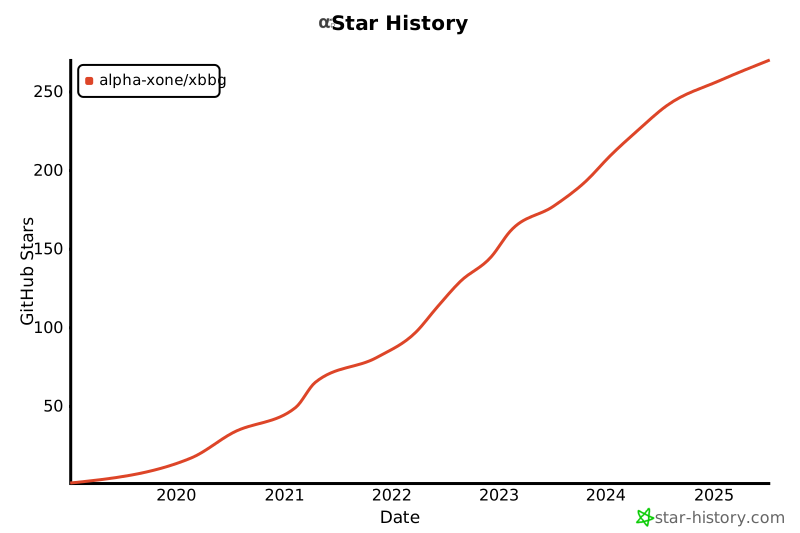
Star History
Project Status
| Category | Badge |
|---|---|
| Docs |  |
| Build |  |
| Coverage |  |
| Quality |  |
 |
|
| License |  |
0.11.0b1 - see release: notes
v0.11.0b1 - Beta Release
Highlights
-
Arrow-first pipeline: Complete rewrite of data processing using PyArrow internally
-
Multi-backend support: New Backend enum supporting narwhals, pandas, polars, polars_lazy, pyarrow, duckdb
-
Output format control: New Format enum with long, semi_long, wide options
-
Bloomberg Technical Analysis (BTA): New
bta()function for technical indicators -
v1.0 migration infrastructure: Deprecation warnings and forward-compatible APIs
Added
-
BackendandFormatenums for output control -
set_backend(),get_backend(),set_format(),get_format()functions -
bta()function for Bloomberg Technical Analysis -
get_sdk_info()as replacement forgetBlpapiVersion() -
v1.0-compatible exception classes (
BlpError,BlpSessionError, etc.) -
EngineConfigdataclass andconfigure()function -
ServiceandOperationenums for Bloomberg services
Changed
-
All API functions now support
backendandformatparameters -
Internal pipeline uses PyArrow tables with narwhals transformations
-
Removed pytz dependency (using stdlib datetime.timezone)
Deprecated
-
connect()/disconnect()- engine auto-initializes in v1.0 -
getBlpapiVersion()- useget_sdk_info() -
lookupSecurity()- will becomeblkp()in v1.0 -
fieldInfo()/fieldSearch()- will merge intobfld()in v1.0
This is a beta release for testing the new Arrow-first architecture before v1.0.
Full Changelog: https://github.com/alpha-xone/xbbg/compare/v0.10.3...v0.11.0b1
0.11.0b3 - see release: notes
v0.11.0b3
-
bqr(): New Bloomberg Quote Request function emulating Excel =BQR() for dealer quote data with broker attribution (#22)
-
Slow Bloomberg fields no longer timeout prematurely - TIMEOUT events handled correctly (#193)
-
Pipeline data types: Preserve original data types in pipeline output instead of converting to strings (#191)
0.11.0b4 - see release: notes
Added
-
yas(): New Bloomberg YAS (Yield Analysis) wrapper for fixed income analytics
- Provides convenient interface to Bloomberg's YAS calculator via
bdp()overrides YieldTypeenum for yield calculation type (YTM=1,YTC=2)- Supports settlement date, spread, yield, price, and benchmark overrides
- Parameter mapping:
settle_dt→SETTLE_DT,yield_type→YAS_YLD_FLAG, etc. - Available via
blp.yas()orfrom xbbg.api.fixed_income import yas, YieldType
- Provides convenient interface to Bloomberg's YAS calculator via
-
Treasury & SOFR futures support: Added TY, ZN, ZB, ZF, ZT, UB, TN (Treasury), SFR, SR1, SR3 (SOFR), and ED (Eurodollar) futures to assets.yml (#198)
Fixed
-
stream() field values: Subscribed field values are now always included in output dict (#199)
- Previously, fields not in
const.LIVE_INFO(likeRT_BN_SURVEY_MEDIAN) were filtered out - Output would show
FIELD='RT_BN_SURVEY_MEDIAN'but containLAST_PRICEvalue instead - Fix ensures the subscribed field's value is always present regardless of info filter
- Previously, fields not in
-
Futures symbol parsing for bdib: Fixed
market_info()to correctly parse futures symbols likeTYH6→TY(#198)- Previously failed to identify root symbol when ticker had single-digit year suffix
Full Changelog: https://github.com/alpha-xone/xbbg/compare/v0.11.0b3...v0.11.0b4
0.11.0b5 - see release: notes
Fixed
-
Import without blpapi installed: Fixed
AttributeErrorwhen importing xbbg without blpapi installed (#200)- Added
from __future__ import annotationsto defer type annotation evaluation inconn.py - Guarded
blpapi.Name()constants withis_available()check inprocess.py
- Added
-
Japan/non-US timezone fix for bdib: Fixed timezone conversion for non-US exchanges (#198)
- Bloomberg returns
TRADING_DAY_START_TIME_EODandTRADING_DAY_END_TIME_EODin EST (America/New_York) - These are now correctly converted to the exchange's local timezone (e.g., Asia/Tokyo for Japanese equities)
- Previously, Tokyo's 09:00-15:45 trading hours appeared as 19:00-01:45 (EST times misinterpreted as local)
FUT_TRADING_HRSis not converted (already in exchange local time)
- Bloomberg returns
-
get_tz() no longer triggers Bloomberg lookup for timezone strings: Direct timezone strings like
"America/New_York"or"UTC"are now recognized without calling Bloomberg API
Removed
-
Trials mechanism removed: Eliminated the retry-blocking system that caused silent failures
- The trials system tracked failed API requests and blocked future attempts after 2 failures
- This caused issues when bugs were fixed (stale entries still blocked requests)
- Users had to manually clear SQLite database entries to retry
- Pipeline caching already handles "don't re-fetch" use case properly
- Deleted
xbbg/core/utils/trials.pyand related test files
-
pandas-market-calendars dependency removed: Simplified exchange metadata resolution
- Removed
PmcCalendarResolverfrom resolver chain - Exchange information now sourced exclusively from Bloomberg API with local caching
- Removed
pmc_extendedcontext option (no longer needed) - Reduces package dependencies and improves consistency
- Removed
Changed
- Internal class renames (backward compatible aliases provided):
YamlMarketInfoProvider→MetadataProviderExchangeYamlResolver→ExchangeMetadataResolver
Full Changelog: https://github.com/alpha-xone/xbbg/compare/v0.10.3...v0.11.0b5
0.11.0 - see release: notes
Highlights
-
Arrow-first pipeline: Complete rewrite of internal data processing using PyArrow for improved performance
-
Multi-backend support: Output to pandas, Polars, PyArrow, DuckDB, or narwhals with the new
Backendenum -
New API functions:
bta()for technical analysis,bqr()for dealer quotes,yas()for fixed income analytics -
BQL helpers:
preferreds()andcorporate_bonds()convenience functions -
Dependency cleanup: Removed pandas-market-calendars and the trials mechanism for a leaner install
-
v1.0 migration path: Deprecation warnings and forward-compatible APIs prepare for the upcoming v1.0 release
Added
-
Arrow-first pipeline: Complete rewrite of internal data processing using PyArrow
-
Multi-backend support: New
Backendenum supporting narwhals, pandas, polars, polars_lazy, pyarrow, duckdb -
Output format control: New
Formatenum with long, semi_long, wide options -
bta(): Bloomberg Technical Analysis function for 50+ technical indicators (#175)
-
bqr(): Bloomberg Quote Request function emulating Excel
=BQR()for dealer quote data with broker attribution (#22) -
yas(): Bloomberg YAS (Yield Analysis) wrapper for fixed income analytics with
YieldTypeenum -
preferreds(): BQL convenience function to find preferred stocks for an equity ticker
-
corporate_bonds(): BQL convenience function to find active corporate bonds for a ticker
-
set_backend(),get_backend(),set_format(),get_format()configuration functions -
get_sdk_info()as replacement for deprecatedgetBlpapiVersion() -
v1.0-compatible exception classes (
BlpError,BlpSessionError,BlpRequestError, etc.) -
EngineConfigdataclass andconfigure()function for engine configuration -
ServiceandOperationenums for Bloomberg service URIs -
Treasury & SOFR futures support: TY, ZN, ZB, ZF, ZT, UB, TN, SFR, SR1, SR3, ED futures (#198)
-
Comprehensive logging improvements across critical paths with better error traceability
-
CONTRIBUTING.md and CODE_OF_CONDUCT.md for community standards
Changed
-
All API functions now accept
backendandformatparameters -
Internal pipeline uses PyArrow tables with narwhals transformations
-
Removed pytz dependency (using stdlib
datetime.timezone) -
Intraday cache now includes interval in path (#80) - different bar intervals cached separately (breaking: existing cache will miss)
-
Internal class renames with backward compatible aliases (
YamlMarketInfoProvider→MetadataProvider) -
Logging level adjustments:
BBG_ROOT not setpromoted to WARNING, cache timing demoted to DEBUG
Deprecated
-
connect()/disconnect()- engine auto-initializes in v1.0 -
getBlpapiVersion()- useget_sdk_info()instead -
lookupSecurity()- will becomeblkp()in v1.0 -
fieldInfo()/fieldSearch()- will merge intobfld()in v1.0 -
bta_studies()- renamed tota_studies()in v1.0 -
getPortfolio()- renamed tobport()in v1.0 -
Helper functions (
dividend(),earning(),turnover(),adjust_ccy()) moving toxbbg.extin v1.0 -
Futures/CDX utilities (
fut_ticker(),active_futures(),cdx_ticker(),active_cdx()) moving toxbbg.extin v1.0
Removed
-
Trials mechanism: Eliminated retry-blocking system that caused silent failures after 2 failed attempts
-
pandas-market-calendars dependency: Exchange info now sourced exclusively from Bloomberg API with local caching
Fixed
-
Import without blpapi installed: Fixed
AttributeErrorwhen importing xbbg without blpapi (#200) -
Japan/non-US timezone fix for bdib: Trading hours now correctly converted to exchange's local timezone (#198)
-
stream() field values: Subscribed field values now always included in output dict (#199)
-
Slow Bloomberg fields: TIMEOUT events handled correctly; requests wait for response with
slow_warn_secondswarning (#193) -
Pipeline data types: Preserve original data types instead of converting to strings (#191)
-
Futures symbol parsing: Fixed
market_info()to correctly parse symbols likeTYH6→TY(#198) -
get_tz() optimization: Direct timezone strings recognized without Bloomberg API call
-
bdtick timezone fix: Pass exchange timezone to fix blank results for non-UTC exchanges (#185)
-
bdtick timeout: Increased from 10s to 2 minutes for tick data requests
-
Extended BDS test date range to 120 days for quarterly dividends
-
Helper functions now work correctly with LONG format output
-
Logging format compliance fixes (G004, G201)
Full Changelog: https://github.com/alpha-xone/xbbg/compare/v0.10.3...v0.11.0
0.11.1 - see release: notes
Fixed
- Field names now lowercase: Restored v0.10.x behavior where
bdp(),bdh(), andbds()return field/column names as lowercase (#206)
Full Changelog: https://github.com/alpha-xone/xbbg/compare/v0.11.0...v0.11.1
0.11.2 - see release: notes
Added
-
Extended multi-backend support: Added 6 new backends matching narwhals' full backend support:
- Eager backends:
cudf(GPU-accelerated via NVIDIA RAPIDS),modin(distributed pandas) - Lazy backends:
dask(parallel computing),ibis(portable DataFrame expressions),pyspark(Apache Spark),sqlframe(SQL-based DataFrames) - Total: 13 backends (6 eager + 7 lazy)
- Eager backends:
-
Backend availability checking: New functions to check and validate backend availability with helpful error messages:
is_backend_available(backend)- Check if a backend package is installedcheck_backend(backend)- Check availability with version validation, raises helpful errorsget_available_backends()- List all currently available backendsprint_backend_status()- Diagnostic function showing all backend statuses
-
Format compatibility checking: New functions to validate format support per backend:
is_format_supported(backend, format)- Check if a format works with a backendget_supported_formats(backend)- Get set of supported formats for a backendcheck_format_compatibility(backend, format)- Validate with helpful errorsvalidate_backend_format(backend, format)- Combined validation for API functions
-
xbbg.extmodule: New extension module for v1.0 migration containing helper functions that will be removed fromblpnamespacexbbg.ext.currency-adjust_ccy()for currency conversionxbbg.ext.dividends-dividend()for dividend historyxbbg.ext.earnings-earning()for earnings breakdownsxbbg.ext.turnover-turnover()for trading volumexbbg.ext.holdings-etf_holdings(),preferreds(),corporate_bonds()BQL helpersxbbg.ext.futures-fut_ticker(),active_futures()for futures resolutionxbbg.ext.cdx-cdx_ticker(),active_cdx()for CDX index resolutionxbbg.ext.yas-yas(),YieldTypefor fixed income analytics
-
New v1.0-compatible import path:
from xbbg.ext import dividend, fut_ticker, ...(no deprecation warnings) -
Pandas removed as required dependency:
xbbg.extmodules now use only stdlib datetime and narwhals, making pandas fully optional
Changed
-
Backend enum reorganized: Backends now categorized as eager (full API) vs lazy (deferred execution)
-
Format restrictions: WIDE format only available for eager backends (pandas, polars, pyarrow, narwhals, cudf, modin); lazy backends limited to LONG and SEMI_LONG
-
Version requirements updated: Minimum versions now match narwhals requirements (duckdb>=1.0, dask>=2024.1)
-
xbbg/markets/resolvers.pynow re-exports fromxbbg.ext.futuresandxbbg.ext.cdxfor backwards compatibility -
Internal implementations moved to
xbbg/ext/module; old import paths still work with deprecation warnings
Fixed
-
ibis backend: Updated to use
ibis.memtable()instead of deprecatedcon.read_in_memory() -
sqlframe backend: Fixed import path to use
sqlframe.duckdb.DuckDBSession
Full Changelog: https://github.com/alpha-xone/xbbg/compare/v0.11.1...v0.11.2
Project details
Verified details
These details have been verified by PyPIProject links
GitHub Statistics
Maintainers
Release history Release notifications | RSS feed


Download files
Download the file for your platform. If you're not sure which to choose, learn more about installing packages.
Source Distribution
Built Distribution
Filter files by name, interpreter, ABI, and platform.
If you're not sure about the file name format, learn more about wheel file names.
Copy a direct link to the current filters
File details
Details for the file xbbg-0.11.3.tar.gz.
File metadata
- Download URL: xbbg-0.11.3.tar.gz
- Upload date:
- Size: 1.5 MB
- Tags: Source
- Uploaded using Trusted Publishing? Yes
- Uploaded via: twine/6.1.0 CPython/3.13.7
File hashes
| Algorithm | Hash digest | |
|---|---|---|
| SHA256 |
9787ad24e9c8c6df3b4881e96f9ecc21ca148c02a591ca5af8bd2ff6d95ff31d
|
|
| MD5 |
7edd657684e1d6d274694eb9e8f02cb3
|
|
| BLAKE2b-256 |
8a139a02675aeffd51517b4a626fe6bd3e99a64fa63a8e4204c2ba9e09cfadcf
|
Provenance
The following attestation bundles were made for xbbg-0.11.3.tar.gz:
Publisher:
pypi_upload.yml on alpha-xone/xbbg
-
Statement:
-
Statement type:
https://in-toto.io/Statement/v1 -
Predicate type:
https://docs.pypi.org/attestations/publish/v1 -
Subject name:
xbbg-0.11.3.tar.gz -
Subject digest:
9787ad24e9c8c6df3b4881e96f9ecc21ca148c02a591ca5af8bd2ff6d95ff31d - Sigstore transparency entry: 921383938
- Sigstore integration time:
-
Permalink:
alpha-xone/xbbg@b929d49d1a2c802b172d7a0625ba9efcaa2feb67 -
Branch / Tag:
refs/tags/v0.11.3 - Owner: https://github.com/alpha-xone
-
Access:
public
-
Token Issuer:
https://token.actions.githubusercontent.com -
Runner Environment:
github-hosted -
Publication workflow:
pypi_upload.yml@b929d49d1a2c802b172d7a0625ba9efcaa2feb67 -
Trigger Event:
release
-
Statement type:
File details
Details for the file xbbg-0.11.3-py3-none-any.whl.
File metadata
- Download URL: xbbg-0.11.3-py3-none-any.whl
- Upload date:
- Size: 196.2 kB
- Tags: Python 3
- Uploaded using Trusted Publishing? Yes
- Uploaded via: twine/6.1.0 CPython/3.13.7
File hashes
| Algorithm | Hash digest | |
|---|---|---|
| SHA256 |
f95685a7d9b56ab8641a0ee2ded098437f231054312c82bd5d1ffc38a006c533
|
|
| MD5 |
bc0e3e135e3521e5b04594733d7cf1bf
|
|
| BLAKE2b-256 |
746a9ef28b30aca701af67cd146e9f49a0a06e5ade393be235e1e938692e8667
|
Provenance
The following attestation bundles were made for xbbg-0.11.3-py3-none-any.whl:
Publisher:
pypi_upload.yml on alpha-xone/xbbg
-
Statement:
-
Statement type:
https://in-toto.io/Statement/v1 -
Predicate type:
https://docs.pypi.org/attestations/publish/v1 -
Subject name:
xbbg-0.11.3-py3-none-any.whl -
Subject digest:
f95685a7d9b56ab8641a0ee2ded098437f231054312c82bd5d1ffc38a006c533 - Sigstore transparency entry: 921384018
- Sigstore integration time:
-
Permalink:
alpha-xone/xbbg@b929d49d1a2c802b172d7a0625ba9efcaa2feb67 -
Branch / Tag:
refs/tags/v0.11.3 - Owner: https://github.com/alpha-xone
-
Access:
public
-
Token Issuer:
https://token.actions.githubusercontent.com -
Runner Environment:
github-hosted -
Publication workflow:
pypi_upload.yml@b929d49d1a2c802b172d7a0625ba9efcaa2feb67 -
Trigger Event:
release
-
Statement type: