
xinvert









1. Introduction
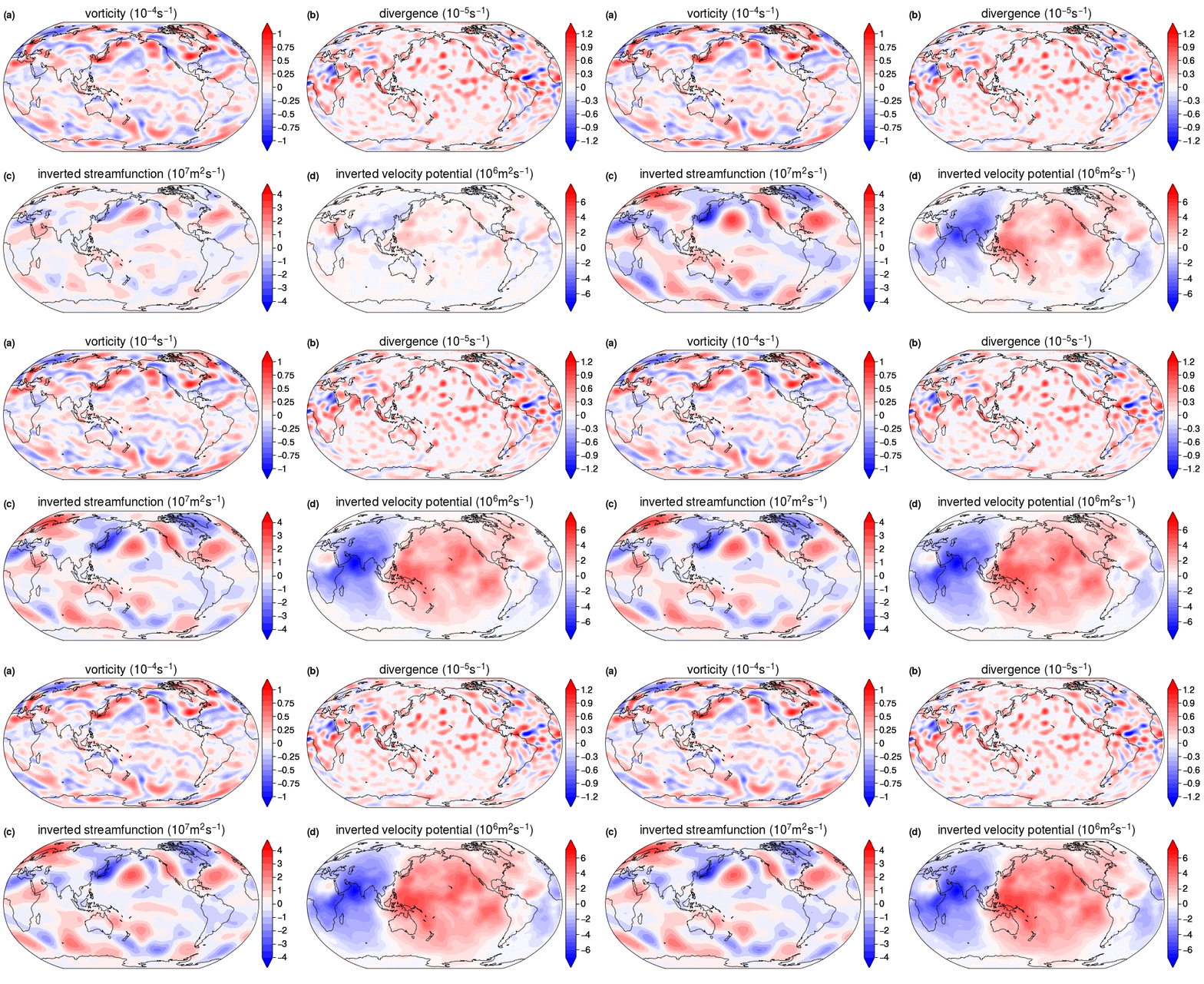
Researches on meteorology and oceanography usually encounter inversion problems that need to be solved numerically. One of the classical inversion problem is to solve Poisson equation for a streamfunction $\psi$ given the vertical component of vorticity $\zeta$ and proper boundary conditions.
$$\nabla^2\psi=\zeta$$
Nowadays xarray becomes a popular data structure commonly used in Big Data Geoscience. Since the whole 4D data, as well as the coordinate information, are all combined into xarray, solving the inversion problem become quite straightforward and the only input would be just one xarray.DataArray of vorticity. Inversion on the spherical earth, like some meteorological problems, could utilize the spherical harmonics like windspharm, which would be more efficient using FFT than SOR used here. However, in the case of ocean, SOR method is definitely a better choice in the presence of irregular land/sea mask.
More importantly, this could be generalized into a numerical solver for elliptical equation using SOR method, with spatially-varying coefficients. Various popular inversion problems in geofluid dynamics will be illustrated as examples.
One problem with SOR is that the speed of iteration using explicit loops in Python will be e-x-t-r-e-m-e-l-y ... s-l-o-w! A very suitable solution here is to use numba. In addition, through using xarray's dask backend for parallel computing, the speed of the inversion could be further improved using multiple CPU cores. Now, we could also make use of CUDA GPU for further acceleration, with a Red-Black SOR kernel achieving up to ~17× speedup over the CPU for large grids (measured on an RTX 3090; see the benchmark docs). See this notebook for more details of CPU/GPU parallel computing, and this docs for benchmark of the inversion speed.
Classical problems include Gill-Matsuno model, Stommel-Munk model, QG omega model, PV inversion model, Swayer-Eliassen balance model... A complete list of the classical inversion problems can be found at this notebook.
Why xinvert?
- Thinking and coding in equations: User APIs are very close to the equations: unknowns are on the LHS of
=, whereas the known forcings are on its RHS; - Genearlize all the steady-state problems: All the known steady-state problems in geophysical fluid dynamics can be easily adapted to fit the solvers;
- Very short parameter list: Passing a single
xarrayforcing is enough for the inversion. Coordinates information is already encapsulated. - Flexible model parameters: Model paramters can be either a constant, or varying with a specific dimension (like Coriolis $f$), or fully varying with space and time, due to the use of
xarray's broadcasting capability; - Parallel inverting: The use of
xarray, and thusdaskallow parallel inverting, which is almost transparent to the user; - Pure Python code for C-code speed: The use of
numbaallow pure python code in this package but native speed;
2. How to install
Requirements
xinvert is developed under the environment with xarray (=version 0.15.0), dask (=version 2.11.0), numpy (=version 1.15.4), and numba (=version 0.51.2). Older versions of these packages are not well tested.
Install via pip
pip install xinvert
Install via conda
conda install -c conda-forge xinvert
Install from github
git clone https://github.com/miniufo/xinvert.git
cd xinvert
python setup.py install
3. Examples:
This is a list of the problems that can be solved by xinvert:


4 Animate the convergence of iteration
One can see the whole convergence process of SOR iteration as:
from xinvert import animate_iteration

# output has 1 more dimension (iter) than input, which could be animated over.
# Here 40 frames and loop 1 per frame (final state is after 40 iterations) is used.
psi = animate_iteration(invert_Poisson, vor, iParams=iParams,
                        loop_per_frame=1, max_frames=40)
See the animation at the top.
5 Cite
If you use the package in research, teaching, or other activities, we would be grateful
if you mention xinvert and cite our paper in JOSS:
@article{Qian2023,
    doi = {10.21105/joss.05510},
    url = {https://doi.org/10.21105/joss.05510},
    year = {2023},
    publisher = {Journal of Open Source Software},
    volume = {8},
    number = {89},
    pages = {5510},
    author = {Yu-Kun Qian},
    title = {xinvert: A Python package for inversion problems in geophysical fluid dynamics}, journal = {Journal of Open Source Software}
}
1 maintainer

Metadata
1 maintainer
Release files for xinvert 0.3.0
For a detailed explanation of source distributions (sdists) and built distributions (wheels), please see the package formats documentation.
Source distribution (sdist)
| File | Size | Uploaded | |
|---|---|---|---|
| xinvert-0.3.0.tar.gz | 88.8 kB | Details |
Built distribution (wheel)
| File | Interpreter | ABI | Platform | Reset |
|---|---|---|---|---|
| xinvert-0.3.0-py3-none-any.whl | Python 3 | none | any | Details |
Total release size: 139.1 kB
Release files / xinvert-0.3.0.tar.gz
| Download URL | xinvert-0.3.0.tar.gz |
|---|---|
| Size | 88.8 kB |
| Tags | Source |
|
SHA-256 checksum How to use checksums |
594ab01c2f9227589fe26539d13ca3fd8dfc1bc709093c0275d7f64512d2ab85
|
|
BLAKE2b-256 checksum How to use checksums |
b7b9ab254263c2ff178861613a01964aa1b72cfc5fe37481ab0b99cdd88ab7f8
|
| Upload date | |
|
Uploaded using Trusted Publishing? What is trusted publishing? |
No |
| Uploaded via |
twine/6.2.0 CPython/3.9.25
|
Release files / xinvert-0.3.0-py3-none-any.whl
| Download URL | xinvert-0.3.0-py3-none-any.whl |
|---|---|
| Size | 50.3 kB |
| Tags | Python 3 |
|
SHA-256 checksum How to use checksums |
4753e7bea05074b1ed52dbb4cd38991b9b360e5588dcb939e6c76059061e0391
|
|
BLAKE2b-256 checksum How to use checksums |
f2e1d83b1afc87a66afe097a328d6a867172e46b0015c6698a275614a8e6606f
|
| Upload date | |
|
Uploaded using Trusted Publishing? What is trusted publishing? |
No |
| Uploaded via |
twine/6.2.0 CPython/3.9.25
|














