
xstructured






Validated Pydantic data and natural-language text from one LLM response.
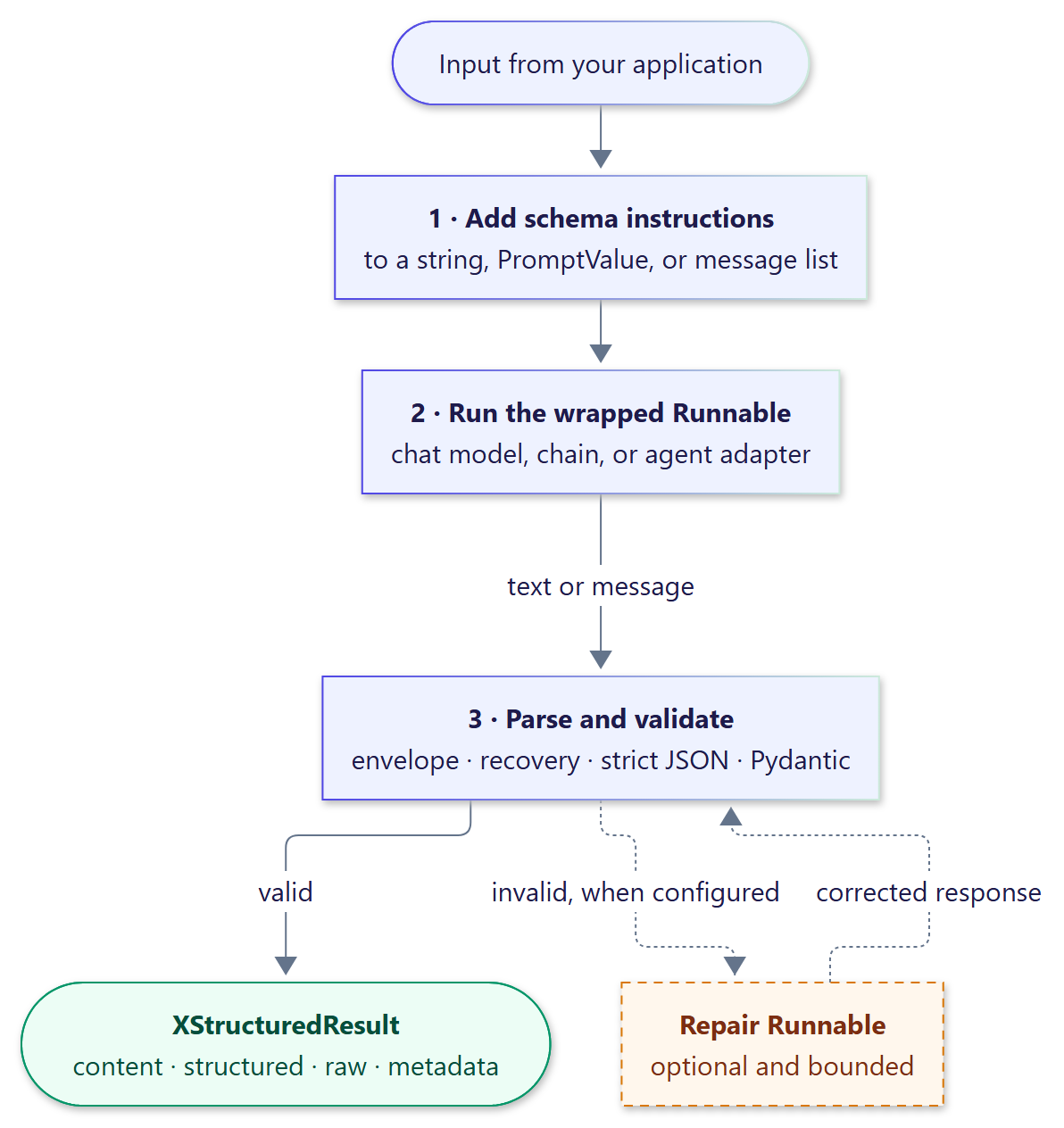
xstructured wraps any LangChain v1 Runnable, chat model, or agent. The model answers in
its own words and places a JSON payload in an envelope; xstructured extracts it, validates
it with Pydantic v2, and returns both, even when the payload is wrapped in Markdown, buried
in prose, or still streaming in.
Highlights
- Validated, never guessed. Strict JSON decoding and Pydantic validation in JSON mode. Recovery only selects which part of a response to parse; it never rewrites JSON.
- Prose and data together.
result.contentfor people,result.structuredfor code. - Ordered streaming. Text deltas as they arrive, and the validated value the moment its envelope closes.
- A native Runnable.
invoke,batch,stream, async variants, tracing, retries, fallbacks, and composition behave as in any LangChain Runnable. - Bounded by design. Input, envelope, payload, and nesting limits; duplicate keys,
NaN, and overflowing numbers are rejected. - Optional, bounded repair. An opt-in repair Runnable gets a fixed number of attempts, and its output must pass the same schema.
- Fully typed. The value type is inferred from your schema.
Installation
pip install xstructured
Requires Python 3.12 or newer. The only runtime dependencies are langchain-core and
pydantic.
Quickstart
from langchain.chat_models import init_chat_model
from pydantic import BaseModel

from xstructured import with_xstructured_output


class Contact(BaseModel):
    name: str
    email: str
    company: str | None = None


model = init_chat_model("openai:gpt-5-mini")
extractor = with_xstructured_output(model, Contact)
result = extractor.invoke(
    "Please loop in Priya Shah (priya.shah@example.com) from Acme Corp."
)

print(result.structured)  # Contact(name='Priya Shah', ...)
print(result.content)  # The model's prose, with the envelope removed.
Stream prose and data in order:
from xstructured import StreamEventKind

message = "Add Priya Shah (priya.shah@example.com) to the review."
for event in extractor.stream(message):
    if event.kind is StreamEventKind.TEXT_DELTA:
        print(event.text, end="")
    elif event.kind is StreamEventKind.STRUCTURED_END:
        print("\nValidated:", event.structured)
Parse text from any source, without LangChain:
from xstructured import StructuredParser

reply = (
    "Sure!\n"
    "```json\n"
    '{"name": "Priya Shah", "email": "priya.shah@example.com"}\n'
    "```"
)
result = StructuredParser(Contact).parse(reply)
print(result.value, result.recovered)  # Contact(...) True
Wrap chains, create_agent agents, Deep Agents, and LangGraph nodes too; see the
integration guides.
Benchmarks
An offline benchmark runs 11 model-style outputs through four parsers and checks each against an explicit expectation, counting a wrongly accepted truncated or ambiguous payload as a failure:
| Mechanism | Correct | Median latency |
|---|---|---|
json.loads + Pydantic |
45.45% | 3.5 µs |
LangChain JsonOutputParser + Pydantic |
45.45% | 284.0 µs |
LangChain PydanticOutputParser |
45.45% | 249.7 µs |
| xstructured | 100% | 21.0 µs |
Reproduce it with uv run python -m benchmarks; methodology and per-case results are in
the benchmark documentation.
Examples
Nine example scripts
cover single- and multi-agent extraction, Deep Agents, LangGraph routing, RAG citations,
incident analysis, streaming UIs, mixed payloads with repair, and named envelopes. Each
runs offline with a scripted model, or live against the Experiential Labs API when
EXPLABS_API_KEY is set.
Documentation
Full documentation is at xstructured.readthedocs.io: quickstart, user guide, architecture, security, and the API reference.
An Agent Skill teaches AI coding agents to use xstructured correctly:
npx skills add smuniharish/xstructured --skill xstructured
Contributing
Contributions are welcome. See CONTRIBUTING.md for the development workflow and SECURITY.md for reporting vulnerabilities.
License
Licensed under the Apache License 2.0.
1 maintainer

Metadata
1 maintainer
Release files for xstructured 0.1.1
For a detailed explanation of source distributions (sdists) and built distributions (wheels), please see the package formats documentation.
Source distribution (sdist)
| File | Size | Uploaded | |
|---|---|---|---|
| xstructured-0.1.1.tar.gz | 35.9 kB | Details |
Built distribution (wheel)
| File | Interpreter | ABI | Platform | Reset |
|---|---|---|---|---|
| xstructured-0.1.1-py3-none-any.whl | Python 3 | none | any | Details |
Total release size: 82.5 kB
Release files / xstructured-0.1.1.tar.gz
| Download URL | xstructured-0.1.1.tar.gz |
|---|---|
| Size | 35.9 kB |
| Tags | Source |
|
SHA-256 checksum How to use checksums |
d5dd84502b30b6b4fe03301de763b95be16c4bb6f5fc3552fa69184cee19493b
|
|
BLAKE2b-256 checksum How to use checksums |
d3d30d677fac324d60b69d502070dba6fc5be35c8997b9b15f59793802164aa9
|
| Upload date | |
|
Uploaded using Trusted Publishing? What is trusted publishing? |
No |
| Uploaded via |
uv/0.12.15 {"installer":{"name":"uv","version":"0.12.15","subcommand":["publish"]},"python":null,"implementation":{"name":null,"version":null},"distro":null,"system":{"name":null,"release":null},"cpu":null,"openssl_version":null,"setuptools_version":null,"rustc_version":null,"ci":null}
|
Release files / xstructured-0.1.1-py3-none-any.whl
| Download URL | xstructured-0.1.1-py3-none-any.whl |
|---|---|
| Size | 46.5 kB |
| Tags | Python 3 |
|
SHA-256 checksum How to use checksums |
c1ae8ea529cdc9d347881233ced34b27d91e3a3465c47fd4234338d923178264
|
|
BLAKE2b-256 checksum How to use checksums |
1aec813e7c46ba042efc7d79f5f0bd49554ea739155e92511026a1045d42c184
|
| Upload date | |
|
Uploaded using Trusted Publishing? What is trusted publishing? |
No |
| Uploaded via |
uv/0.12.15 {"installer":{"name":"uv","version":"0.12.15","subcommand":["publish"]},"python":null,"implementation":{"name":null,"version":null},"distro":null,"system":{"name":null,"release":null},"cpu":null,"openssl_version":null,"setuptools_version":null,"rustc_version":null,"ci":null}
|














