
XtremeFlow
"Exhaust rate limits, not patience. Squeezing maximum throughput from every second."
🦅 About
XtremeFlow is a high-performance asynchronous task scheduler engineered to push Large Language Model (LLM) workloads to their absolute physical limits.
The Problem: LLM providers throttle your velocity through a combination of Concurrency, RPS/RPM or TPS/TPM. Most schedulers are defensive—they wait too long, leave gaps in your schedule, and waste capacity. In high-volume production, idle time is a lost resource.
The XtremeFlow Philosophy: Stop being polite with your rate limits. XtremeFlow is offensive. It is designed to saturate your provider's capacity with surgical precision. Using a unique Backpressure Reflex, it maintains peak velocity until the very moment a limit is hit, executes a synchronized global cool-down, and resumes at full speed the millisecond the provider allows.
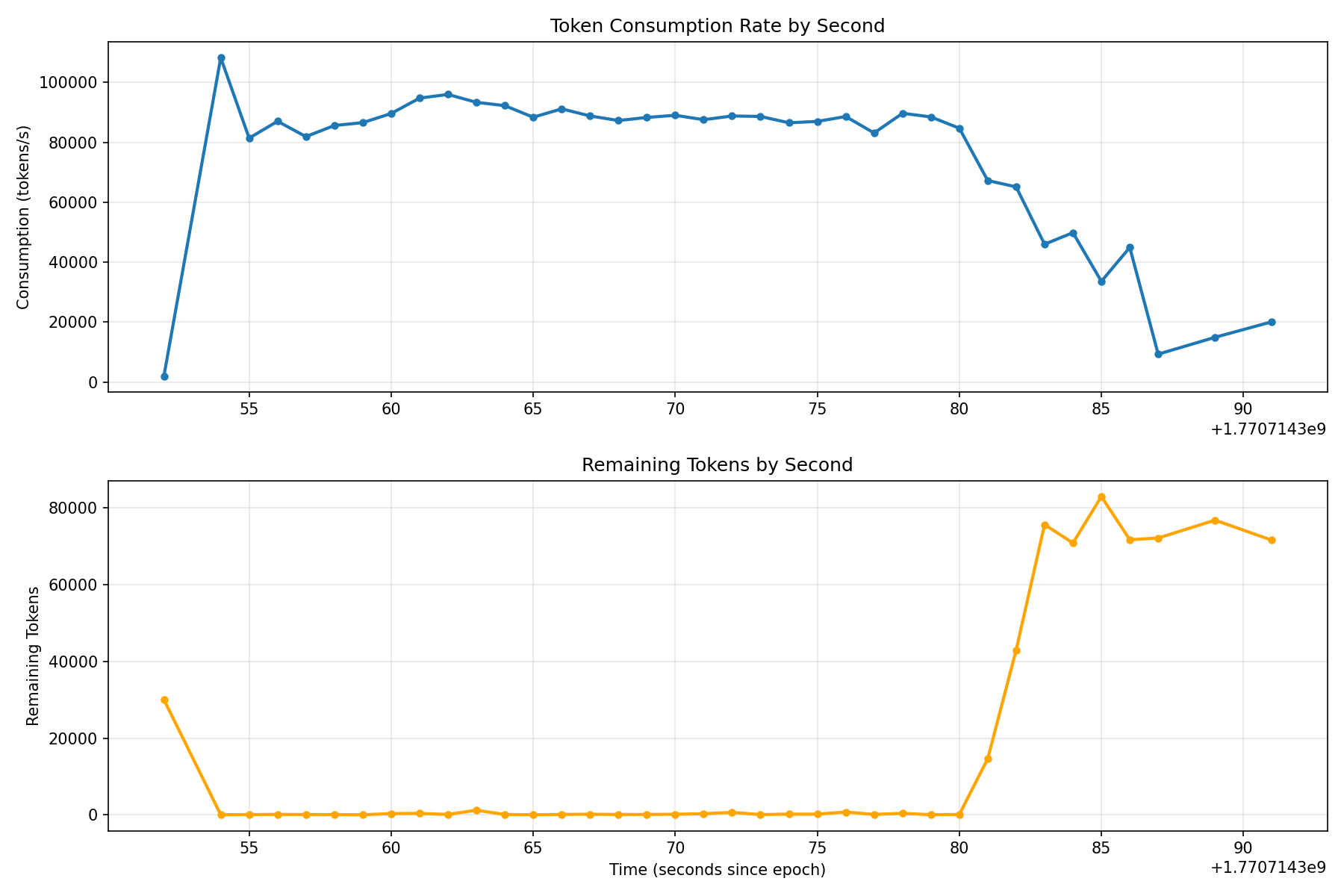
Here's an example shows controlled token consumption rate regulated by XtremeFlow's TokenRateScheduler (TPM:5000000, BURST_RATIO: 0.1):
⚠️ Limitation: XtremeFlow is currently optimized for single-process
asyncioapplications. It manages state in-memory and does not support distributed rate limiting (e.g., Redis-based) out of the box.
⚡ Key Features
- Aggressive Saturation: Engineered to fill every available millisecond of your allowed rate, ensuring zero wasted throughput.
- Backpressure Reflex: Automatically detects 429 triggers and orchestrates a global Exponential Backoff across all workers to stay in perfect sync with provider resets.
- Dynamic Calibration: Supports post-request reporting of actual usage to instantly "refund" over-estimated capacity back to the scheduler.
- Async-Native: Built on
asynciofor low-latency scheduling where every microsecond counts. - KV Cache Optimization: Provides utilities to maximize KV cache utilization across parallel LLM requests, dramatically reducing token consumption and improving throughput.
- Async Pipeline: Producer-consumer pipeline for streaming workloads with automatic backpressure handling.
🚀 Quick Start
import asyncio
from openai import RateLimitError
from xtremeflow.scheduler.rate_limit import auto_backoff
from xtremeflow.scheduler.token import TokenRateScheduler, report_token_usage

# Initialize: 10 concurrent slots, 50k TPM
scheduler = TokenRateScheduler(
    max_concurrency=10,
    max_tps=900  # ~54k TPM
)

@auto_backoff(retry_for=RateLimitError, base_retry_after=2.0)
async def call_llm_api(prompt: str):
    """
    Wraps LLM call with Backpressure Reflex.
    Global synchronization ensures you don't keep hitting the wall during cooldown.
    """
    print(f"Executing task: {prompt}")

    # Simulated API call
    await asyncio.sleep(1)

    # Calibration: Refund unused quota to the scheduler
    await report_token_usage(actual=450)

    return "success"

async def main():
    tasks = []
    for i in range(10):
        # Dispatch with an estimated cost to saturate the current limit
        t = await scheduler.start_task(
            call_llm_api(f"Task {i}"),
            estimated_tokens=500
        )
        tasks.append(t)

    results = await asyncio.gather(*tasks)
    print(f"XtremeFlow: Successfully processed {len(results)} tasks at peak throughput.")

if __name__ == "__main__":
    asyncio.run(main())
📏 Rate Limit Configuration
RPM/TPM → RPS/TPS Conversion
LLM providers typically quote limits in RPM (requests per minute) or TPM (tokens per minute) for billing purposes, but rate limiting is enforced per-second in practice. Convert to RPS/TPS:
RPS = RPM / 60
TPS = TPM / 60

# Example: 50,000 TPM
max_tps = 50000 / 60  # ≈ 833 TPS
Burst Traffic
If your provider supports burst traffic, gradually increase burst_ratio (starting from 0.1) until you encounter throttling errors:
scheduler = TokenRateScheduler(
    max_tps=900,
    burst_ratio=0.1  # Start with 10% burst
)
⚠️ Important: Each
burst_ratioadjustment requires waiting for the provider's rate limiter to cooldown (typically 1-2 minutes) before testing again.
🔥 Performance Tools
Beyond rate limiting, XtremeFlow provides utilities to maximize token efficiency and throughput.
KV Cache Optimization (kv_batch)
from xtremeflow.kvbatch import kv_batch

# First request establishes KV cache, rest run in parallel
task = kv_batch(
    llm_score(prompt) for prompt in same_job_with_different_resumes
)
results = await task
Reduces token consumption by 40-60% for batched requests with shared prefixes.
Async Pipeline (async_pipeline)
from xtremeflow.pipeline import async_pipeline

# Producer: scheduler-controlled, exhausts this tier's rate limit
async def producer(queue: asyncio.Queue):
    async for item in source:
        task = await scheduler.start_task(llm_api(item), estimated_tokens=1000)
        await queue.put(task)

# Processor: slower sequential processing, yields to next tier
async def process_item(item):
    result = await item
    return await db_write(result)  # Different rate limit tier

async for result in async_pipeline(producer, process_item):
    yield result  # Can chain to another tier
Decouples rate limit tiers—exhausting each tier's limit frees up quota for other tasks immediately, maximizing overall system throughput.
1 maintainer

Metadata
1 maintainer
Release files for xtremeflow 0.4.4
For a detailed explanation of source distributions (sdists) and built distributions (wheels), please see the package formats documentation.
Source distribution (sdist)
| File | Size | Uploaded | Provenance | Actions |
|---|---|---|---|---|
| xtremeflow-0.4.4.tar.gz | 14.0 kB | Without provenance | Details for xtremeflow-0.4.4.tar.gz |
Built distribution (wheel)
| File | Interpreter | ABI | Platform | Actions Reset |
|---|---|---|---|---|
| xtremeflow-0.4.4-py3-none-any.whl | Python 3 | none | any | Details for xtremeflow-0.4.4-py3-none-any.whl |
Total release size: 25.5 kB
Release files / xtremeflow-0.4.4.tar.gz
| Download URL | xtremeflow-0.4.4.tar.gz |
|---|---|
| Size | 14.0 kB |
| Tags | Source |
|
SHA-256 checksum How to use checksums |
ee1ddd1ce1dabd29715f91a104adfe02f284154be135bc091393b19bd4ecdd2c
|
|
BLAKE2b-256 checksum How to use checksums |
6ea65c6ed5fcd3679e7cd4e01168c7cc5f86928befd127a88cddbc9e306f330a
|
| Upload date | |
|
Uploaded using Trusted Publishing? What is trusted publishing? |
No |
| Uploaded via |
uv/0.11.26 {"installer":{"name":"uv","version":"0.11.26","subcommand":["publish"]},"python":null,"implementation":{"name":null,"version":null},"distro":{"name":"macOS","version":null,"id":null,"libc":null},"system":{"name":null,"release":null},"cpu":null,"openssl_version":null,"setuptools_version":null,"rustc_version":null,"ci":null}
|
Release files / xtremeflow-0.4.4-py3-none-any.whl
| Download URL | xtremeflow-0.4.4-py3-none-any.whl |
|---|---|
| Size | 11.5 kB |
| Tags | Python 3 |
|
SHA-256 checksum How to use checksums |
47617abfeaabfe641f64d33be55cf2f682fef16be960b6a9c4c91d19198cf228
|
|
BLAKE2b-256 checksum How to use checksums |
998bdb31e88f0e439082f2b201a1d0a5a7177311929ef3ce8408230577f8115f
|
| Upload date | |
|
Uploaded using Trusted Publishing? What is trusted publishing? |
No |
| Uploaded via |
uv/0.11.26 {"installer":{"name":"uv","version":"0.11.26","subcommand":["publish"]},"python":null,"implementation":{"name":null,"version":null},"distro":{"name":"macOS","version":null,"id":null,"libc":null},"system":{"name":null,"release":null},"cpu":null,"openssl_version":null,"setuptools_version":null,"rustc_version":null,"ci":null}
|
Security for xtremeflow 0.4.4
Provenance
Provenance describes where a file came from. On PyPI, provenance is shared via attestations, which provide a verifiable record of the build or publishing details. View details, limitations and caveats.
No provenance found
None of the files in this release were uploaded with provenance metadata.
A note on package security
PyPI is a repository for distributing packages, not a service for auditing them. While third-party security researchers and our staff do their best to detect and remove malicious packages, PyPI cannot guarantee the quality, security or suitability of any given package.
To learn more about protecting yourself from malicious actors, visit our package security documentation.














