
Yap Studio
The video editor you never have to learn.
For people with more to say than time to edit. 30 card types. Every cut checked. No timeline.
Drop in your raw takes, stumbles and all. An agent in Claude Code, the Claude app's Code tab, Codex or Cursor cuts the dead air and the restarts, adds your captions, cards, B-roll and music, and checks the video before you see it. You leave notes from your phone, and the next version follows them.




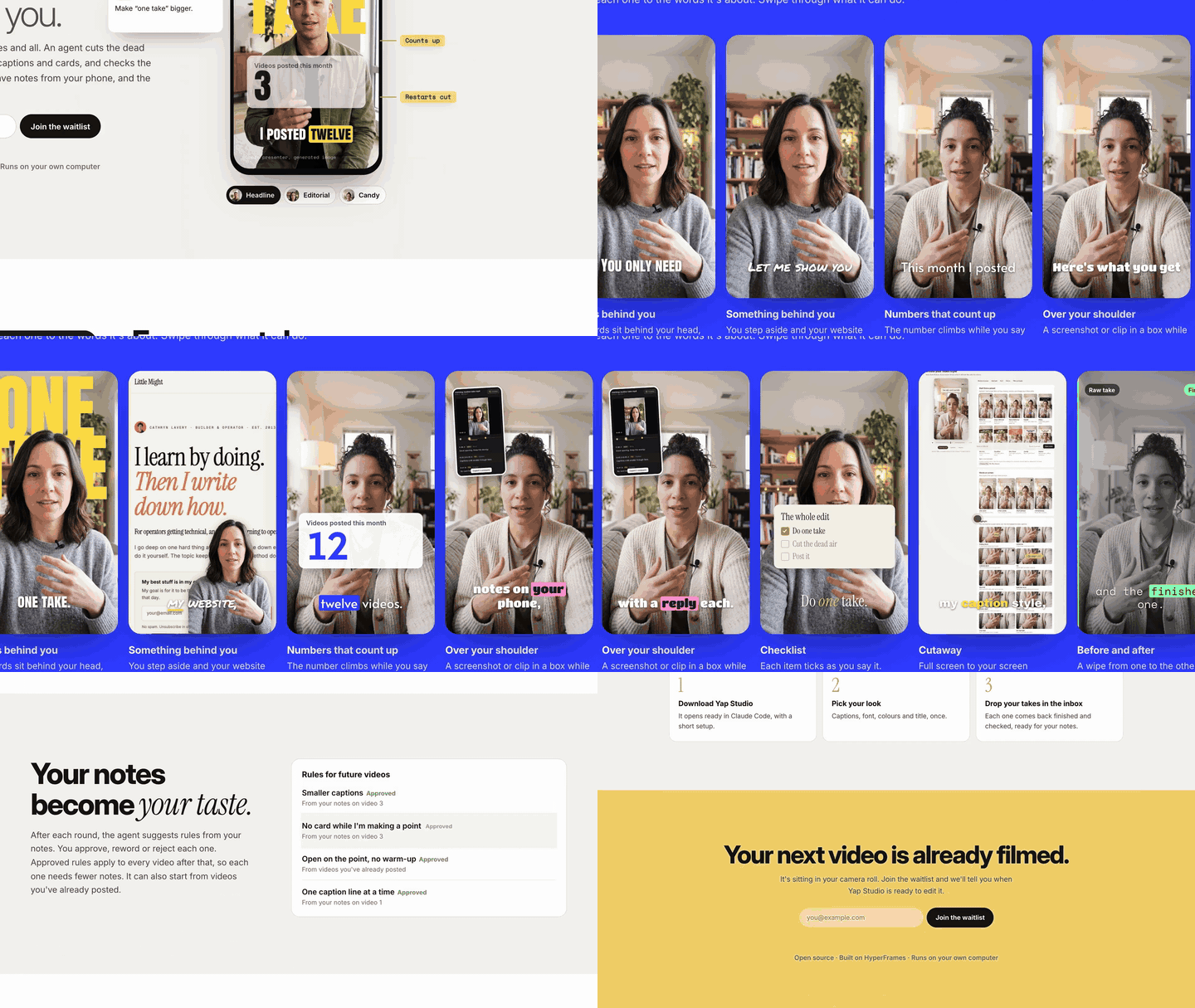
You talk. The agent edits. You comment.
If it saves you an evening of editing, star the repo so other creators can find it.
Yap Studio is an open-source add-on for HyperFrames that edits vertical and horizontal videos on your own computer. It is for people who talk to a camera and would rather not spend the evening in an editor. There is no timeline to drag. A page in your browser walks you through each video, and the notes you approve become taste rules, so the next video starts closer to how you like it.
Your video files stay on your computer. Still frames from pinned notes and contact sheets of your clips go to Anthropic in Claude Code and the Claude app's Code tab, or OpenAI in Codex, along with the transcript, your notes, the project files your agent reads and command output, as part of your agent session. On personal ChatGPT plans, OpenAI may train on it unless "Improve the model for everyone" is off. In Cursor, the same data goes to Cursor (Anysphere) and the company running your chosen model; Privacy Mode stops training. ElevenLabs, WaveSpeed and Pexels get only what they need, and only if you turn them on. Notes about problems with the tool stay on your computer until you agree to share them.
If you build software, the engine is Python with a command line. Skip to For developers.
Three steps, then you talk
You need a Mac with macOS 14 or newer and about 10 GB free on a local disk. Your agent runs setup one step at a time and asks before each install. On a Mac, it uses Homebrew and offers to install Homebrew first if needed.
- Download
yap-studio-workspace-<version>.zipfrom the latest release and unzip it into a local folder, not a synced one. - Open that folder in one of the apps below and say "set me up". The first setup downloads the speech model (about 2.5 GB) and the video renderer, then opens Yap Studio home in your browser.
- Choose what you're making, add your footage, pick your look on a still from your own take, and press Make my video.
- Claude Code in Terminal: change to the
unzipped folder, run
claude, and sign in once with/login. - The Claude app: click Code, choose Local, then Open folder and pick the workspace. Sign in on a paid plan.
- Codex in the ChatGPT app: choose Codex, add a project,
then Use an existing folder. Trust the folder once. Or install the
Terminal CLI, run
codexin this folder, and choose Trust and continue. - Cursor: File > Open Folder, then Cmd+I. Use Agent mode on this Mac, not a cloud agent. Privacy Mode is suggested.
In your chosen app, type set me up. Chat apps (Claude Chat, Cowork, ChatGPT chat)
can't edit these videos.
In Codex and Cursor, press the button on the page, then tell the agent in chat so it can check for your choice. Claude Code can listen in the background.
After that, you watch the story cut and then the finished video, leave notes on any moment, and approve the version you keep. docs/home.md explains how the page and the agent work together.
You talk. The agent edits. You comment.
These are real screens from a full run on synthetic footage: a photo of a generated sample presenter with a slow push, reading a short script in the Mac's built-in voice.
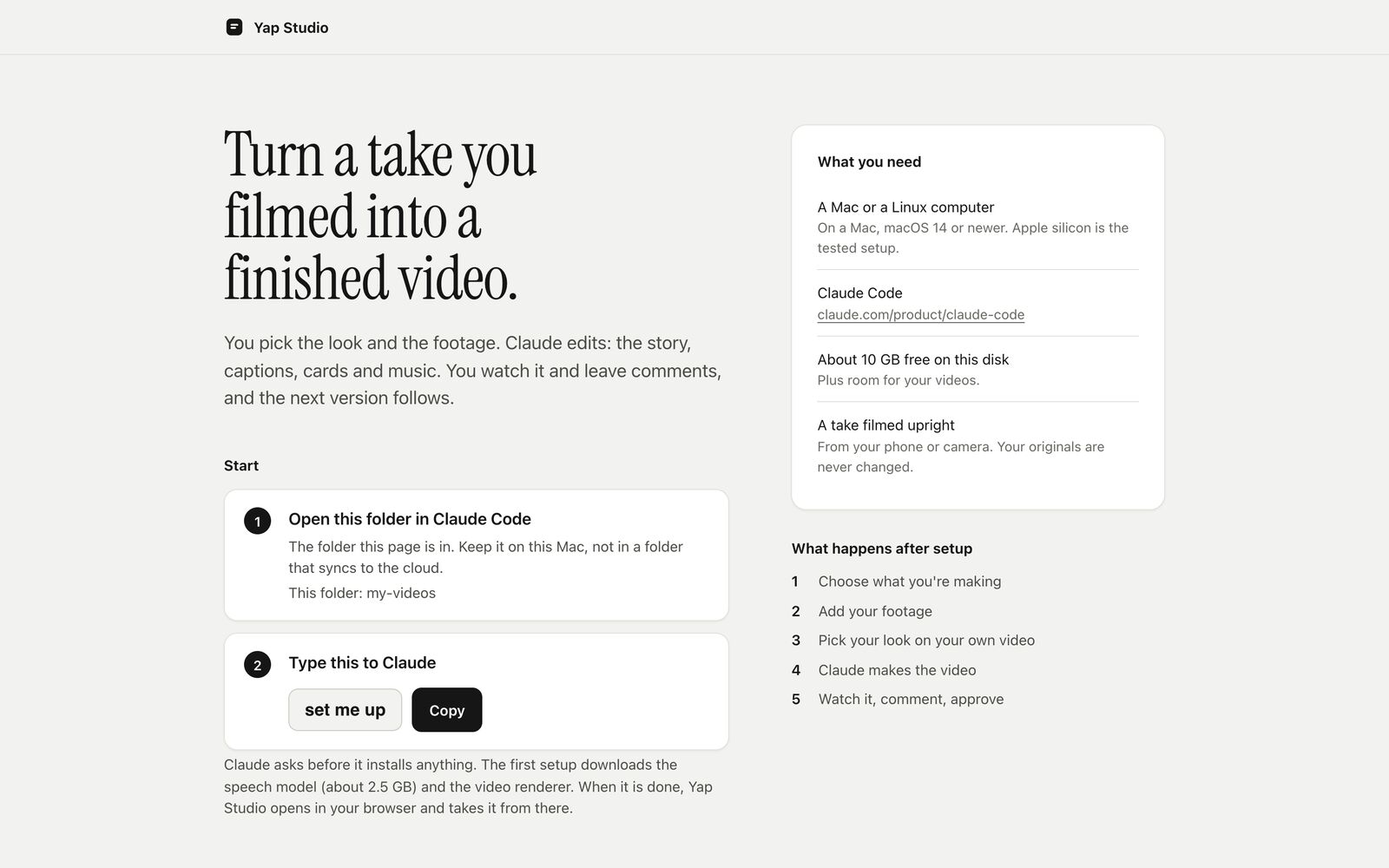 1. Start here. The workspace opens with a page that lists what you need and the one phrase to type in your agent app. The agent asks before it installs anything. |
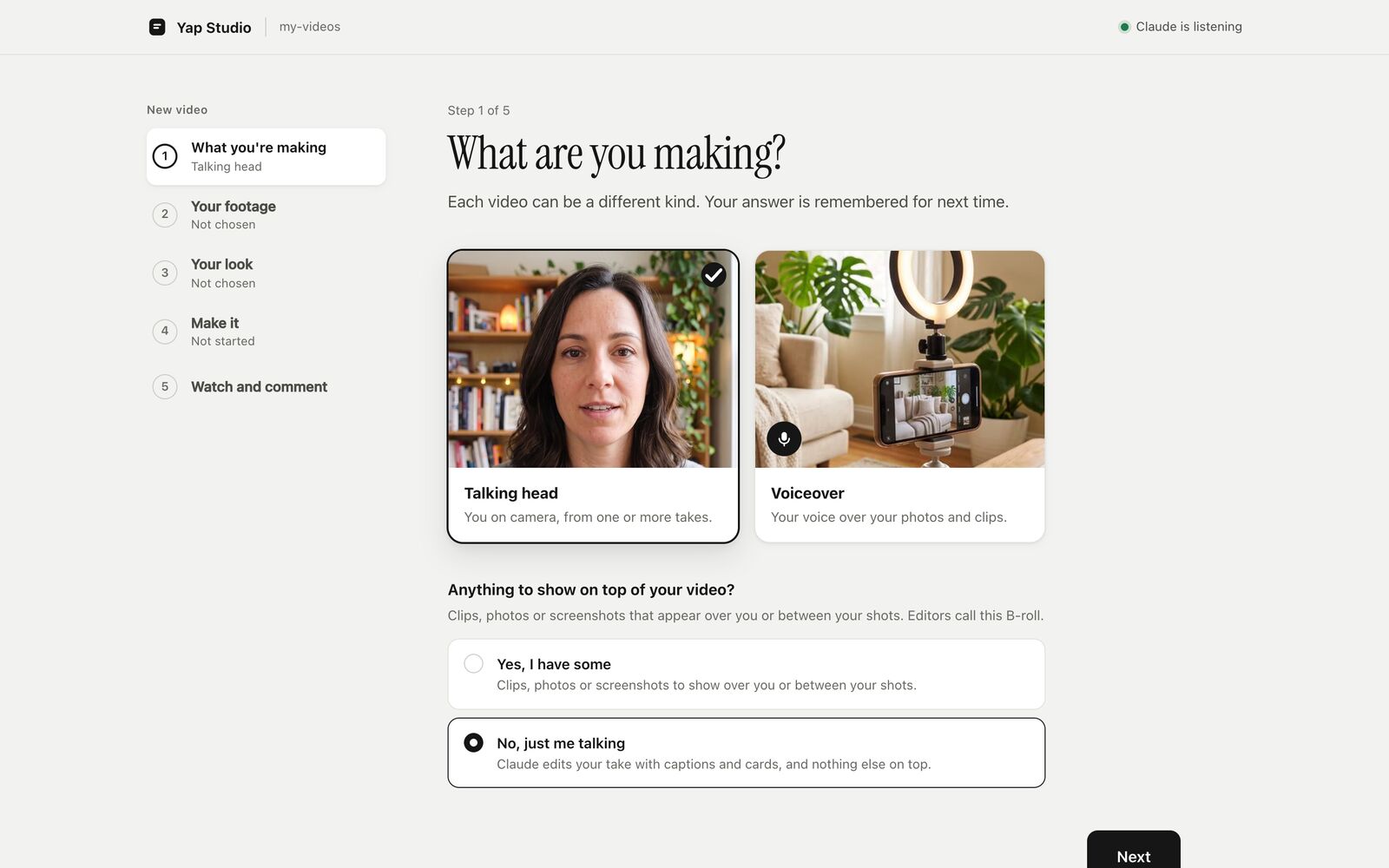 2. What you're making. Talking head or voiceover. A talking head asks whether you have anything to show on top before asking where it is. |
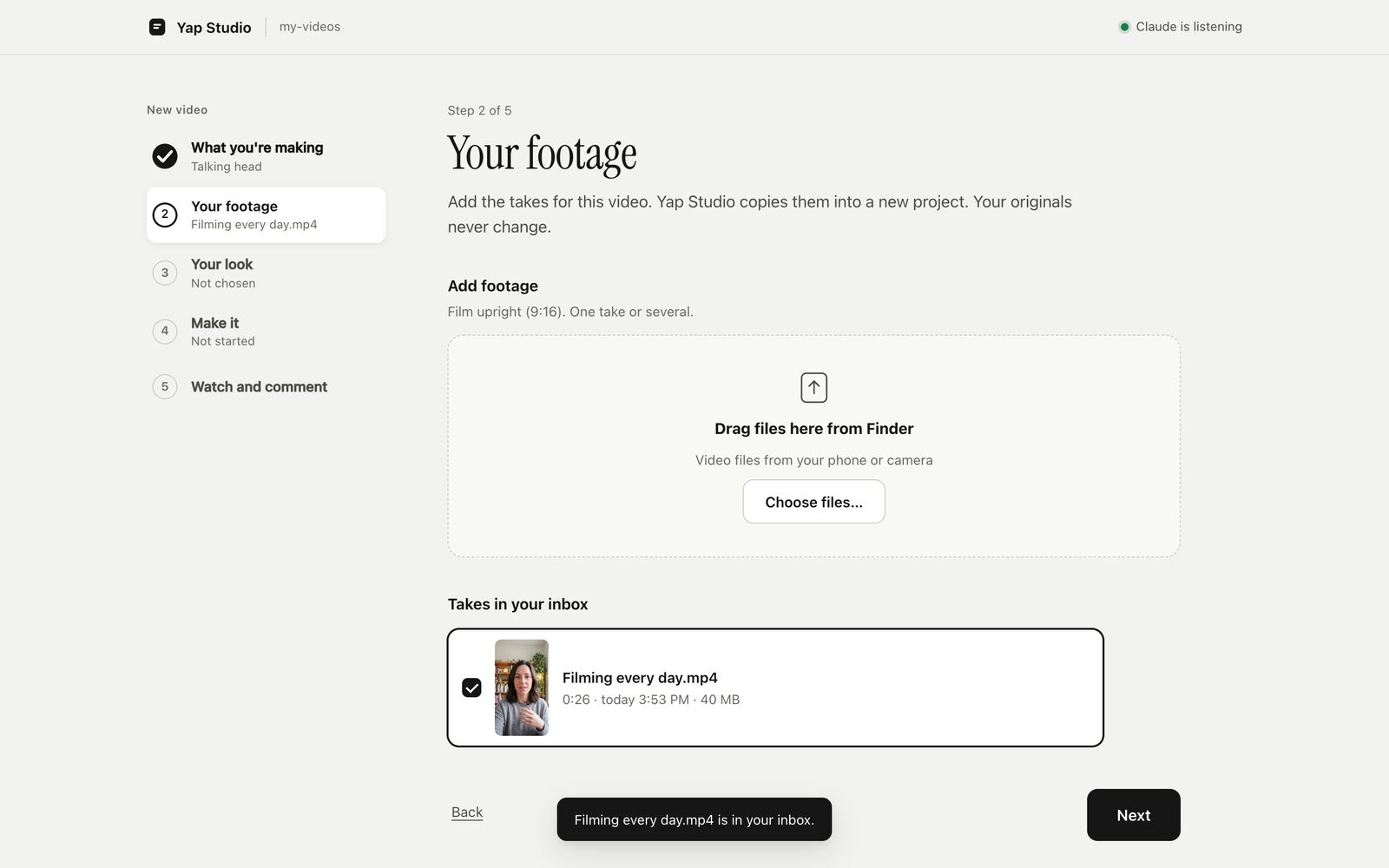 3. Your footage. Drag takes in from Finder or choose files. Yap Studio copies them into the inbox and never changes the originals. |
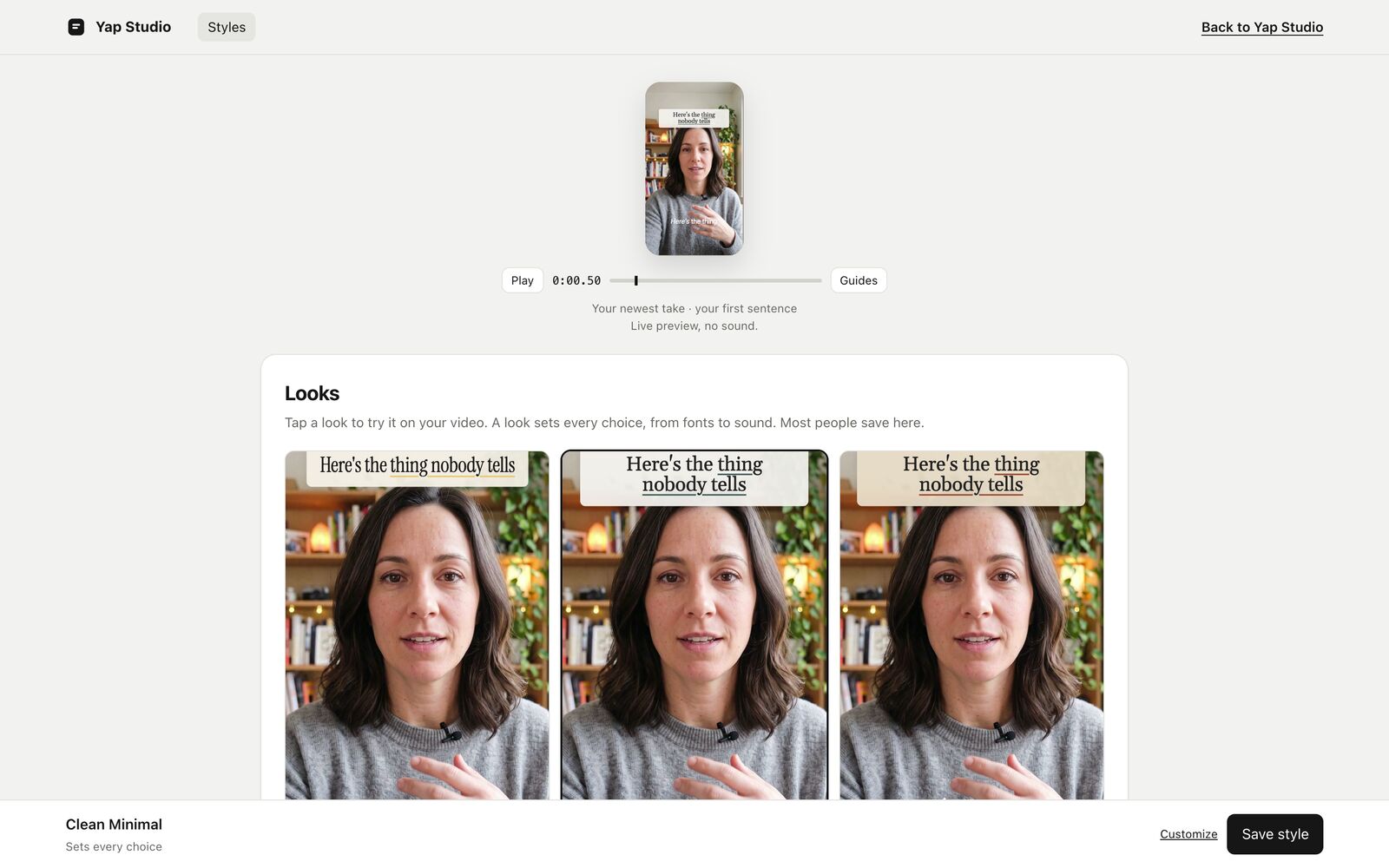 4. Your look. Tap a look on a still from your own take, or fine-tune it. |
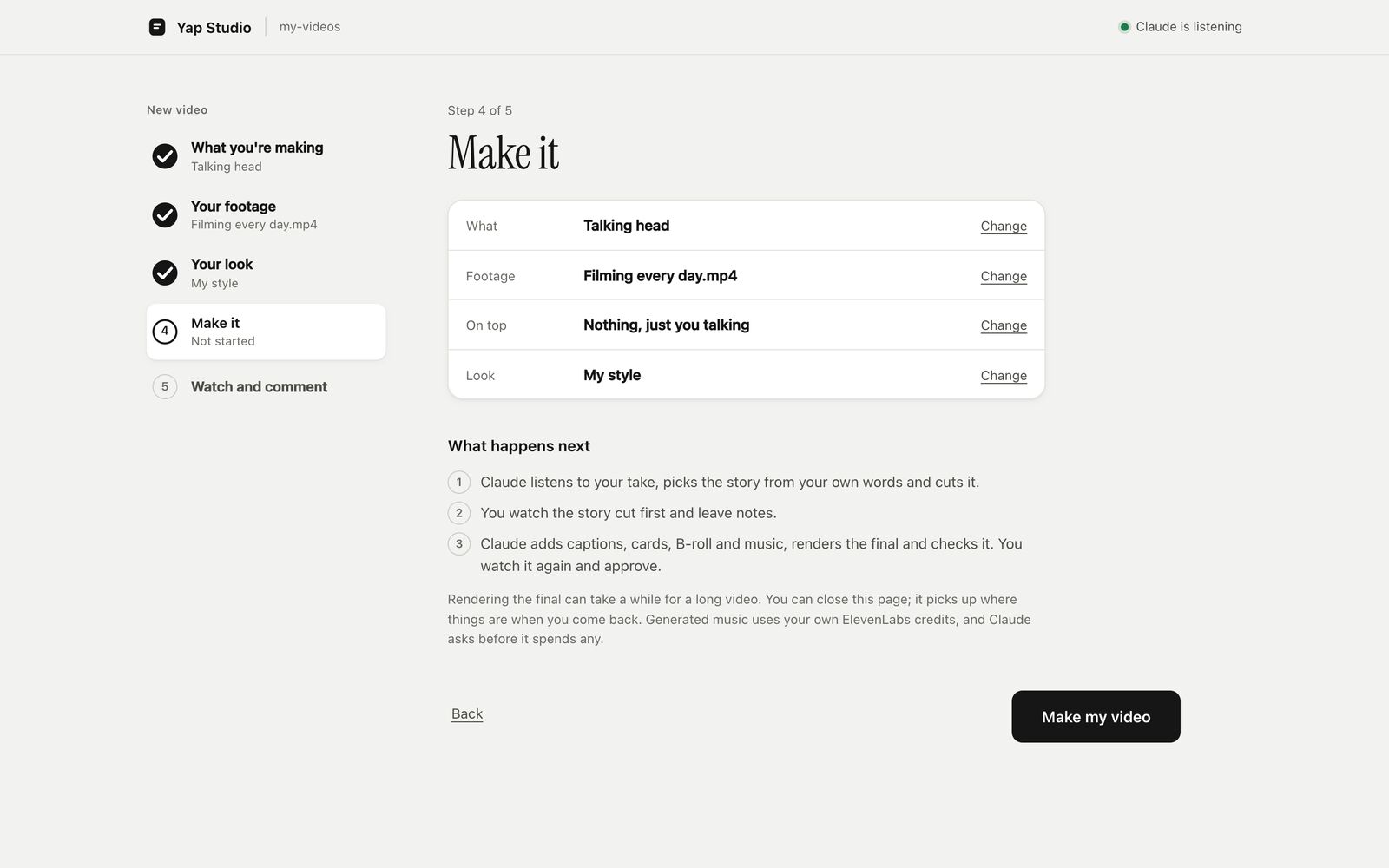 5. Make it. Press Make my video. In Codex and Cursor, tell the agent you pressed it. |
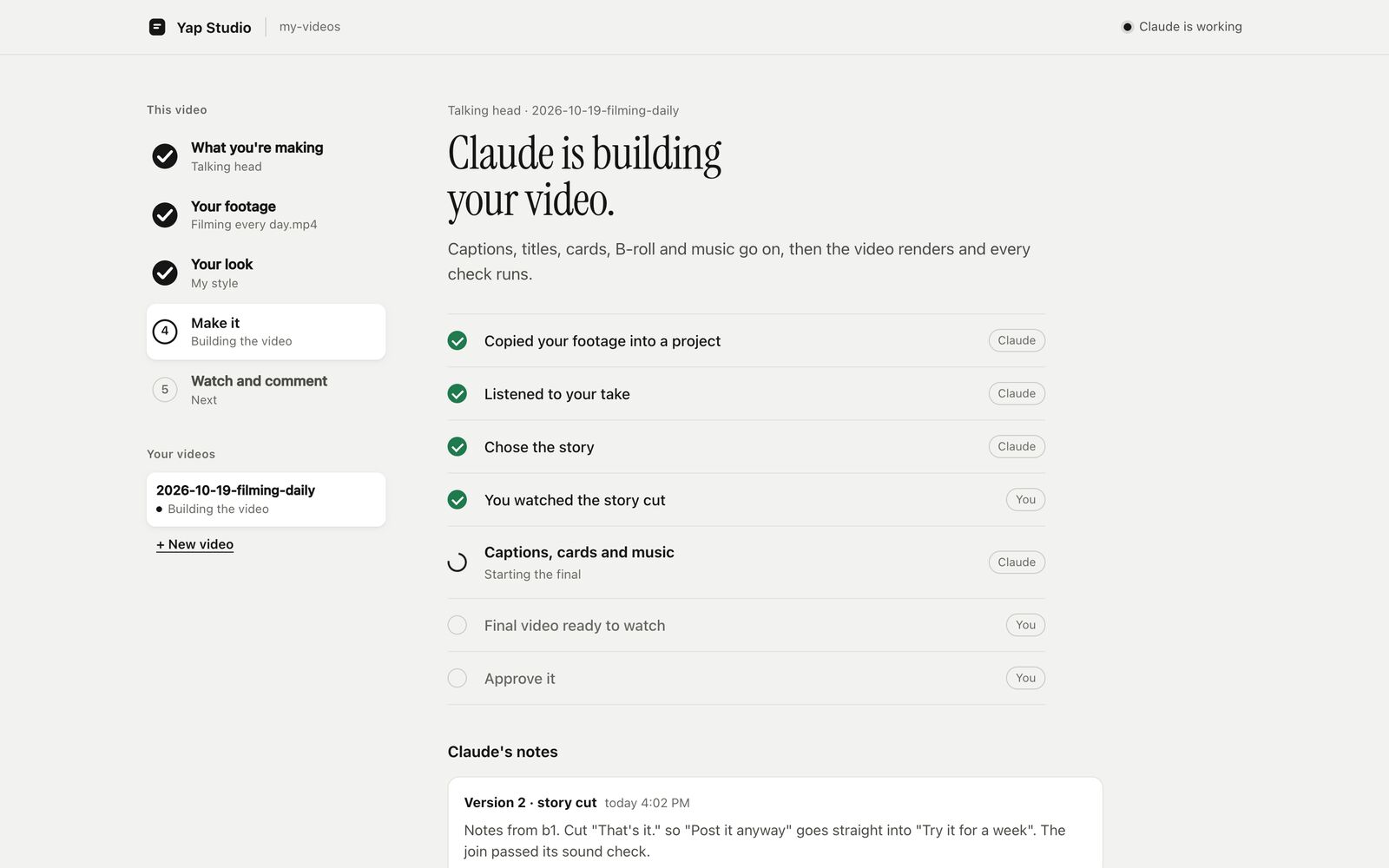 6. While your agent works. The page shows each step as it happens. Your agent's notes say what each version changed, and you can message your agent from the page. |
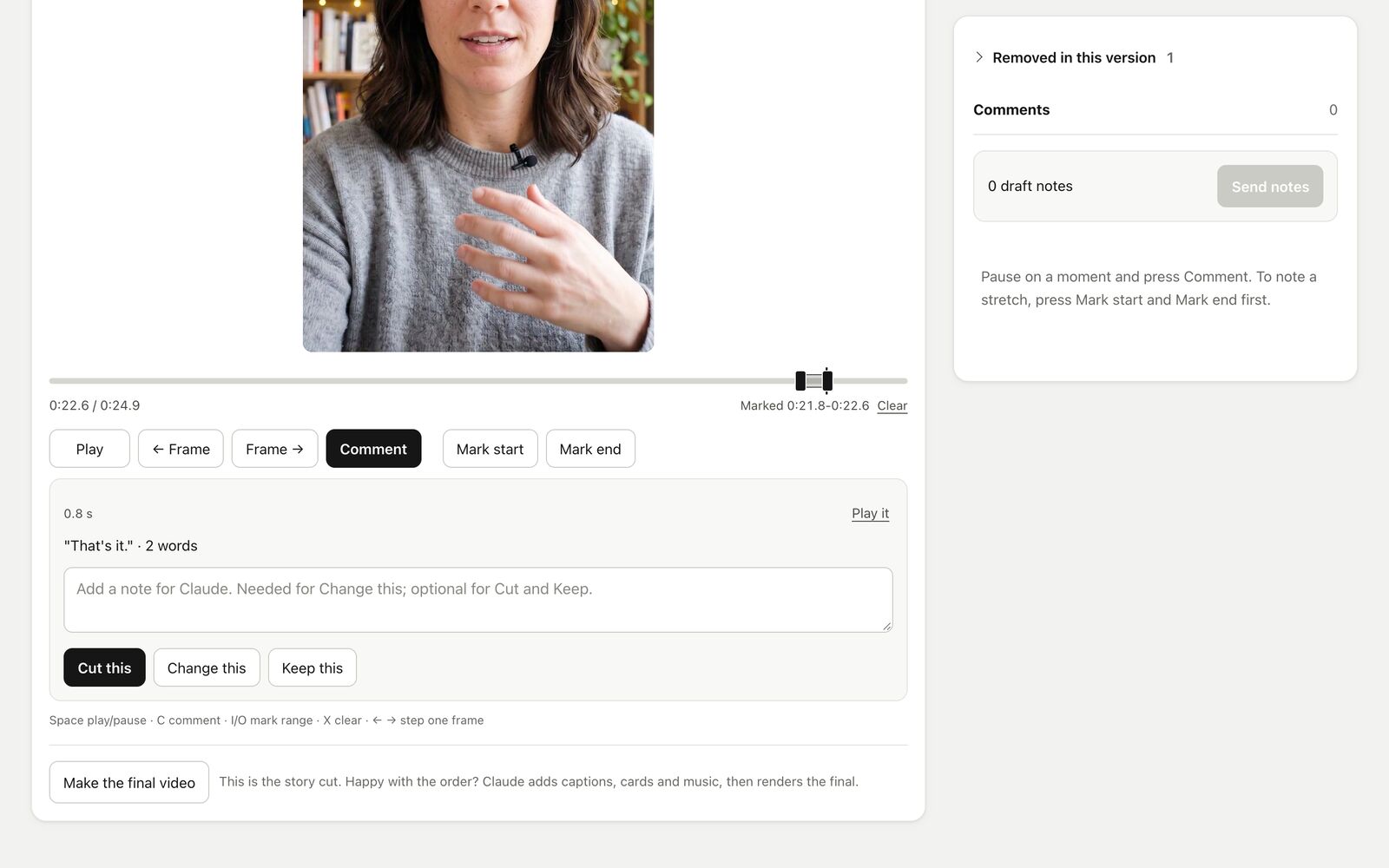 7. Watch and comment. Mark a stretch and say Cut this, Change this or Keep this, with a note. When the story is right, press Make the final video. |
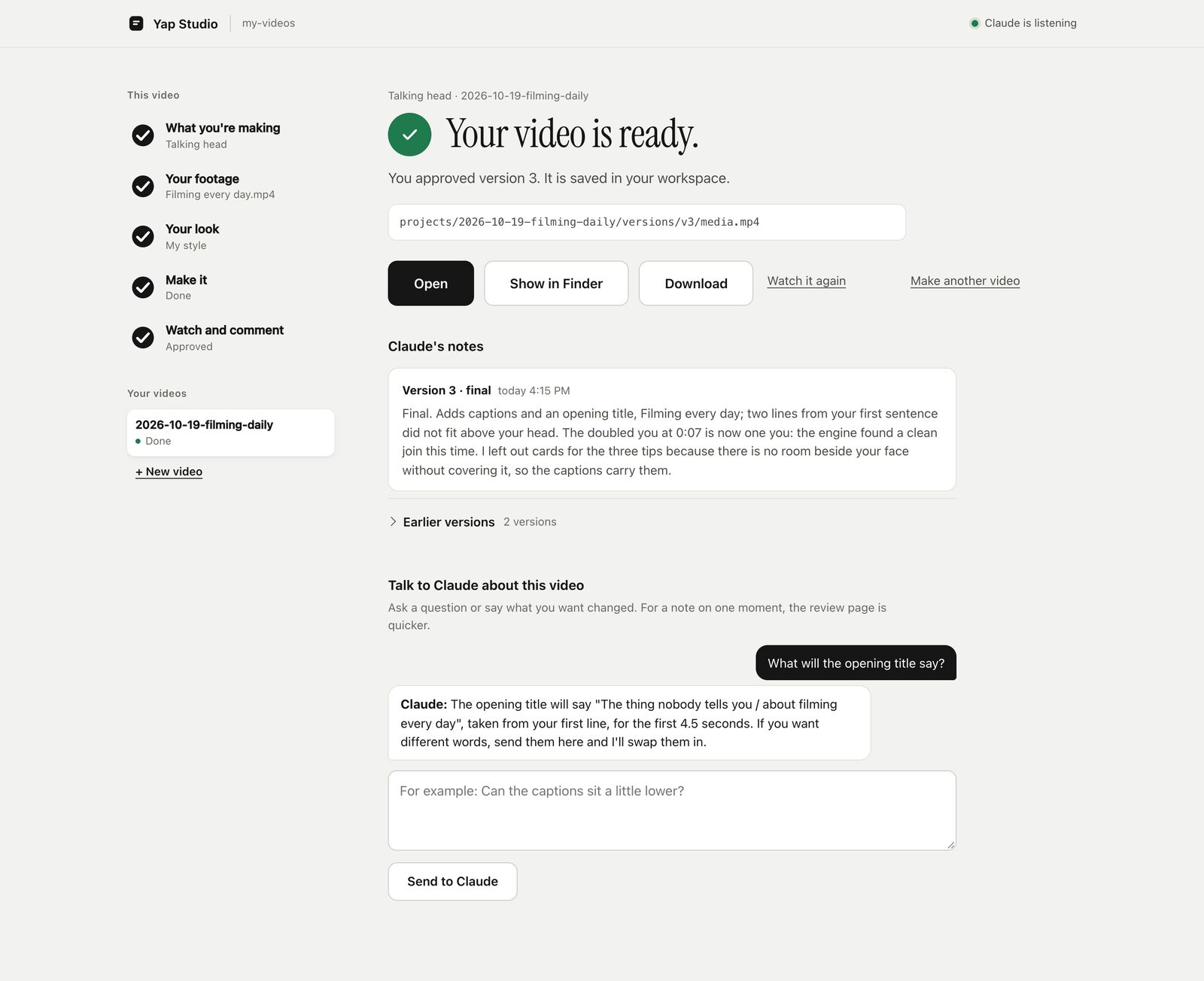 8. Done. Approve the final, then open it on your Mac, show it in Finder, or download it. |
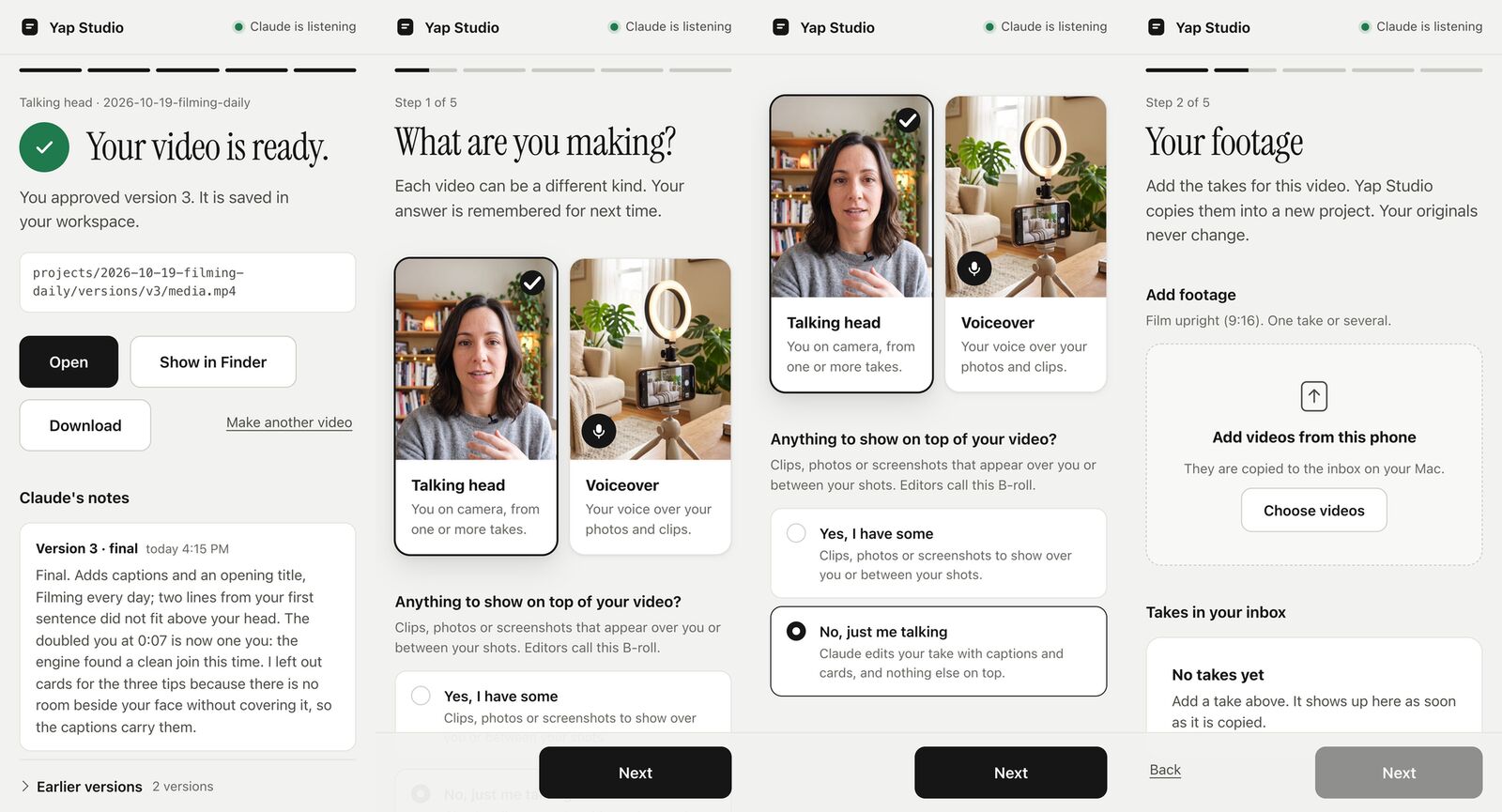
The same pages work on a phone over the same Wi-Fi or Tailscale. Anything paid, such as generated music, still goes through your agent in chat, and your agent asks first.
Made with Yap Studio
- How I use Tailscale: a talking-head video, edited end to end by the agent.
- A cold plunge build: the first voiceover test, made from footage that sat in a camera roll since 2023.
- The launch teaser.
Made something with it? Share it in Discussions.
What goes into the edit
- A story cut from your own words. Fillers, restarts and long pauses come out, and every join is checked for clicks and clipped words.
- Captions in your look: font, colours, highlight, one word at a time or whole phrases.
- Titles and more than two dozen kinds of cards (stats, quotes, checklists, steps, charts), each timed to the words it is about.
- Big words behind your head, cut around your outline, or a page, screenshot or clip behind you for a stretch (macOS).
- B-roll from your own photos and clips, cut in while you talk about them. Stock clips only if you turn them on, and only the ones you approve.
- Music from your own track, or composed with your ElevenLabs account (affiliate link) once you approve it.
- Sound effects on cuts, cards and counts, kept under your voice. They are made on your computer with no account, or come from your own ElevenLabs kit.
- Captions and cards that stay off your face. When faces were measured, a final that covers them fails its check. Otherwise, verify reports face clearance as "not measured".
- Phone review with comments pinned to a frame, a range or a spot on the picture, and versions side by side with earlier comments carried over.
Your notes become your taste
After each round, the agent suggests rules from your notes. You approve, edit or reject each one. Yap Studio enforces some of those rules itself. The agent follows the rest:
- Yap Studio applies and checks: how captions, titles, cards, B-roll and music look, and keeping text off your face. These apply to every later video unless you ask for something different on one video, and the final's checks measure the ones they can.
- The agent follows, unchecked: pacing, filler words and anything written as free text. The agent reads them when it plans the edit. Nothing changes the cut automatically, and nothing checks that it followed them.
It can also learn a style from videos you already posted. Styles and taste rules has the details.
It gets better from real use
When the agent struggles, it writes a one-line note about the tool: a step that failed, a doc that was wrong, a check that missed something. With your OK, those notes become issues on this repo, and that is how Yap Studio gets better.
Nothing private is shared. A note carries the agent's sentence, the step, the error code and the Yap Studio and macOS versions, never your footage, your words, names, file names or paths. You can read every note before it goes, or turn sharing off. Feedback has the details.
Checked before you see it
Every render is checked before anyone watches it. Verify looks at every join for clicks, gaps, broken words and wrong frames, and at picture and sound sync, frame and sample counts, loudness, black or frozen picture, and the published rules for YouTube, Shorts, TikTok and Reels.
Source comparisons for sync, joins and expected frame and sample counts need an edit list
(--edl); platform rules need --platform. Checks that listen for words at joins or compare
captions with heard speech need a speech engine.
It works without the editor too. Point it at any finished video:
yap-studio verify final.mp4
yap-studio verify final.mp4 --edl edits/cut.json --platform youtube
On its own, verify needs only ffmpeg 6.1 or newer. Findings, fixes, exit codes and the JSON report are in docs/verify.md.
How it works
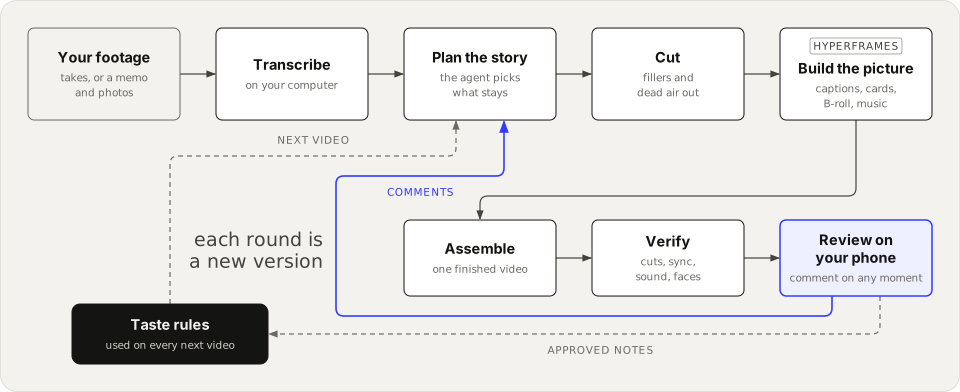
Your speech is transcribed on your computer, word by word. The agent reads the transcript and picks the story. It keeps your words and your meaning and makes nothing up. HyperFrames draws the captions, titles and cards, and Yap Studio assembles and verifies the video before it reaches your phone. Each round of comments makes a new version.
Four kinds of video
The home page asks for a talking head or a voiceover. For the other two, tell your agent in chat.
- Talking head, from one or more takes to camera. That is the quick start above.
- Voiceover, from a voice memo and your own photos and clips of a project or a day. This one is early and still being built. See docs/recipes/voiceover.md and the first test.
- Green screen, with you cut out over a page, screenshot, photo or clip that fills the frame (macOS). You can sit full size, along the bottom or in a corner. See the workspace guide.
- Screen recording, with your screen as the picture and your voice recorded with it or in a separate memo. You in a corner over the screen is not in this version yet.
For developers
Yap Studio is a Python engine with a command line, so any agent that runs shell commands, Codex included, can drive it. Every stage writes a receipt.
Install the released version from PyPI:
brew install uv ffmpeg node@22
uv tool install 'yap-studio[asr,mcp]'
yap-studio renderer install
yap-studio speech download
yap-studio doctor --edit
Upgrade a PyPI install with uv tool upgrade yap-studio.
Or install from a source checkout:
git clone https://github.com/cathrynlavery/yap-studio.git
cd yap-studio
brew install uv ffmpeg node@22
uv tool install '.[asr,mcp]'
yap-studio renderer install
yap-studio speech download
yap-studio doctor --edit
You need Python 3.11 or newer, uv, ffmpeg 6.1 or newer and
Node.js 22 or newer.
To build the workspace zip from a checkout, run uv run python scripts/build_workspace.py. It
writes dist/yap-studio-workspace-<version>.zip. docs/install.md has the full
requirements, the zip builder, and plugins for Claude Code, Codex and Claude Desktop. To run each
step yourself, see docs/editing.md.
Version 1 limits
- Vertical 9:16 at 1080 by 1920 stays the default. Horizontal talking-head videos at
1920 by 1080 support hard cuts, audio/music, captions, opening titles, chapter cards, name tags,
floating cards, full-frame or boxed B-roll and YouTube thumbnails; use platform
youtubeornone. Start withinit DIR --take FILE --shape horizontal. Split B-roll, video letters, transitions, zooms, person effects, grades, applied taste preferences, 3D captions and studio export are refused. - The filler and restart rules are English only. For other languages,
fillersproposes pauses only. - Person cutouts, face detection and backgrounds behind you need macOS with the Xcode command line tools.
The full list, including card and layout limits and what Yap Studio never judges, is in docs/limits.md.
Docs
- Install: requirements, PyPI and source installs, the workspace zip, plugins, updates.
- Yap Studio home: the guided page, and how its buttons reach the agent.
- Edit from the command line: the steps the agent runs, by hand.
- Commands: every command, the project commands and timeline lanes.
- Captions, titles and cards
- Music, sound effects and loudness
- Styles and taste rules
- The style page: each screen, saving, and learning a style from videos you already posted.
- Review: the review page, phone links, keys and exported feedback.
- Feedback: local product notes, consent and sharing.
- Verify: what it checks, findings, the JSON report and exit codes.
- Edit lists: the formats verify reads.
- Limits
- How it works: the engine, receipts and a map of the code.
- Changelog
Contributing
Pull requests are welcome. CONTRIBUTING.md lists the local checks to run first. Report security issues privately through SECURITY.md, and follow the code of conduct.
License
Copyright 2026 Cathryn Lavery.
Yap Studio is licensed under the Apache License 2.0; see LICENSE. Bundled third-party code and fonts keep their own licenses, listed in NOTICE and LICENSES/.
1 maintainer

Metadata
1 maintainer
Release files for yap-studio 1.3.0
For a detailed explanation of source distributions (sdists) and built distributions (wheels), please see the package formats documentation.
Source distribution (sdist)
| File | Size | Uploaded | Provenance | Actions |
|---|---|---|---|---|
| yap_studio-1.3.0.tar.gz | 12.2 MB | With provenance | Details for yap_studio-1.3.0.tar.gz |
Built distribution (wheel)
| File | Interpreter | ABI | Platform | Actions Reset |
|---|---|---|---|---|
| yap_studio-1.3.0-py3-none-any.whl | Python 3 | none | any | Details for yap_studio-1.3.0-py3-none-any.whl |
Total release size: 15.6 MB
Release files / yap_studio-1.3.0.tar.gz
| Download URL | yap_studio-1.3.0.tar.gz |
|---|---|
| Size | 12.2 MB |
| Tags | Source |
|
SHA-256 checksum How to use checksums |
f5c23f5eb02c3c69b1d2231f15bf26d2944b0cfcbcc7631c9e9d440715913413
|
|
BLAKE2b-256 checksum How to use checksums |
c3876cda824b2a2553527687e9cd925dac041e25cd4375c67ddbfda3af0fcd1e
|
| Upload date | |
|
Uploaded using Trusted Publishing? What is trusted publishing? |
Yes |
| Uploaded via |
twine/7.0.0 CPython/3.13.16
|
Provenance
Provenance describes where a file came from. On PyPI, provenance is shared via attestations, which provide a verifiable record of the build or publishing details. View details, limitations and caveats.


PyPI Publish Attestation
PyPI verified that this artifact, at this checksum, originated from the publisher listed below.
Signed by GitHub Actions, verified by PyPI on Nov 4, 2026.
Transparency logRelease files / yap_studio-1.3.0-py3-none-any.whl
| Download URL | yap_studio-1.3.0-py3-none-any.whl |
|---|---|
| Size | 3.5 MB |
| Tags | Python 3 |
|
SHA-256 checksum How to use checksums |
531649732745055d0c1e00420f0cb2dc819b8b2c8bc1e2655ebb9523ee0bf4a8
|
|
BLAKE2b-256 checksum How to use checksums |
2dc85fb41ceab52126758a6e5ad2146641cbfd4de22a9dd5325acc7dbd62610e
|
| Upload date | |
|
Uploaded using Trusted Publishing? What is trusted publishing? |
Yes |
| Uploaded via |
twine/7.0.0 CPython/3.13.16
|
Provenance
Provenance describes where a file came from. On PyPI, provenance is shared via attestations, which provide a verifiable record of the build or publishing details. View details, limitations and caveats.
PyPI Publish Attestation
PyPI verified that this artifact, at this checksum, originated from the publisher listed below.
Signed by GitHub Actions, verified by PyPI on Nov 4, 2026.
Transparency logSecurity for yap-studio 1.3.0
Provenance
Provenance describes where a file came from. On PyPI, provenance is shared via attestations, which provide a verifiable record of the build or publishing details. View details, limitations and caveats.
Full provenance
Both files in this release have been uploaded with provenance metadata.
Attestation for yap_studio-1.3.0.tar.gz
PyPI Publish Attestation
PyPI verified that this artifact, at this checksum, originated from the publisher listed below.
Signed by GitHub Actions, verified by PyPI on Nov 4, 2026.
Transparency logA note on package security
PyPI is a repository for distributing packages, not a service for auditing them. While third-party security researchers and our staff do their best to detect and remove malicious packages, PyPI cannot guarantee the quality, security or suitability of any given package.
To learn more about protecting yourself from malicious actors, visit our package security documentation.














