



zanii-agents
zanii-agents is a Python runtime for AI agents that a company can hire for a defined job and hold to account afterwards. Each tool call, human approval and run outcome is recorded as a signed, hash-chained receipt. With the optional Zanii packages, those receipts go to a public transparency log, the agent carries a signed CV built from the log, and payment is released per task only when the receipt is proven.
The package has no dependencies. It runs offline with a built-in mock model, and it connects to any OpenAI-compatible endpoint for real work.
Installation
pip install zanii-agents                 # runtime only, standard library
pip install "zanii-agents[zanii]"        # ledger, identity, escrow, industry profiles
pip install "zanii-agents[memory]"       # long-term memory with a firewall (ZaniiDB)
Python 3.10 or newer. The import name is agents_standard.
Quickstart
from agents_standard import Agent, ModelGateway, MockProvider, Router, Tool, ToolRegistry

def track_order(order_id: str) -> dict:
    return {"order_id": order_id, "status": "delivered"}

registry = ToolRegistry()
registry.register(Tool("track_order", track_order, "Look up an order",
                       {"type": "object", "properties": {"order_id": {"type": "string"}}},
                       permissions=frozenset({"read:orders"})))

agent = Agent("tracker", "You track orders and report their status.",
              ModelGateway([MockProvider()]), registry, {"read:orders"}, keywords=["track"])

result = Router([agent]).run("track order ORD-100")
print(result.ok, result.output, result.receipt)
To use a real model, replace MockProvider() with OpenAICompatProvider("model-name", base_url="https://.../v1"). The gateway accepts a list of providers and falls back in order.
What the runtime does
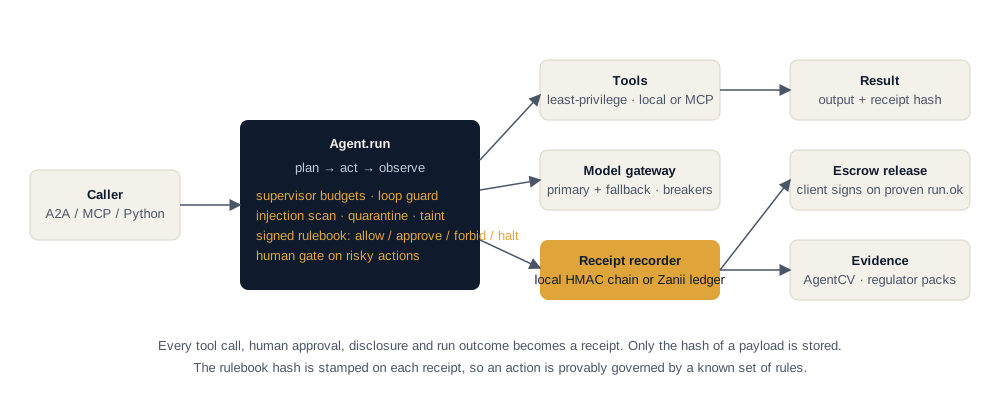
| Concern | Mechanism |
|---|---|
| Least privilege | A tool declares the permissions it needs; an agent only sees tools whose permissions it holds. |
| Bounded runs | Step, cost and latency budgets per run; identical repeated calls end the run. |
| Prompt injection | Untrusted text is scanned, quarantined and, when flagged, summarised by a separate model before the planner sees it. Values that first appeared inside an injection cannot be used as write arguments. |
| Hallucination | Sampled self-agreement and a fact check against tool data; low agreement routes to a human instead of shipping an answer. |
| Human oversight | A confidence floor and a signed rulebook decide which actions need approval. Every decision is receipted. |
| Proof of action | Every tool call, approval, disclosure and run outcome is a receipt in a hash chain. Locally: HMAC over a JSONL file. With Zanii: Ed25519 did:key signatures on a public Merkle log. |
| Kill switch | The owner revokes the delegation; the next run ends with halted and executes nothing. Peers over A2A receive a distinct error. |
| Memory | Bounded episodic and procedural memory in a JSON file, or ZaniiDB per client with a memory firewall. |
| Interop | MCP tool-server client with size caps; A2A agent card and JSON-RPC server with bearer auth, rate limiting and health endpoints. |
Measured behaviour
The numbers below come from the benchmark scripts in bench/ and can be reproduced against any OpenAI-compatible model. They are for glm-4.7-flash on the AgentDojo suites, important_instructions attack, defenses off and on.
| Suite | Attacked runs | Attack success, off | Attack success, on |
|---|---|---|---|
| slack | 105 | 52% | 5% |
| banking | 144 | 22% | under 1% |
| workspace | 560 | 3% | 0% |
| travel | 140 | 24% | 1% |
Utility under attack costs between zero and five points on three suites. On workspace an early version of the taint rule blocked legitimate writes; the corrected rule recovered utility from 44% to 76% on a 168-case sample with attacks still at zero. Both result files are kept.
A load test of the A2A server sustains 100 requests per second at a p99 of 28 ms on the mock model. With a live model the ceiling is model latency, roughly one task every ten seconds per process. Details, caveats and the resilience probes are in docs/readiness-report.md in the source distribution.
Hiring an agent for a defined job
With the zanii extra, a job is a signed set of artifacts rather than a prompt.
from agents_standard.core.job import Job, Offer
from agents_standard.profiles import PROFILES

job = PROFILES["logistics"].job(
    "cold-chain-monitoring",
    scopes=["tool.read_temperature_log", "tool.flag_violation", "run.*"],
    require_approval=["tool.flag_violation"],
    rate="2.00", currency="AED",
)
offer = Offer.from_files(job, "agent-identity.sealed.json", "owner-identity.sealed.json")

engagement = offer.hire(client)                  # screening, then co-signed terms
escrow = engagement.escrow_for_task(task)        # released only on a proven run.ok
agent = Agent(..., recorder=offer, policy=offer.policy)
result = agent.run(task)
engagement.settle(escrow, result.receipt)        # Merkle proof checked, client signs
| Job field | Backed by | Enforced |
|---|---|---|
scopes |
owner-signed delegation certificate | the ledger rejects receipts outside the scope |
forbid, require_approval, wall |
signed rulebook, hash stamped on every receipt | before each tool call, and audited afterwards |
deny_list |
counterparty screening | before any terms are signed |
rate, commitments |
co-signed SLA and per-task escrow, integer minor units | compliance computed from the receipt chain |
Seven industry profiles ship with the regulator's rule as code: public sector, healthcare, finance, tax, real estate, logistics and consumer operations. Each has a test that proves its load-bearing rule, for example that a public-sector decision cannot be issued without a rulebook hash, or that a clinical recommendation requires a named clinician's signature.
Evidence for insurers and regulators
agents_standard.packs builds evidence packs from receipts: an underwriter questionnaire, DIFC Regulation 10, UAE PDPL Article 18, CBUAE guidance and the EU AI Act. Controls the runtime cannot evidence are marked as missing rather than omitted.
Specifications and conformance
Two documents define the interoperable parts: spec/agentcv-v1.md (AgentCV v1) and spec/engagement-v1.md (Engagement v1), both in the source distribution and at https://agents.zanii.agency. Conformance vectors are generated from the Python reference, and an independent TypeScript implementation in conformance/ts passes 103 of 103 checks against them.
Repository layout
agents_standard/     runtime, profiles, packs, control, identity, payments, a2a, mcp
agents_standard/     service (multi-tenant A2A), tenancy, db + migrations, idp (Zanii ID),
                     console_api + console/ (client web console), payout, and the extensions:
                     market, orgs, taskops, webhooks, finance, assurance, dataroom, lifecycle,
                     teams, i18n, durable, access, secrets, egress, atrest, admin, plans,
                     auditchain, safety, models, backup, notify, openapi, client, tenantops,
                     connect (Zanii Connect) (docs/EXTENSIONS-CONTRACT.md)
bench/               benchmarks and their results
spec/                AgentCV v1, Engagement v1, conformance vectors
conformance/ts/      TypeScript conformance runner
deploy/              container image, compose file, host overlay, backup and restore scripts
docs/                API reference, runbooks, deployment guide, readiness report
examples/            live runs against the Zanii ledger
pilot/               client-side signer and pilot runbook
Development
pip download zanii-agents --no-binary :all: --no-deps   # or work from the source distribution
tar xzf zanii_agents-*.tar.gz && cd zanii_agents-*
pip install -e ".[zanii,memory,postgres,idp]"
for t in standard profiles money future ops hardening idp_payout db service console market taskops finance lifecycle teams durable access operator safety ops_platform connect scale_receipts scale_sql assembly; do python test_$t.py; done
Tests that need an optional extra skip when it is absent. The CI workflow runs the same suites, the TypeScript conformance runner, ruff, bandit, pip-audit and a secrets scan.
Hosted service
deploy/serve.py runs the hosted shape behind agents.zanii.agency: one multi-tenant A2A listener (service.AgentService) with the client console mounted on it. A client signs in with Zanii ID, picks a job from the catalogue, signs the SLA and each task's escrow in the browser with a key that never leaves it, sends tasks over JSON-RPC with an API token, verifies each release request against the ledger's Merkle proof before signing it, and is paid out over a bank reference or x402 rail. Tasks, engagements, escrows, releases, API tokens and an append-only audit trail live in Postgres (sqlite for development) through agents_standard.db. docs/BACKEND-PLAN.md has the design, docs/API.md the routes, deploy/host/README.md the rollout.
What a client gets beyond running tasks, each one a console route and a ledger receipt where money or accountability is involved:
| area | functions |
|---|---|
| Finding and starting | agent marketplace with verified external listings, free trials with real receipts, KYB/KYA onboarding, organisation members with roles, standing instructions co-signed into the SLA |
| Running work | approval queue for human sign-off, cancel and deadlines, recurring schedules, batches with CSV export, live progress, signed webhooks |
| Money and assurance | budgets with auto-pause, monthly statements and VAT invoices, refunds on failed tasks, disputes that hold the escrow, SLA monitoring with automatic service credits, insurance certificates and claims, ratings and client-signed references that feed the CV |
| Data and lifecycle | per-engagement data room with a read-only file tool, retention and residency with attestations, offboarding export and erasure with a key-destruction receipt, agent versioning with re-acceptance, an incident register, a public status page with capacity reservation |
| Teams and language | multi-agent teams under one SLA with a verifiable delegation chain, Arabic and English console, statements and evidence packs |
And underneath, the platform the operator runs it on:
| area | functions |
|---|---|
| Durability | engagements reloaded on boot, a durable task queue with retries and dead-letter, idempotency keys, persisted outputs with hashes, a ledger outbox so no receipt is lost, Postgres pooling with advisory locks and leader election |
| Access and security | scoped API keys with expiry, rotation and IP allowlists, step-up authentication for money and kill-switch actions, secrets from files or a sealed config with key rotation, per-engagement egress policy and tool limits, encryption at rest with per-client keys |
| Operator platform | admin API with review queues, plans and quotas, usage metering with margin, a hash-chained audit trail anchored to the ledger, maintenance mode with dependency-checked readiness and rolling-deploy drain |
| Safety and governance | sentinel drift watcher with auto-halt, output walls with eval receipts, content credentials for outputs, model routing per engagement with build hashes in the record |
| Integration and operations | verified backups with a restore drill, an event store with webhook replay and email, an OpenAPI spec with a Python client, per-client metrics with SLO burn-rate alerts, whole-tenant export and import |
| Client's own apps | Zanii Connect: the client binds a scoped vault key per engagement, its connected Gmail, Calendar, Sheets, Slack, GitHub and 400+ other apps become the agent's tools, writes wait for the client's confirmation at the vault, and every executed action's vault receipt is cited in the agent's own receipt |
Status
Version 0.14.0. The runtime, the hosted service, the 26 client-facing functions, the 24 platform functions and the Zanii Connect integration are complete and measured at scale (bench/scale.py: 200 000 tasks, 300 000 receipts, 2 000 clients — every hot endpoint in single-digit to low-hundreds milliseconds, boot in seconds, a flat heap) and verified against the public ledger and the live vault with test identities and a test organisation. The production readiness gate in docs/readiness-report.md records 37 requirements passing and 10 open; the open items need the deployed host, its Postgres, a pentest, or a run of the restore drill on that host rather than code changes.
License
MIT. See the LICENSE file. Contact: info@zanii.agency. Product site: https://agents.zanii.agency.
1 maintainer

Metadata
1 maintainer
Release files for zanii-agents 0.16.1
For a detailed explanation of source distributions (sdists) and built distributions (wheels), please see the package formats documentation.
Source distribution (sdist)
| File | Size | Uploaded | Provenance | Actions |
|---|---|---|---|---|
| zanii_agents-0.16.1.tar.gz | 553.2 kB | Without provenance | Details for zanii_agents-0.16.1.tar.gz |
Built distribution (wheel)
| File | Interpreter | ABI | Platform | Actions Reset |
|---|---|---|---|---|
| zanii_agents-0.16.1-py3-none-any.whl | Python 3 | none | any | Details for zanii_agents-0.16.1-py3-none-any.whl |
Total release size: 1.1 MB
Release files / zanii_agents-0.16.1.tar.gz
| Download URL | zanii_agents-0.16.1.tar.gz |
|---|---|
| Size | 553.2 kB |
| Tags | Source |
|
SHA-256 checksum How to use checksums |
870008d481ddf750ea7ce3cb1de80270e145a0ede21fa02a4dec2c6cde73d170
|
|
BLAKE2b-256 checksum How to use checksums |
5a713423fc68bc2ba08ce9de60e72173cec8ab65257ed863a6db06451bc1c1a0
|
| Upload date | |
|
Uploaded using Trusted Publishing? What is trusted publishing? |
No |
| Uploaded via |
twine/7.0.0 CPython/3.12.10
|
Release files / zanii_agents-0.16.1-py3-none-any.whl
| Download URL | zanii_agents-0.16.1-py3-none-any.whl |
|---|---|
| Size | 528.3 kB |
| Tags | Python 3 |
|
SHA-256 checksum How to use checksums |
04d56483083288f36b90e382673fec528a354320464ac0fc6c594963f475c448
|
|
BLAKE2b-256 checksum How to use checksums |
bdbe7ddcbe942f294fbe48a411f856507cc436a3ef74480e8dcfe7b3e1ed5667
|
| Upload date | |
|
Uploaded using Trusted Publishing? What is trusted publishing? |
No |
| Uploaded via |
twine/7.0.0 CPython/3.12.10
|
Security for zanii-agents 0.16.1
Provenance
Provenance describes where a file came from. On PyPI, provenance is shared via attestations, which provide a verifiable record of the build or publishing details. View details, limitations and caveats.
No provenance found
None of the files in this release were uploaded with provenance metadata.
A note on package security
PyPI is a repository for distributing packages, not a service for auditing them. While third-party security researchers and our staff do their best to detect and remove malicious packages, PyPI cannot guarantee the quality, security or suitability of any given package.
To learn more about protecting yourself from malicious actors, visit our package security documentation.














