
ZeroDOM



Point it at an app as two users. It finds the broken access control.
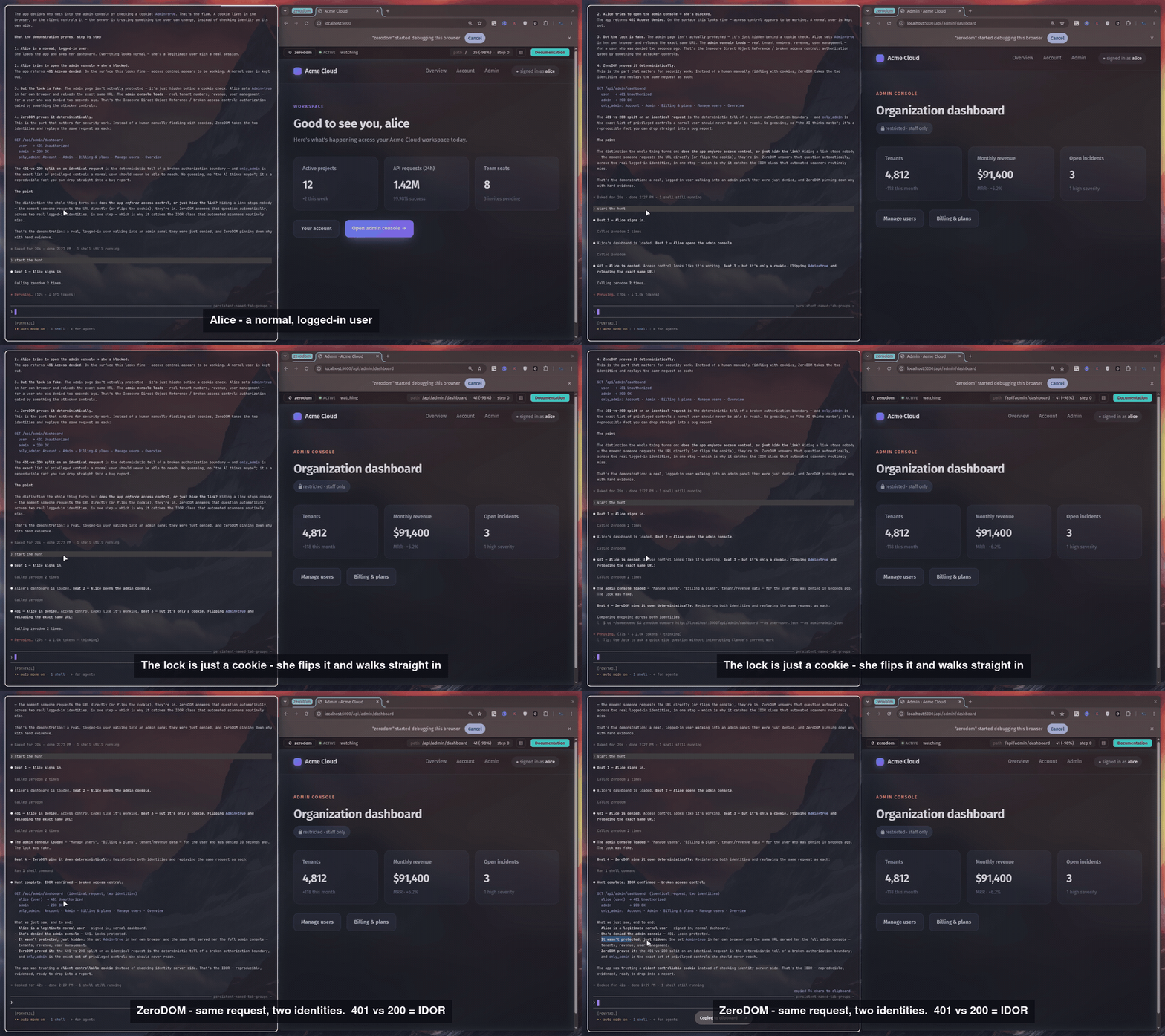
ZeroDOM drives your real, logged-in browser as two identities, replays the same requests as each, and flags where one user reaches what another can't — IDOR / broken access control, caught deterministically. Open-core, runs local, no account, no API key, nothing leaves your machine.
Under the hunt is a deterministic, token-lean perception engine for AI agents — the same core powers
scan,crawland any browser-driving task. IDOR is just where it bites hardest.
Quickstart
See it run in 10 seconds — no account, no browser download (bare zerodom <url> is a static fetch):
pip install zerodom
zerodom https://news.ycombinator.com     # the interaction graph + a token report
Find an IDOR. Save two logged-in sessions as Playwright storage_state files (one per
account), then diff a protected endpoint across both:
zerodom compare https://app.example.com/api/admin/dashboard \
  --as user=user.json --as admin=admin.json
{
  "identities": { "user": { "status": 401 }, "admin": { "status": 200 } },
  "only_admin": ["Manage users", "Billing & plans", "Overview"],
  "note": "admin authorized (200) where user denied (401) — broken access control if the only difference is client-controllable"
}
Same request, two identities, a 401-vs-200 split → a lead to confirm. No LLM guessing: ZeroDOM surfaces the tell with the exact replay that proves it. You confirm the bug.
How it hunts
zerodom compare— one endpoint across identities: a 401-vs-200 split, or a byte-identical cross-tenant response, is the IDOR tell.zerodom sweep URL --as user=… --as admin=…— the whole app in one command: crawls as one identity to map the GET surface, replays every in-scope URL across all identities, reports only the deterministic tells (--format mdfor a report table).zerodom crawl/scan/audit— recon: routes/forms/API plus the callable API surface (method + body) and DOM-XSS sinks read from the page's JS, response-header posture (CSP/CORS/cookie) and acsrf-posturecorrelation, and resolving the selectors in an existing test suite.zerodom repeat/probe/race— act & verify: a Repeater (--saveHAR/.http evidence), a tampered-body diff for mass assignment (probe --tamper), and a concurrent burst to flag a check-then-act race (race; HTTP/2 multiplexing via thezerodom[race]extra).
It drives your real Chrome (relay mode) over chrome.debugger — cookies, MFA, SSO already
done — or a throwaway browser (--stealth). Read-only by default; scope is enforceable and
lockable. Route through Burp/Caido with --proxy. Only test targets you're authorized to.
From an AI agent (MCP)
ZeroDOM is a native MCP server. Claude, Cursor, LangGraph, CrewAI, the OpenAI Agents SDK, Pydantic AI and more load the full 39-tool set from one config:
{ "mcpServers": { "zerodom": { "command": "uvx", "args": ["--from", "zerodom", "zerodom-mcp"] } } }
Run zerodom setup for a guided first-run. Runnable per-framework examples:
examples/integrations/.
Why the agent sees so few tokens
A live page becomes a flat list where every entry has an id that resolves to exactly one element, and the CSS selector never enters the model's context:
[01] a 'Show HN: ZeroDOM — agents only need to know what they can click'
[02] a 'dev'
[03] a '214 comments'
Deterministic (lxml in, graph out, no LLM). Measured and re-runnable: ~71% fewer tokens than
Playwright MCP's aria_snapshot(mode="ai") (mean; ~53–96% per site), 99.00% of 10,756 audited
selectors across 111 live sites resolve to exactly one element, parse median 55ms.
Open core
Everything in the package — parser, CLI, relay, stealth, scan/crawl/compare/audit, the clearance ladder, the MCP server — is the free, Apache-2.0 Core, complete on its own: one operator, local, no account, no key. Enterprise is an additive team layer (fleet dashboard, compliance export packs, SSO/RBAC, SLA) that never gates, phones home from, or adds telemetry to the Core. Details: contact@vexralabs.com.
GitHub · Docs · Site · Discord — Apache-2.0, a Vexra Labs project.
1 maintainer

Metadata
1 maintainer
Release files for zerodom 0.1.5
For a detailed explanation of source distributions (sdists) and built distributions (wheels), please see the package formats documentation.
Source distribution (sdist)
| File | Size | Uploaded | Provenance | Actions |
|---|---|---|---|---|
| zerodom-0.1.5.tar.gz | 640.2 kB | With provenance | Details for zerodom-0.1.5.tar.gz |
Built distribution (wheel)
| File | Interpreter | ABI | Platform | Actions Reset |
|---|---|---|---|---|
| zerodom-0.1.5-py3-none-any.whl | Python 3 | none | any | Details for zerodom-0.1.5-py3-none-any.whl |
Total release size: 871.3 kB
Release files / zerodom-0.1.5.tar.gz
| Download URL | zerodom-0.1.5.tar.gz |
|---|---|
| Size | 640.2 kB |
| Tags | Source |
|
SHA-256 checksum How to use checksums |
e100627ecc04d0c5ee43f46f2ed87ef98488566cdfa3b9b4864d4fa41adc9a85
|
|
BLAKE2b-256 checksum How to use checksums |
75a8870acac99ad8bcda15609b419867a5bee53c6cc57484fbf643d3f508f1f0
|
| Upload date | |
|
Uploaded using Trusted Publishing? What is trusted publishing? |
Yes |
| Uploaded via |
twine/7.0.0 CPython/3.13.16
|
Provenance
Provenance describes where a file came from. On PyPI, provenance is shared via attestations, which provide a verifiable record of the build or publishing details. View details, limitations and caveats.


PyPI Publish Attestation
PyPI verified that this artifact, at this checksum, originated from the publisher listed below.
Signed by GitHub Actions, verified by PyPI on Nov 2, 2026.
Transparency logRelease files / zerodom-0.1.5-py3-none-any.whl
| Download URL | zerodom-0.1.5-py3-none-any.whl |
|---|---|
| Size | 231.2 kB |
| Tags | Python 3 |
|
SHA-256 checksum How to use checksums |
dd6f826eac2a17e962fdf52575940b60fc7beae0fbe64748e3b03ca922eca8a7
|
|
BLAKE2b-256 checksum How to use checksums |
de0e2b9f0afd7f426c06e84b4eb189abe96cce57090023d4630ab7c7e7684a10
|
| Upload date | |
|
Uploaded using Trusted Publishing? What is trusted publishing? |
Yes |
| Uploaded via |
twine/7.0.0 CPython/3.13.16
|
Provenance
Provenance describes where a file came from. On PyPI, provenance is shared via attestations, which provide a verifiable record of the build or publishing details. View details, limitations and caveats.
PyPI Publish Attestation
PyPI verified that this artifact, at this checksum, originated from the publisher listed below.
Signed by GitHub Actions, verified by PyPI on Nov 2, 2026.
Transparency logSecurity for zerodom 0.1.5
Provenance
Provenance describes where a file came from. On PyPI, provenance is shared via attestations, which provide a verifiable record of the build or publishing details. View details, limitations and caveats.
Full provenance
All 2 files in this release have been uploaded with provenance metadata.
Attestation for zerodom-0.1.5.tar.gz
PyPI Publish Attestation
PyPI verified that this artifact, at this checksum, originated from the publisher listed below.
Signed by GitHub Actions, verified by PyPI on Nov 2, 2026.
Transparency logA note on package security
PyPI is a repository for distributing packages, not a service for auditing them. While third-party security researchers and our staff do their best to detect and remove malicious packages, PyPI cannot guarantee the quality, security or suitability of any given package.
To learn more about protecting yourself from malicious actors, visit our package security documentation.














