
ziban
Correct CJK line breaking for everything that is not a browser.
Browsers got text-spacing-trim, line-break: strict and proper kinsoku years
ago. Everything else — Pillow, ReportLab, SVG, ffmpeg subtitles, python-pptx,
canvas — still reimplements it badly, because there is nothing to ask.
ziban is that thing: a pure-Python typesetting engine that turns a string and
a box into lines a Chinese typesetter would accept — and tells you, in machine
readable form, every time it had to compromise.
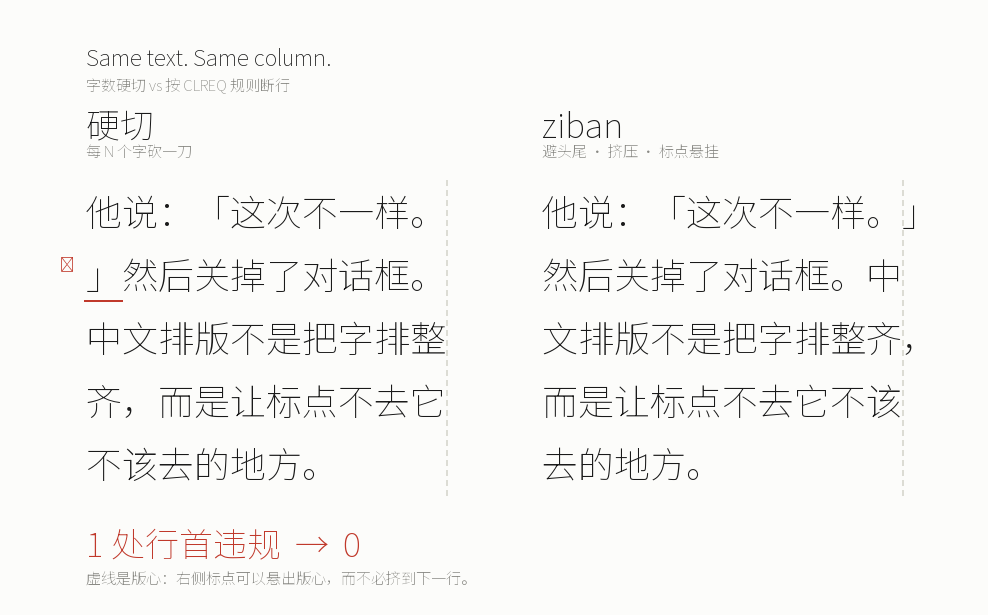
The problem, in eight seconds
Naive if len(s) > N: cut():
他说:「这次不一样。
」然后关掉了对话框。
ziban:
他说:「这次不一样。」
然后关掉了对话框。
The first version starts a line with 」. That is not a matter of taste:
《中文排版需求》(CLREQ) forbids closing
punctuation at line start (避头) and opening punctuation at line end (避尾).
Every renderer that is not a browser quietly breaks that rule — and the
punctuation it breaks is exactly the punctuation readers notice.
The image above is generated, not drawn by hand:
python examples/compare.py --font <path-to-a-CJK-font>. Re-run it after any
change to the rules and you will see immediately whether the typography got
better or worse.
Install


pip install ziban              # core, zero dependencies
pip install "ziban[pillow]"    # + measuring with real font files
Published at https://pypi.org/project/ziban/.
Python 3.9+. No browser, no native build, no ICU, no model.
Use it
As a CLI
$ echo "这是一个比较长的段落,用来看断行在真实文本上的表现。" \
    | ziban wrap - --width-em 8 --ruler
      +----------------+
  1   | 这是一个比较长的 |   8.0em
  2   | 段落,用来看断行 |   8.0em
  3   | 在真实文本上的表 |   8.0em
  4   | 现。             |   2.0em

4 line(s), box 8.0em, no diagnostics
> in the gutter means the line ends with a hanging mark, < means a
compressed one, ! means it overflowed. --json gives you the same thing
as structured data, for scripts and agents.
As a library
from ziban import Style, layout, EmMetrics

page = layout(
    "他说:「这次不一样。」然后关掉了对话框。",
    width=10 * 32,                     # 10 characters wide
    style=Style(size=32, leading=1.7),
    metrics=EmMetrics(32),             # or PillowMetrics("NotoSerifSC.otf", 32)
)

for line in page.lines:
    print(line.text, line.width)

page.diagnostics
# [Diagnostic(code='ORPHAN_LINE', line=1, ...)]
Every line carries its own explanation:
line.adjustments   # (Adjustment(kind='hang', index=10, delta=32.0),)
line.slack         # pixels left over
line.overflow      # pixels past the box, 0 if it fits
line.justify_spacing
Four card layouts, three themes
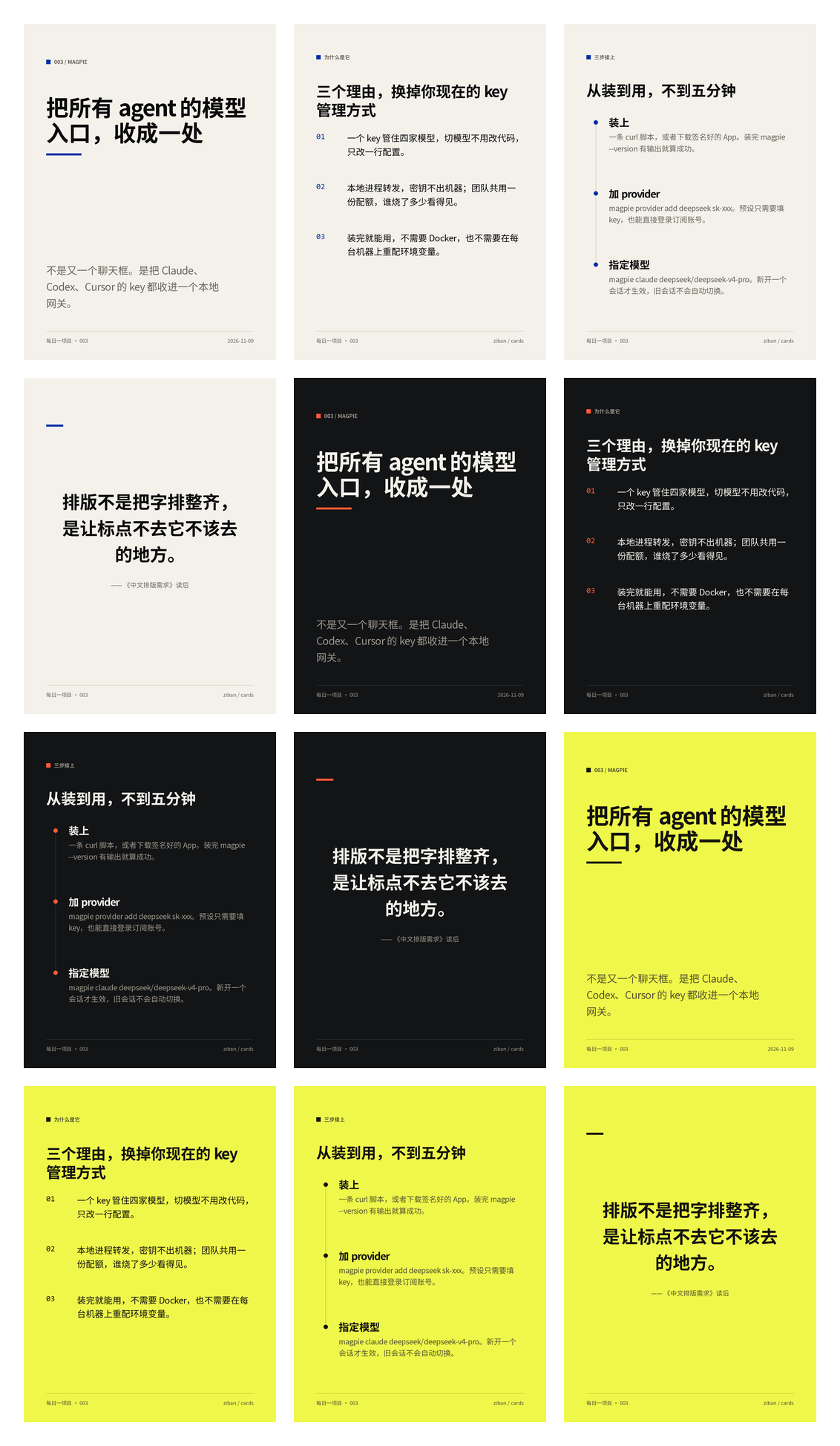
python examples/cards/build.py     # renders all 12 + the sheet above
ziban card examples/cards/specs/cover.json --theme ink --out cover.png
A spec is plain JSON — kind is one of cover / list / steps / note:
{
  "kind": "cover",
  "kicker": "003 / MAGPIE",
  "title": "把所有 agent 的模型入口,收成一处",
  "subtitle": "不是又一个聊天框。",
  "meta": "2026-11-09"
}
Themes: ikb (paper + Klein blue), ink (near-black + orange), citron
(acid yellow). If a block does not fit its slot the size steps down until it
does, and only then does it report TEXT_OVERFLOW — a card is never
silently clipped. Boundaries are checked, not eyeballed:
$ ziban card spec.json --theme ink
wrote spec.png (1080x1440, theme=ink, fonts=NotoSansSC-VF.ttf / …)
What it does
| 避头尾 (kinsoku) | closing marks never start a line, opening marks never end one |
| 标点挤压 (compression) | a full-width mark is drawn at half width when that is what makes the line fit |
| 行末悬挂 (hanging) | a mark may sit outside the margin rather than be pushed down — capped at one em and a quarter of the measure |
| 中西混排 | breaks between CJK and Latin, never inside a Latin word, numbers stay glued to their units |
| 硬断行 | \n is always honoured, blank lines survive |
| 诊断 | OVERFLOW, NO_BREAK_OPPORTUNITY, KINSOKU_FALLBACK, ORPHAN_LINE — with a suggested fix |
| 确定性 | same text + same font + same size → byte-identical output, on every platform |
What it does not do
- No AI. No API keys. No "generate my copy".
- No browser, no headless Chromium, no layout engine to install.
- No GUI editor.
- No auto-publishing to any platform.
- No bundled fonts. Microsoft YaHei and PingFang are not redistributable; bring your own, or use Noto Sans SC / Noto Serif SC (OFL).
Being explicit about the last one is not pedantry: a library that ships a proprietary font is a library companies cannot use.
Rules are data, not if-statements
The whole policy lives in src/ziban/data/clreq.toml:
[kinsoku]
head_forbidden = " ,、。.;:?!)〕〉》」』】”’}…"
tail_forbidden = "(〔〈《「『【“‘{"

[compress]
compressed_ratio = 0.5
chars = ",、。.;:?!)〕〉》」』】”’…"

[hang]
max_ratio = 1.0
max_share = 0.25
Change the file to change the behaviour. A Japanese ruleset is a second TOML, not a second engine. This is also why contributing is cheap: most typographic bugs are one line of data.
How it compares
| kinsoku | compression | hanging | works outside a browser | deterministic | |
|---|---|---|---|---|---|
| heti | via browser | partial | ✗ | ✗ | ✗ |
| pangu.py | ✗ | ✗ | ✗ | ✓ | ✓ |
| budoux | ✗ | ✗ | ✗ | ✓ | ✓ |
browser text-spacing-trim |
✓ | ✓ | partial | ✗ | ✓ |
| ziban | ✓ | ✓ | ✓ | ✓ | ✓ |
budoux decides where a break is semantically acceptable; ziban decides
whether the break is typographically legal. They compose.
Status
0.2.0 — published on PyPI. Breaker complete for horizontal text; a drawing
layer and four card templates on top of it. 994 tests green (144 corpus ×
width combinations — 24 paragraphs × 6 measures — checked against six
invariants, plus golden cases, rendering tests and a 100k-character stress test).
Next:
- 0.3 font probing beyond the bundled table, pair compression (「。」 in one em), a Knuth–Plass-style cost function so the last line stops being an orphan
- 0.4 adapters: ReportLab, SVG,
python-pptx; vertical text behind a flag
License
MIT. See LICENSE.
The ruleset follows CLREQ (W3C). Character classes follow a curated subset of UAX #14.
1 maintainer

Metadata
1 maintainer
Release files for ziban 0.2.0
For a detailed explanation of source distributions (sdists) and built distributions (wheels), please see the package formats documentation.
Source distribution (sdist)
| File | Size | Uploaded | Provenance | Actions |
|---|---|---|---|---|
| ziban-0.2.0.tar.gz | 109.0 kB | With provenance | Details for ziban-0.2.0.tar.gz |
Built distribution (wheel)
| File | Interpreter | ABI | Platform | Actions Reset |
|---|---|---|---|---|
| ziban-0.2.0-py3-none-any.whl | Python 3 | none | any | Details for ziban-0.2.0-py3-none-any.whl |
Total release size: 143.2 kB
Release files / ziban-0.2.0.tar.gz
| Download URL | ziban-0.2.0.tar.gz |
|---|---|
| Size | 109.0 kB |
| Tags | Source |
|
SHA-256 checksum How to use checksums |
f7179014be55895ddbdb0ff980bd2a21ad5136f241d771144ab239ce8343cb88
|
|
BLAKE2b-256 checksum How to use checksums |
62b0daddcf8011094bdd67391996fe3c06c7b6d05b321a0b1de948c5b7c87af8
|
| Upload date | |
|
Uploaded using Trusted Publishing? What is trusted publishing? |
Yes |
| Uploaded via |
twine/7.0.0 CPython/3.13.16
|
Provenance
Provenance describes where a file came from. On PyPI, provenance is shared via attestations, which provide a verifiable record of the build or publishing details. View details, limitations and caveats.


PyPI Publish Attestation
PyPI verified that this artifact, at this checksum, originated from the publisher listed below.
Signed by GitHub Actions, verified by PyPI on Nov 8, 2026.
Transparency logRelease files / ziban-0.2.0-py3-none-any.whl
| Download URL | ziban-0.2.0-py3-none-any.whl |
|---|---|
| Size | 34.3 kB |
| Tags | Python 3 |
|
SHA-256 checksum How to use checksums |
4cd85692f2fd9d71c6d9bef86be4c6d306ca06a4e3890cfb8bc471ec95fbfb65
|
|
BLAKE2b-256 checksum How to use checksums |
82c726280272f10bbcc08ee15ff09263afffcf885cbf5e971c4beaca41246b99
|
| Upload date | |
|
Uploaded using Trusted Publishing? What is trusted publishing? |
Yes |
| Uploaded via |
twine/7.0.0 CPython/3.13.16
|
Provenance
Provenance describes where a file came from. On PyPI, provenance is shared via attestations, which provide a verifiable record of the build or publishing details. View details, limitations and caveats.
PyPI Publish Attestation
PyPI verified that this artifact, at this checksum, originated from the publisher listed below.
Signed by GitHub Actions, verified by PyPI on Nov 8, 2026.
Transparency logSecurity for ziban 0.2.0
Provenance
Provenance describes where a file came from. On PyPI, provenance is shared via attestations, which provide a verifiable record of the build or publishing details. View details, limitations and caveats.
Full provenance
Both files in this release have been uploaded with provenance metadata.
Attestation for ziban-0.2.0.tar.gz
PyPI Publish Attestation
PyPI verified that this artifact, at this checksum, originated from the publisher listed below.
Signed by GitHub Actions, verified by PyPI on Nov 8, 2026.
Transparency logA note on package security
PyPI is a repository for distributing packages, not a service for auditing them. While third-party security researchers and our staff do their best to detect and remove malicious packages, PyPI cannot guarantee the quality, security or suitability of any given package.
To learn more about protecting yourself from malicious actors, visit our package security documentation.














