
ZIC
A local-library desktop music player with album/genre browsing and genre-aware smart playlists.







Features
- Smart playlists that never run dry : an album flows into the rest of the artist's discography, then into albums of near genres, then into a random selection (see Smart playlists)
- Mood-following shuffle : the random playlist learns from what you listen to the end, and resets as soon as you skip (see Mood)
- Genre intelligence : genre proximity is computed from your own library's co-occurrence patterns, not a fixed taxonomy (see Genre Intelligence)
- Global search : find artists, albums, genres and songs as you type, forgiving accents, word order and small typos
- Metadata editing : fix song and album info from the app, optionally written back to your files' tags
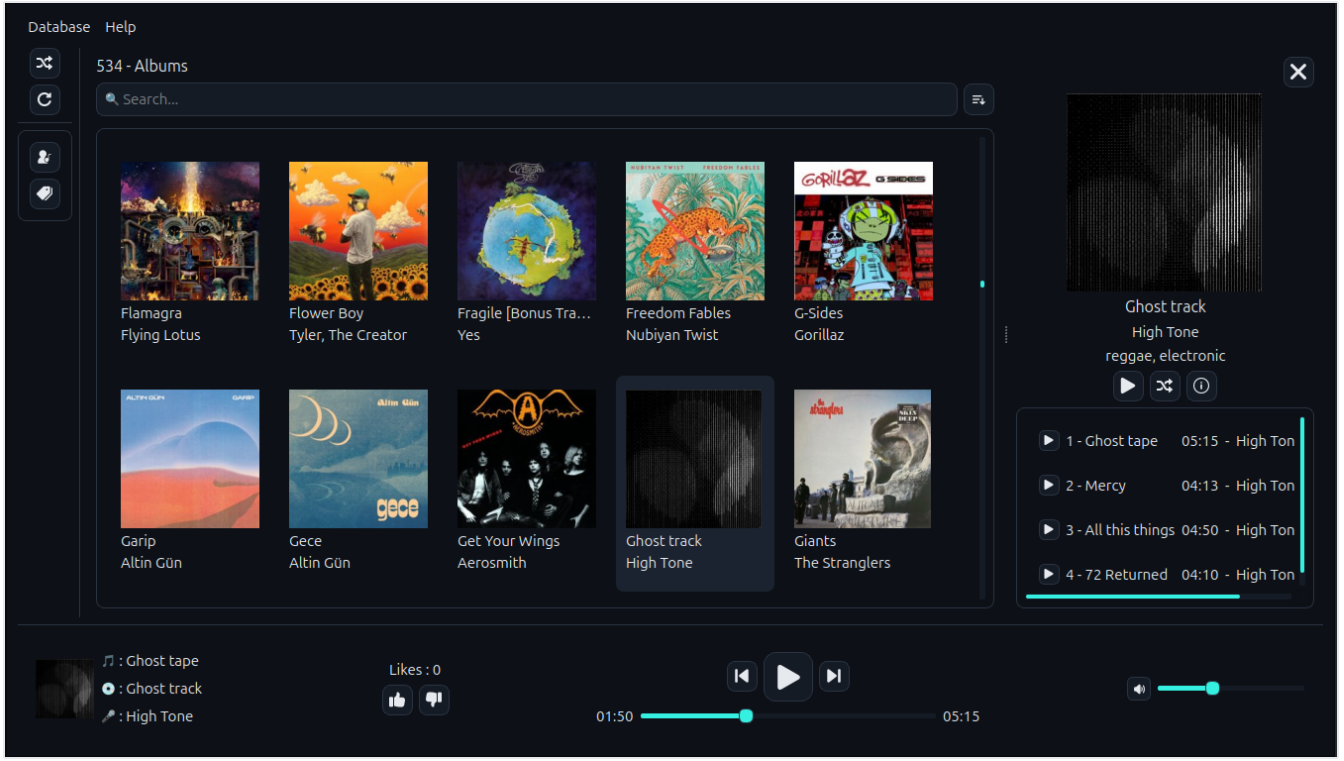
- Play local MP3/M4A music files, browse your albums, artists and genres
- Automatic metadata enrichment and covers with the Discogs API
- Library scans with live progress, in the terminal and in the app, that follow moved files and drop deleted ones
- Likes and plays history
Prerequisites
-
Python 3.13+
-
Audio codecs : ZIC relies on Qt Multimedia to play MP3/M4A files, which in turn relies on system-level codecs (via FFmpeg on most platforms). If you get no sound with no error, install FFmpeg for your OS:
OS Command Linux (Debian/Ubuntu) sudo apt install ffmpegLinux (Arch) sudo pacman -S ffmpegmacOS (Homebrew) brew install ffmpeg(maybe no action needed)Windows Usually bundled with Qt Multimedia, no action needed
Installation
With uv (Recommended)
uv is a faster and more convenient package manager than pip
# cd where you want to create the virtual env
uv venv zic-venv

source zic-venv/bin/activate # Linux/macOS
# zic-venv\Scripts\activate  # Windows

uv pip install zic-player
Quick install
pip install zic-player
The package is named zic-player on PyPI; the app itself is launched with zic.
Getting started
Import your library
zic ingest /path/to/your/library
First launch
zic
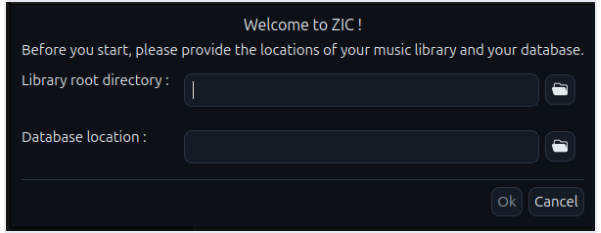
The first time you launch ZIC, a welcome dialog will ask you to register where your MP3/M4A library and your database are located.
Keep your library up to date
Use Database > Check for new songs in the app (or run zic ingest again). Only new and modified files are read, and a progress dialog shows the files left, the elapsed time and an estimate of the remaining time. Music keeps playing meanwhile, and the library can't be edited until the scan is over.
A scan also keeps the library in sync with your folders:
- moved or renamed files are recognized by their content and keep their plays and likes (as long as the file itself wasn't modified on the way)
- deleted files are removed from the library, along with the albums they leave empty
- if no audio file is found at all (e.g. an external drive that isn't mounted), nothing is removed
Database > Full rescan re-reads every file, e.g. after re-tagging files with another tool.
From the terminal, zic ingest shows the same progress in a live text interface, then a summary.
Smart playlists
Whatever you start, ZIC keeps the music going with songs that make sense, instead of stopping at the end of an album or jumping to anything:
- The album you started, in order (or shuffled, or from the song you picked)
- The rest of the artist's discography
- Albums of near genres : the album's genres and their closest neighbors in your genre space
- A random selection, which follows your current mood
Each step only kicks in when the previous one is exhausted, and songs already played in the playlist aren't picked again.
Mood
The shuffle button starts a fully random playlist. Then, ZIC listens to how you listen:
- Listening to a song to the end sets the mood : the song's genres, extended to their near genres. The next songs are picked within that mood.
- Skipping a song resets the mood : the next pick is fully random again, until a song catches you.
The playlist drifts along with you: let a song play and you get more of its kind; skip and you're off somewhere else. The mood also drives the random step of the other playlists. When no song matches the mood anymore, ZIC falls back to a fully random pick.
Search
The search bar of the album explorer finds artists, albums, genres and songs as you type, grouped by kind. It ignores case, accents and punctuation (beyonce finds Beyoncé), word order, and tolerates small typos in artist, album and genre names (daft pnuk finds Daft Punk).
- An artist or a genre filters the explorer
- An album opens it
- A song opens its album with the song highlighted
Use the arrow keys and Enter to pick a result. Pressing Enter without picking one filters the album explorer by the typed text.
Editing metadata
The info buttons of the album view open a dialog for the album or for a song, showing its details (file, format, bitrate, plays, likes, dates...) and letting you edit:
- Songs : title, artist, track and disc numbers. A song can also be hidden from the library; hidden songs are listed in their album's info, where they can be shown again.
- Albums : name, album artist, year and genres. Giving an album the name and artist of another one merges them.
Genre Intelligence
Most music apps treat genres as a flat, external taxonomy. ZIC does something different: it computes how your genres relate to each other based on how they actually co-occur across your own albums.
How it works
- Co-occurrence analysis — ZIC looks at which genre tags appear together on the same albums in your library.
- Positive PMI (Pointwise Mutual Information) — rather than raw counts (which would let generic tags like "rock" dominate purely through volume), ZIC measures how much more often two genres co-occur than pure chance would predict, with discounting to avoid overweighting rare pairs.
- Classical MDS (Multidimensional Scaling) — the resulting similarity scores are projected into a compact set of coordinates per genre, positioning genres close together when they tend to appear side by side in your collection, and far apart when they don't.
These positions power the genre-aware smart playlists (finding "near genres" when an album and its artist's discography are exhausted) and the mood, and can be visualized directly.
Computing positions
Run this after importing your library, and again whenever you've ingested enough new albums that genre relationships might have shifted:
zic genres compute ~/Music/.db
Visualizing genre space
See how your own genres cluster together, in an interactive 2D plot opened in your browser:
zic genres vis ~/Music/.db
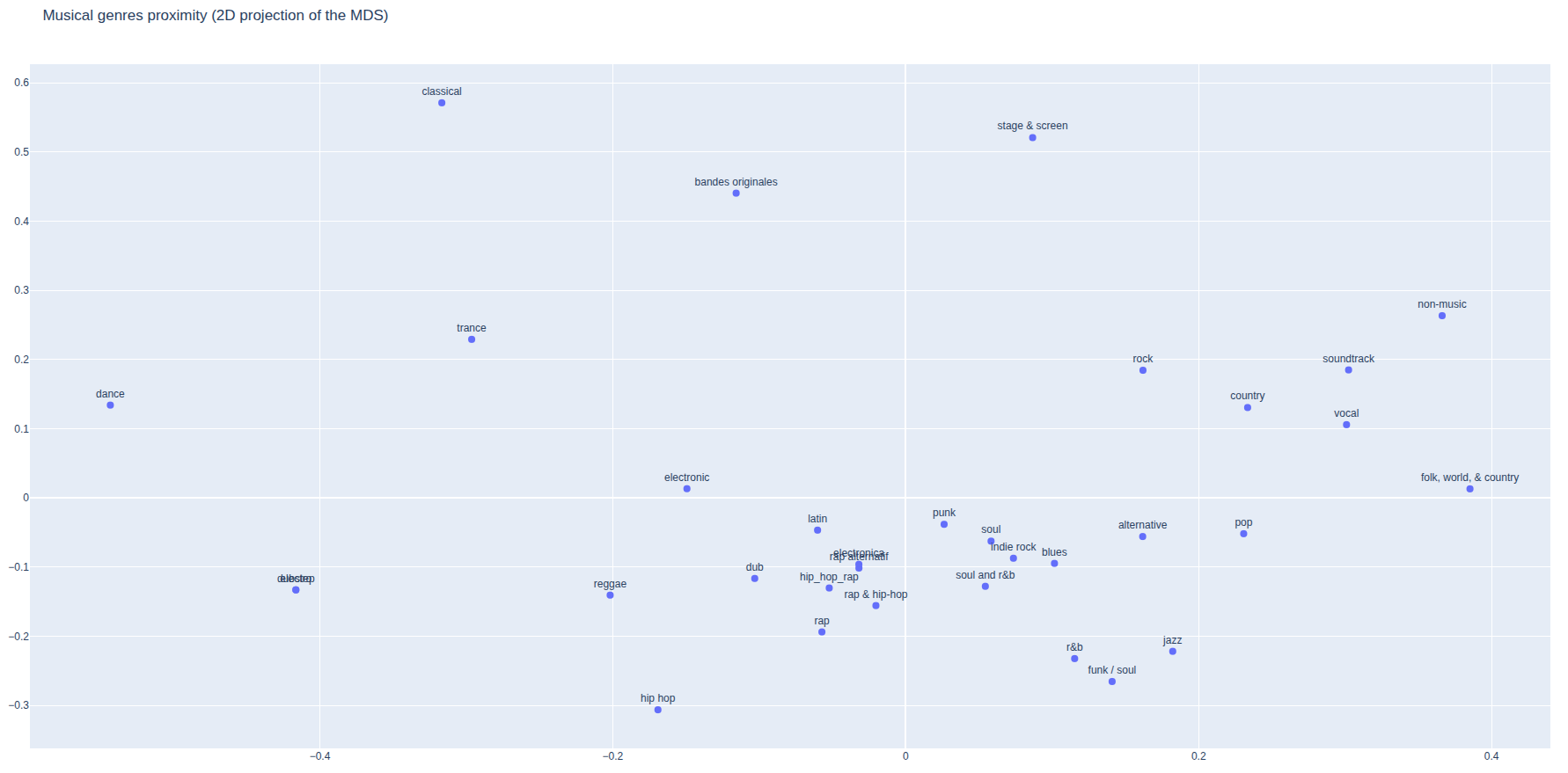
[!NOTE] These visualizations are in 2D, so they are partial representations of the real space which is in 8 dimensions
Configuration
App config
A toml file containing the library directory and database locations
| OS | Location |
|---|---|
| Linux | ~/.config/Zic/app_config.toml |
| Windows | %LOCALAPPDATA%\Zic\app_config.toml |
| Mac Os | ~/Library/Application Support/Zic/app_config.toml |
User Config
When closed, ZIC saves your preferences (volume, sorting, hotkeys, whether edits are written to your files...) in a json file
| OS | Location |
|---|---|
| Linux | ~/.local/share/Zic/user_config.json |
| Windows | %LOCALAPPDATA%\Zic\user_config.json |
| Mac Os | ~/Library/Application Support/Zic/user_config.json |
Ingestor environment variables
While running the ingestor, you can specify your Discogs API credentials with the following environment variables : ZIC_INGESTOR_DISCOGS_KEY and ZIC_INGESTOR_DISCOGS_TOKEN
Hotkeys
| Key | Action |
|---|---|
| Space | Toggle play/pause |
| m | Mute |
| n | Next song |
| p | Previous song |
| F5 | Reload library |
| s | Shuffle playlist |
| Right arrow | Advance playback (5s) |
| Left arrow | Rewind playback (5s) |
| + | Volume up |
| - | Volume down |
| l | Like current song |
| d | Dislike current song |
CLI Reference
❯ zic --help
Usage: zic [OPTIONS] [COMMAND] [ARGS]...

  A local-library desktop music player with album/genre browsing and genre-
  aware smart playlists.

Options:
  -V      Show the current version of ZIC
  --help  Show this message and exit.

Commands:
  genres  Manage genre proximity positions used to build genre-aware...
  ingest  Ingests an audio library (mp3/m4a) into a SQLite database.

  Run the GUI : zic
❯ zic ingest --help
Usage: zic ingest [OPTIONS] FOLDER

  Ingests an audio library (mp3/m4a) into a SQLite database.

Positional arguments:
  FOLDER  Root folder of the library to scan

Options:
  --db PATH                 Path to the SQLite database, default to
                            '$FOLDER/.db'
  --rescan                  Force re-parsing of every file, even unchanged
                            ones
  -k, --discogs-key TEXT    A Discogs Auth key
  -t, --discogs-token TEXT  A Discogs Auth token
  --help                    Show this message and exit.
❯ zic genres --help
Commands:
  compute  Computes proximity positions for every genre in the library.
  vis      Opens an interactive 2D plot of the computed genre positions.
Contributing
Contributions are welcome !
Installation
- Clone this repository
- cd into
zic - Create a venv
uv venv
source .venv/bin/activate # Linux/macOS
# .venv\Scripts\activate  # Windows
- Install zic as editable package
uv pip install -e .
Debug
You can set the ZIC_DEVEL=1 env var to activate the debug level of logging.
Run tests and checks
uv sync installs the development tools (pytest, ruff) along with ZIC. The same checks run on every push and pull request to main (see .github/workflows/ci.yml):
uv run ruff check src tests          # lint
uv run ruff format --check src tests # formatting (`ruff format src tests` to fix it)
uv run pytest                        # tests
Releasing
-
In
pyproject.toml, bumpversionand set therelease-date:keyword to the release day (it's shown in the About dialog), then merge tomain. -
Tag the merged commit and push the tag:
git tag v0.2.0
git push origin v0.2.0
The release workflow then runs the CI again, checks that the tag matches the version and that the release date is today, builds the package, publishes it to PyPI (once approved in the pypi environment) and creates the GitHub release.
Database schema
The database is a cache of your library, rebuilt from your files: after a change to schema.sql, delete the database and run zic ingest again. Plays, likes, hidden songs and library-only edits live in the database only and are lost when it's deleted.
License
See LICENSE.
1 maintainer

Metadata
1 maintainer
Release files for zic-player 0.1.0
For a detailed explanation of source distributions (sdists) and built distributions (wheels), please see the package formats documentation.
Source distribution (sdist)
| File | Size | Uploaded | |
|---|---|---|---|
| zic_player-0.1.0.tar.gz | 216.6 kB | Details |
Built distribution (wheel)
| File | Interpreter | ABI | Platform | Reset |
|---|---|---|---|---|
| zic_player-0.1.0-py3-none-any.whl | Python 3 | none | any | Details |
Total release size: 448.4 kB
Release files / zic_player-0.1.0.tar.gz
| Download URL | zic_player-0.1.0.tar.gz |
|---|---|
| Size | 216.6 kB |
| Tags | Source |
|
SHA-256 checksum How to use checksums |
4678a5d069f78c791ddb623130a2c0ff333cf1edcf649b538dde4e0f3b4b058a
|
|
BLAKE2b-256 checksum How to use checksums |
400c6c681fb4450484303b12a761a943dce931bff026df0c10bd8d9057697f6d
|
| Upload date | |
|
Uploaded using Trusted Publishing? What is trusted publishing? |
Yes |
| Uploaded via |
twine/7.0.0 CPython/3.13.14
|
Provenance
Provenance describes where a file came from. On PyPI, provenance is shared via attestations, which provide a verifiable record of the build or publishing details. View details, limitations and caveats.


PyPI Publish Attestation
PyPI verified that this artifact, at this checksum, originated from the publisher listed below.
Signed by GitHub Actions, verified by PyPI on Oct 4, 2026.
Transparency logRelease files / zic_player-0.1.0-py3-none-any.whl
| Download URL | zic_player-0.1.0-py3-none-any.whl |
|---|---|
| Size | 231.9 kB |
| Tags | Python 3 |
|
SHA-256 checksum How to use checksums |
07952e7ce20791daec8a89c4688568254eebb794c92bebc53eb920a6aa95041d
|
|
BLAKE2b-256 checksum How to use checksums |
0632a3987530d7c87b239e1692cb27ba2f97df4add29b872ea9a485adeb821b7
|
| Upload date | |
|
Uploaded using Trusted Publishing? What is trusted publishing? |
Yes |
| Uploaded via |
twine/7.0.0 CPython/3.13.14
|
Provenance
Provenance describes where a file came from. On PyPI, provenance is shared via attestations, which provide a verifiable record of the build or publishing details. View details, limitations and caveats.
PyPI Publish Attestation
PyPI verified that this artifact, at this checksum, originated from the publisher listed below.
Signed by GitHub Actions, verified by PyPI on Oct 4, 2026.
Transparency log












