
zodify
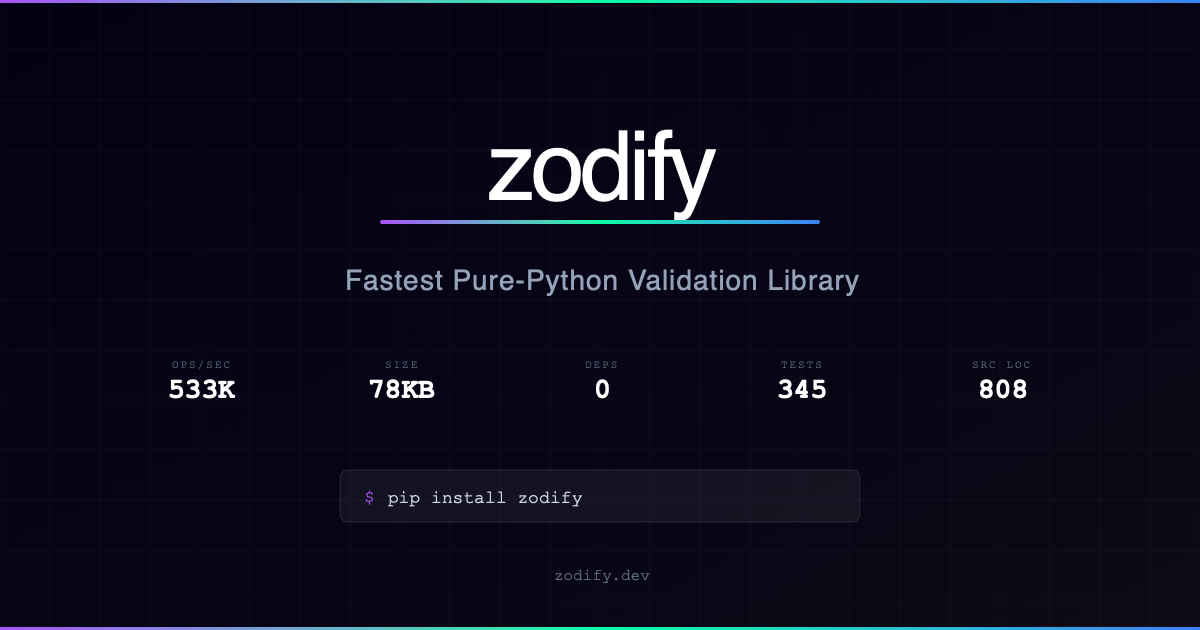
Zod-inspired validation for Python. Zero deps. One engine.



Website · Docs · Benchmarks · Issues · Changelog
Note: zodify is in alpha. The API is minimal and may change. Feedback and contributions are welcome!
Quick Start
from zodify import validate

config = validate(
    {"port": int, "debug": bool},
    {"port": 8080, "debug": True},
)
That's it. Plain dicts by default. Optional class syntax when you want typed attribute access. No DSL, no dependencies.
Why zodify?
Most validation libraries ask you to learn a new DSL or model system. zodify doesn't.
| zodify | zon | zodic | Pydantic | |
|---|---|---|---|---|
| Philosophy | Minimalist | Full Zod port | Full Zod port | Full ORM |
| API style | Plain dicts + class sugar | Chained builders | Chained builders | Classes |
| Schema composition | Plain dict reuse | Requires schema DSL/builders | Requires schema DSL/builders | Requires model classes |
| Dependencies | 0 | 2 | 0 | 4 |
| Code size | 808 source LOC | ~1,900 LOC | ~1,400 LOC | ~32,000 LOC |
| Learning curve | Zero | Must learn DSL | Must learn DSL | Must learn DSL |
| Env var support | Built-in | No | No | Partial |
Install
pip install zodify
Requires Python 3.10+
To install from source:
git clone https://github.com/junyoung2015/zodify.git && pip install ./zodify
Usage
validate() - Dict Schema Validation
Define a schema as a plain dict of key: type pairs, then validate any dict against it.
from zodify import validate

schema = {"port": int, "debug": bool, "name": str}

# Exact type match
result = validate(schema, {"port": 8080, "debug": True, "name": "myapp"})
# → {"port": 8080, "debug": True, "name": "myapp"}

# Coerce strings - great for env vars and config files
raw = {"port": "8080", "debug": "true", "name": "myapp"}
result = validate(schema, raw, coerce=True)
# → {"port": 8080, "debug": True, "name": "myapp"}

# All errors are collected at once
validate({"a": int, "b": str}, {"a": "x", "b": 42})
# ValueError: a: expected int, got str
#             b: expected str, got int
Parameters:
| Param | Type | Default | Description |
|---|---|---|---|
schema |
dict |
- | Mapping of keys to expected types (str, int, ...) |
data |
dict |
- | The dict to validate |
coerce |
bool |
False |
Cast string values to the target type when possible |
max_depth |
int |
32 |
Maximum nesting depth to prevent stack overflow |
unknown_keys |
str |
"reject" |
How to handle extra keys: "reject" or "strip" |
error_mode |
str |
"text" |
Error output format: "text" or "structured" |
Behavior:
- Extra keys in
dataare rejected by default (unknown_keys="reject"). - Use
unknown_keys="strip"to silently drop extra keys and return only schema-declared keys. - Missing keys raise
ValueError. - When
coerce=True, onlystrinputs are coerced toint,float, orbool(non-string mismatches still error). Forstrtargets, any value is accepted via Python'sstr()builtin. - Bool coercion accepts:
true/false,1/0,yes/no(case-insensitive).
# Default: reject unknown keys
validate({"name": str}, {"name": "kai", "age": 25})
# ValueError: age: unknown key

# Opt-in: strip unknown keys
validate(
    {"name": str},
    {"name": "kai", "age": 25},
    unknown_keys="strip",
)
# -> {"name": "kai"}
Configuration
validate() remains the recommended starting point. Use Validator when you repeatedly apply the same options and want reusable defaults.
from zodify import Validator

validator = Validator(
    coerce=True,
    max_depth=16,
    unknown_keys="strip",
    error_mode="structured",
)

result = validator.validate(
    {"port": int, "debug": bool},
    {"port": "8080", "debug": "true", "unused": "x"},
)
# -> {"port": 8080, "debug": True}
Per-call keyword arguments override instance defaults for that call only:
from zodify import Validator

validator = Validator(coerce=False, unknown_keys="reject")

# Temporary override for one call:
result = validator.validate(
    {"port": int},
    {"port": "8080"},
    coerce=True,
)
# -> {"port": 8080}

# Defaults remain unchanged:
validator.validate({"port": int}, {"port": "8080"})
# ValueError: port: expected int, got str
Class-Based Schemas
Schema gives you typed attribute access without changing the validation engine.
Class schemas are syntactic sugar - the dict engine does all the work.
from zodify import Optional, Schema, Validator, validate

dict_schema = {
    "host": str,
    "port": Optional(int, 5432),
}


class DBConfig(Schema):
    host: str
    port: int = 5432


payload = {"host": "db.local"}

assert validate(dict_schema, payload) == {"host": "db.local", "port": 5432}

db = validate(DBConfig, payload)
assert db.host == "db.local"
assert db["port"] == 5432

validator = Validator(unknown_keys="strip")
assert validator.validate(DBConfig, {"host": "db.local", "extra": "x"}).host == "db.local"
The class and dict forms are equivalent for the same structure:
from zodify import Optional, Schema

db_dict_schema = {
    "host": str,
    "port": Optional(int, 5432),
}


class DBConfig(Schema):
    host: str
    port: int = 5432
Nested composition works the same way:
from zodify import Schema, validate


class Credentials(Schema):
    username: str
    password: str


class DatabaseConfig(Schema):
    host: str
    port: int = 5432
    creds: Credentials


class AppConfig(Schema):
    name: str
    db: DatabaseConfig


app = validate(
    AppConfig,
    {
        "name": "api",
        "db": {
            "host": "localhost",
            "creds": {"username": "svc", "password": "secret"},
        },
    },
)

assert app.db.host == "localhost"
assert app.db.creds.username == "svc"
Prefer class syntax when you want autocomplete, attribute access, and field names that are already valid Python identifiers. Prefer plain dict schemas when you need the lowest-friction runtime shape, invalid identifiers, or callable field validators.
Supported in v0.6.0:
- Direct annotations for primitive fields
- Default values compiled into
Optional(...) - Unions whose members are plain runtime types (for example
str | intorint | None) - Typed lists, bare
dict, and barelist - Nested
Schemasubclasses resolved at class-definition time - Wrapped nested results for nested
Schemafields andlist[Schema] - Wrapped results preserve Schema-origin nesting across
|and|=dict merges - Non-dict operands on
|still raiseTypeError, matching plaindictsemantics
Intentional non-goals and unsupported boundaries in v0.6.0:
- Later-defined forward references and self-referential schemas
- Postponed string annotations
- Inheritance beyond direct
class X(Schema): ... - Unions containing nested
Schemasubclasses or parameterized container members - Parameterized
dict[K, V]annotations - Invalid identifier field names
- Dict-method field names such as
items,keys, andvalues - Callable validators in the class body
model_config-style options and custom metaclass APIs- User-facing registries and caching layers
- Direct
MySchema()instantiation; Schema classes are declarations, not runtime models
Notes:
ValidatedDictis an internal runtime carrier, not a supported public import.- Only annotated fields become schema fields. Unannotated control objects such as
model_config,registry, orcachestay inert plain class attributes and are not interpreted by zodify. - If you need dict-method field names or unsupported union members, stay on plain dict schemas.
- Plain dict schemas still return plain
dictvalues. Nested plain dict fields stay plain dicts.
Structured Errors
By default, validation failures raise ValueError with human-readable messages. Use error_mode="structured" to get machine-readable ValidationError exceptions with an .issues list - ideal for API error responses.
from zodify import validate, ValidationError

try:
    validate(
        {"port": int, "host": str},
        {"port": "abc", "host": 42},
        error_mode="structured",
    )
except ValidationError as e:
    print(e.issues)
    # [
    #   {"path": "port", "message": "expected int, got str", "expected": "int", "got": "str"},
    #   {"path": "host", "message": "expected str, got int", "expected": "str", "got": "int"},
    # ]
ValidationError subclasses ValueError, so existing except ValueError handlers still work. Each issue dict has four keys: path, message, expected, and got.
# Works with all error types: type mismatch, missing key, coercion failure,
# custom validator failure, depth exceeded, unknown key, and union mismatch.

# Combine with other parameters freely:
validate(schema, data, coerce=True, unknown_keys="strip", error_mode="structured")
Union Types
Use Python's str | int syntax to accept multiple types for a single key.
schema = {"value": str | int}

validate(schema, {"value": "hello"})  # → {"value": "hello"}
validate(schema, {"value": 42})       # → {"value": 42}

validate(schema, {"value": 3.14})
# ValueError: value: expected str | int, got float
Types are checked left-to-right. With coerce=True, type order controls coercion priority:
# str first → "42" stays as string (str coercion matches first)
validate({"value": str | int}, {"value": "42"}, coerce=True)
# → {"value": "42"}

# int first → "42" coerced to int (int coercion matches first)
validate({"value": int | str}, {"value": "42"}, coerce=True)
# → {"value": 42}
Union types compose with lists, nested dicts, and Optional:
validate({"items": [int | str]}, {"items": ["42"]}, coerce=True)
# → {"items": [42]}

validate({"config": {"v": int | str}}, {"config": {"v": "42"}}, coerce=True)
# → {"config": {"v": 42}}
Note: When
stris a union member andcoerce=True,stracts as a catch-all fallback - any value that fails earlier union members will coerce viastr()(e.g.,int | strwithTrueproduces"True"). Placestrlast in unions to use it as a deliberate fallback, or first to prefer string preservation.
Requires Python 3.10+ (for
X | Yunion syntax).
Nested Dict Validation
Your schema can contain nested dicts - validation recurses automatically.
schema = {"db": {"host": str, "port": int}}

validate(schema, {"db": {"host": "localhost", "port": 5432}})
# → {"db": {"host": "localhost", "port": 5432}}

validate(schema, {"db": {"host": "localhost", "port": "bad"}})
# ValueError: db.port: expected int, got str
Errors use dot-notation paths: db.host, a.b.c, etc.
Schema Composition
schemas are data, not DSL - they compose like dicts because they are dicts
from zodify import validate

db_schema = {"host": str, "port": int}
credentials_schema = {"username": str, "password": str}
flag_schema = {"beta": bool | str}

service_schema = {
    "name": str,
    "db": db_schema,
    "credentials": credentials_schema,
    "flags": {
        "signup_flow": flag_schema,
    },
}

validate(
    service_schema,
    {
        "name": "api",
        "db": {"host": "localhost", "port": 5432},
        "credentials": {"username": "svc", "password": "secret"},
        "flags": {"signup_flow": {"beta": "true"}},
    },
    coerce=True,
)
For the full runnable version, see examples/nested_schemas.py.
Optional Keys
Use Optional to mark keys that can be missing. Provide a default, or omit it to exclude the key from results.
from zodify import validate, Optional

schema = {
    "host": str,
    "port": Optional(int, 8080),     # default 8080
    "debug": Optional(bool),          # absent if missing
}

validate(schema, {"host": "localhost"})
# → {"host": "localhost", "port": 8080}
Note:
Optionalshadowstyping.Optional. If you use both in the same file, alias it:from zodify import Optional as Optor usezodify.Optional(...).
List Element Validation
Use a single-element list as the schema value to validate every element in the list.
validate({"tags": [str]}, {"tags": ["python", "config"]})
# → {"tags": ["python", "config"]}

validate({"tags": [str]}, {"tags": ["ok", 42]})
# ValueError: tags[1]: expected str, got int
List of dicts works too:
validate(
    {"users": [{"name": str, "age": int}]},
    {"users": [{"name": "Alice", "age": 30}]},
)
Combined Example
All features compose naturally:
from zodify import validate, Optional

schema = {
    "db": {"host": str, "port": Optional(int, 5432)},
    "tags": [str],
    "debug": Optional(bool, False),
}

validate(schema, {
    "db": {"host": "localhost"},
    "tags": ["prod"],
})
# → {"db": {"host": "localhost", "port": 5432},
#    "tags": ["prod"], "debug": False}
env() - Typed Environment Variables
Read and type-cast environment variables with a single call.
from zodify import env

port   = env("PORT", int, default=3000)
debug  = env("DEBUG", bool, default=False)
secret = env("SECRET_KEY", str)  # raises ValueError if missing
Parameters:
| Param | Type | Default | Description |
|---|---|---|---|
name |
str |
- | Environment variable name |
cast |
type |
- | Target type (str, int, float, bool) |
default |
any | (none) | Fallback if the var is unset. Not type-checked - ensure your default matches the cast type. |
Release Process
Release automation is tag-driven:
- Pushing a tag that matches
v*triggers.github/workflows/publish.yml. - The workflow runs tests, builds distributions, publishes to PyPI, and creates a GitHub Release.
- GitHub Release notes are sourced from the matching section in
CHANGELOG.md(for example,## [v0.1.0]).
Run local preflight before tagging:
./scripts/release_preflight.sh
If preflight passes, push the release tag for the version in pyproject.toml:
TAG="v$(sed -nE 's/^version = "([^"]+)"/\1/p' pyproject.toml | head -n 1)"
git tag "${TAG}"
git push origin "${TAG}"
Roadmap
zodify is in alpha. The API surface is small and may evolve. All pre-1.0 APIs are provisional per semver. See CHANGELOG.md for released version-by-version details.
Shipped (current mainline capabilities):
- Nested schema validation with dot-path errors
- Optional keys with defaults
- List element validation (including list-of-dicts)
- Custom validator functions
-
unknown_keysparameter ("reject"/"strip") -
max_depthrecursion depth limit - Performance benchmark infrastructure
- PEP 561
py.typedmarker & inline type annotations -
@overloadsignatures forenv()(IDE type inference) - Google-style docstrings on all public API symbols
- mypy (strict) & pyright CI gates
- Union type schemas (
str | intsyntax) with left-to-right coercion priority -
ValidationErrorexception with.issuesfor machine-readable errors -
error_mode="structured"parameter onvalidate() -
Validatorclass with reusable configuration defaults and per-call overrides -
Schemabase class with typed attribute access, nested wrapping for nestedSchemafields, andValidatedDictkept internal - Runnable example scripts in
examples/(basic_validation.py,nested_schemas.py,custom_validators.py,union_types.py,env_config.py,structured_errors.py) - README schema composition documentation with plain dict reuse patterns
Planned:
| Version | Theme |
|---|---|
| v0.7.0 | .env file loading (load_env()) |
| v0.8.0 | JSON Schema export (to_json_schema()) |
| v1.0.0 | API freeze, docs polish, and release hardening |
Post-v1.0 (exploring):
- Framework integrations as extension packages (
zodify-fastapi, etc.)
License
MIT - 2026 Jun Young Sohn
1 maintainer

Download files
Download the file for your platform. If you're not sure which to choose, learn more about installing packages.
Source Distribution
Built Distribution
Filter files by name, interpreter, ABI, and platform.
If you're not sure about the file name format, learn more about wheel file names.
Copy a direct link to the current filters
File details
Details for the file zodify-0.6.0.tar.gz.
File metadata
- Download URL: zodify-0.6.0.tar.gz
- Upload date:
- Size: 23.8 kB
- Tags: Source
- Uploaded using Trusted Publishing? Yes
- Uploaded via:
twine/6.1.0 CPython/3.13.7
File hashes
| Algorithm | Hash digest | |
|---|---|---|
| SHA256 |
499f04a7a93939f3b61747fa2610915062481f2eb5e8f2825069419809bcb722
|
|
| MD5 |
7f77617455d931648e5dd66453955acb
|
|
| BLAKE2b-256 |
dbd801723e8cdbe78cacc0bfa2a9ed58496e126e157980fdca7832cec67f913a
|
Provenance
The following attestation bundles were made for zodify-0.6.0.tar.gz:
Publisher:
publish.yml on junyoung2015/zodify
-
Statement:
-
Statement type:
https://in-toto.io/Statement/v1 -
Predicate type:
https://docs.pypi.org/attestations/publish/v1 -
Subject name:
zodify-0.6.0.tar.gz -
Subject digest:
499f04a7a93939f3b61747fa2610915062481f2eb5e8f2825069419809bcb722 - Sigstore transparency entry: 1079328571
- Sigstore integration time:
-
Permalink:
junyoung2015/zodify@c443bed288e443f88f2fc994703677edeb560e23 -
Branch / Tag:
refs/tags/v0.6.0 - Owner: https://github.com/junyoung2015
-
Access:
public
-
Token Issuer:
https://token.actions.githubusercontent.com -
Runner Environment:
github-hosted -
Publication workflow:
publish.yml@c443bed288e443f88f2fc994703677edeb560e23 -
Trigger Event:
push
-
Statement type:
File details
Details for the file zodify-0.6.0-py3-none-any.whl.
File metadata
- Download URL: zodify-0.6.0-py3-none-any.whl
- Upload date:
- Size: 15.8 kB
- Tags: Python 3
- Uploaded using Trusted Publishing? Yes
- Uploaded via:
twine/6.1.0 CPython/3.13.7
File hashes
| Algorithm | Hash digest | |
|---|---|---|
| SHA256 |
ee6a453d1afcfdbebf0480be1368e982e90a588732aae7887222112991496b38
|
|
| MD5 |
085ab504c0f0114285a4c73be232148b
|
|
| BLAKE2b-256 |
c27043edd77ff8430f277e78b8a71485907087b47f8b2620e35dbb2a4191ce01
|
Provenance
The following attestation bundles were made for zodify-0.6.0-py3-none-any.whl:
Publisher:
publish.yml on junyoung2015/zodify
-
Statement:
-
Statement type:
https://in-toto.io/Statement/v1 -
Predicate type:
https://docs.pypi.org/attestations/publish/v1 -
Subject name:
zodify-0.6.0-py3-none-any.whl -
Subject digest:
ee6a453d1afcfdbebf0480be1368e982e90a588732aae7887222112991496b38 - Sigstore transparency entry: 1079328593
- Sigstore integration time:
-
Permalink:
junyoung2015/zodify@c443bed288e443f88f2fc994703677edeb560e23 -
Branch / Tag:
refs/tags/v0.6.0 - Owner: https://github.com/junyoung2015
-
Access:
public
-
Token Issuer:
https://token.actions.githubusercontent.com -
Runner Environment:
github-hosted -
Publication workflow:
publish.yml@c443bed288e443f88f2fc994703677edeb560e23 -
Trigger Event:
push
-
Statement type:














