
ZROS: A fast, lightweight ROS-like library

Project description
ZROS: A fast, lightweight ROS-like library



ZROS is a fast, lightweight ROS-like library designed to bring the ease of ROS-2 to Python projects that require minimal overhead and high performance, using ZeroMQ for fast, asynchronous communication.
It provides a simple, pure Python alternative for robotic applications, computer vision pipelines, and distributed systems where a full ROS installation might be overkill.
Key Features
- Fast & Lightweight: Built on top of ZeroMQ, ensuring low-latency communication between nodes.
- ROS-like API: Uses familiar concepts like
Node,Publisher,Subscriber,Timer, andspin()making it easy for ROS-2 developers to adapt. - No Complex Build System: Pure Python. No
catkin_make, nocolcon build, nosource setup.bash. Just run your Python scripts. - Computer Vision Ready: Includes a built-in
zCvBridgefor seamless OpenCV image transport, andzCompressedCVBridgewhich can optimize bandwidth usage up to 30x during transmission. - Bridge Legacy and Modern Environments: Build hybrid architectures spanning Python 3.8 and Python 3.12+ gracefully over
localhost.
Why ZROS? Bridging Legacy and Modern Robotics
A major hurdle in modern robotics research is the software gap between established frameworks and cutting-edge AI.
Projects using robust legacy systems like ROS1 Noetic are strictly tied to Python 3.8 and specific OS/hardware driver stacks. However, integrating state-of-the-art AI tools like SAM3 (Segment Anything) requires modern Python 3.10+, updated PyTorch versions, and fresh dependencies.
Traditional workarounds fall short:
- Installing new ML libraries into a legacy
catkin_wsalmost always breaks the system with dependency hell. - Using Docker introduces friction: passing through physical GPUs/cameras is unreliable, networking ROS topics across container boundaries is tedious, and rebuilding containers ruins rapid prototyping.
The ZROS + uv Solution:
Run your hardware and control loops in their native ROS1 environment. Run your modern AI models in completely isolated, modern Python virtual environments managed by uv. ZROS connects them instantly.
Example Usage:
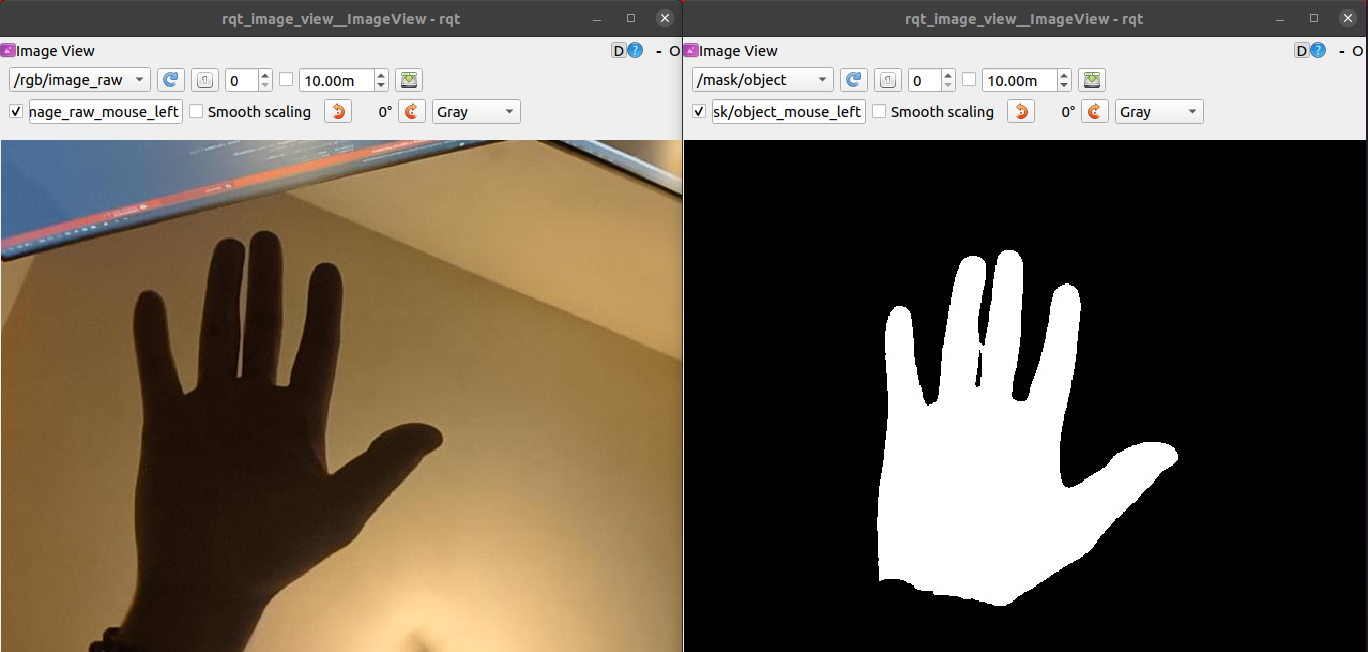
sjmp@pc:~$ rostopic pub -1 /detect_object/prompt std_msgs/String "data: 'hand'"
SAM3 Object Detection in ROS Noetic:
Read the full guide on Bridging Systems in the documentation.
Installation
From PyPI (Recommended)
uv venv
# For basic ZROS (no computer vision features):
uv pip install zros

# To include OpenCV and Numpy for image transport:
uv pip install zros[cv2]
From Source
git clone https://github.com/juliodltv/zros.git
cd zros
uv sync # Add --extra cv2 for image transport support
Quick Start
Create a Publisher (publisher.py)
from zros import zNode, zCompressedCVBridge
import cv2

class CameraPublisher(zNode):
    def __init__(self):
        super().__init__("camera_pub")
        self.pub = self.create_publisher("video_topic")
        self.bridge = zCompressedCVBridge()
        self.cap = cv2.VideoCapture(0)
        self.create_timer(1/60, self.timer_callback)

    def timer_callback(self):
        ret, frame = self.cap.read()
        if ret:
            # msg is a dictionary
            msg = {
                "zimgmsg": self.bridge.cv2_to_zimgmsg(frame),
                "info": "My Camera Frame"
            }
            self.pub.publish(msg)

if __name__ == "__main__":
    CameraPublisher().spin()
Create a Subscriber (subscriber.py)
from zros import zNode, zCompressedCVBridge
import cv2

class VideoSubscriber(zNode):
    def __init__(self):
        super().__init__("video_sub")
        self.bridge = zCompressedCVBridge()
        self.create_subscriber("video_topic", self.callback)

    def callback(self, msg):
        img = self.bridge.zimgmsg_to_cv2(msg["zimgmsg"])
        # info = msg["info"]
        # print(info)
        cv2.imshow("Video", img)
        cv2.waitKey(1)

if __name__ == "__main__":
    VideoSubscriber().spin()
Running Examples
You can find another examples in the examples/ directory.
# Terminal 1
uv run zroscore

# Terminal 2
uv run publisher.py

# Terminal 3
uv run subscriber.py
Documentation
For detailed usage instructions, please refer to the ZROS Documentation.
Citation
@software{zros2026,
  author = {Julio De La Torre-Vanegas},
  title = {ZROS: A fast, lightweight ZeroMQ ROS-like library},
  year = {2026},
  url = {https://github.com/juliodltv/zros}
}
Release history Release notifications | RSS feed


Download files
Download the file for your platform. If you're not sure which to choose, learn more about installing packages.
Source Distribution
Built Distribution
Filter files by name, interpreter, ABI, and platform.
If you're not sure about the file name format, learn more about wheel file names.
Copy a direct link to the current filters
File details
Details for the file zros-0.1.12.tar.gz.
File metadata
- Download URL: zros-0.1.12.tar.gz
- Upload date:
- Size: 10.5 kB
- Tags: Source
- Uploaded using Trusted Publishing? Yes
- Uploaded via: twine/6.1.0 CPython/3.13.7
File hashes
| Algorithm | Hash digest | |
|---|---|---|
| SHA256 |
606c9ccd36d81028fb4a5a63c116fdaaf50677f19ff61acc2cf3e0e70476718c
|
|
| MD5 |
93ee4d6276dce2243ea2986eeedd959c
|
|
| BLAKE2b-256 |
0f2a4e4dcc0562f76248bc81d1241466a19b89a13866cc27637ae86bddb97e38
|
File details
Details for the file zros-0.1.12-py3-none-any.whl.
File metadata
- Download URL: zros-0.1.12-py3-none-any.whl
- Upload date:
- Size: 9.8 kB
- Tags: Python 3
- Uploaded using Trusted Publishing? Yes
- Uploaded via: twine/6.1.0 CPython/3.13.7
File hashes
| Algorithm | Hash digest | |
|---|---|---|
| SHA256 |
bbbc432728b0aa9de57502cfb7a31c5d67789bee2052a06fa93ec699fd562e7b
|
|
| MD5 |
befdfa0d471830d8d60e6951c5902b39
|
|
| BLAKE2b-256 |
5f9b7aebbf9ba045c66bb1c582fc57fe05fb07375b3452ad8276271c51cac903
|






