
Certified selective classification on top of any classifier. Your model shouldn't be forced to move.

Project description
zugzwang

Certified selective classification on top of any classifier. Your model shouldn't be forced to move.
In chess, zugzwang is the obligation to move when every move worsens your position. A standard classifier lives in permanent zugzwang: forced to predict even when every prediction is bad. zugzwang gives your model the move the rules deny it — abstention — with statistical risk guarantees. It does not train models: it wraps the one you already have.
from zugzwang import SelectiveClassifier

clf = SelectiveClassifier(LGBMClassifier())              # any predict_proba
clf.fit(X_train, y_train)                                # standard sklearn fit
clf.certify(X_select, y_select, risk=0.02, delta=0.05)   # risk <= 2%, conf. 95%
pred = clf.predict(X)                                    # labels or ABSTAIN (-1)
No wrapper needed (neural nets, LLM logprobs, legacy systems):
from zugzwang.core import certify_threshold

thr = certify_threshold(scores_select, errors_select, risk=0.02, delta=0.05,
                        method="sgr")                    # or "crc"
accept = scores_test >= thr.threshold
The falsifiable contract — every verdict published, win or lose
The product was benchmarked against a contract frozen before the first
run: 15 datasets (12 from the preceding research trilogy + 3 external
OpenML-CC18), 5 seeds, r* ∈ {0.01, 0.02, 0.05, 0.10}, paired Wilcoxon
p<0.05 pre-declared. Full operationalization, amendment trail and losing
verdicts included: benchmarks/reports/.
| Criterion | Verdict | Key numbers |
|---|---|---|
| B1 validity (blocking) | PASS | sgr 9/217 violations (16 allowed); crc 15/294; conformal 21/295 |
| B2 floor vs artisanal | GRAY | Pareto-undominated: +13.7 pp coverage vs the risk-respecting recipe (p=8e-34); the coverage-matching recipe violates risk 38% of the time |
| B3 ceiling vs MAPIE | REFUTED | MAPIE's sets certify more median coverage; we document when to use MAPIE |
| B4 budget refund | REFUTED | claim retired; diagnostic: the calibration tax is ~nil — select-split size is what matters |
An exploratory follow-up on non-frozen data (X1) decomposed the B3 gap: the method gap vs MAPIE is exactly zero (identical LAC machinery, 300 paired runs) — the whole gap is the price of the high-probability flavor. What that price buys: at the same r*, marginal set readings exceeded the target selective risk on 62% of eval runs; sgr on 3.8%. Score choice and the hybrid budget split moved certified coverage ≤ 0.2 pp: the defaults stand.
With and without, in one picture
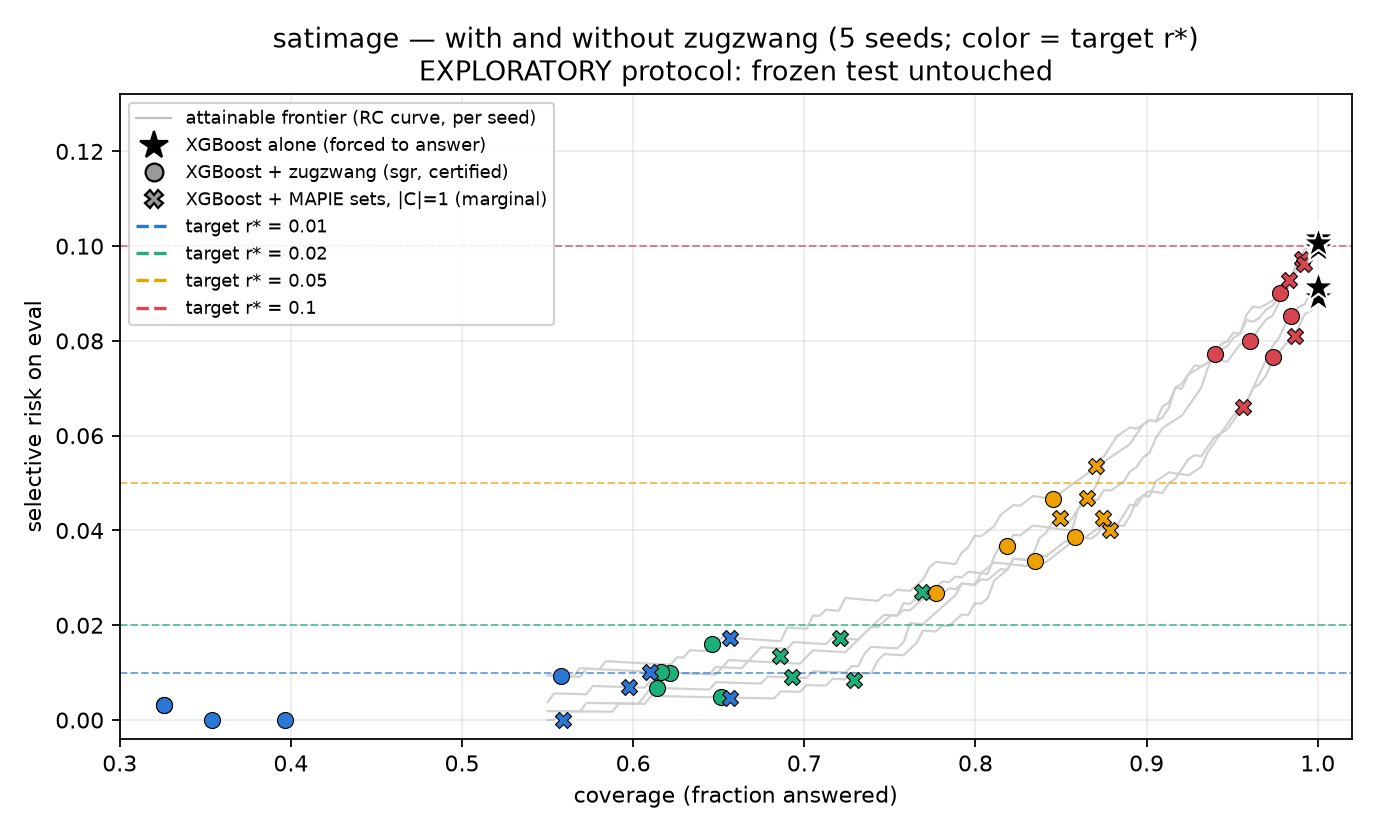
XGBoost on satimage (5 seeds, exploratory protocol — the frozen test stays
untouched): alone, the model is forced to answer everything at ~9–10% error
(black stars). Wrapped, it slides down the risk–coverage frontier and each
zugzwang point sits at its certified target (dashed line of its color).
The MAPIE selective reading answers a bit more but lands where the marginal
guarantee lands it — sometimes past the target. Reproduce:
python benchmarks/fig_demo.py satimage.
Three risk notions, one promise
All defaults carry the same high-probability flavor — with confidence ≥ 1−δ over the select sampling, the certified quantity is controlled — and spend at most half the stated error budget (structural safety margin: the stated confidence is a floor, never an estimate).
| Method | Certified quantity (confidence ≥ 1−δ) | Machinery |
|---|---|---|
sgr (default) |
P(error | accepted) ≤ r* | Exact binomial bound, hybrid search (Geifman & El-Yaniv 2017) |
crc |
P(error AND accepted) ≤ r* | RCPS (Bates et al. 2021) |
conformal |
set coverage ≥ 1−r* | PAC / training-conditional (Vovk 2012; Park et al. 2020) |
In-expectation / marginal variants (classic CRC, classic split conformal)
remain available as explicit opt-in via delta=None, labeled verbatim in
the certificate.
The honest data protocol
Train with your full budget; reserve a small labeled select split only to
certify. Our own benchmark refuted the stronger version of this claim (B4):
what actually matters is the select-split size — certifying power scales
with it. UncertifiableRiskError.min_certifiable_risk tells you the floor
your data can back, and min_select_size(risk, delta, p_err) plans the
budget before you reserve anything:
from zugzwang import min_select_size

min_select_size(risk=0.02, delta=0.05)              # 183 — absolute floor
min_select_size(risk=0.02, delta=0.05, p_err=0.01)  # 851 — realistic budget
Loud, early errors
- Unreachable risk →
UncertifiableRiskErrorreporting the minimum certifiable risk for your data. Never silent thresholds. - Select rows duplicating training rows → contamination error before any certificate is issued.
What zugzwang is NOT
- It does not train engines (LightGBM/XGBoost are optional extras, never dependencies).
- It does not learn uncertainty scores — nothing learned on top of the model's own confidence paid, measured three ways in the trilogy behind this product. Bring a custom score as a callable if you want.
- It does not detect distribution drift. The production monitor (v1.0) watches observed coverage/risk against the certificate — measurable quantities — and alarms on deviation, with no epistemic claims.
Install
pip install zugzwang # coming with v0.1.0
Core dependencies: numpy, scipy, scikit-learn. Docs: quickstart, tutorials
(sklearn / LightGBM / raw scores), theory per guarantee, and the benchmark
pages — see docs/ (GitHub Pages once public).
Phases
| Phase | Deliverable | Release | Status |
|---|---|---|---|
| F0 | Packaging, CI, frozen benchmark data | — | ✅ |
| F1 | Certified core + SelectiveClassifier + contract B1–B4 run and published |
v0.1 → PyPI | ✅ |
| F2 | Opt-in calibration + self-contained HTML report | v0.2 | ✅ |
| F3 | DecisionGate + monitoring |
v1.0 | ✅ |
The companion book (Spanish): book/libro.pdf.
License
MIT
Release history Release notifications | RSS feed

Download files
Download the file for your platform. If you're not sure which to choose, learn more about installing packages.
Source Distribution
Built Distribution
Filter files by name, interpreter, ABI, and platform.
If you're not sure about the file name format, learn more about wheel file names.
Copy a direct link to the current filters
File details
Details for the file zugzwang-1.1.0.tar.gz.
File metadata
- Download URL: zugzwang-1.1.0.tar.gz
- Upload date:
- Size: 5.0 MB
- Tags: Source
- Uploaded using Trusted Publishing? No
- Uploaded via: twine/6.2.0 CPython/3.13.14
File hashes
| Algorithm | Hash digest | |
|---|---|---|
| SHA256 |
5cc0bec2408d92c07963b4b521c86150c57639d2eb16b84d19e2c957c6865ee5
|
|
| MD5 |
49281c775038bc6b33aff56a97e1d14f
|
|
| BLAKE2b-256 |
7603fc8abea32caa075249e369b80afe920df7dbc1339b545e2033b3b34cc2bd
|
File details
Details for the file zugzwang-1.1.0-py3-none-any.whl.
File metadata
- Download URL: zugzwang-1.1.0-py3-none-any.whl
- Upload date:
- Size: 25.8 kB
- Tags: Python 3
- Uploaded using Trusted Publishing? No
- Uploaded via: twine/6.2.0 CPython/3.13.14
File hashes
| Algorithm | Hash digest | |
|---|---|---|
| SHA256 |
ddf6ad3a7915246635bf2d7232dc5dbd341cf80ba09e6691b3a21a7c142c62e1
|
|
| MD5 |
e217d39abb03fa87db1ee135fc427166
|
|
| BLAKE2b-256 |
c0cf4937c9b744ca5faa42d4457497adb304254b57650255a11f89eb59169d21
|






