
aleatory


Overview
The aleatory (/ˈeɪliətəri/) Python library provides functionality for simulating and visualising stochastic processes. More precisely, it introduces objects representing a number of stochastic processes and provides methods to:
- generate realizations/trajectories from each process —over discrete time sets
- create visualisations to illustrate the processes properties and behaviour
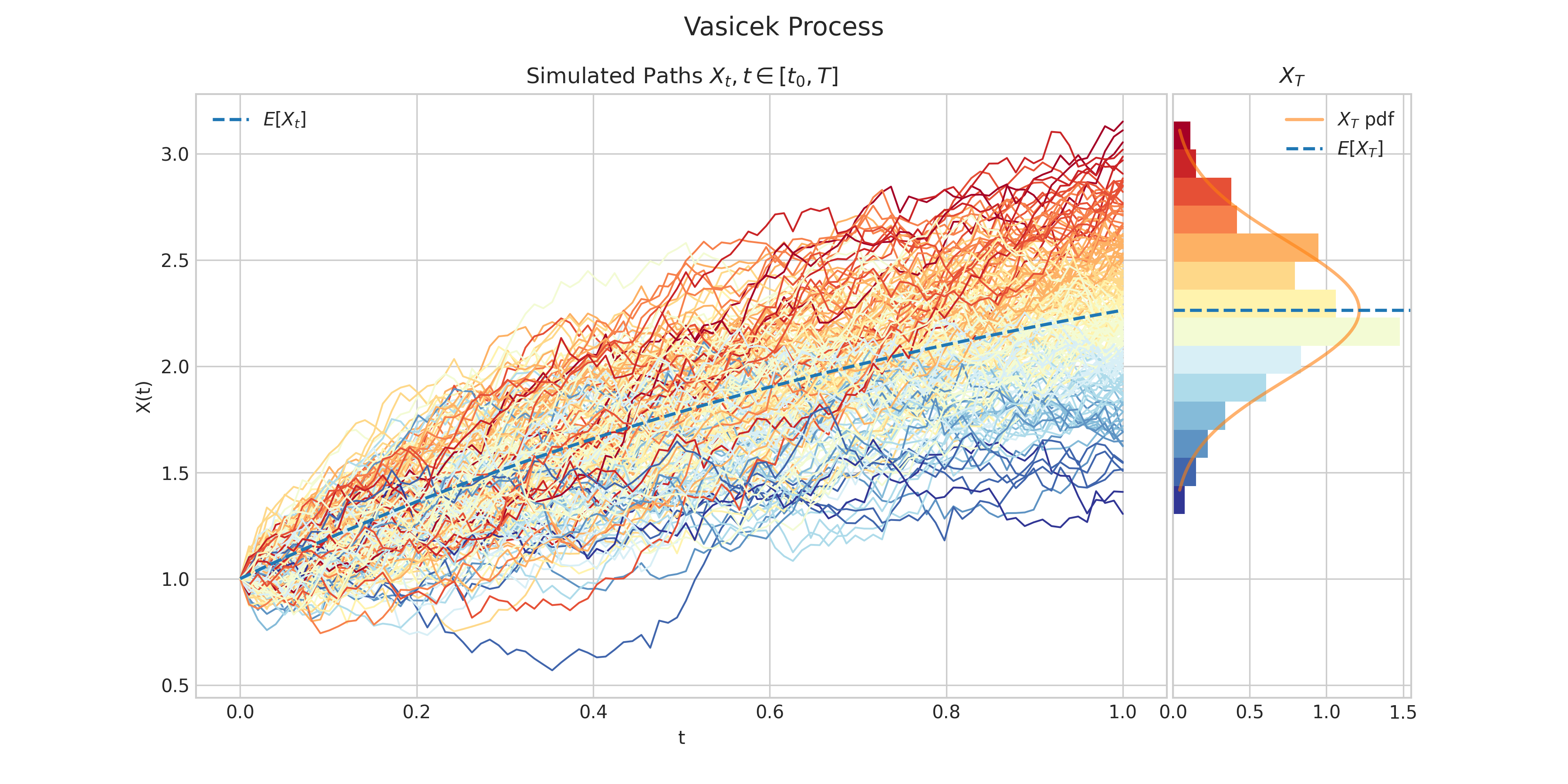
Currently, aleatory supports the following stochastic processes in one dimension:
- Arithmetic Brownian Motion (see Brownian Motion)
- Bessel process
- Brownian Bridge
- Brownian Excursion
- Brownian Meander
- Brownian Motion
- Constant Elasticity Variance (CEV) process
- Cox–Ingersoll–Ross (CIR) process
- Chan-Karolyi-Longstaff-Sanders (CKLS) process
- Fractional Brownian Motion process
- Galton-Watson process with Poisson branching
- Gamma process
- Gaussian Process with Constant Kernel
- Gaussian Process with Linear Kernel
- Gaussian Process with Matern Kernel
- Gaussian Process with Periodic Kernel
- Gaussian Process with RBF Kernel
- Gaussian Process with Squared Exponential Kernel
- General Random Walk
- Geometric Brownian Motion
- Hawkes process
- Inverse Gaussian process
- Inhomogeneous Poisson process
- Mixed Poisson process
- Ornstein–Uhlenbeck (OU) process
- Poisson process
- Random Walk
- Squared Bessel processes
- Vasicek process
- Variance-Gamma process
- White Noise
From v1.1.1 aleatory supports the following 2-d stochastic processes:
Installation
Aleatory is available on pypi and can be installed as follows
pip install aleatory
Dependencies
Aleatory relies heavily on
numpyfor random number generationscipyandstatsmodelsfor support for a number of one-dimensional distributions.matplotlibfor creating visualisations
Compatibility
Aleatory is tested on Python versions 3.8, 3.9, 3.10, and 3.11
Quick-Start
Aleatory allows you to create fancy visualisations from different stochastic processes in an easy and concise way.
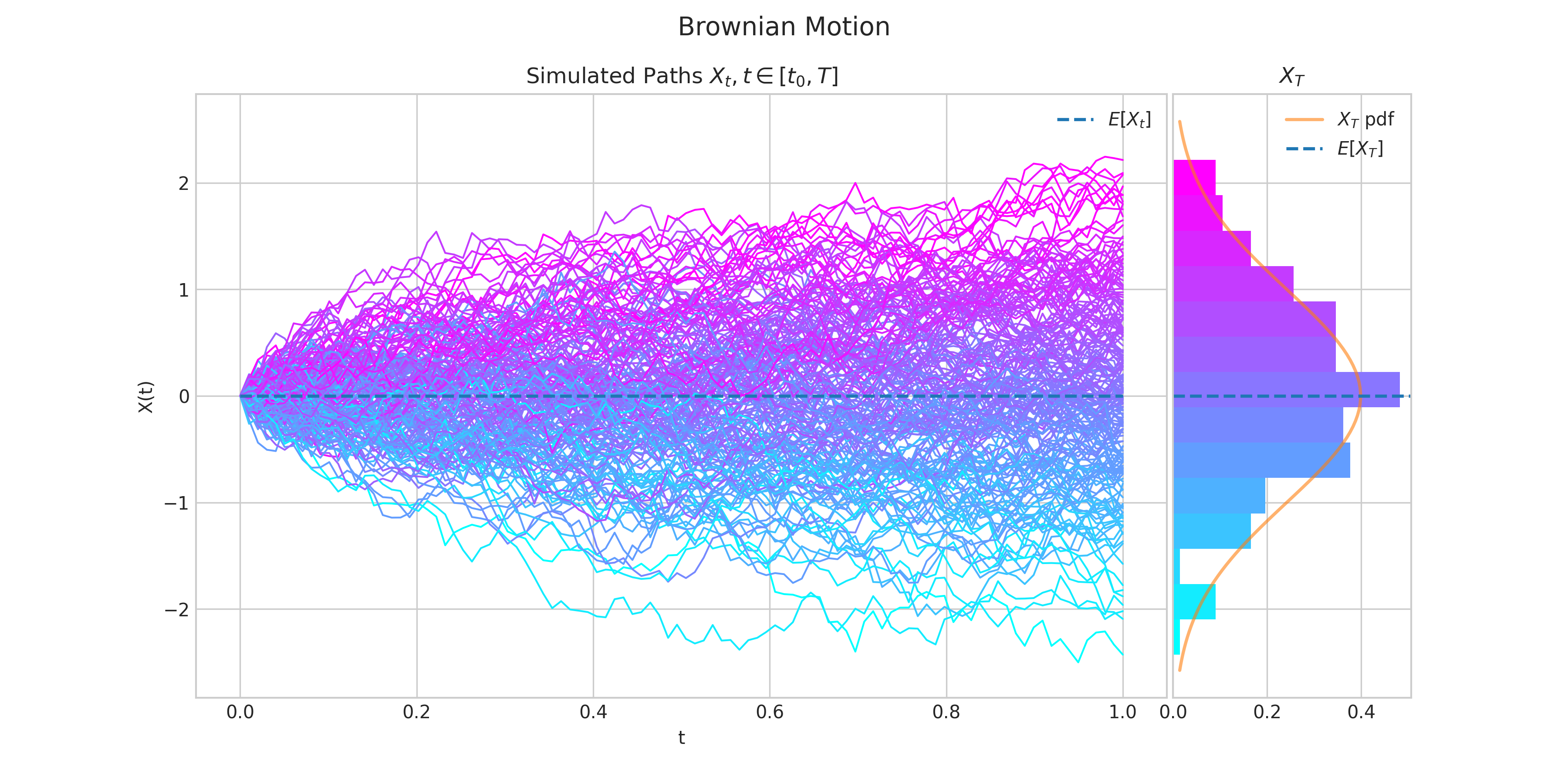
For example, the following code
from aleatory.processes import BrownianMotion

brownian = BrownianMotion()
brownian.draw(n=100, N=100, colormap="cool", figsize=(12,9))
generates a chart like this:
For more examples visit the Quick-Start Guide.
If you like this project, please give it a star! ⭐️
Thanks for Visiting! ✨
Connect with me via:
- 👾 Personal Website
1 maintainer

Metadata
1 maintainer
Release files for aleatory 1.2.4
For a detailed explanation of source distributions (sdists) and built distributions (wheels), please see the package formats documentation.
Source distribution (sdist)
| File | Size | Uploaded | Provenance | Actions |
|---|---|---|---|---|
| aleatory-1.2.4.tar.gz | 75.7 kB | Without provenance | Details for aleatory-1.2.4.tar.gz |
Built distribution (wheel)
| File | Interpreter | ABI | Platform | Actions Reset |
|---|---|---|---|---|
| aleatory-1.2.4-py3-none-any.whl | Python 3 | none | any | Details for aleatory-1.2.4-py3-none-any.whl |
Total release size: 181.6 kB
Release files / aleatory-1.2.4.tar.gz
| Download URL | aleatory-1.2.4.tar.gz |
|---|---|
| Size | 75.7 kB |
| Tags | Source |
|
SHA-256 checksum How to use checksums |
1363c8b6cdbe9ab188701ac8c1664017ea82a8b7df29716051c6d57abb7b0b72
|
|
BLAKE2b-256 checksum How to use checksums |
a4324b709bf9302361a42bf92b1606e992f995e6e9b5b60d9b3680bbfb810c05
|
| Upload date | |
|
Uploaded using Trusted Publishing? What is trusted publishing? |
No |
| Uploaded via |
twine/6.2.0 CPython/3.11.4
|
Release files / aleatory-1.2.4-py3-none-any.whl
| Download URL | aleatory-1.2.4-py3-none-any.whl |
|---|---|
| Size | 105.9 kB |
| Tags | Python 3 |
|
SHA-256 checksum How to use checksums |
25918c27b731315f1da0c32b18d026437c4786e639131584dd16fbc3b8c357e5
|
|
BLAKE2b-256 checksum How to use checksums |
0a3968249a7903c25df6085bdeceeca3821a4909782815654e20d5b84adaf354
|
| Upload date | |
|
Uploaded using Trusted Publishing? What is trusted publishing? |
No |
| Uploaded via |
twine/6.2.0 CPython/3.11.4
|
Security for aleatory 1.2.4
Provenance
Provenance describes where a file came from. On PyPI, provenance is shared via attestations, which provide a verifiable record of the build or publishing details. View details, limitations and caveats.
No provenance found
None of the files in this release were uploaded with provenance metadata.
A note on package security
PyPI is a repository for distributing packages, not a service for auditing them. While third-party security researchers and our staff do their best to detect and remove malicious packages, PyPI cannot guarantee the quality, security or suitability of any given package.
To learn more about protecting yourself from malicious actors, visit our package security documentation.














