
Gandalf the Grader 



Your verifier is probably the bottleneck. We built one that isn't.
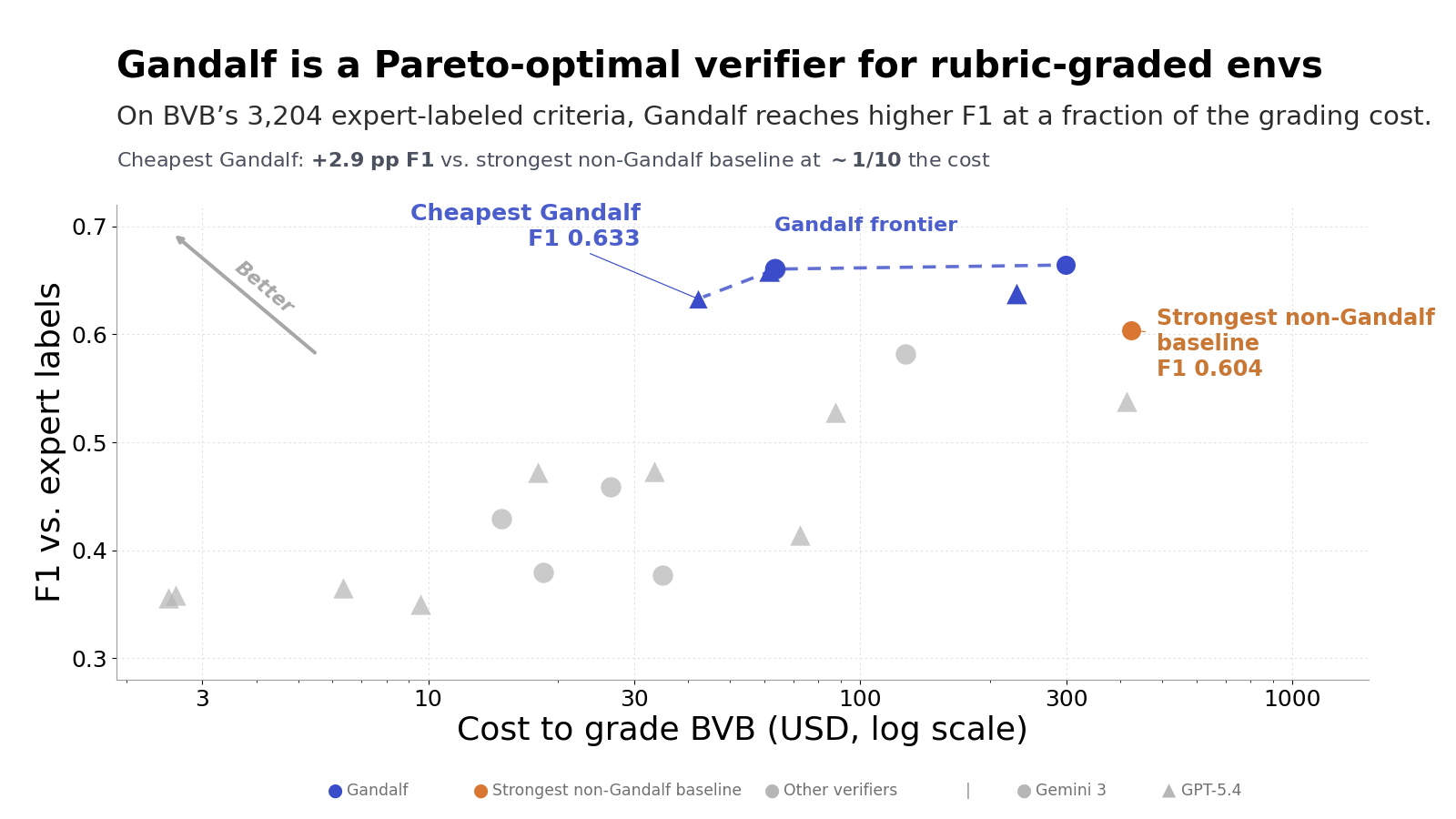
Read the launch blog post for the motivation, benchmark results, and design rationale behind Gandalf.
Gandalf is a reactive agent-as-judge for rubric-graded agent environments. Given a rubric of binary criteria, it runs inside the rollout environment, uses the same tools as the rollout agent, and decides at inference time which files to open and which tool state to query.
That lets Gandalf grade criteria that depend on artifacts or state — formulas in a workbook, charts in a deck, files on disk, MCP tool state, or whether an email was actually sent — rather than just the final text response.
Gandalf is built around three design choices:
-
Environment alignment: Gandalf runs in the same filesystem, Python interpreter, installed packages, and tool environment as the rollout agent, using the OpenHands SDK as the agent harness.
-
Reactive verification: Gandalf chooses what evidence to inspect while grading, instead of relying on a precomputed transcript or serialized snapshot.
-
Swappable domain guidance: Domain knowledge enters as natural-language guidance at runtime, making the same verifier portable across domains.
In our evaluation, this design beat text-only, snapshot-based, and workflow-based agentic verifiers at a fraction of the cost — see the blog post for the full meta-eval.
Examples and integrations: BankerToolBench is a public agentic RL benchmark environment that uses Gandalf as the verifier. rle-pkg is a reference runtime that integrates Gandalf. Both run under the Harbor framework, but Gandalf's design and implementation are framework-agnostic.
Installation
Gandalf is published on PyPI.
uv tool install gandalf-the-grader
For production use, we recommend that you pin a specific version of Gandalf, and furthermore use the [pinned] version to pin all transitive dependencies.
uv tool install 'gandalf-the-grader[pinned]==1.0.0'
Runtime dependencies
Important: Gandalf is built on top of OpenHands, which works best when tmux is installed. The judge refuses to run when tmux is not on PATH rather than silently falling back to a less stable subprocess-based terminal.
Quick start
The repo ships a runnable example under examples/quickstart/ that grades a pre-staged workspace + ATIF trajectory against a 3-criterion rubric. Two criteria are designed to be met and one is designed to fail, so you can see Gandalf's partial-credit grading and per-criterion reasoning in one run. From a fresh clone:
# 1. Install
uv tool install gandalf-the-grader

# 2. Provide a Gemini API key (any litellm-compatible model works; see Configuration)
export LLM_API_KEY="<your-gemini-api-key>"

# 3. Run from the repo root
gandalf-the-grader --config examples/quickstart/grader.toml

# 4. Inspect the result
cat examples/quickstart/output/reward.json   # -> {"reward": 0.75}
cat examples/quickstart/output/info.json     # per-criterion verdicts + reasoning
Expected verdicts: the welcome.txt file exists (met), the message mentions Gandalf (met), and the message is not longer than 50 words (unmet, by design). Raw score 3.0 of a possible 4.0, for a reward of 0.75.
The example uses gemini/gemini-2.5-flash and runs the inner judge as the current user (no sandbox_user, no sudo). To adapt it to your own setup, edit examples/quickstart/grader.toml. See the Configuration section below for the full field reference.
Configuration
grader.toml
| Field | Required | Default | Description |
|---|---|---|---|
instructions |
Yes* | Inline task instructions given to the original agent (mutually exclusive with instructions_path) |
|
instructions_path |
Yes* | Path to a file with task instructions (mutually exclusive with instructions) |
|
rubric |
Yes* | Inline rubric as a TOML array of tables (mutually exclusive with rubric_path) |
|
rubric_path |
Yes* | Path to rubric JSON file (mutually exclusive with rubric) |
|
judge_guidance |
No | Inline judge guidance text (mutually exclusive with judge_guidance_path) |
|
judge_guidance_path |
No | Path to a file with extra judge instructions (mutually exclusive with judge_guidance) |
|
workdir |
Yes | Agent workspace directory | |
trajectory_path |
Yes | Path to ATIF trajectory JSON | |
output_dir |
Yes | Directory for grader output files | |
model |
No | gemini/gemini-2.5-flash |
LLM model for the judge agent |
mode |
No | batch |
Evaluation mode: batch or individual |
judge_timeout |
No | 300 |
Max seconds per judge invocation |
batch_timeout |
No | Max total seconds for batch mode (caps judge_timeout * N) |
|
judge_retries |
No | 1 |
Number of retry attempts for criteria that error due to infrastructure failures |
batch_splits |
No | Split criteria into N chunks in batch mode (>= 2). Each chunk is evaluated as a separate batch session. Only valid with mode = "batch". |
|
max_concurrency |
No | Max parallel judge sessions (>= 1). Defaults to 1 for individual mode, batch_splits for batch mode. |
|
sandbox_user |
No | Username for running the inner judge (via sudo). When omitted the judge runs as the current user. | |
judge_prompt |
No | Inline Jinja2 template that completely overrides the built-in judge task prompt (mutually exclusive with judge_prompt_path) |
|
judge_prompt_path |
No | Path to a Jinja2 template file that completely overrides the built-in judge task prompt (mutually exclusive with judge_prompt) |
MCP servers can be configured as TOML array of tables:
[[mcp_servers]]
name = "magic-server"
transport = "stdio"
command = "/usr/bin/mcp-server"
args = ["--verbose"]
Custom Judge Prompt
By default, the grader uses a built-in prompt template to kick off each judge session. judge_prompt / judge_prompt_path let you replace it entirely with a custom Jinja2 template.
Note: This prompt is sent as the opening user message to the judge agent, not the LLM system prompt. The underlying agent framework (OpenHands) has its own immutable system message with coding and tool-use instructions that we never modify. Our prompt sits on top of that as the first user turn, setting up the grading task.
For most use cases, judge_guidance / judge_guidance_path is all you need: it injects extra instructions into the built-in prompt without replacing it. Fully overriding the judge prompt is an uncommon escape hatch for situations where the built-in prompt structure itself is unsuitable.
The template receives these variables:
| Variable | Type | Mode | Description |
|---|---|---|---|
instructions |
str |
both | Task instructions given to the original agent |
final_output |
str |
both | Agent's final message from the trajectory |
criterion |
str |
individual | The single criterion string to evaluate |
criteria |
list[str] |
batch | List of all criterion strings to evaluate |
verdict_path |
str |
both | File path the judge must write its verdict to |
judge_guidance |
str |
both | Additional guidance text (may be empty) |
Individual and batch modes use separate built-in templates. In a custom template, use {% if criterion is defined %} vs {% if criteria is defined %} if you need to distinguish modes. In batch mode, use loop.index0 for the criterion index (e.g., {% for c in criteria %}[{{ loop.index0 }}] {{ c }}{% endfor %}).
Rubric JSON
A JSON array of objects with criterion (string) and weight (float). Weights can be negative to penalise undesired outcomes:
[
  {"criterion": "The output file exists", "weight": 2.0},
  {"criterion": "The output contains correct totals", "weight": 3.0},
  {"criterion": "The agent used hardcoded values instead of computing", "weight": -1.0}
]
- Positive weight: adds to the raw score when the criterion's condition is met
- Negative weight: deducts from the raw score when the criterion's condition is met (the bad thing happened)
- The judge evaluates each criterion on its own merits; it never sees weights
Trajectory Format (ATIF)
The grader reads agent trajectories in Agent Trajectory Interchange Format (ATIF). An ATIF file is a JSON object with a steps array:
{
  "steps": [
    {"source": "user", "message": "Build a hello world web app"},
    {"source": "agent", "message": "I'll create the file now", "tool_calls": [...]},
    {"source": "agent", "message": "Done! I created index.html with a Hello World page."}
  ]
}
The grader extracts the final agent message (last "source": "agent" step with a non-empty message and no tool_calls) and passes it to the judge as context.
Environment Variables
| Variable | Description |
|---|---|
LLM_API_KEY |
API key for the LLM provider |
LLM_BASE_URL |
Base URL for the LLM API (optional) |
GRADER_INSTRUCTIONS_PATH |
Fallback path to task instructions file (if not set in TOML) |
GRADER_JUDGE_GUIDANCE_PATH |
Fallback path to judge guidance file (if not set in TOML) |
GRADER_JUDGE_PROMPT_PATH |
Fallback path to custom judge prompt template (if not set in TOML) |
OTEL_EXPORTER_OTLP_ENDPOINT |
OTLP endpoint URL for trace export (optional) |
OTEL_EXPORTER_OTLP_HEADERS |
OTLP auth headers, URL-encoded (optional) |
OTEL_EXPORTER_OTLP_TRACES_PROTOCOL |
OTLP transport protocol, e.g. http/protobuf (optional) |
Tracing / Observability
Gandalf builds on top of OpenHands, which has built-in OpenTelemetry tracing that automatically instruments LLM calls, tool executions, and agent steps. Set the OTEL_EXPORTER_OTLP_* variables above to export traces to any OTEL-compatible backend with no code changes required.
Example: Langfuse
# Encode your Langfuse keys
echo -n "pk-lf-...:sk-lf-..." | base64

# Export the variables
export OTEL_EXPORTER_OTLP_ENDPOINT=https://cloud.langfuse.com/api/public/otel/v1/traces
export OTEL_EXPORTER_OTLP_HEADERS="Authorization=Basic%20<base64-encoded-keys>"
export OTEL_EXPORTER_OTLP_TRACES_PROTOCOL=http/protobuf
Output
The grader writes to output_dir:
reward.json: Reward file (e.g.,{"reward": 0.75}) (always in [0, 1]). Only written when all criteria are successfully evaluated. If any criteria still have errors after retries, the grader writesinfo.jsonbut skipsreward.jsonand exits with code 1.info.json: Always written. Per-criterion results withmet/not-met, reasoning, evidence, LLM usage, plusreward,raw_score,minimum_score,maximum_score,errored_criterion_count, andevaluated_criteria_pct.judge_trace_*.txt: stdout/stderr capture for each judge invocation. Naming varies by mode:judge_trace_{i}.txt(individual),judge_trace_batch.txt(batch),judge_trace_batch_split{i}.txt(batch with splits). Retries append a_retry{N}suffix.
The reward in reward.json is clip(0, 1, raw_score / sum_of_positive_weights), always in [0, 1]. info.json additionally includes raw_score (the raw sum of weights for met criteria, which can be negative) and minimum_score/maximum_score bounds for reference.
Next steps
- Try the benchmark environment. BankerToolBench on Hugging Face is the public RL environment that Gandalf was originally evaluated against. Clone it, run rollouts, and grade them with Gandalf.
- Adapt Gandalf to a new rollout environment. Edit
examples/quickstart/grader.tomlto point at your workspace, trajectory, and rubric. See the Configuration and Custom Judge Prompt sections for the full reference, including domain-specific judge guidance.
License
Copyright (c) Handshake. Released under the Apache-2.0 license. See LICENSE.txt for details.
7 maintainers


Metadata
7 maintainers
Release files for gandalf-the-grader 1.0.2
For a detailed explanation of source distributions (sdists) and built distributions (wheels), please see the package formats documentation.
Source distribution (sdist)
| File | Size | Uploaded | |
|---|---|---|---|
| gandalf_the_grader-1.0.2.tar.gz | 337.6 kB | Details |
Built distribution (wheel)
| File | Interpreter | ABI | Platform | Reset |
|---|---|---|---|---|
| gandalf_the_grader-1.0.2-py3-none-any.whl | Python 3 | none | any | Details |
Total release size: 373.2 kB
Release files / gandalf_the_grader-1.0.2.tar.gz
| Download URL | gandalf_the_grader-1.0.2.tar.gz |
|---|---|
| Size | 337.6 kB |
| Tags | Source |
|
SHA-256 checksum How to use checksums |
c580e25e8fc8e3c7bd46c0b10787e922210a62a53d62bb662d7a2953afdb3f62
|
|
BLAKE2b-256 checksum How to use checksums |
fad2fa1acd54639492f5071dea8b69239f282028f823b35bbffb707960fe04f3
|
| Upload date | |
|
Uploaded using Trusted Publishing? What is trusted publishing? |
Yes |
| Uploaded via |
twine/7.0.0 CPython/3.13.14
|
Provenance
Provenance describes where a file came from. On PyPI, provenance is shared via attestations, which provide a verifiable record of the build or publishing details. View details, limitations and caveats.


PyPI Publish Attestation
PyPI verified that this artifact, at this checksum, originated from the publisher listed below.
Signed by GitHub Actions, verified by PyPI on Sep 18, 2026.
Transparency logRelease files / gandalf_the_grader-1.0.2-py3-none-any.whl
| Download URL | gandalf_the_grader-1.0.2-py3-none-any.whl |
|---|---|
| Size | 35.6 kB |
| Tags | Python 3 |
|
SHA-256 checksum How to use checksums |
57af90514b022f128c4a347347d19016cedc594f06a89f3cbecd734dc59b119e
|
|
BLAKE2b-256 checksum How to use checksums |
613288a5058229f75c94d160b7886c948586270b67ae3f23bfb8361b24a0f704
|
| Upload date | |
|
Uploaded using Trusted Publishing? What is trusted publishing? |
Yes |
| Uploaded via |
twine/7.0.0 CPython/3.13.14
|
Provenance
Provenance describes where a file came from. On PyPI, provenance is shared via attestations, which provide a verifiable record of the build or publishing details. View details, limitations and caveats.
PyPI Publish Attestation
PyPI verified that this artifact, at this checksum, originated from the publisher listed below.
Signed by GitHub Actions, verified by PyPI on Sep 18, 2026.
Transparency log













