
ITU-Rpy






A python implementation of the ITU-R P. Recommendations to compute atmospheric attenuation in slant and horizontal paths.
The propagation loss on an Earth-space path and a horizontal-path, relative to the free-space loss, is the sum of different contributions, namely: attenuation by atmospheric gases; attenuation by rain, other precipitation and clouds; scintillation and multipath effects; attenuation by sand and dust storms. Each of these contributions has its own characteristics as a function of frequency, geographic location and elevation angle. ITU-Rpy allows for fast, vectorial computation of the different contributions to the atmospheric attenuation.
Documentation
The documentation can be found at ITU-Rpy documentation in Read the docs.
Examples of use cases can be found in the examples folder.
Installation
ITU-Rpy has the followind dependencies: numpy, scipy, pyproj, and astropy. Installation of cartopy and matplotlib is recommended to display results in a map.
Using pip, you can install all of them by running:
pip install iturMore information about the installation process can be found on the documentation.
ITU-R Recommendations implemented
- The following ITU-R Recommendations are implemented in ITU-Rpy
ITU-R P.453-13: The radio refractive index: its formula and refractivity data
ITU-R P.530-17: Propagation data and prediction methods required for the design of terrestrial line-of-sight systems
ITU-R P.618-13: Propagation data and prediction methods required for the design of Earth-space telecommunication systems
ITU-R P.676-12: Attenuation by atmospheric gases
ITU-R P.835-6: Reference Standard Atmospheres
ITU-R P.836-6: Water vapour: surface density and total columnar content
ITU-R P.837-7: Characteristics of precipitation for propagation modelling
ITU-R P.838-3: Specific attenuation model for rain for use in prediction methods
ITU-R P.839-4: Rain height model for prediction methods.
ITU-R P.840-8: Attenuation due to clouds and fog
ITU-R P.1144-10: Interpolation methods for the geophysical properties used to compute propagation effects
ITU-R P.1510-1: Mean surface temperature
ITU-R P.1511-2: Topography for Earth-to-space propagation modelling
ITU-R P.1623-1: Prediction method of fade dynamics on Earth-space paths
ITU-R P.1853-1: Tropospheric attenuation time series synthesis
The individual models can be accessed using the itur.models package.
Usage
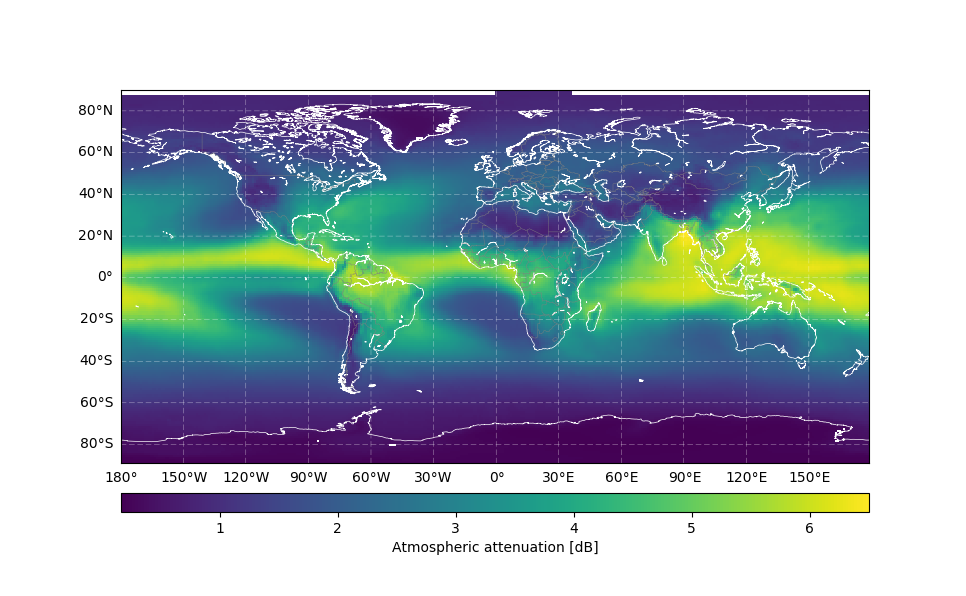
The following code example shows the usage of ITU-Rpy. More examples can be found in the examples folder.
import itur

f = 22.5 * itur.u.GHz    # Link frequency
D = 1 * itur.u.m         # Size of the receiver antenna
el = 60                  # Elevation angle constant of 60 degrees
p = 3                    # Percentage of time that attenuation values are exceeded.

# Generate a regular grid latitude and longitude points with 1 degrees resolution
lat, lon = itur.utils.regular_lat_lon_grid()

# Comute the atmospheric attenuation
Att = itur.atmospheric_attenuation_slant_path(lat, lon, f, el, p, D)
itur.plotting.plot_in_map(Att.value, lat, lon,
                          cbar_text='Atmospheric attenuation [dB]')
which produces:
Validation
ITU-Rpy has been validated using the ITU Validation examples (rev 5.1) , which provides test cases for parts of Recommendations ITU-R P.453-14, P.618-13, P.676-12, P.836-6, P.837-7, P.838-3, P.839-4, P.840-8, P.1511-2, P.1623-1.
The results of this validation exercise are available at the validation page in the documentation.
Citation
If you use ITU-Rpy in one of your research projects, please cite it as:
@misc{iturpy-2017,
      title={ITU-Rpy: A python implementation of the ITU-R P. Recommendations to compute atmospheric
         attenuation in slant and horizontal paths.},
      author={Inigo del Portillo},
      year={2017},
      publisher={GitHub},
      howpublished={\url{https://github.com/inigodelportillo/ITU-Rpy/}}
}
1 maintainer

Metadata
1 maintainer
Release files for itur 0.4.0
For a detailed explanation of source distributions (sdists) and built distributions (wheels), please see the package formats documentation.
Source distribution (sdist)
| File | Size | Uploaded | Provenance | |
|---|---|---|---|---|
| itur-0.4.0.tar.gz | 163.4 MB | Without provenance | Details |
Built distribution (wheel)
| File | Interpreter | ABI | Platform | Reset |
|---|---|---|---|---|
| itur-0.4.0-py2.py3-none-any.whl | Python 3, Python 2 | none | any | Details |
Total release size: 326.7 MB
Release files / itur-0.4.0.tar.gz
| Download URL | itur-0.4.0.tar.gz |
|---|---|
| Size | 163.4 MB |
| Tags | Source |
|
SHA-256 checksum How to use checksums |
b833021dc11321f28a03560ec4ee27cdff60234bf4ec25642f013e33d254411e
|
|
BLAKE2b-256 checksum How to use checksums |
9c57d0eaedc1829a410b2c17e12259c423993186de0af233da5f83a2ea0674a1
|
| Upload date | |
|
Uploaded using Trusted Publishing? What is trusted publishing? |
No |
| Uploaded via |
twine/4.0.2 CPython/3.9.16
|
Release files / itur-0.4.0-py2.py3-none-any.whl
| Download URL | itur-0.4.0-py2.py3-none-any.whl |
|---|---|
| Size | 163.4 MB |
| Tags | Python 2 Python 3 |
|
SHA-256 checksum How to use checksums |
d7a357172216075b9f0b8f38cd68ce975dba1b7e22db8329f013e6ef651db9b2
|
|
BLAKE2b-256 checksum How to use checksums |
617be682678c0a6fcdd4529abc5f22324149cd7a725138465d76885a3a53c88f
|
| Upload date | |
|
Uploaded using Trusted Publishing? What is trusted publishing? |
No |
| Uploaded via |
twine/4.0.2 CPython/3.9.16
|
Security for itur 0.4.0
Provenance
Provenance describes where a file came from. On PyPI, provenance is shared via attestations, which provide a verifiable record of the build or publishing details. View details, limitations and caveats.
No provenance found
None of the files in this release were uploaded with provenance metadata.
A note on package security
PyPI is a repository for distributing packages, not a service for auditing them. While third-party security researchers and our staff do their best to detect and remove malicious packages, PyPI cannot guarantee the quality, security or suitability of any given package.
To learn more about protecting yourself from malicious actors, visit our package security documentation.














