





A well tested, cli, python version-agnostic, multi-platform hangman game. It’s built following a TDD workflow and a MVC design pattern. Each component services a sensibly distinct logical purpose. Python Hangman is a version agnostic, tox tested, travis-backed program! Documented and distributed.
Features
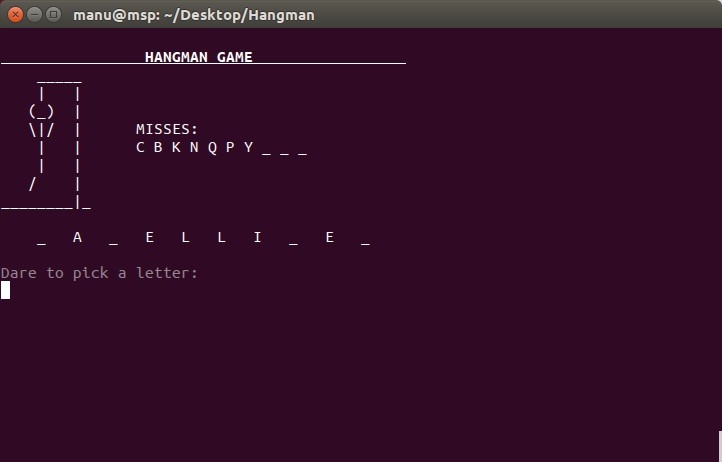
Hangman!
Documentation: https://python_hangman.readthedocs.org
Open Source: https://github.com/bionikspoon/python_hangman
Idiomatic code.
Thoroughly tested with very high coverage.
Python version agnostic.
Demonstrates MVC design out of the scope of web development.
MIT license
Compatibility

Python 2.6
Python 2.7
Python 3.3
Python 3.4
Python 3.5
PyPy
Installation
At the command line either via easy_install or pip
$ mkvirtualenv hangman  # optional for venv users
$ pip install python_hangman
$ hangman
Uninstall
$ pip uninstall python_hangmanGoals
2.0.0
MVC pattern. The goal was to explicitly demonstrate an MVC pattern out of the scope of web development.
Idiomatic code. In this overhaul there’s a big emphasis on idiomatic code. The code should be describing its’ own intention with the clarity your grandmother could read.
1.0.0
Learning! This was a Test Driven Development(TDD) exercise.
Also, explored:
Tox, test automation
Travis CI
Python version agnostic programming
Setuptools
Publishing on pip
Coverage via coveralls
Documentation with sphinx and ReadTheDocs
Cookiecutter development
Design
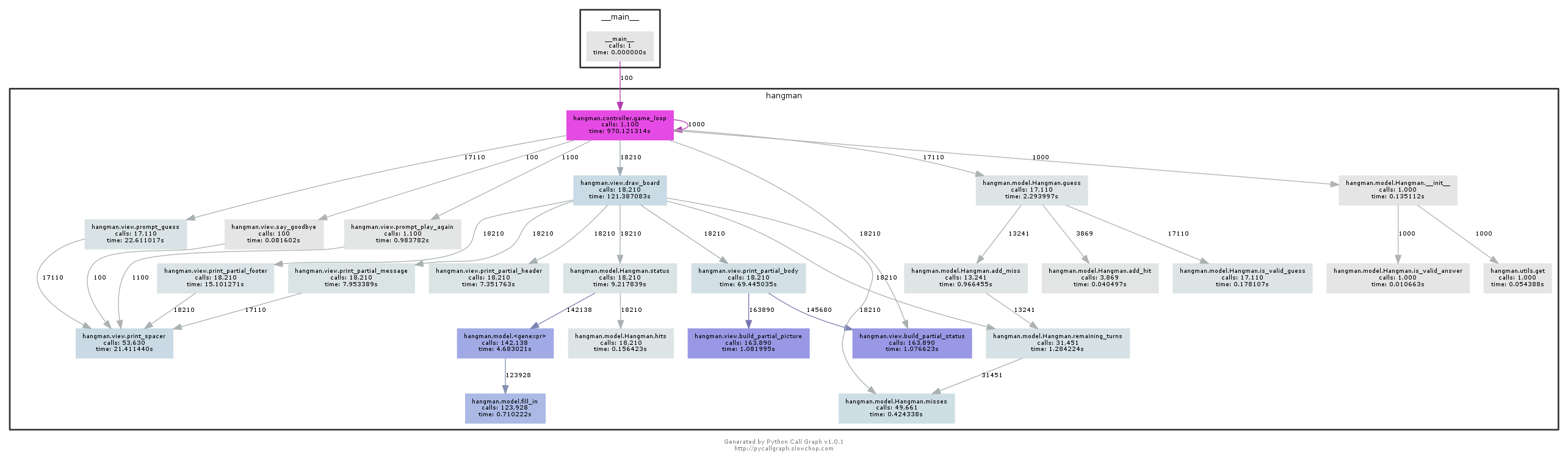
This game roughly follows the Model-View-Controller(MVC) pattern. In the latest overhaul, these roles have been explicitly named: hangman.model, hangman.view, hangman.controller.
Traditionally in MVC the controller is the focal point. It tells the view what information to collect from the user and what to show. It uses that information to communicate with the model–also, the data persistence later–and determine the next step. This Hangman MVC adheres to these principals
Model
The model is very simply the hangman game instance–hangman.model.Hangman. It’s a class. Every class should have “state” and the methods of that class should manage that state. In this case, the “state” is the current “state of the game”. The public API are for managing that state.
The entirety of the game logic is contained in hangman.model.Hangman. You could technically play the game in the python console by instantiating the class, submitting guesses with the method hangman.model.Hangman.guess and printing the game state.
For example:
>>> from hangman.model import Hangman
>>> game = Hangman(answer='hangman')
>>> game.guess('a')
hangman(status='_A___A_', misses=[], remaining_turns=10)

>>> game.guess('n').guess('z').guess('e')
hangman(status='_AN__AN', misses=['E', 'Z'], remaining_turns=8)

>>> game.status
'_AN__AN'

>>> game.misses
['E', 'Z']

>>> game.remaining_turns
8
View
hangman.view is a collection of stateless functions that represent the presentation layer. When called these functions handles printing the art to the console, and collecting input from the user.
Controller
In this program, the controller is actually the “game_loop”–hangman.controller.game_loop. I still think of it as a controller because the role it plays–communicating I/O from the view with the model-persistence layer.
The controller tells the view later what to print and what data to collect. It uses that information update the state of the game (model) and handle game events.
Call Diagram
Credits
Tools used in rendering this package:
History
Next Release
Stay Posted
2.2.0 (2015-18-05)
Fixed max recursion issue with game loop.
Updated requirements.
Removed gratuitous docs – less is more.
2.2.1 Handle ctrl+d EOF to exit.
2.2.2 Fix broken coverage report.
2.2.3 Fix broken wheel
2.1.0 (2015-18-05)
Updated docs, divided and automated in a more reasonable way.
renamed the github repo to mirror pypi name.
2.1.1 Fix pypi’s rst render
2.0.0 (2015-12-05)
Establishing a changelog.
Massive refactoring, explicit MVC structure.
Code is even more idiomatic!
Created a FlashMessage utility.
Removed poorly implemented classes in favor of stateless functions.
Add, Remove support for py35, py32.
100% code coverage. (2 untestable, inconsequential lines ignored)
1 maintainer

Metadata
1 maintainer
Release files for python_hangman 2.2.3
For a detailed explanation of source distributions (sdists) and built distributions (wheels), please see the package formats documentation.
Source distribution (sdist)
| File | Size | Uploaded | Provenance | |
|---|---|---|---|---|
| python_hangman-2.2.3.tar.gz | 24.5 kB | Without provenance | Details |
Built distribution (wheel)
| File | Interpreter | ABI | Platform | Reset |
|---|---|---|---|---|
| python_hangman-2.2.3-py2.py3-none-any.whl | Python 2, Python 3 | none | any | Details |
Total release size: 39.3 kB
Release files / python_hangman-2.2.3.tar.gz
| Download URL | python_hangman-2.2.3.tar.gz |
|---|---|
| Size | 24.5 kB |
| Tags | Source |
|
SHA-256 checksum How to use checksums |
c61a15769f6224fdf3089974183d5ef03370b25d224d41f61f50f6975fe343e3
|
|
BLAKE2b-256 checksum How to use checksums |
e9a446c566936d8c3d7b1503e0b8eacd0c1b2ca9d20e15a043c1053bae3c924a
|
| Upload date | |
|
Uploaded using Trusted Publishing? What is trusted publishing? |
No |
Release files / python_hangman-2.2.3-py2.py3-none-any.whl
| Download URL | python_hangman-2.2.3-py2.py3-none-any.whl |
|---|---|
| Size | 14.7 kB |
| Tags | Python 2 Python 3 |
|
SHA-256 checksum How to use checksums |
3577561c04f80a8fdc50b0c2070072dc343a72613d4f74e3a07a6279ca7a02a6
|
|
BLAKE2b-256 checksum How to use checksums |
a83013952e304d9cebb853039643a357a691aa2c250e1f228691317f7b35db77
|
| Upload date | |
|
Uploaded using Trusted Publishing? What is trusted publishing? |
No |
Security for python_hangman 2.2.3
Provenance
Provenance describes where a file came from. On PyPI, provenance is shared via attestations, which provide a verifiable record of the build or publishing details. View details, limitations and caveats.
No provenance found
None of the files in this release were uploaded with provenance metadata.
A note on package security
PyPI is a repository for distributing packages, not a service for auditing them. While third-party security researchers and our staff do their best to detect and remove malicious packages, PyPI cannot guarantee the quality, security or suitability of any given package.
To learn more about protecting yourself from malicious actors, visit our package security documentation.














