
This release is a pre-release and may not be stable for production use.

Computational Uncertainty Quantification for Inverse Problems in python



CUQIpy stands for Computational Uncertainty Quantification for Inverse Problems in python. It's a robust Python package designed for modeling and solving inverse problems using Bayesian inference. Here's what it brings to the table:
- A straightforward high-level interface for UQ analysis.
- Complete control over the models and methods.
- An array of predefined distributions, samplers, models, and test problems.
- Easy extendability for your unique needs.
CUQIpy is part of the CUQI project supported by the Villum Foundation.
📚 Resources
-
Documentation: CUQIpy website
-
CUQI book: CUQI book website
-
User showcases: Showcase repository
🚀 Quickstart
Install CUQIpy using pip:
pip install cuqipy
For more detailed instructions, see the Getting Started guide.
🧪 Quick Example - UQ in a few lines of code
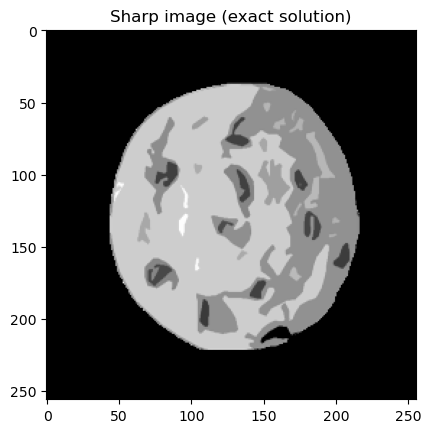
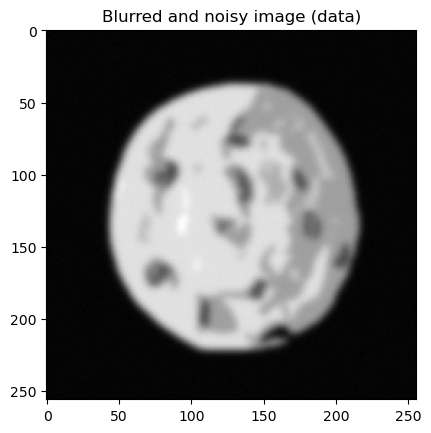
Experience the simplicity and power of CUQIpy with this Image deconvolution example. Getting started with UQ takes just a few lines of code:
# Imports
import matplotlib.pyplot as plt
from cuqi.testproblem import Deconvolution2D
from cuqi.distribution import Gaussian, LMRF, Gamma
from cuqi.problem import BayesianProblem

# Step 1: Set up forward model and data, y = Ax
A, y_data, info = Deconvolution2D(dim=256, phantom="cookie").get_components()

# Step 2: Define distributions for parameters
d = Gamma(1, 1e-4)
s = Gamma(1, 1e-4)
x = LMRF(0, lambda d: 1/d, geometry=A.domain_geometry)
y = Gaussian(A@x, lambda s: 1/s)

# Step 3: Combine into Bayesian Problem and sample posterior
BP = BayesianProblem(y, x, d, s)
BP.set_data(y=y_data)
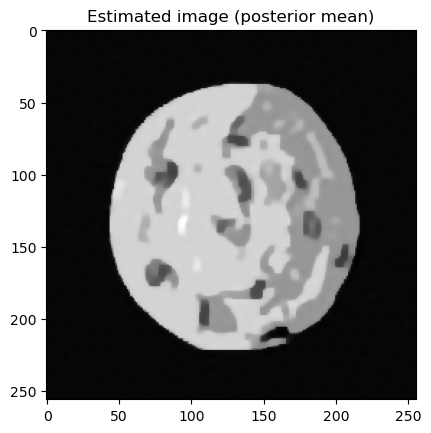
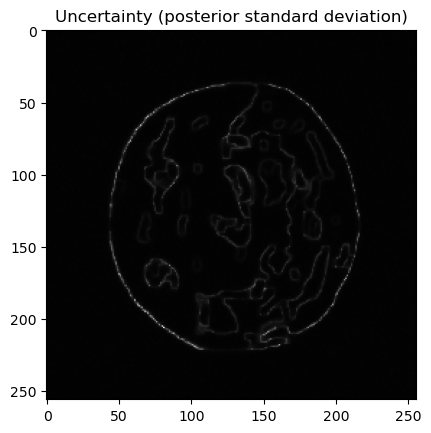
samples = BP.sample_posterior(200)

# Step 4: Analyze results
info.exactSolution.plot(); plt.title("Sharp image (exact solution)")
y_data.plot(); plt.title("Blurred and noisy image (data)")
samples["x"].plot_mean(); plt.title("Estimated image (posterior mean)")
samples["x"].plot_std(); plt.title("Uncertainty (posterior standard deviation)")
samples["s"].plot_trace(); plt.suptitle("Noise level (posterior trace)")
samples["d"].plot_trace(); plt.suptitle("Regularization parameter (posterior trace)")


🔌 Plugins
CUQIpy can be extended with additional functionality by installing optional plugins. We currently offer the following plugins:
-
CUQIpy-CIL A plugin for the Core Imaging Library (CIL) providing access to forward models for X-ray computed tomography.
-
CUQIpy-FEniCS: A plugin providing access to the finite element modelling tool FEniCS, which is used for solving PDE-based inverse problems.
-
CUQIpy-PyTorch: A plugin providing access to the automatic differentiation framework of PyTorch within CUQIpy. It allows gradient-based sampling methods without manually providing derivative information of distributions and forward models.
💻 Maintainers
🌟 Contributors
A big shoutout to our passionate team! Discover the talented individuals behind CUQIpy here.
🤝 Contributing
We welcome contributions to CUQIpy. Please see our contributing guidelines for more information.
1 maintainer

Download files
Download the file for your platform. If you're not sure which to choose, learn more about installing packages.
Source Distribution
Built Distribution
Filter files by name, interpreter, ABI, and platform.
If you're not sure about the file name format, learn more about wheel file names.
Copy a direct link to the current filters
File details
Details for the file cuqipy-1.2.0.post0.dev501.tar.gz.
File metadata
- Download URL: cuqipy-1.2.0.post0.dev501.tar.gz
- Upload date:
- Size: 2.3 MB
- Tags: Source
- Uploaded using Trusted Publishing? No
- Uploaded via:
twine/6.1.0 CPython/3.12.8
File hashes
| Algorithm | Hash digest | |
|---|---|---|
| SHA256 |
35cac965e23b0b2cc018fda47334de7e52226cff8e1af0bdf9f31a774b583875
|
|
| MD5 |
75b1a843ed938cdad97d9fa2dcdbaaee
|
|
| BLAKE2b-256 |
73e046294e37dcb0d474ba80d45733d73b479de38c386928263f7276907a0818
|
File details
Details for the file CUQIpy-1.2.0.post0.dev501-py3-none-any.whl.
File metadata
- Download URL: CUQIpy-1.2.0.post0.dev501-py3-none-any.whl
- Upload date:
- Size: 2.3 MB
- Tags: Python 3
- Uploaded using Trusted Publishing? No
- Uploaded via:
twine/6.1.0 CPython/3.12.8
File hashes
| Algorithm | Hash digest | |
|---|---|---|
| SHA256 |
517cd98a39750f9d75cbb4415e454084de1c255826ebdd5a2dfcd1d7b2f54361
|
|
| MD5 |
ae069786861927e75a23cf6a7a4ffcc9
|
|
| BLAKE2b-256 |
b3ab7cf5ebc3d3820bebc180389aa603fb311d40662ade08fd3709e34495667f
|














