

GRSdriver package
Driver dedicated to load and prepare data for the GRS processor





GRSdriver loads a Level-1 satellite image into a single xarray.Dataset ready for the
GRS atmospheric and sunglint correction:
- Sentinel-2 L1C (
.SAFE): top-of-atmosphere reflectance of the selected bands on a common grid, with accurate viewing angles computed per band and per detector from the granule metadata - Landsat 8 and 9 Collection-2 L1: reflectance, brightness temperature of the thermal bands, sun/viewing angles and L1 quality flags
- spectral response functions and central wavelengths of each band
- spatial subsetting, parallel reading, lazy (dask) loading and low memory options for full tiles
- visualization tools
Full documentation: https://grsdriver.readthedocs.io
What's new in 2.0
- pip-only install: EOReader and the GDAL Python bindings are no longer needed.
- ~2x faster: full Sentinel-2 tile at 20 m in ~30 s (bands read and angles computed in parallel), fully lazy dask mode in ~20 s.
- Fixes: Sentinel-2 angles of processing baselines < 4.0, alignment of the Landsat
panchromatic band, size of the
SpatioTempboxes. - Upgrading from 1.x: the drivers no longer take
**kwargs(they were passed to EOReader) and have no.readerattribute; asubsetgiven as a sequence is a bounding box(minx, miny, maxx, maxy)in the product CRS. See the CHANGELOG.
Installation
Python 3.9 to 3.13:
pip install GRSdriver
No separate GDAL installation is needed: rasterio and geopandas ship with their own GDAL (including the JPEG2000 driver for Sentinel-2). Optional extras:
| Extra | For | Install |
|---|---|---|
cli |
grs_driver command line (RGB quicklooks) |
pip install "GRSdriver[cli]" |
viz |
interactive visualization tools (GRSdriver.visual) |
pip install "GRSdriver[viz]" |
tutorials |
running the tutorial notebooks | pip install "GRSdriver[tutorials]" |
From the repository
To run the tutorials or work on the code:
git clone https://github.com/Tristanovsk/GRSdriver.git
cd GRSdriver
pip install -e ".[cli,viz,tutorials,dev]"
or with conda: conda env create -f environment.yml && conda activate grsdriver.
Quick start
from GRSdriver import Sentinel2Driver, LandsatDriver

# Sentinel-2: 20 m bands, viewing angles computed on a 60 m grid
l1c = Sentinel2Driver('S2B_MSIL1C_..._.SAFE', resolution=20)
l1c.load_product()
prod = l1c.prod          # bands, vza, raa, sza, SRF, wl_true + metadata

# Landsat 8/9
l1 = LandsatDriver('LC09_L1TP_..._02_T1', resolution=30)
l1.load_product()

# region of interest: any geometry (GeoSeries, any CRS), here a lon/lat box
import geopandas as gpd
from shapely.geometry import box
roi = gpd.GeoSeries([box(5.0, 43.38, 5.25, 43.58)], crs=4326)
l1c = Sentinel2Driver('S2B_MSIL1C_..._.SAFE', resolution=20, subset=roi)
The bands are read by 4 threads in parallel: set n_workers (e.g. n_workers=1) to trade speed
for memory. For a full Sentinel-2 tile at 10 m, Sentinel2Driver(..., lazy_geom=True) keeps the
per-band viewing angles lazy and saves several GB of memory. Set GRSDRIVER_USE_DASK=1 before
importing GRSdriver to get a fully lazy (dask-backed) product.
Command line
grs_driver writes an RGB quicklook (PNG) of a Sentinel-2 or Landsat product:
grs_driver S2B_MSIL1C_..._.SAFE --odir ./quicklooks --resolution 60
Tutorials
The notebooks are in docs/source/tutorials/ and rendered with their outputs in the
documentation:
| Notebook | Content |
|---|---|
GRSdriver_basics |
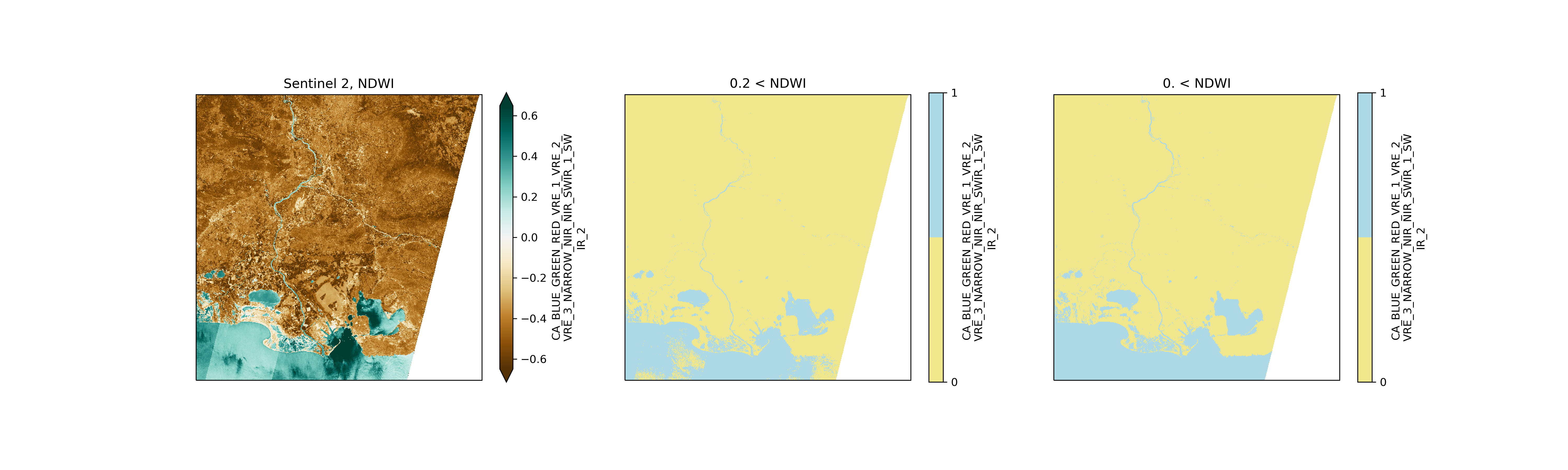
load a Sentinel-2 L1C image, geometry, RGB, NDWI water mask |
GRSdriver_subsetting |
subset a time series of images and build a datacube |
GRSdriver_landsat9_TIR |
Landsat 9 with its thermal bands |
GRSdriver_landsat9_L1_CAMS |
Landsat 9 with CAMS atmospheric data |
sentinel2_download |
download Sentinel-2 L1C images |
The paths to the images are those of the author's machine: set them to your own data. See Updating the tutorials to rerun them for the documentation.
Sentinel-2 viewing geometry
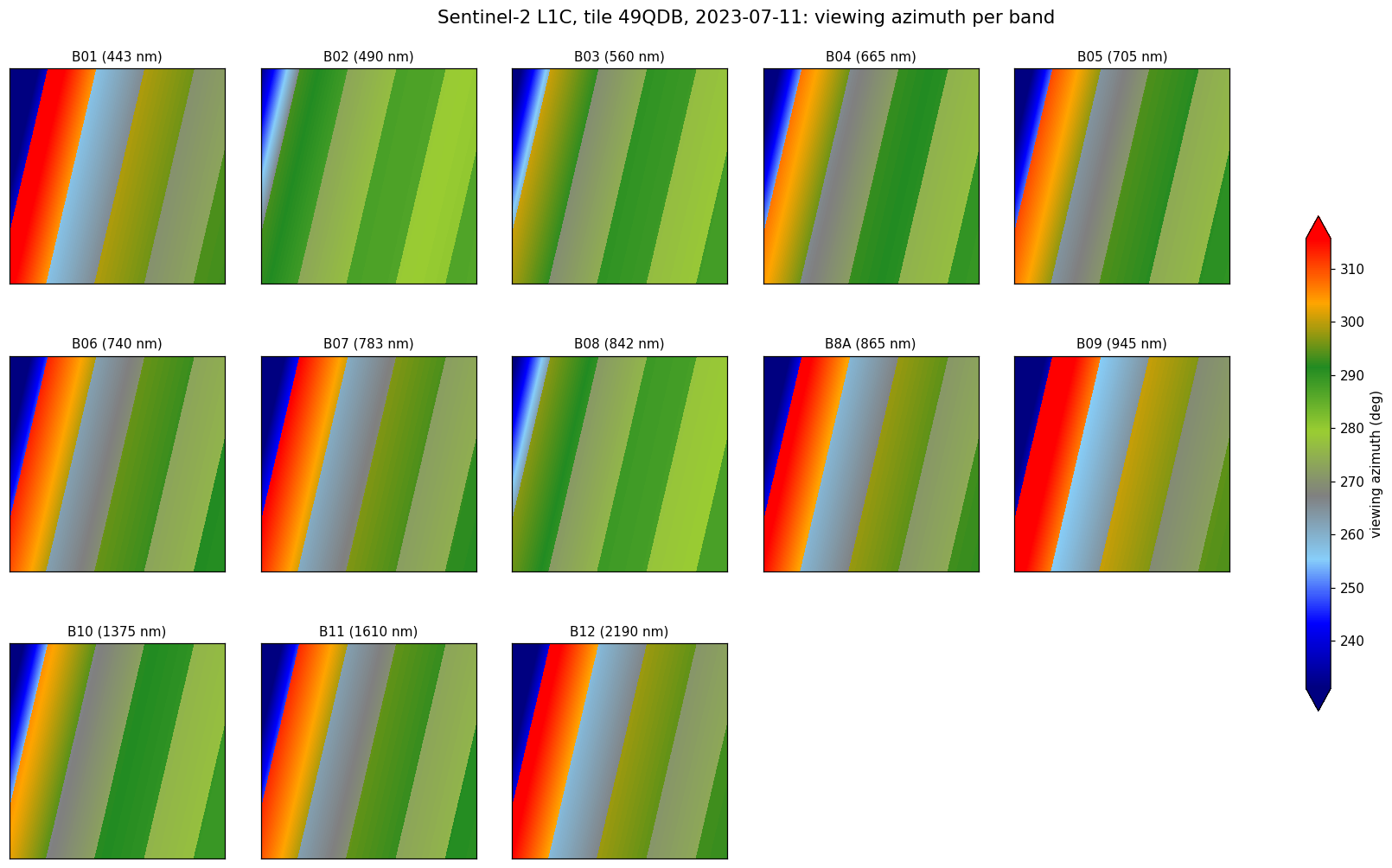
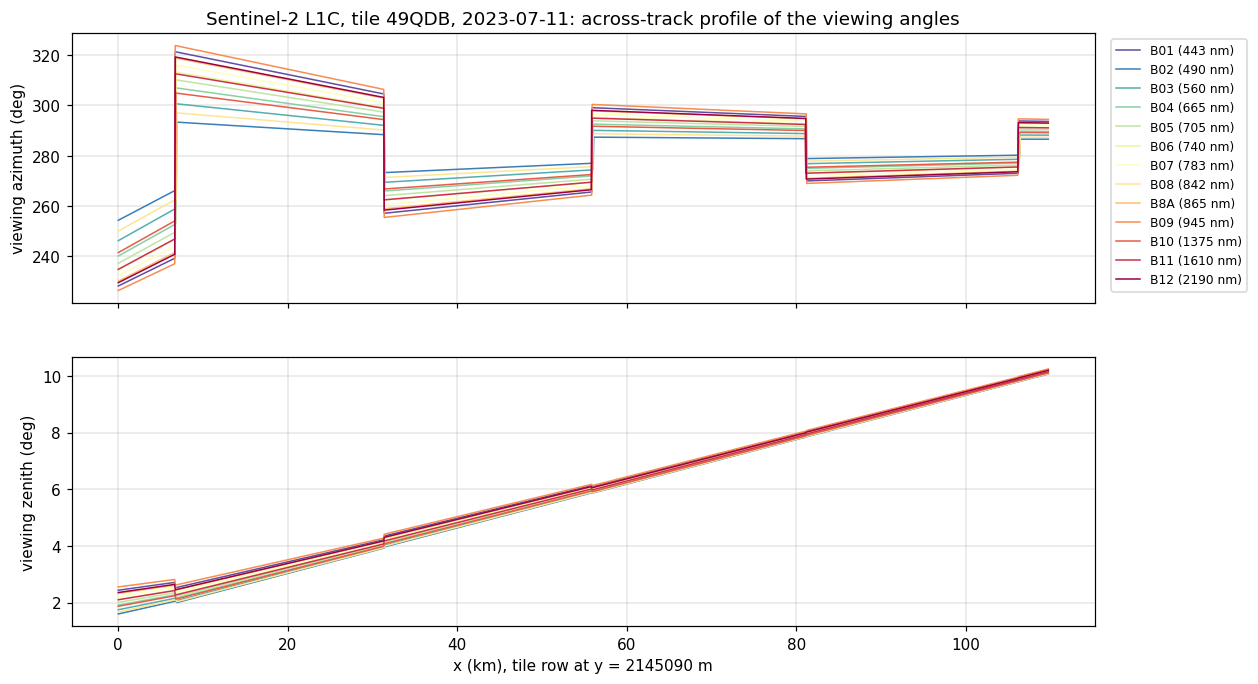
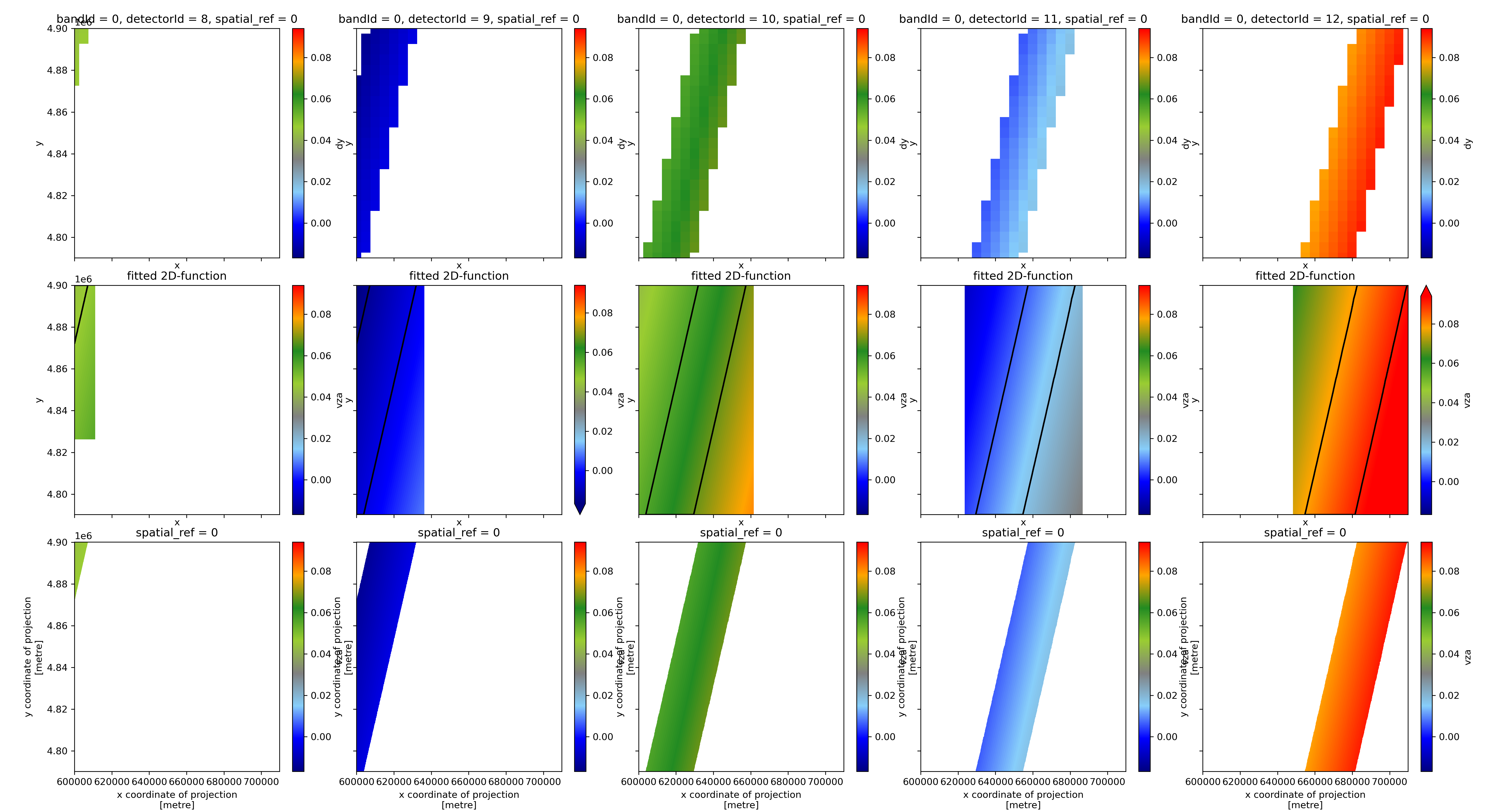
The MSI swath is covered by 12 staggered detectors: odd and even detectors look in opposite directions, and the bands of a detector are shifted in the focal plane. Each band therefore has its own viewing angles, with jumps at the detector borders. GRSdriver computes them per band and per detector from the L1C metadata (see Methods).
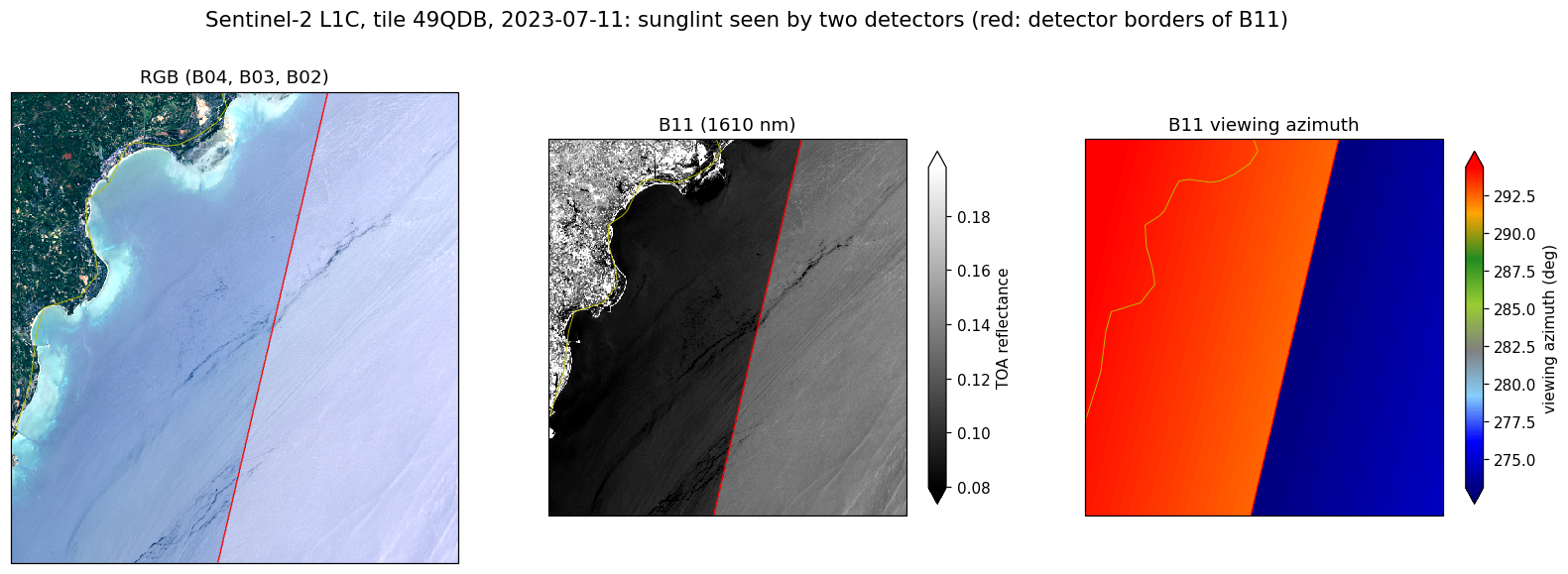
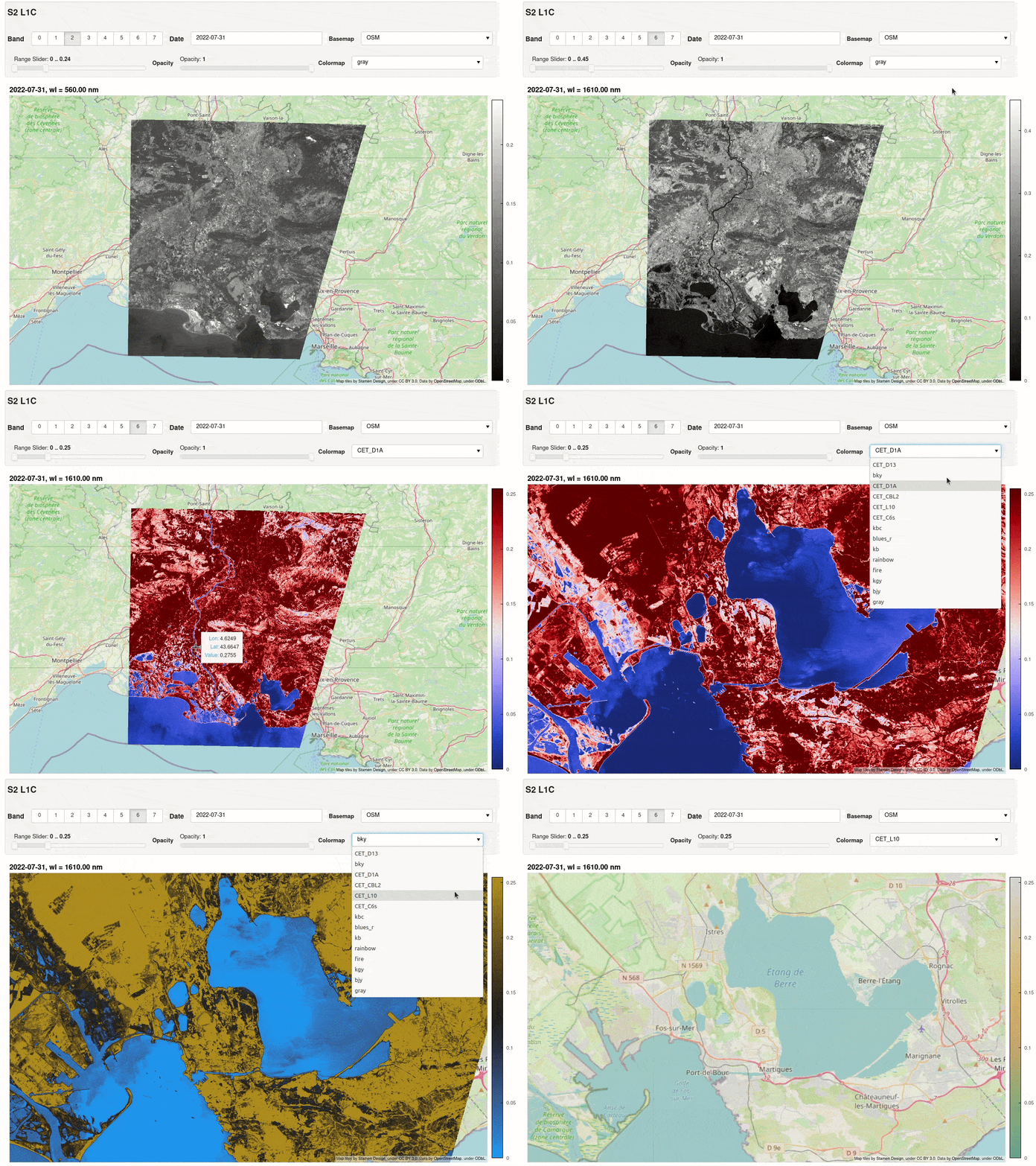
Over water, sunglint is so directional that its reflectance changes abruptly at the detector borders: here +23 % in B11 (1610 nm) between detectors 10 and 11 (right: viewing azimuth). These stripes are a property of the target, not an artifact, and their size depends on the sea roughness, i.e. on the wind speed (Fougnie et al., 2016; Harmel et al., 2018):
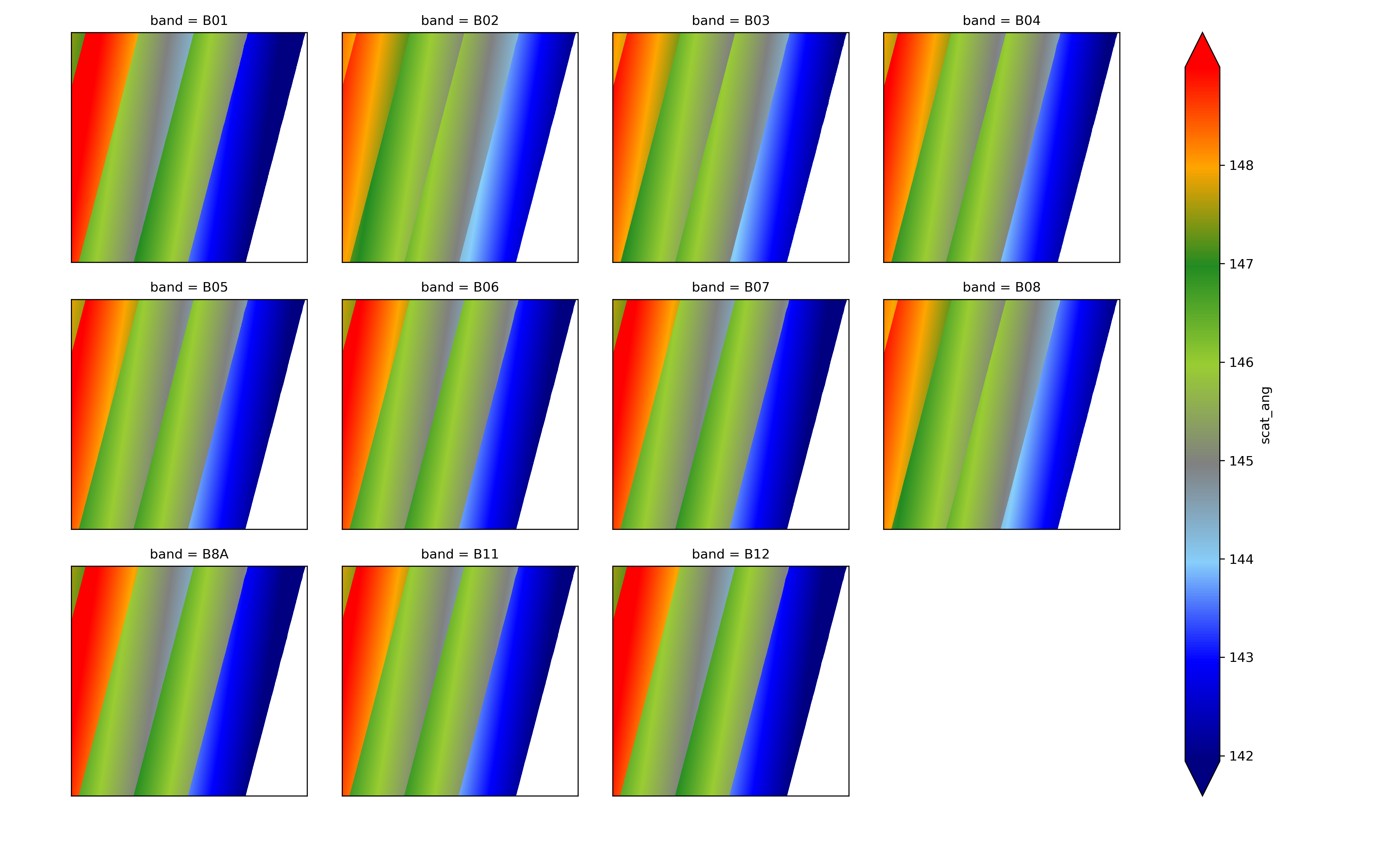
Viewing azimuth of each band computed by GRSdriver:
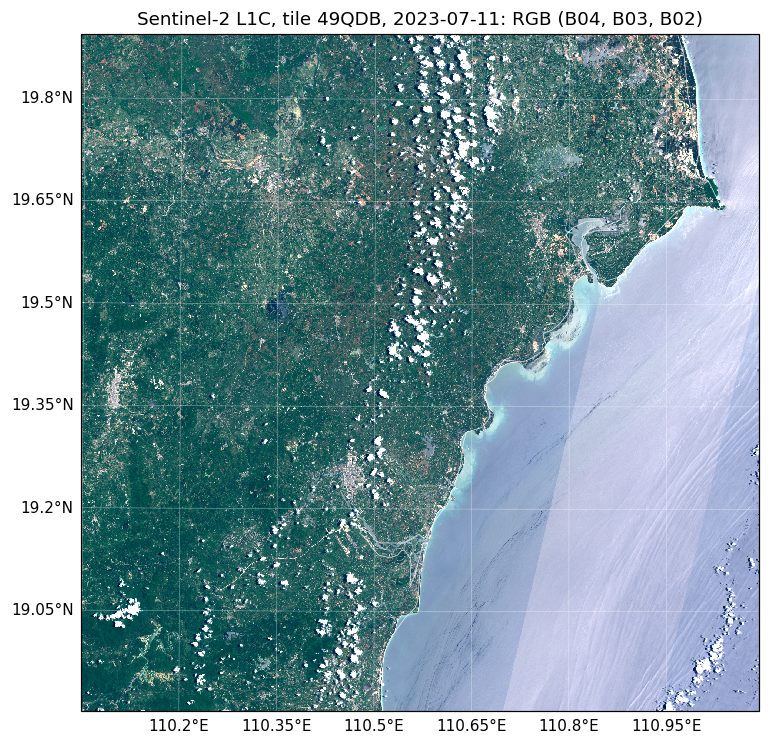
Example
2D-fitting method for angle computation
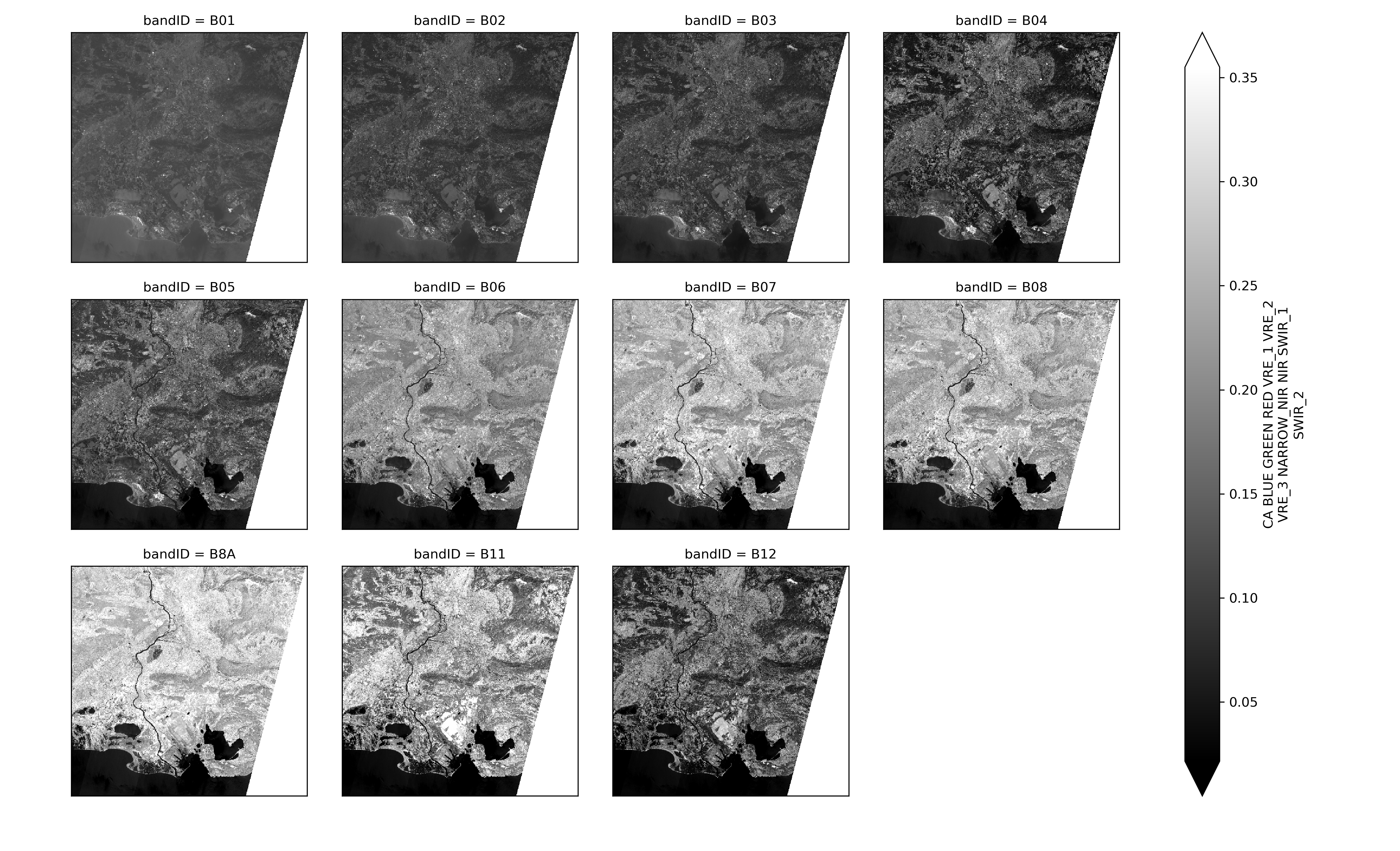
Example of water masking
Changes and contributing
See the CHANGELOG. Tests run
with pytest tests (the tests that need satellite products are skipped when they are not
available); the contributing guide
explains how to update the tutorials and make a release.
1 maintainer

Metadata
1 maintainer
Release files for GRSdriver 2.0.3
For a detailed explanation of source distributions (sdists) and built distributions (wheels), please see the package formats documentation.
Source distribution (sdist)
| File | Size | Uploaded | |
|---|---|---|---|
| grsdriver-2.0.3.tar.gz | 1.7 MB | Details |
Built distribution (wheel)
| File | Interpreter | ABI | Platform | Reset |
|---|---|---|---|---|
| grsdriver-2.0.3-py3-none-any.whl | Python 3 | none | any | Details |
Total release size: 3.4 MB
Release files / grsdriver-2.0.3.tar.gz
| Download URL | grsdriver-2.0.3.tar.gz |
|---|---|
| Size | 1.7 MB |
| Tags | Source |
|
SHA-256 checksum How to use checksums |
8e1ee49d462aa266f8e94656289617056356125ddd06554e52e4ad7594189d4f
|
|
BLAKE2b-256 checksum How to use checksums |
fa3ba89efdb5229c452d4f430234a0d2981f220aa9c817edf2fe7cd0929acba2
|
| Upload date | |
|
Uploaded using Trusted Publishing? What is trusted publishing? |
Yes |
| Uploaded via |
twine/7.0.0 CPython/3.13.14
|
Provenance
Provenance describes where a file came from. On PyPI, provenance is shared via attestations, which provide a verifiable record of the build or publishing details. View details, limitations and caveats.


PyPI Publish Attestation
PyPI verified that this artifact, at this checksum, originated from the publisher listed below.
Signed by GitHub Actions, verified by PyPI on Oct 16, 2026.
Transparency logRelease files / grsdriver-2.0.3-py3-none-any.whl
| Download URL | grsdriver-2.0.3-py3-none-any.whl |
|---|---|
| Size | 1.7 MB |
| Tags | Python 3 |
|
SHA-256 checksum How to use checksums |
f7725fd04d424ece55323b1c521beba91ec8b9415ebbcf655b59f7d3f25e1a9d
|
|
BLAKE2b-256 checksum How to use checksums |
1692aa0f4ad7db84537b941ad389e0607accd82567ead92d39113abd4ad47b50
|
| Upload date | |
|
Uploaded using Trusted Publishing? What is trusted publishing? |
Yes |
| Uploaded via |
twine/7.0.0 CPython/3.13.14
|
Provenance
Provenance describes where a file came from. On PyPI, provenance is shared via attestations, which provide a verifiable record of the build or publishing details. View details, limitations and caveats.
PyPI Publish Attestation
PyPI verified that this artifact, at this checksum, originated from the publisher listed below.
Signed by GitHub Actions, verified by PyPI on Oct 16, 2026.
Transparency log













