
MartiniGlass: seeing your martini is believing
MartiniGlass uses vermouth to stably rewrite your input topology files as ones that can be used for visualisation in VMD. Although much of the functionality is focused on proteins, and the program has a particular focus on being able to visualise protein secondary/tertiary structure networks, MartiniGlass can in fact be used to reconstruct bonded networks of any Martini molecule!
If you can't view your system as expected, please open an issue if it is related to the code itself, or a discussion for any other issues in the workflow of the code.
Documentation
Documentation for MartiniGlass is available on the readthedocs site. The documentation covers multiple use cases and runs through the tutorials in the examples folder step by step.
Installation
MartiniGlass v1.1.0 is available via pip:
python3 -m venv venv && source venv/bin/activate # Not required, but often convenient.
pip install martiniglass
Alternatively, to benefit from the latest added features, install from the repository source:
python3 -m venv venv && source venv/bin/activate # Not required, but often convenient.
pip install git+https://github.com/Martini-Force-Field-Initiative/MartiniGlass
Citation
If you use MartiniGlass to visualise your system in a publication, please cite the following paper:
@article{Brasnett2025MartiniGlass,
    author = {Brasnett, Christopher and Marrink, Siewert J.},
    title = {MartiniGlass: a Tool for Enabling Visualization of Coarse-Grained Martini Topologies},
    journal = {Journal of Chemical Information and Modeling},
    volume = {65},
    number = {7},
    pages = {3137-3141},
    year = {2025},
    doi = {10.1021/acs.jcim.4c02277}
}
Basic Usage
Ideally, MartiniGlass can generate all the visualisable topology files for a system with a single command:
martiniglass -p topol.top
However, if the system contains proteins with complex tertiary structure networks that are also needed, extra options may be requried. More comprehensive documentation and tutorials are available on the readthedocs site. If you think something is broken or have a feature request, please open an issue.
Gallery
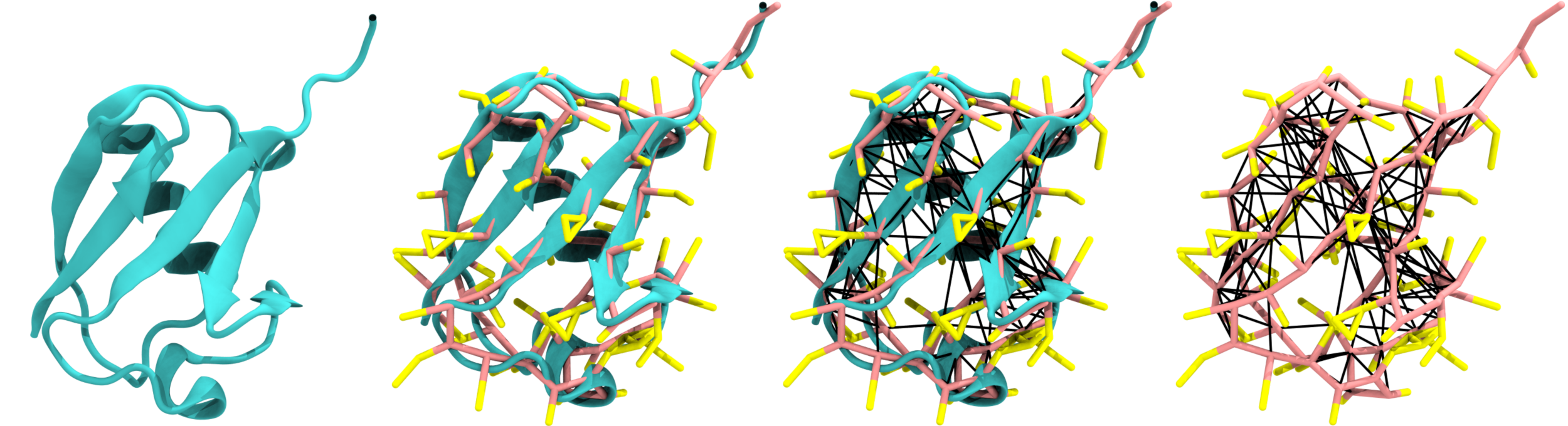
For a practical example of how MartiniGlass can be used to generate visualisable topologies, and see the expected output, there is an example of the 1UBQ system shown below in the examples folder. Here are some illustrations of how MartiniGlass can be used to visualise your molecules
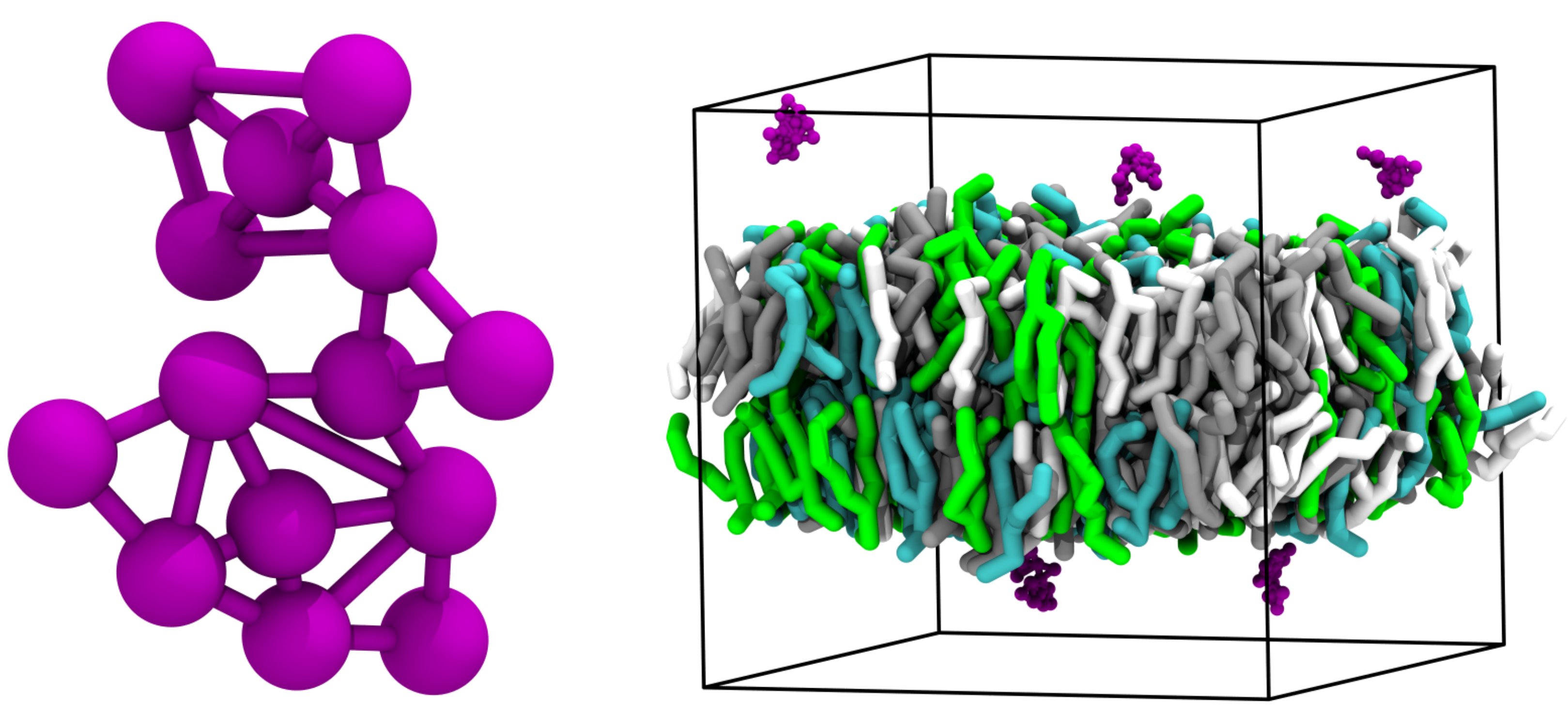
Non-protein systems. Left: the molecular motor of Vainikka and Marrink, a synthetic molecule with complex topology, showing how the beads are connected using the CPK mode in VMD. Right: Several molecular motors together with a lipid bilayer of several different lipid types.
1 maintainer

Metadata
1 maintainer
Release files for MartiniGlass 1.1.3
For a detailed explanation of source distributions (sdists) and built distributions (wheels), please see the package formats documentation.
Source distribution (sdist)
| File | Size | Uploaded | |
|---|---|---|---|
| martiniglass-1.1.3.tar.gz | 40.7 kB | Details |
Built distribution (wheel)
| File | Interpreter | ABI | Platform | Reset |
|---|---|---|---|---|
| martiniglass-1.1.3-py3-none-any.whl | Python 3 | none | any | Details |
Total release size: 88.0 kB
Release files / martiniglass-1.1.3.tar.gz
| Download URL | martiniglass-1.1.3.tar.gz |
|---|---|
| Size | 40.7 kB |
| Tags | Source |
|
SHA-256 checksum How to use checksums |
770fe0e1c6f25196c25f2c63afc91a91392daf11ccc11143ad056ddb94f48a89
|
|
BLAKE2b-256 checksum How to use checksums |
b73e965753612af46c1dbb912209f3c0a1671251a0ef24d3c52a80552924f116
|
| Upload date | |
|
Uploaded using Trusted Publishing? What is trusted publishing? |
No |
| Uploaded via |
twine/6.1.0 CPython/3.10.12
|
Release files / martiniglass-1.1.3-py3-none-any.whl
| Download URL | martiniglass-1.1.3-py3-none-any.whl |
|---|---|
| Size | 47.3 kB |
| Tags | Python 3 |
|
SHA-256 checksum How to use checksums |
1b87946d1f4fa39e52ed3717758ab3748b11a834dc88b832018d0527ac3f410c
|
|
BLAKE2b-256 checksum How to use checksums |
92d913ff0ad5c88fe14966819ebf208c59a37cf62f9338894482bdbc4de973e5
|
| Upload date | |
|
Uploaded using Trusted Publishing? What is trusted publishing? |
No |
| Uploaded via |
twine/6.1.0 CPython/3.10.12
|














