
This project aims to ease the workflow of working with neural networks, I will be updating the code as I learn.
I am currently pursuing bachelor's in data science and I am interested in Machine Learning and Statistics
Github Profile
Medium Profile
Website
Github Repository of the source code
PyPI link of the project
This code contains two classes, one for the Layer and one for the Network
Layer Class
This class creates a Layer of the neural network which can be used for further calculations
def __init__(self,inputs:np.array,n,activation = 'sigmoid',weights=None,bias=None,random_state=123,name=None) -> None:
Args:
- name - The name of the layer, defaults to None
- inputs - The inputs for the layer, shape = (n_x,m)
- n - The number of neurons you would like to have in the layer
- weights - The weights for the layer, initialized to random values if not given, shape = (n[l], n[l-1])
- bias - The bias for the layer, initialized to random values if not given, shape = (n[l],1)
- activation- The activation function you would like to use, defaults to sigmoid
Can chose from ['sigmoid','tanh','relu']
Raises ValueError if the activaion function is not among the specified functions
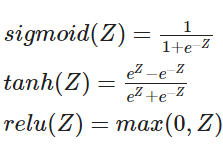
Equations of activation functions for reference - random_state - The numpy seed you would like to use, defaults to 123
Returns: None
Example
# goal - to create a layer of 5 neurons with relu activation function whose name is 'First hidden layer'and initializes random weights
x = np.random.randn(5,5)
layer1 = Layer(name='First hidden layer',inputs=x)
Fit function
def fit(self)->np.array:
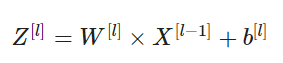
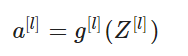
Fits the layer according to the activation function given to that layer
For the process of fitting, it first calculates Z according to the equation
Then calculates the activation function by using the formula
Returns: np.array - Numpy array of the outputs of the activation function applied to the Z function
Example
# goal - you want to fit the layer to the activation function
outputs = layer1.fit()
Derivative function
def derivative(self)->np.array:
Calculates the derivative of the acivation function accordingly
Returns: np.array - Numpy array containing the derivative of the activation function accordingly
Example
# goal - You want to calculate the derivative of the activation function of the layer
derivatives = layer1.derivative()
Network Class
This class creates a neural network of the layers list passed to it
def __init__(self,layers:list) -> None:
Args:
- layers - The list of layer objects
Raises TypeError if any element in the layers list is not a Layer instance
Example
# goal - To create a network with the following structure
# Input layer - 2 neurons
# First Hidden layer - 6 neurons with sigmoid activation function
# Second Hidden Layer - 6 neurons with tanh activation function
# Output Layer - 1 neuron with sigmoid activation function
X = np.random.randn(2,400)
layer1 = Layer('First hidden layer',n=6,inputs=X,activation='sigmoid')
layer2 = Layer('Second Hidden layer',n=6,activation='tanh',inputs=layer1.fit())
layer3 = Layer('Output layer',n=1,inputs=layer2.fit(),activation='sigmoid')
nn = Network([layer1,layer2,layer3])
Fit function
def fit(self)->np.array:
Propagates through the network and calcuates the output of the final layer i.e the output of the network
Returns: np.array - The numpy array containing the output of the network
Example
# Goal- to propagate and find out the outputs of the network
outputs = nn.fit()
Compute cost function
def compute_cost(self,y:np.array,natural_log=True)->float:
Calculates the cost of the network compared to the target
Args:
- y (np.array): Target values for the network
- natural_log (bool, optional): Whether you want to use log10 or natural log. Defaults to True.
Returns:
float: The cost of that network
Example:
# Goal - to compute the cost for the network
cost = nn.compute_cost(y=y)
Train function
Trains the neural network for the specified iterations
def train(self, epochs:int,history=False)->dict:
Args:
- epochs (int): The number of iterations for which you want to train the network
- history (bool, optional): If you want the history of gradients at each iterations. Defaults to False.
Returns:
dict: The dictionary containing the gradients of parameters at each iteration
Example:
# Goal - to train the network for 500 epochs and get history at each epoch
nn.train(epochs=500, history=True)
Predict function
Performs predictions on the given values
def predict(self,values:np.array)->np.array:
Args:
- values (np.array): The values on which you want to predict
Returns:
np.array: The array of predictions
Attributes of a network
- params - The list containing total number of parameters initialized at each layer of the network
- Summary
Returns the summary of the network which is a pandas dataframe containing the following columns:
- Layer Name: The name of the layer
- Weights: The shape of the weights
- Bias: The shape of the bias
- Total Parameters: Total number of parameters initialized in the layer
Output
| Layer Name | Weights | Bias | Total parameters |
| First hidden layer | (6,2) | (6,1) | 18 |
| Second hidden layer | (6,6) | (6,1) | 42 |
| Output Layer | (1,6) | (1,1) | 7 |
1 maintainer

Download files
Download the file for your platform. If you're not sure which to choose, learn more about installing packages.
Source Distribution
Built Distribution
Filter files by name, interpreter, ABI, and platform.
If you're not sure about the file name format, learn more about wheel file names.
Copy a direct link to the current filters
File details
Details for the file MiniTensorflow-0.2.2.tar.gz.
File metadata
- Download URL: MiniTensorflow-0.2.2.tar.gz
- Upload date:
- Size: 19.0 kB
- Tags: Source
- Uploaded using Trusted Publishing? No
- Uploaded via:
twine/3.4.2 importlib_metadata/4.8.1 pkginfo/1.7.1 requests/2.26.0 requests-toolbelt/0.9.1 tqdm/4.62.2 CPython/3.9.6
File hashes
| Algorithm | Hash digest | |
|---|---|---|
| SHA256 |
3f2685d7945e54a9b9db357a9492c37554382cd39c91b032935e80feacad6fb8
|
|
| MD5 |
5d19114ac9834b936f575a70aa5a6dc5
|
|
| BLAKE2b-256 |
d28d8612d83d9d1d6433e0a53ccd451222f5cf705f52064dbe2574dddfaf19e3
|
File details
Details for the file MiniTensorflow-0.2.2-py3-none-any.whl.
File metadata
- Download URL: MiniTensorflow-0.2.2-py3-none-any.whl
- Upload date:
- Size: 19.2 kB
- Tags: Python 3
- Uploaded using Trusted Publishing? No
- Uploaded via:
twine/3.4.2 importlib_metadata/4.8.1 pkginfo/1.7.1 requests/2.26.0 requests-toolbelt/0.9.1 tqdm/4.62.2 CPython/3.9.6
File hashes
| Algorithm | Hash digest | |
|---|---|---|
| SHA256 |
8e5bc0289ffbab2d638c05fae6b6358c8655bc279651ae9d5c6bebdfcfb5fb8f
|
|
| MD5 |
56072fa8385c332e8c4abb10691b1ace
|
|
| BLAKE2b-256 |
e02046240d8fb501caca0743781fb004aae1d8409c20b1608fc6426886b5736f
|














