

Badge |
Status |
|---|---|
Python versions |
|
Documentation |
|
Tests |
|
Coverage workflow |
|
PyPI package |
|
PyPI downloads |
|
Anaconda package |
|
Anaconda downloads |
|
Latest Anaconda release |









MomentRT
MomentRT is a Python library for deterministic light transport in scattering media. It is designed for biomedical optics workflows such as exploring how layered skin, diffuse illumination, and a contact detector influence the light reaching a sensor.
Define the tissue, source, detector, boundary conditions, mesh, and transport model as separate objects. MomentRT solves for unit-bearing optical fields and reports detector power and energy-balance diagnostics. Its general-purpose transport API also supports nonbiological media and instruments.
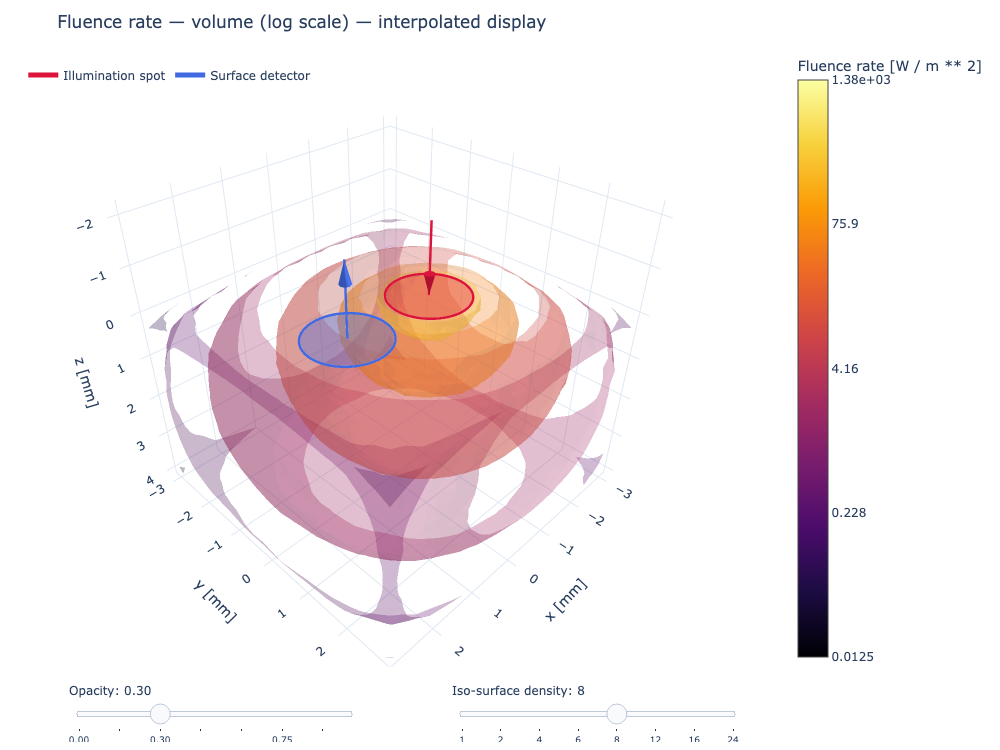
A P1 finite-element solution for an illustrative three-layer skin sample. The colored volume shows fluence interpolated from the nodal solution onto a display grid. Explore the interactive example.
What you can model
Tissue and phantoms: finite layered samples with inclusions, named skin models, and user-supplied monochromatic or wavelength-dependent materials.
Contact instruments: diffuse disk or full-face illumination and circular detector apertures with explicit orientation and angular acceptance.
Light transport: analytical infinite-medium P1 and finite-sample P1, SP3, and full three-dimensional P3 angular-moment models.
Time-resolved transport: coupled transient P1 fluence and current for explicit diffuse pulse profiles, with time-resolved contact-detector power.
Spectral response: monochromatic sweeps, source spectra, and linear detector responsivity for broadband optical power and photocurrent.
Inspection and verification: interactive 3D fields, sample sections, sampled footprint areas, energy diagnostics, and detector mesh studies.
Install
python -m pip install MomentRTOr install from conda:
conda install -c martinpdes -c conda-forge momentrtSkin contact-sensor example
This complete example constructs a finite skin sample and a source and detector on its upper face, refines a tetrahedral mesh around the contacts, and solves with P1. The preset contains coefficients near 850 nm interpolated from one ex vivo skin dataset; its dimensions and optical properties are illustrative rather than patient-specific.
import MomentRT
from MomentRT.models.skin import ShimojoThreeLayer850nm

ureg = MomentRT.ureg

sample = ShimojoThreeLayer850nm(
    origin=(-3, -3, 0) * ureg.mm,
    size=(6, 6, 4) * ureg.mm,
)

source = MomentRT.source.SurfaceSource.on_face(
    sample=sample,
    face="z_min",
    coordinates=(-1, 0) * ureg.mm,
    radius=0.8 * ureg.mm,
    wavelength=850 * ureg.nm,
    optical_power=1 * ureg.mW,
)

detector = MomentRT.detector.SurfaceDetector.on_face(
    sample=sample,
    face="z_min",
    coordinates=(1, 0) * ureg.mm,
    radius=0.8 * ureg.mm,
    orientation="outward_normal",
    acceptance_angle=90 * ureg.degree,
)

mesh = MomentRT.mesh.TetrahedralMesh.from_sample(
    sample=sample,
    resolution=0.4 * ureg.mm,
)
mesh.refine_near(
    objects=[source, detector],
    resolution=0.2 * ureg.mm,
    distance=0.3 * ureg.mm,
)

solver = MomentRT.transport.P1(
    boundaries=MomentRT.boundary.Boundaries.uniform(
        condition=MomentRT.boundary.RobinBoundary(effective_reflectance=0),
    ),
)
simulation = MomentRT.simulation.Simulation(
    medium=sample,
    source=source,
    mesh=mesh,
    solver=solver,
    detectors={"contact": detector},
)

result = simulation.run()
measurement = result.detectors["contact"]

print(f"Collected power: {measurement.collected_power.to('uW'):~P}")
print(f"Sampled source area: {result.source_sampled_area.to('mm^2'):~P}")
print(f"Geometric source area: {result.source_geometric_area.to('mm^2'):~P}")
print(f"Sampled detector area: {measurement.sampled_area.to('mm^2'):~P}")
print(f"Geometric detector area: {measurement.geometric_area.to('mm^2'):~P}")
print(f"Minimum nodal fluence: {result.fluence.values.min().to('W/m^2'):~P}")

system_figure = simulation.plot_system(show=False)
mesh_figure = mesh.plot(max_edges=4000, show=False)
fluence_figure = result.fluence.plot(
    view="volume",
    scale="log",
    display_resolution=0.3 * ureg.mm,
    opacity=0.3,
    overlays=[source, detector],
    show=False,
)
fluence_figure.show()
The figure objects are Plotly figures; call .show() on any of them to rotate, zoom, and inspect values interactively. The complete executable example includes the same configuration and generated figures.
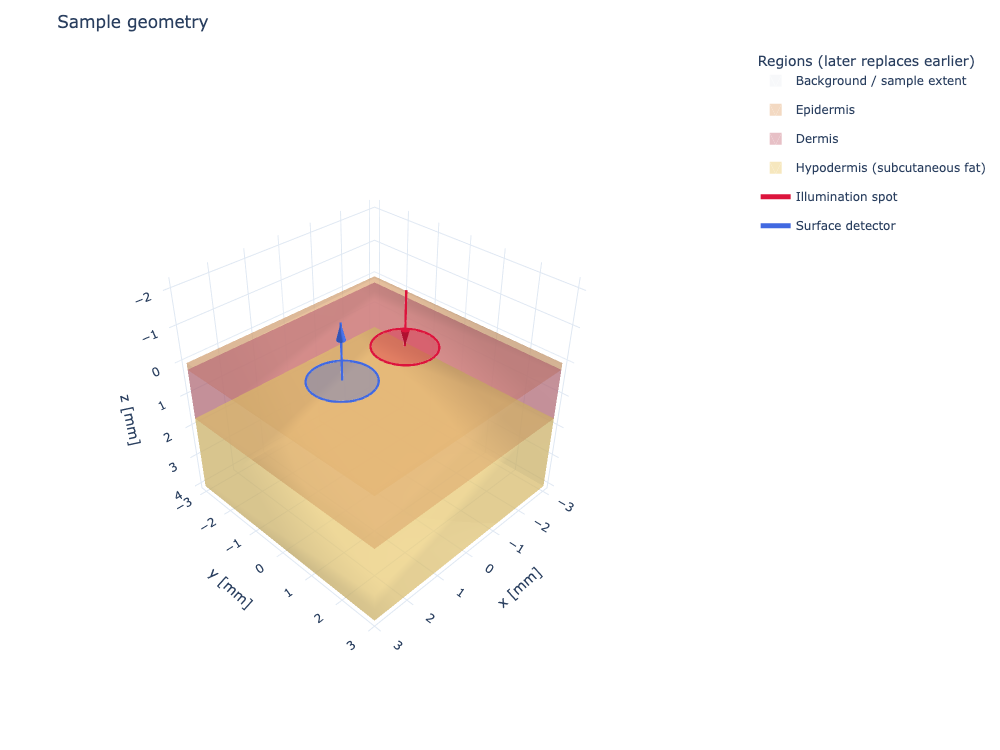
The skin construction and contact footprints. Positive z points into the sample. Transparent layer surfaces show the construction geometry.
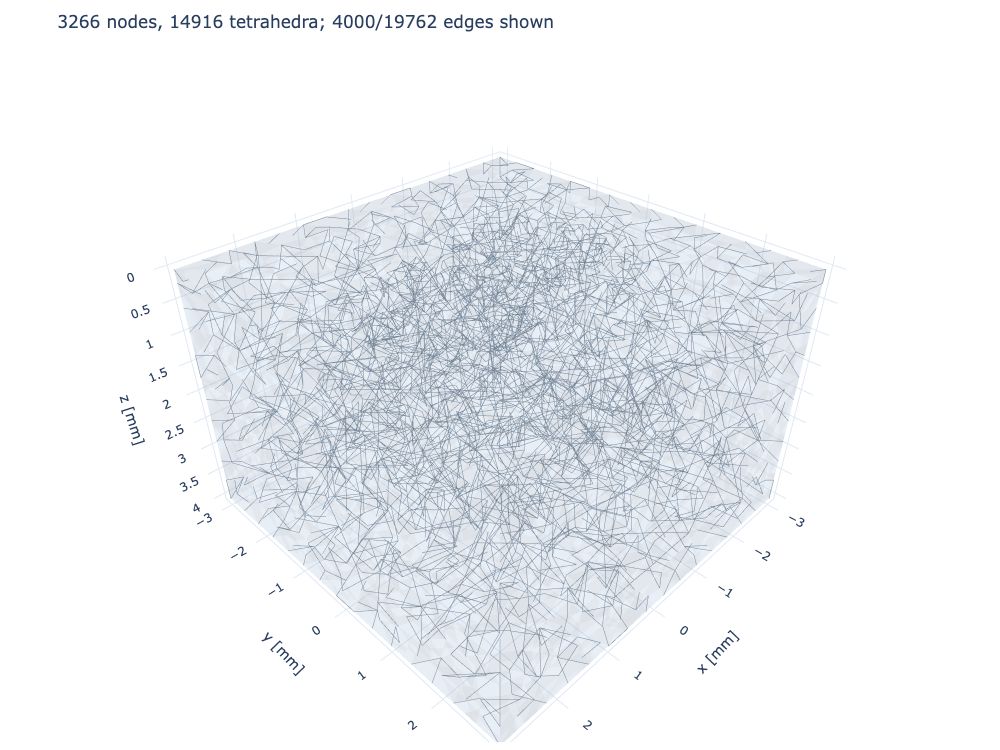
Tetrahedral mesh refined near the source and detector. Only a subset of edges is displayed; the solve uses the full mesh.
Interpreting the result
Skin properties: the preset uses a shared refractive index and fixed coefficients interpolated to 850 nm from Shimojo et al. (2020), doi:10.1117/1.JBO.25.4.045002. Individual skin properties, blood content, and optical behavior vary. Use explicit or spectral materials when needed.
Source and boundaries: surface-source power is diffuse power already coupled into the sample. The model does not simulate collimated LED propagation or specular entry losses. Robin effective reflectance is a supplied diffuse partial-current coefficient, not a Fresnel value inferred from refractive index. Finite solvers currently reject internal index jumps.
Detector: the circular aperture integrates escaping irradiance using a Lambertian angular approximation. It is not a Fresnel-resolved radiance or a simulation of external detector optics.
Accuracy: P1, SP3, and P3 are distinct approximations to transport, not full radiative transfer. Check mesh and source/detector footprint convergence, and compare the intended geometry against an independent transport reference or measurements. Energy balance and footprint-area agreement alone do not establish physical accuracy, especially near illumination. Negative nodal values can occur as numerical artifacts; they are reported, not clipped.
The scientific guide explains the equations and limitations, and the detector convergence guide shows how to examine mesh refinement.
Explore further
Example gallery: sample construction, meshes, contact sensors, spectral calculations, and comparisons of transport models.
Seven-fiber skin probe: six illumination fibers and one collection aperture on layered skin.
Spectral modeling: spectral materials, source power density, detector responsivity, and wavelength-integration convergence.
Model selection: choose between the available approximations and review their limits.
Development and citation
To work on the package or build the executable documentation locally:
git clone https://github.com/MartinPdeS/MomentRT.git
cd MomentRT
python3 -m venv .venv
.venv/bin/python -m pip install -e ".[testing,documentation,dev,release]"
make check typecheck docstring-check PYTHON=.venv/bin/python
make docs PYTHON=.venv/bin/python
See the contributor guide and changelog. MomentRT is distributed under the MIT license. If you use it in research, cite the version recorded in CITATION.cff.
1 maintainer

Metadata
1 maintainer
Release files for MomentRT 0.12.0
For a detailed explanation of source distributions (sdists) and built distributions (wheels), please see the package formats documentation.
Source distribution (sdist)
| File | Size | Uploaded | Provenance | Actions |
|---|---|---|---|---|
| momentrt-0.12.0.tar.gz | 124.7 kB | Without provenance | Details for momentrt-0.12.0.tar.gz |
Built distribution (wheel)
| File | Interpreter | ABI | Platform | Actions Reset |
|---|---|---|---|---|
| momentrt-0.12.0-py3-none-any.whl | Python 3 | none | any | Details for momentrt-0.12.0-py3-none-any.whl |
Total release size: 259.1 kB
Release files / momentrt-0.12.0.tar.gz
| Download URL | momentrt-0.12.0.tar.gz |
|---|---|
| Size | 124.7 kB |
| Tags | Source |
|
SHA-256 checksum How to use checksums |
aba0c3bc0f5b7e1d956e0cf181945c7fc4787d48fb8bc8ac85e560e51fc233d5
|
|
BLAKE2b-256 checksum How to use checksums |
3bded8a429027dca5e16ef130122786965eea0017df658b95d5baa71bcb30678
|
| Upload date | |
|
Uploaded using Trusted Publishing? What is trusted publishing? |
No |
| Uploaded via |
twine/7.0.0 CPython/3.11.18
|
Release files / momentrt-0.12.0-py3-none-any.whl
| Download URL | momentrt-0.12.0-py3-none-any.whl |
|---|---|
| Size | 134.4 kB |
| Tags | Python 3 |
|
SHA-256 checksum How to use checksums |
c5cd2b15a181ff834839a01d989b9d16d4dc039d5b02374261ed991c4f5b634a
|
|
BLAKE2b-256 checksum How to use checksums |
4c9cf8aef98b23c8fc126fd70f09ef9b7817d2d412d551186c128f2e8901ab55
|
| Upload date | |
|
Uploaded using Trusted Publishing? What is trusted publishing? |
No |
| Uploaded via |
twine/7.0.0 CPython/3.11.18
|
Security for MomentRT 0.12.0
Provenance
Provenance describes where a file came from. On PyPI, provenance is shared via attestations, which provide a verifiable record of the build or publishing details. View details, limitations and caveats.
No provenance found
None of the files in this release were uploaded with provenance metadata.
A note on package security
PyPI is a repository for distributing packages, not a service for auditing them. While third-party security researchers and our staff do their best to detect and remove malicious packages, PyPI cannot guarantee the quality, security or suitability of any given package.
To learn more about protecting yourself from malicious actors, visit our package security documentation.














