
FT8 Decoding and Encoding in Python with test/loopback code

Project description
FT8 Decoding and Encoding in Python with test/loopback code
I've changed the scope of this repo from the previous 'codec with integrated GUI' as it started to grow too wide in scope. The last version including the GUI is in release 6.4.0. This repo is now moving towards a packageable FT8 codec.
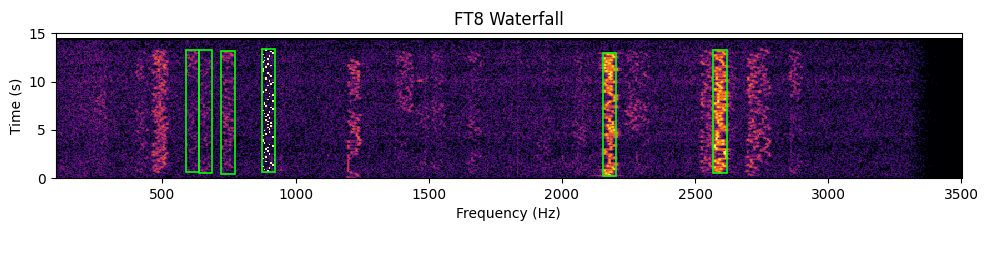
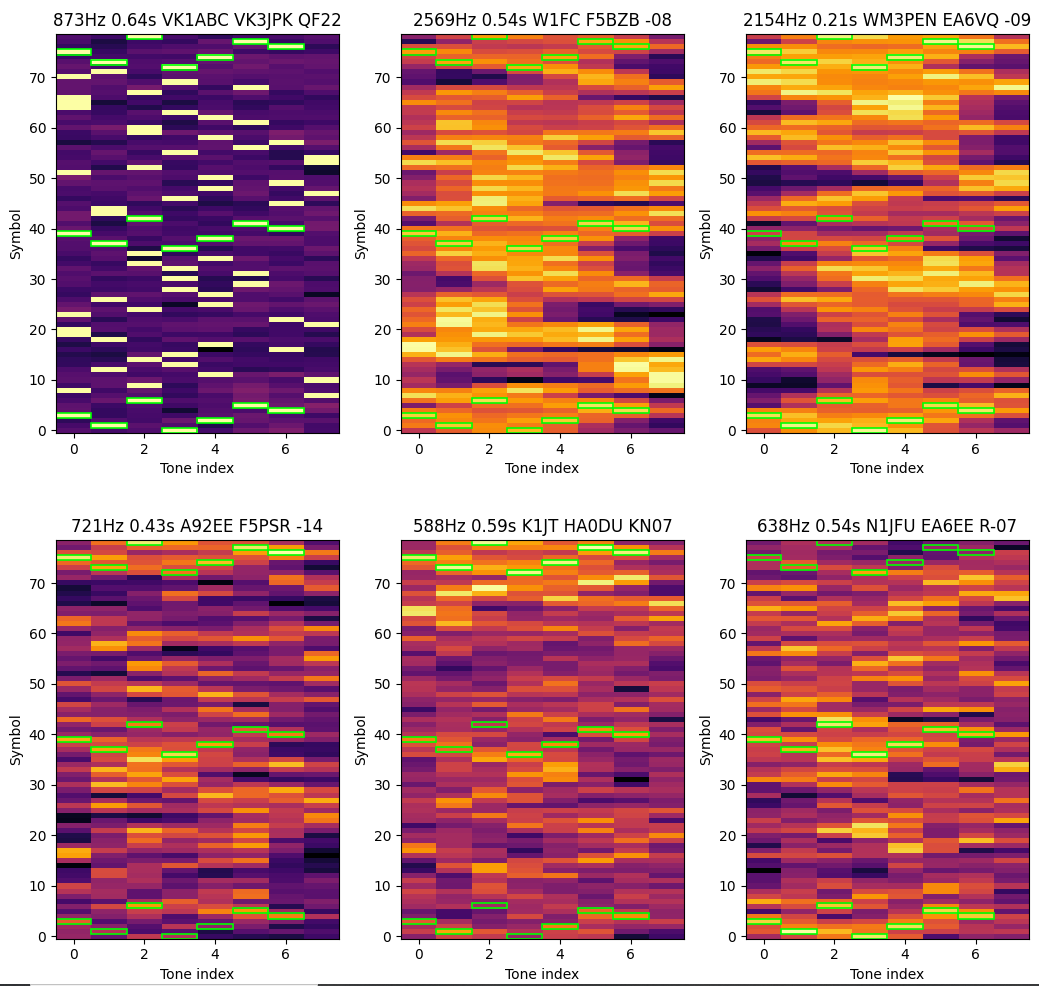
Below are some screenshots from test programs that can be used to look at how the protocols actually work, illustrated with a fairly ordinary waterfall and some zoomed-in depictions of captured signals with an overlay of the syncrhonisation tones that are used to search for the signals (Costas patterns).
Approach
You won't find many comments in the code; I try to make things as obvious as possible via variable names and logical structure, to minimise the need for comments. Also - this is mainly my plaything, and I find bloated, sprawling code incredibly difficult to read, so I like to keep things very compact so that I can see the bigger picture. If you find an if-then-else spanning several paragraphs, it's probably a mistake.
Do feel free to get in touch and ask how anything works. I might add some diagrams etc at some point too - especially if I find an approach that seems to offer something improved and/or very compact (I'm very pleased for e.g. that the entire candidate search, synch, and demodulate process all works by refering to a single time-frequency grid; read the audio, FFT 5 times for each symbol duration, store it, and that's used for everything that follows.)
Limitations
In pursuit of tight code, I've concentrated on core standard messages, leaving out some of the less-used features. The receive part of the code doesn't (yet) have the full capability of the advanced decoders used in WSJT-x, and so gets only about 50% of the decodes that WSJT-x gets.
Here's my current understanding of the differences:
| Step | PyFT8 | WSJT-X |
|---|---|---|
| Find candidate signals | Search every possible time/frequency offset for match with the Costas pattern, excluding times where candidates would not complete before the next cycle (i.e. first few seconds of the grid) | TBD |
| Syncronise signals in time | See above | TBD |
| Use of FFTs for the above | A single time-frequency grid with 5 time samples per symbol and 3 frequency samples per tone | Several FFTs per operation, details in VK3JPK's great write-up here |
| Demodulation | Extract 1 sample per symbol, 1 sample per tone grid. Correlate each symbol with Gray code to create Log Likelyhood Ratios for each bit. | Noncoherent block detection over 3 symbols - creates LLRs by correlating the 512 possible tone sequences (3 symbols with 8 possible tones each) with the actual received symbols. This is done in the frequency domain by combining the whole-symbol correlations already calculated. |
| Decoding the FEC code | Belief Propagation LDPC decoder | Belief Propagation LDPC decoder |
| Further decoding if LDPC fails | None | Ordered Statistics Decoding |
| Further signal extraction | None | Subtraction of the idealised power of the decoded signals, then rescanning the residual spectrum. Further synchronisation adjustments TBC |
Acknowledgements
This project implements a decoder for the FT8 digital mode. FT8 was developed by Joe Taylor, K1JT, Steve Franke, K9AN, and others as part of the WSJT-X project. Protocol details are based on information publicly described by the WSJT-X authors and in related open documentation.
Some constants and tables (e.g. Costas synchronization sequence, LDPC structure, message packing scheme) are derived from the publicly available WSJT-X source code and FT8 protocol descriptions. Original WSJT-X source is © the WSJT Development Group and distributed under the GNU General Public License v3 (GPL-3.0), hence the use of GPL-3.0 in this repository.
Also thanks to Robert Morris for:
- basicft8(*1) - the first code I properly read when I was wondering whether to start this journey
- weakmon - much good information
(*1 note: applies to FT8 pre V2)
Other useful resources:
- W4KEK WSJT-x git mirror
- VK3JPK's FT8 notes including comprehensive Python source code
- Optimizing the (Web-888) FT8 Skimmer Experience Web-888 is a hardware digimode skimmer currenly covering FT4/FT8 & WSPR, part of the RX-888 project.
- WSJT-X on Sourceforge
- Declercq_2003_TurboCodes.pdf
- Q65 coding discussion
- G4JNT notes on LDPC coding process
- FT8Play - full details of message to bits etc
- Post about ft8play
- FT8_lib
- Decoding LDPC Codes with Belief Propagation | by Yair Mazal
- 'DX-FT8-Transceiver' source code, the firmware part of the DX-FT8 Transceiver project
- 'ft8modem - a command-line software modem for FT8' Matt Roberts' implementation as an FT8 modem with a CLI interface, including source code (C++ and Python) (bottom of page)
Release history Release notifications | RSS feed


Download files
Download the file for your platform. If you're not sure which to choose, learn more about installing packages.
Source Distribution
Built Distribution
Filter files by name, interpreter, ABI, and platform.
If you're not sure about the file name format, learn more about wheel file names.
Copy a direct link to the current filters
File details
Details for the file pyft8-0.0.3.tar.gz.
File metadata
- Download URL: pyft8-0.0.3.tar.gz
- Upload date:
- Size: 362.2 kB
- Tags: Source
- Uploaded using Trusted Publishing? No
- Uploaded via: twine/6.1.0 CPython/3.12.2
File hashes
| Algorithm | Hash digest | |
|---|---|---|
| SHA256 |
89c9258172241224e25097ac62d6556b15650161117b778a4a7a265e6dab70fc
|
|
| MD5 |
7fdefcb9e1ad444b8ab614b670173e0e
|
|
| BLAKE2b-256 |
f70c93a9a1f6be0c7e40d545182ef050fe30d1a56ed32e40f7862efeb81c5a71
|
File details
Details for the file pyft8-0.0.3-py3-none-any.whl.
File metadata
- Download URL: pyft8-0.0.3-py3-none-any.whl
- Upload date:
- Size: 31.3 kB
- Tags: Python 3
- Uploaded using Trusted Publishing? No
- Uploaded via: twine/6.1.0 CPython/3.12.2
File hashes
| Algorithm | Hash digest | |
|---|---|---|
| SHA256 |
7e6a2822a466be41a9c29dc07630030c566e92c75b222ae61c45453ce7655aaa
|
|
| MD5 |
ef1d6ae9b5a257b99ddc51a9e9b7c6d7
|
|
| BLAKE2b-256 |
f2aea3107cb8fbdcd32cd1fb0195c09558c039e78a9f8caae08c7c535b5f4149
|






