
SCPI Instrument Control






Drive your whole bench from Python. Oscilloscopes, function generators, power supplies, and DAQ units — one API, over LAN, USB, GPIB, or serial.
Point it at an IP address and it identifies the instrument, picks the right SCPI dialect, and gets out of your way. Or point it at nothing at all: the built-in mock synthesizes real waveforms so you can write and test the entire acquisition pipeline with an empty bench.
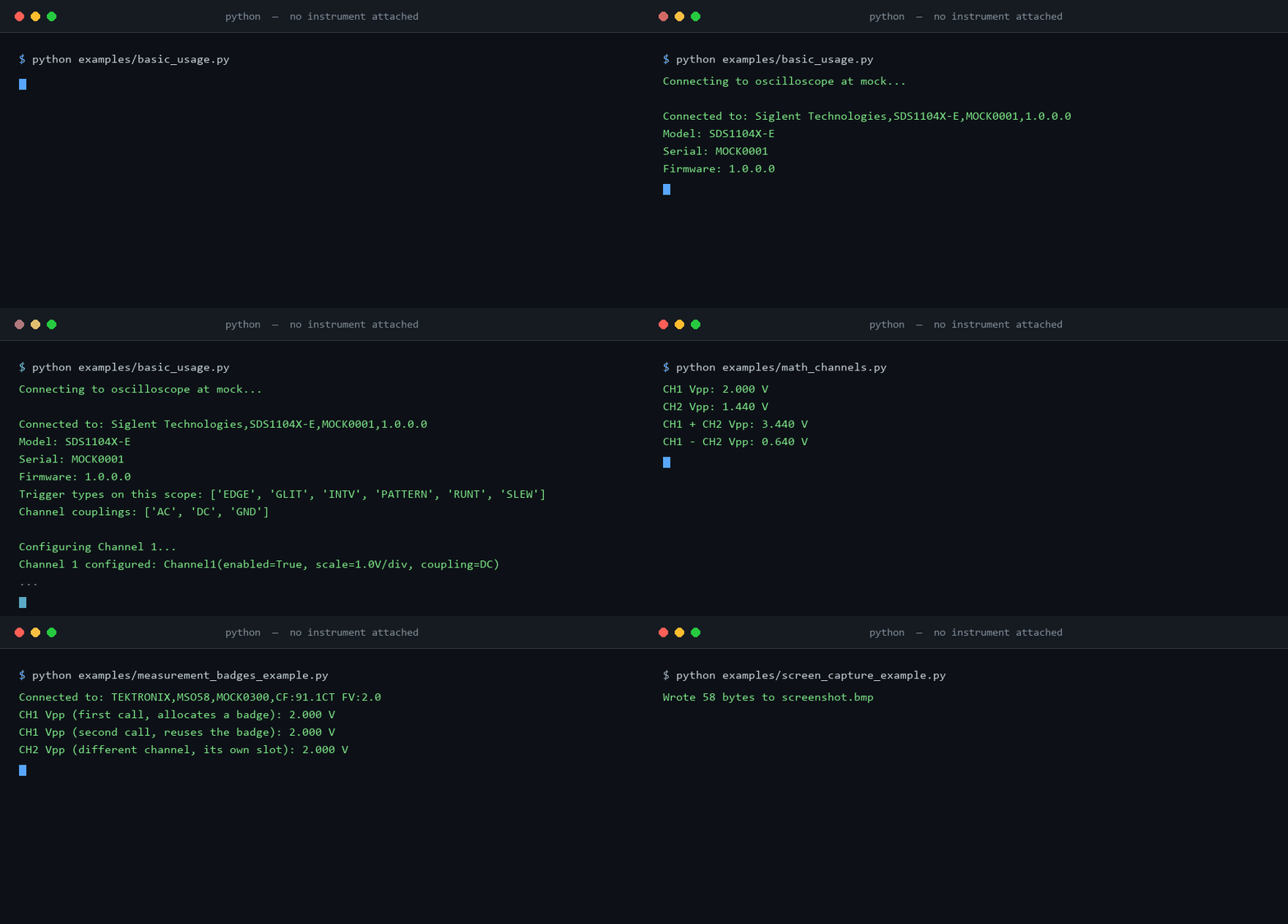
Try it with no instrument on your desk
pip install SCPI-Instrument-Control
from scpi_control.connection import MockConnection
from scpi_control.oscilloscope import Oscilloscope
from scpi_control.signal_synth import SignalSpec

# A virtual SDS1104X-E probing a 3.3 V, 1 kHz logic clock.
scope = Oscilloscope("mock", connection=MockConnection(
    "mock",
    channel_states={1: True},
    signals={1: SignalSpec(kind="square", frequency=1000.0, amplitude=1.65, offset=1.65)},
    sample_rate=20e6,
    timebase=500e-6,
))
scope.connect()

wf = scope.get_waveform(channel=1)
print(f"{len(wf.time)} samples")
print(f"Vpp  {wf.voltage.max() - wf.voltage.min():.3f} V")
print(f"Freq {scope.measurement.measure_frequency(1):.2f} Hz")
14000 samples
Vpp  3.280 V
Freq 1000.00 Hz
Those are the same 3.28 V rails as the real SDS824X HD calibration square wave further down this page — captured with nothing plugged in. The mock is not a stub replaying a canned buffer: every sample is computed from the scope's current timebase, volts/division, offset, and trigger state, so the capture window follows the timebase, the code grid quantizes the way an 8-bit digitizer does, and free-running acquisitions drift in phase like a real one. Your CI can exercise the full stack with nothing plugged in.
What you get
| One API, many vendors | Siglent, Tektronix, and LeCroy scopes auto-detected from *IDN?, plus AWGs, PSUs, and DAQ units. Unknown models fall back to a conservative per-vendor profile instead of being rejected. |
| Capture with provenance | Every saved waveform records the instrument, settings, and timestamp that produced it. Read any of it back with load_waveform() or the scpi-extract CLI. |
| Analysis built in | FFT, SNR, THD, jitter, rise/fall, and 25+ statistics — no separate toolchain. |
| A real desktop GUI | PyQt6 + PyQtGraph live view with draggable measurement markers. |
| A browser lab gateway | Share an instrument with the bench next door over HTTP/WebSocket. |
| Publication-ready reports | Automated PDF/Markdown test reports, optionally analyzed by a local LLM. |
Honest about limits
This project would rather raise than invent a number. Setting a trigger type a
scope's dialect cannot express raises FeatureNotSupportedError instead of
silently leaving the instrument as it was; a PSU without a documented protection
subsystem refuses ovp_level rather than sending a command the firmware
discards. Tektronix and LeCroy command tables were verified line-by-line against
the vendor programming manuals and exercised against a dialect-aware mock, but
have not yet been run against physical Tektronix or LeCroy hardware — the
Siglent path has.
Install
pip install SCPI-Instrument-Control          # core: capture + analysis
pip install "SCPI-Instrument-Control[all]"   # everything below
| Extra | Adds |
|---|---|
[gui] |
PyQt6 desktop application, live view, visual measurements |
[web] |
scpi-web browser lab gateway (FastAPI) |
[report-generator] |
PDF/Markdown test reports, local-LLM analysis |
[usb] |
USB-TMC, GPIB, and serial instruments via PyVISA |
[hdf5] |
.h5 waveform export |
[fun] |
Vector graphics / XY-mode drawing |
Requires Python 3.9+. The core install needs only NumPy, SciPy, and Matplotlib.
Then point it at real hardware
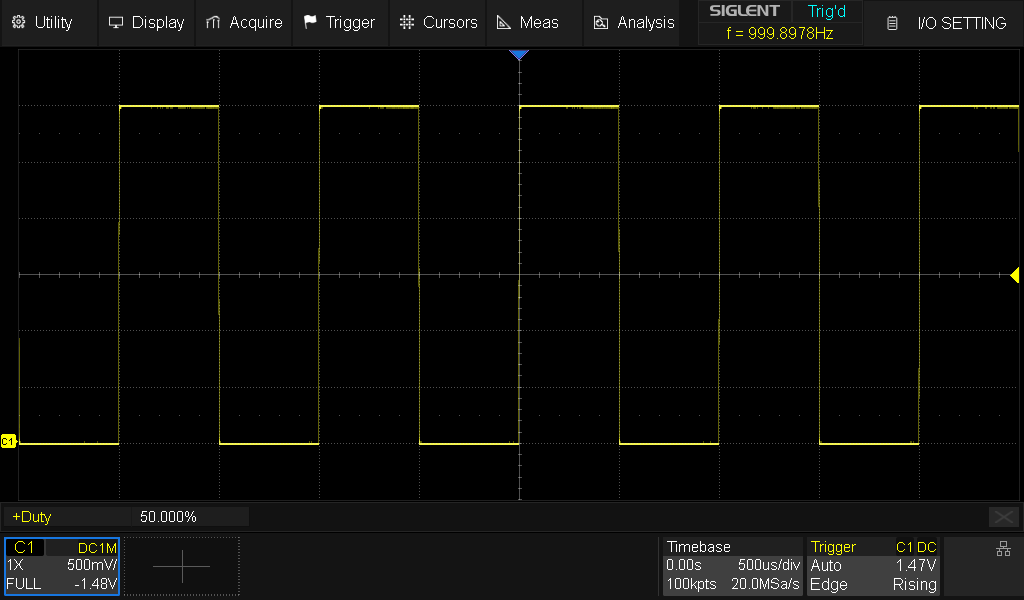
Not a mockup — a live screen grab pulled over LAN from a Siglent
SDS824X HD with scope.screen_capture.get_screenshot_pil().
from scpi_control import Oscilloscope

scope = Oscilloscope("192.168.1.100")   # dialect auto-detected from *IDN?
scope.connect()

scope.channel1.enable()
scope.channel1.voltage_scale = 1.0      # V/div
scope.channel1.coupling = "DC"

scope.trigger.set_edge_trigger(source="C1", slope="POS")
scope.trigger.level = 1.0

wf = scope.get_waveform(channel=1)
scope.waveform.save_waveform(wf, "capture.npz")   # provenance travels with it

scope.disconnect()
Ask the instrument what it can actually do before you ask it to do something:
caps = scope.capabilities
print(caps.trigger_types, caps.channel_couplings)
Batch sweeps, continuous logging, and trigger-driven capture live in
scpi_control.automation — see the
automation guide.
The desktop GUI
pip install "SCPI-Instrument-Control[gui]"
siglent-gui
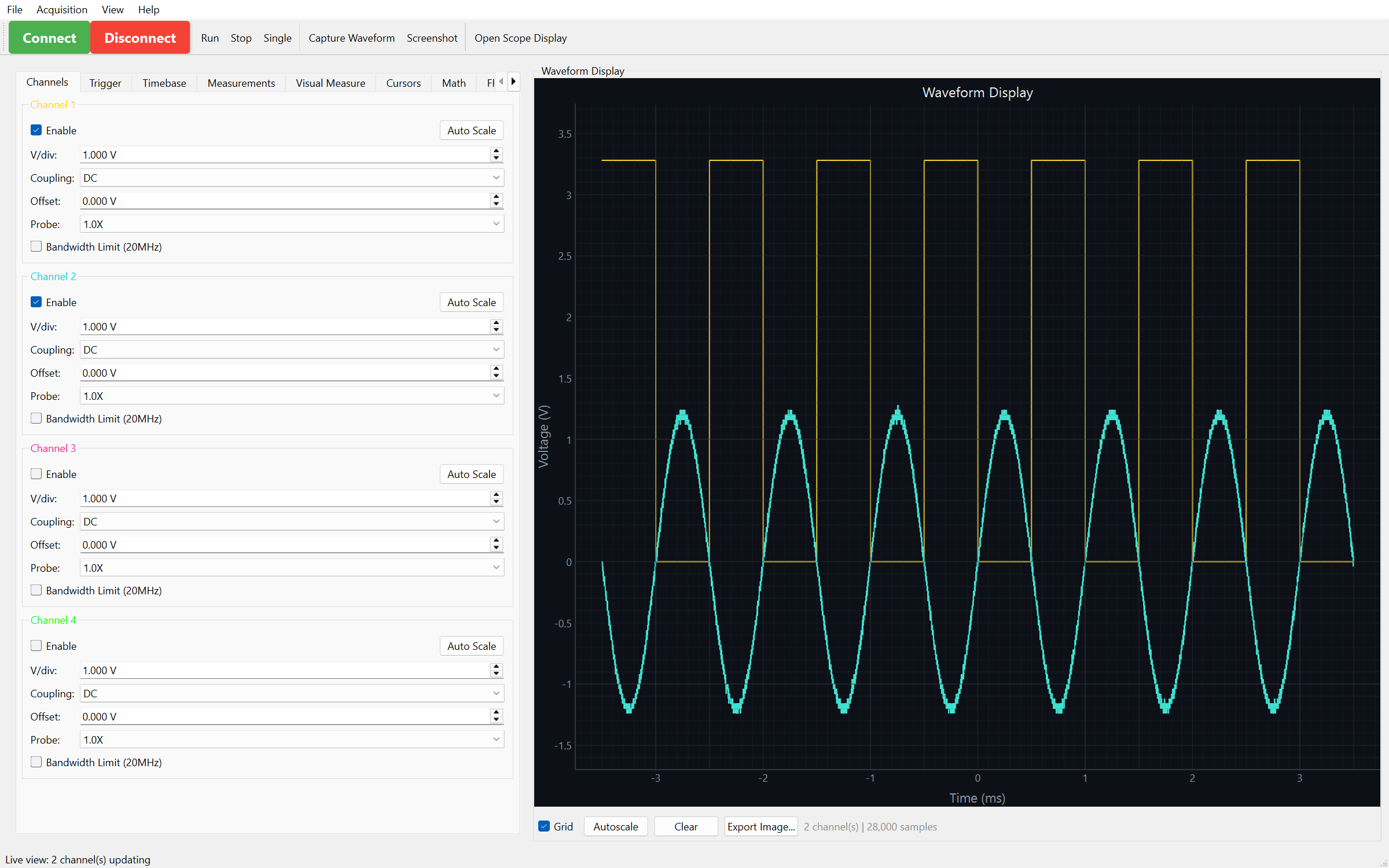
Two channels live. This one is the mock again — the desktop app runs
hardware-free too.
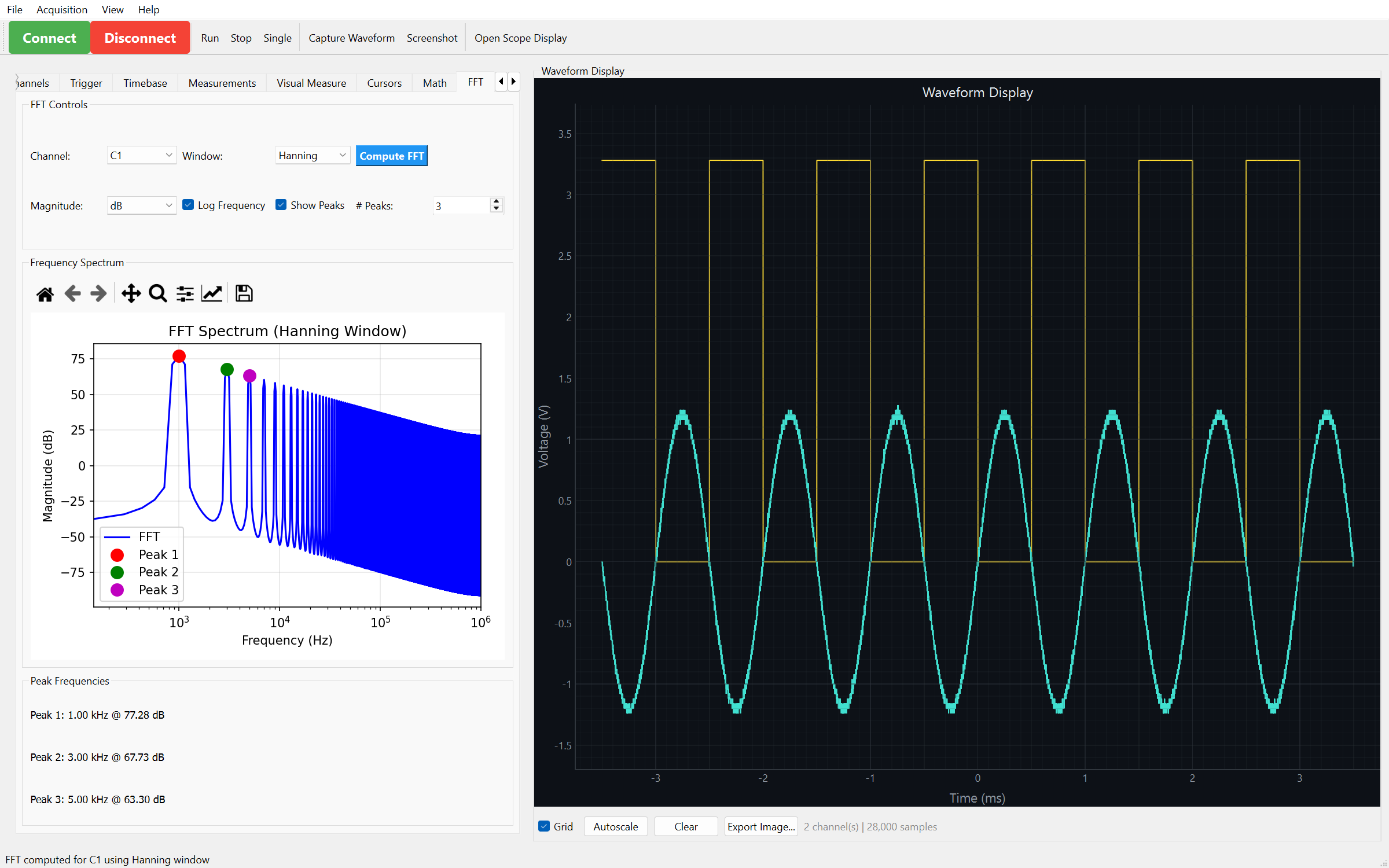
FFT of that square wave — the odd-harmonic comb, peaks picked out at
1, 3, and 5 kHz.
A live view that holds 5–20 fps on four channels, measurement markers you drag directly onto the trace, cursors, FFT, math channels, reference-waveform overlays, and a raw SCPI terminal for when you need to talk to the instrument yourself. Dedicated tabs connect to a power supply or a DAQ / data logger alongside the scope.
Software protocol decoding covers I2C, SPI, and UART.
The browser lab gateway
pip install "SCPI-Instrument-Control[web]"
scpi-web                    # prints its URL on every start
scpi-web invite alice       # a 10-minute link + code for a colleague
Run one gateway on the bench machine and reach your instruments from any browser
on the LAN — live traces, screenshots, measurements, server-side FFT and
filters, and ~1 Hz measurement logging with CSV export. GET /api/discover
sweeps the subnet for instruments when DHCP moves them.
Every request needs a token, each session has an owner (owner writes, everyone else watches), and outbound connection targets are validated. The admin panel binds loopback only. It does not terminate TLS — keep it on a trusted network or behind a reverse proxy.
→ Gateway guide · Security model
Automated test reports
pip install "SCPI-Instrument-Control[report-generator]"
Turn captures into PDF or Markdown reports with plots, signal classification, 25+ statistics, pass/fail criteria, and a SHA-256 manifest of the raw data. Comparison and batch modes handle before/after runs and multi-DUT yield tables. Analysis text can be generated by a local LLM through Ollama — on your machine, no cloud provider, no API key.
See example_reports/ for generated samples, including one
with LLM analysis.
Supported instruments
| Class | Models |
|---|---|
| Siglent scopes (hardware-tested) | SDS800X HD (SDS804X/824X HD) · SDS1000X-E (1102X-E/1104X-E/1202X-E/1204X-E) · SDS2000X Plus (2104X+/2204X+/2354X+) · SDS5000X (5034X/5054X/5104X) |
| Tektronix scopes (manual-verified) | TBS1000C (TBS1102C) · 2 Series MSO (MSO24) · 4 Series (MSO44/46) · 5 Series (MSO54/56/58/58LP) · 6 Series (MSO64) |
| LeCroy scopes (manual-verified) | WaveSurfer 3000z (3024z) · WaveRunner 8000 (8104) |
| Function generators | Siglent SDG1000X (1032X/1025/1020) · SDG2000X (2122X/2082X/2042X) |
| Power supplies | Siglent SPD3303X / SPD3303X-E · SPD1305X / SPD1168X |
| DAQ / data loggers | Keysight 34970A / 34972A · DAQ970A / DAQ973A · generic SCPI-99 |
Other SCPI instruments generally work: model-specific behavior comes from the
ModelCapability registry, and unrecognized models fall back to a conservative
profile for their vendor with a logged warning.
→ SCPI dialects and per-vendor gaps
Command-line tools
| Command | Does |
|---|---|
siglent-gui |
Launch the desktop application |
scpi-web |
Serve the browser lab gateway |
scpi-extract |
Inspect or export a saved waveform file |
siglent-report-generator |
Launch the standalone report generator |
Documentation
- Full documentation — guides, tutorials, API reference
- Quick start · Connecting an instrument
- Interactive tutorial — Jupyter notebook, step by step
- 31 runnable examples — 14 of them run with no instrument attached
- Changelog · Security policy
Upgrading?
import siglentbecameimport scpi_controlin v1.0.0 and the compatibility shim was removed in v2.0.0; the API is otherwise identical. PinSCPI-Instrument-Control<2.0if you cannot migrate yet. The v4.x → 5.0 gateway now requires a token — see the security guide.
Contributing
Issues and pull requests are welcome — see the Contributing Guide.
git clone https://github.com/little-did-I-know/SCPI-Instrument-Control.git
cd SCPI-Instrument-Control
make dev-setup
make check
License
MIT — see LICENSE.
1 maintainer

Download files
Download the file for your platform. If you're not sure which to choose, learn more about installing packages.
Source Distribution
Built Distribution
Filter files by name, interpreter, ABI, and platform.
If you're not sure about the file name format, learn more about wheel file names.
Copy a direct link to the current filters
File details
Details for the file scpi_instrument_control-7.0.1.tar.gz.
File metadata
- Download URL: scpi_instrument_control-7.0.1.tar.gz
- Upload date:
- Size: 11.4 MB
- Tags: Source
- Uploaded using Trusted Publishing? Yes
- Uploaded via:
twine/7.0.0 CPython/3.13.14
File hashes
| Algorithm | Hash digest | |
|---|---|---|
| SHA256 |
8e6518e4394f7dba76d7aeac15d43628a9d66ade57636d5e4c6ef44dfbfe50af
|
|
| MD5 |
c956fa8c567734af8961f27293607b1f
|
|
| BLAKE2b-256 |
b1ada0b9625a4e043f1e12f3cb2585e5bc5a61f6657879a2c6438b08d96f5b64
|
Provenance
The following attestation bundles were made for scpi_instrument_control-7.0.1.tar.gz:
Publisher:
publish.yml on little-did-I-know/SCPI-Instrument-Control
-
Statement:
-
Statement type:
https://in-toto.io/Statement/v1 -
Predicate type:
https://docs.pypi.org/attestations/publish/v1 -
Subject name:
scpi_instrument_control-7.0.1.tar.gz -
Subject digest:
8e6518e4394f7dba76d7aeac15d43628a9d66ade57636d5e4c6ef44dfbfe50af - Sigstore transparency entry: 2372860018
- Sigstore integration time:
-
Permalink:
little-did-I-know/SCPI-Instrument-Control@5e3552595e369362d1221abaf846c3a59e47c2f7 -
Branch / Tag:
refs/tags/v7.0.1 - Owner: https://github.com/little-did-I-know
-
Access:
public
-
Token Issuer:
https://token.actions.githubusercontent.com -
Runner Environment:
github-hosted -
Publication workflow:
publish.yml@5e3552595e369362d1221abaf846c3a59e47c2f7 -
Trigger Event:
workflow_dispatch
-
Statement type:
File details
Details for the file scpi_instrument_control-7.0.1-py3-none-any.whl.
File metadata
- Download URL: scpi_instrument_control-7.0.1-py3-none-any.whl
- Upload date:
- Size: 766.5 kB
- Tags: Python 3
- Uploaded using Trusted Publishing? Yes
- Uploaded via:
twine/7.0.0 CPython/3.13.14
File hashes
| Algorithm | Hash digest | |
|---|---|---|
| SHA256 |
f8531715f8c64da5d976ff53140303e031802999297251cfd86c6df28ad7da8d
|
|
| MD5 |
53c34fc8609556917f38878c22498d9e
|
|
| BLAKE2b-256 |
a48a4c02b2564e9d1e95e178b777a3e4859fa6a4aedd0ee563ece7ad988b3ddb
|
Provenance
The following attestation bundles were made for scpi_instrument_control-7.0.1-py3-none-any.whl:
Publisher:
publish.yml on little-did-I-know/SCPI-Instrument-Control
-
Statement:
-
Statement type:
https://in-toto.io/Statement/v1 -
Predicate type:
https://docs.pypi.org/attestations/publish/v1 -
Subject name:
scpi_instrument_control-7.0.1-py3-none-any.whl -
Subject digest:
f8531715f8c64da5d976ff53140303e031802999297251cfd86c6df28ad7da8d - Sigstore transparency entry: 2372860115
- Sigstore integration time:
-
Permalink:
little-did-I-know/SCPI-Instrument-Control@5e3552595e369362d1221abaf846c3a59e47c2f7 -
Branch / Tag:
refs/tags/v7.0.1 - Owner: https://github.com/little-did-I-know
-
Access:
public
-
Token Issuer:
https://token.actions.githubusercontent.com -
Runner Environment:
github-hosted -
Publication workflow:
publish.yml@5e3552595e369362d1221abaf846c3a59e47c2f7 -
Trigger Event:
workflow_dispatch
-
Statement type:







