









SeismicMesh: Mesh generation for Seismology in Python
SeismicMesh is a tool to generate 2D/3D triangular meshes that are used for acoustic and elastic wave propagators discretized with the finite element method. With short scripts, variable resolution meshes are built that have size transitions which reflect variations in P-wave or S-wave velocities. Seismic P-wave/S-wave data are typically provided on regular Cartesian grids for global and regional domains.
Generating variable resolution unstructured meshes of complex and large-scale 2D/3D geophysical domains with popular mesh generation tools such as gmsh or cgal requires deciding how to size elements in the domain, which can become a complex task. Typically users must either create their own mesh sizing function that reflect the geophysical data in the domain or rely on analytical mesh sizing functions. However, for seismological problems with mesh size variations mostly in the interior of the domain, mesh sizing heuristics like boundary layer/attractor adaptation or characteristic size calculations may not be directly relevant. Instead, in a typical seismologial domain, variations in mesh size generally reflect internal material properties such as P-wave or S-wave velocity, which are used to cost-effectively model waves by ensuring there are sufficient number of grid-points per wavelength.
Thus in this work we provide an approach to build large scale 2D/3D mesh sizing functions with the mesh sizing function module. This tool maps variations in seismic velocities from a seismic velocity model to triangular mesh sizes. Importantly, the sizing module can ensure that mesh size transitions vary smoothly (e.g., are graded) and an estimate of the Courant number can be bounded above by a constant--amongst other capabilities--which are important considerations for accurate and successful simulations with finite elements. Our sizing functions are defined on the same regular Cartesian grids as the original seismic velocity model bypassing the need for the user to create their own sizing function on a triangular mesh. Their structured nature also enables efficient performance.
SeismicMesh supports both 2D and 3D triangular meshing in either serial or using distributed memory parallelism relying on the Message Passing Interface. In 3D mesh generation, a mesh improvement method (sliver removal) is used to ensure a minimum quality bound (e.g. minimum dihedral angle) can be enforced and will lead to numerically stable simulations.
Our mesh generation approach provided in this package can be operated standalone (e.g., without the sizing function module). It is based off modifications to the DistMesh algorithm. Thus in its most basic operation, SeismicMesh can mesh any domain that can be defined by a signed distance function with mesh sizes that follow variations described by a user-defined mesh sizing function
SeismicMesh is distributed under the GPL3 license and more details can be found in our short paper.
Installation
For installation, SeismicMesh needs CGAL and pybind11:
sudo apt install libcgal-dev python-pybind11
After that, SeismicMesh can be installed from the Python Package Index (pypi), so with:
pip install -U SeismicMesh
For more detailed information about installation and requirements see:
Install - How to install SeismicMesh.
Example
The user can quickly build quality 2D/3D meshes from seismic velocity models in serial/parallel.
WARNING: To run the code snippet below you must download the 2D BP2004 seismic velocity model and then you must uncompress it (e.g., gunzip). This file can be downloaded from here

from mpi4py import MPI
import meshio

from SeismicMesh import get_sizing_function_from_segy, generate_mesh, Rectangle

comm = MPI.COMM_WORLD

"""
Build a mesh of the BP2004 benchmark velocity model in serial or parallel
Takes roughly 1 minute with 2 processors and less than 1 GB of RAM.
"""

# Name of SEG-Y file containg velocity model.
fname = "vel_z6.25m_x12.5m_exact.segy"

# Bounding box describing domain extents (corner coordinates)
bbox = (-12000, 0.0, 0.0, 67000.0)

# Desired minimum mesh size in domain
hmin = 75.0

rectangle = Rectangle(bbox)

# Construct mesh sizing object from velocity model
ef = get_sizing_function_from_segy(
    fname,
    bbox,
    hmin=hmin,
    wl=10,
    freq=2,
    dt=0.001,
    grade=0.15,
    domain_pad=1e3,
    pad_style="edge",
)

points, cells = generate_mesh(domain=rectangle, cell_size=ef, h0=hmin)

if comm.rank == 0:
    # Write the mesh in a vtk format for visualization in ParaView
    # NOTE: SeismicMesh outputs assumes the domain is (z,x) so for visualization
    # in ParaView, we swap the axes so it appears as in the (x,z) plane.
    meshio.write_points_cells(
        "BP2004.vtk",
        points[:, [1, 0]] / 1000,
        [("triangle", cells)],
        file_format="vtk",
    )
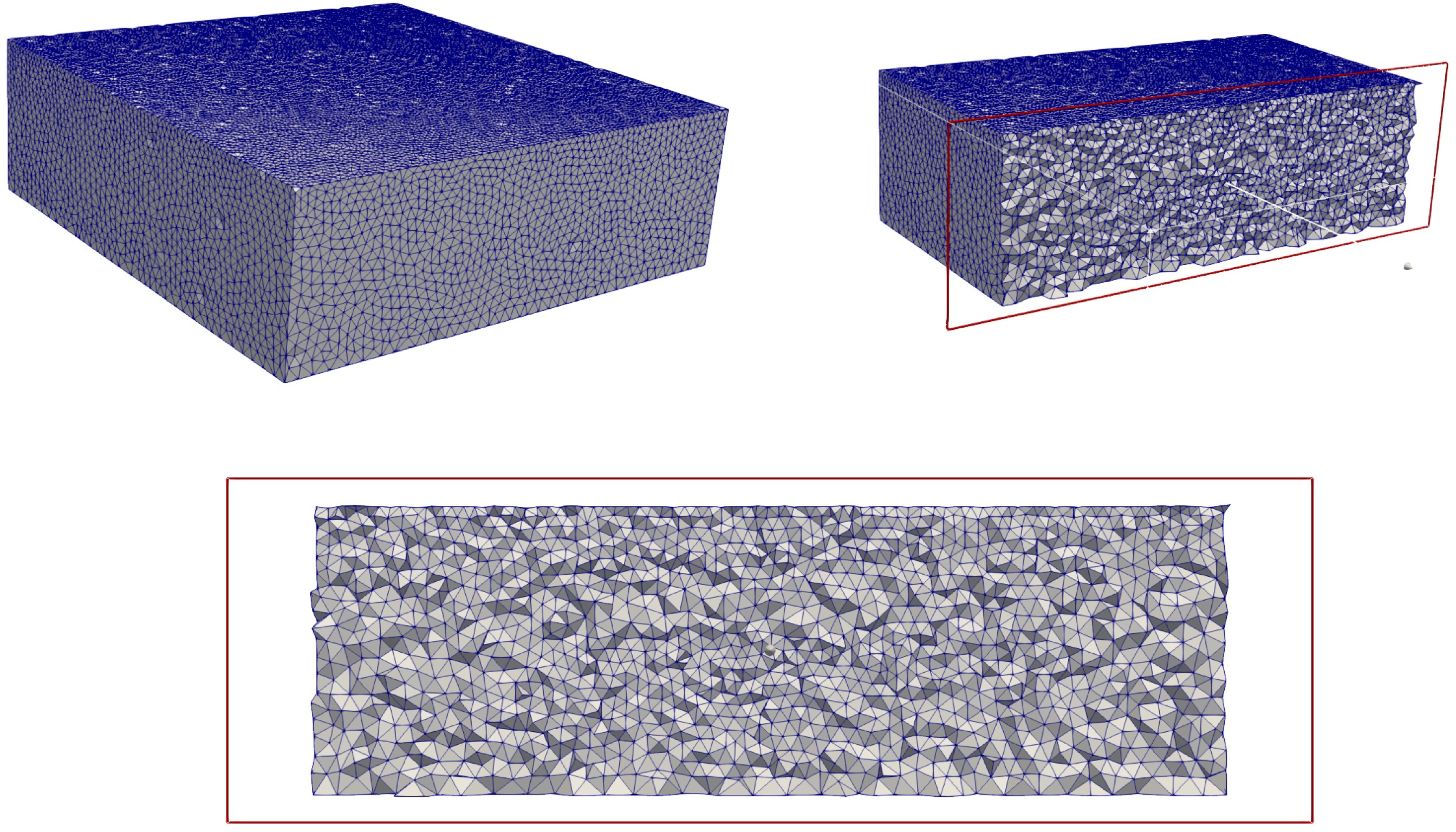
WARNING: To run the code snippet below you must download (and uncompress) the 3D EAGE seismic velocity model from (WARNING: File is ~500 MB) here
WARNING: Computationaly demanding! Running this example takes around 5 minutes in serial and requires around 2 GB of RAM due to the 3D nature of the problem and the domain size.
from mpi4py import MPI
import zipfile
import meshio

from SeismicMesh import (
    get_sizing_function_from_segy,
    generate_mesh,
    sliver_removal,
    Cube,
)

comm = MPI.COMM_WORLD

# Bounding box describing domain extents (corner coordinates)
bbox = (-4200, 0, 0, 13520, 0, 13520)

# Desired minimum mesh size in domain.
hmin = 150.0

# This file is in a big Endian binary format, so we must tell the program the shape of the velocity model.
if comm.rank == 0:
    path = "Salt_Model_3D/3-D_Salt_Model/VEL_GRIDS/"
    # Extract binary file Saltf@@ from SALTF.ZIP
    zipfile.ZipFile(path + "SALTF.ZIP", "r").extract("Saltf@@", path=path)

fname = path + "Saltf@@"

# Dimensions of model (number of grid points in z, x, and y)
nx, ny, nz = 676, 676, 210

cube = Cube(bbox)

# A graded sizing function is created from the velocity model along with a signed distance function by passing
# the velocity grid that we created above. More details for the :class:`MeshSizeFunction` can be found here
# https://seismicmesh.readthedocs.io/en/par3d/api.html#seimsicmesh-meshsizefunction

ef = get_sizing_function_from_segy(
    fname,
    bbox,
    hmin=hmin,
    dt=0.001,
    freq=2,
    wl=5,
    grade=0.25,
    hmax=5e3,
    domain_pad=250,
    pad_style="linear_ramp",
    nz=nz,
    nx=nx,
    ny=ny,
    byte_order="big"
)

points, cells = generate_mesh(domain=cube, h0=hmin, cell_size=ef)

# For 3D mesh generation, we provide an implementation to bound the minimum dihedral angle::
points, cells = sliver_removal(
    points=points, bbox=bbox, h0=hmin, domain=cube, cell_size=ef
)

# Meshes can be written quickly to disk using meshio and visualized with ParaView::
if comm.rank == 0:

    # NOTE: SeismicMesh outputs assumes the domain is (z,x,y) so for visualization
    # in ParaView, we swap the axes so it appears as in the (x,y,z) plane.
    meshio.write_points_cells(
        "EAGE_Salt.vtk",
        points[:, [1, 2, 0]] / 1000.0,
        [("tetra", cells)],
    )
More information
All other information is available at: https://seismicmesh.readthedocs.io
Getting started - Learn the basics about the program and the application domain.
Tutorials - Tutorials that will guide you through the main features.
1 maintainer

Release files for SeismicMesh 3.0.0
For a detailed explanation of source distributions (sdists) and built distributions (wheels), please see the package formats documentation.
Source distribution (sdist)
| File | Size | Uploaded | |
|---|---|---|---|
| SeismicMesh-3.0.0.tar.gz | 5.8 MB | Details |
Built distribution (wheel)
| File | Interpreter | ABI | Platform | Reset |
|---|---|---|---|---|
| SeismicMesh-3.0.0-cp37-cp37m-macosx_10_15_x86_64.whl | CPython 3.7 | CPython 3.7 pymalloc | macOS 10.15+ x86-64 | Details |
Total release size: 8.1 MB
Release files / SeismicMesh-3.0.0.tar.gz
| Download URL | SeismicMesh-3.0.0.tar.gz |
|---|---|
| Size | 5.8 MB |
| Tags | Source |
|
SHA-256 checksum How to use checksums |
d48b0bee273e094740a1b9d4716a0a720c9e38afbf39bcc740cac75d9d95af29
|
|
BLAKE2b-256 checksum How to use checksums |
d8d7e9e40e587fe1022842a16597de4ac08d4cda666af899a0df6ece9d7294d0
|
| Upload date | |
|
Uploaded using Trusted Publishing? What is trusted publishing? |
No |
| Uploaded via |
twine/3.2.0 pkginfo/1.5.0.1 requests/2.24.0 setuptools/49.6.0 requests-toolbelt/0.9.1 tqdm/4.48.2 CPython/3.7.4
|
Release files / SeismicMesh-3.0.0-cp37-cp37m-macosx_10_15_x86_64.whl
| Download URL | SeismicMesh-3.0.0-cp37-cp37m-macosx_10_15_x86_64.whl |
|---|---|
| Size | 2.3 MB |
| Tags | CPython 3.7 CPython 3.7 pymalloc macOS 10.15+ x86-64 |
|
SHA-256 checksum How to use checksums |
3e5e97ee0bd3ff9f0f8dae84e5a1ca8014658d4caf805ed78ca417bcd67f1e4a
|
|
BLAKE2b-256 checksum How to use checksums |
9eabfb2361e1afbaecb872cc44cbeb722096064be7c5353db6661bd3b4bec957
|
| Upload date | |
|
Uploaded using Trusted Publishing? What is trusted publishing? |
No |
| Uploaded via |
twine/3.2.0 pkginfo/1.5.0.1 requests/2.24.0 setuptools/49.6.0 requests-toolbelt/0.9.1 tqdm/4.48.2 CPython/3.7.4
|














