
SmartMDAO 🚀
Extensible MDAO framework with zero boilerplate integration and plug-and-play optimization.




SmartMDAO is a lightweight, purely Pythonic framework for Multidisciplinary Design Analysis and Optimization (MDAO). Define your disciplines as plain Python functions, and SmartMDAO maps the dependency graph, converges cyclic feedback loops, caches expensive calls, and bridges straight into your optimizer of choice.
What makes it different
There are mature MDAO frameworks already. SmartMDAO is not trying to be a smaller one — these are the things it does that they do not:
| Converges on decisions, not just numbers | A coupling variable can be a set, an enum, a frozen dataclass or a whole architecture. Anything supporting == converges on structural equality — unchanged since the last sweep means at rest. Discrete architectural choice sits inside the feedback loop, next to the floats. |
| Tells you what a solve would do, without running it | analyze() and validate() read signatures, annotations and the graph. Execution order, feedback loops, which variable needs a starting value, every structural problem at once — all free, because no discipline is ever called. |
| Makes the assumptions reviewable | The threshold that turns mass_kg = 880 into "heavy" is a declared object, not a number buried in a helper. explain() states it; validate() checks it. A hypothesis you cannot see is one nobody reviews. |
| Disciplines can be rules, not code | A reviewed .lp file becomes a discipline: deterministic, diffable, version-controlled. "No feasible architecture" stops being a sentinel someone invented and becomes a proof, with the minimal set of conflicting requirements to take into a design review. |
| Says what a run will cost before it starts | One sweep proves the model executes and measures the unit cost, so every estimate above it falls out of it. An unbounded run is never what happens by accident. |
| Knows when a step touches the world | A step that writes a file or calls an API is declared (effects=), so the library can tell a recomputed number from a resent email. Inside a loop, repeating it unasked is refused before anything runs; an optimizer or a comparison that would multiply it needs an explicit yes. |
| Reports what actually happened | Every iterative block returns a ConvergenceReport: converged, exhausted, or abandoned — with the reason and the full residual trace. You never infer it from a list of numbers. |
| Zero boilerplate, zero ceremony | No component classes, no add_subsystem, no XML, no separate problem description. A discipline is a function; wiring is by parameter name. |
The thread through all of it: surface the consequences before the engineer commits to them, and never let a default quietly decide the answer. That principle is written down in design record 003.
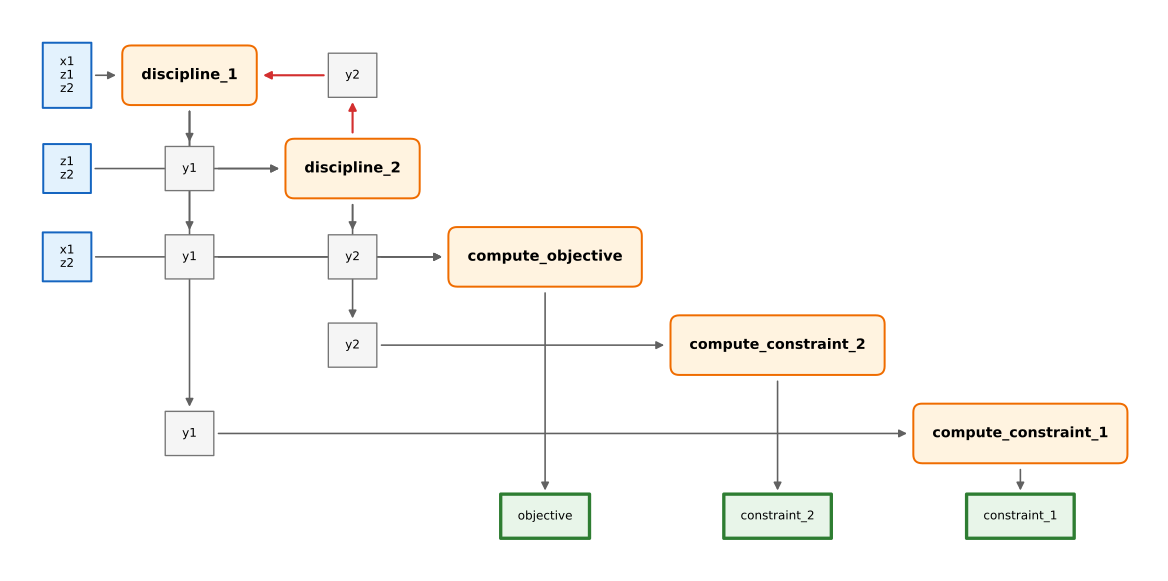
🔍 See It In Action
Without SmartMDAO — you hand-write the convergence loop and track state yourself:
y2 = 1.0  # initial guess
for _ in range(100):
    y1 = z1 ** 2 + z2 + x1 - 0.2 * y2
    y2_next = math.sqrt(abs(y1)) + z1 + z2
    if abs(y2_next - y2) < 1e-6:
        break
    y2 = y2_next
With SmartMDAO — declare each discipline once; the y1 ↔ y2 cycle is found and converged for you:
@pipeline.step(outputs=["y1"])
def discipline_1(z1, z2, x1, y2): return z1 ** 2 + z2 + x1 - 0.2 * y2

@pipeline.step(outputs=["y2"])
def discipline_2(z1, z2, y1): return math.sqrt(abs(y1)) + z1 + z2

pipeline.run(z1=1.0, z2=1.0, x1=1.0, y2=1.0)
🌟 Why SmartMDAO?
- Effortless MDA — no DSL, just
@pipeline.stepand standard type hints. Works with plain types, dataclasses, or your own objects. - Convergence Beyond Numbers — coupling variables don't have to be floats. Dicts, sets, dataclasses, or any equatable type converge too: SmartMDAO falls back to structural equality when there's no numeric residual to drive to zero, so a feedback loop over a negotiated plan or a resolved dependency set converges exactly like a numeric MDA loop does. See it in action below.
- Built-in Caching — layer
@cached(RAM, HDF5, Pickle) onto expensive functions for instant speedups. - Agnostic MDO — define your
OptimizationProblemonce, then run it through any backend with a single string:optimize(problem, backend="scipy")orbackend="openturns". Bring your own via@register_backend, or drop straight toPipelineEvaluatorfor full control. - Type-Safe — static validation catches mismatched disciplines before a single step runs; opt-in runtime checks catch the rest.
- Built Also for Researchers — solvers are plain
Protocolclasses, so custom MDA convergence algorithms drop in without touching the core framework. - Inspectable Before You Run It —
analyze()andvalidate()report execution order, feedback loops, which variables need an initial guess, and every structural error, without executing a single discipline. Available to coding agents over MCP. - Solves That Explain Themselves — every feedback loop returns a
ConvergenceReport: converged, out of iterations, or abandoned as hopeless, with the reason and the full residual trace.
🔄 Convergence Beyond Numbers
OpenMDAO and GEMSEO converge coupled disciplines by driving a numeric residual (|Δ| between
successive floats) to zero. That assumption breaks the moment a discipline exchanges something
that isn't a number — a resolved set of dependencies, a negotiated plan, a piece of state an AI
agent is refining across a feedback loop. SmartMDAO's StandardConvergenceChecker falls back to
structural equality for non-numeric values: "did this value change since the last iteration?" is
a perfectly good convergence criterion when there's no derivative to speak of.
from smartmdao import Pipeline, IterativeSolver

pipeline = Pipeline(solver=IterativeSolver(max_iterations=10))

depends_on = {
    "billing": frozenset({"database", "auth"}),
    "auth": frozenset({"database"}),
}

@pipeline.step(outputs=["enabled"])
def resolve_dependencies(requested: frozenset, enabled: frozenset) -> frozenset:
    expanded = set(enabled) | set(requested)
    for feature in list(expanded):
        expanded |= depends_on.get(feature, frozenset())
    return frozenset(expanded)

result = pipeline.run(requested=frozenset({"billing"}), enabled=frozenset())
# result["enabled"] -> frozenset({"billing", "auth", "database"}) - converged in
# 2 iterations, with not a single float anywhere in the coupling variable.
Bring your own equatable type — a dict, a set, a frozen @dataclass — and the same
IterativeSolver/HybridSolver machinery converges it, no numeric tolerance required.
🧭 Where this leads. If a coupling variable can be a negotiated plan, one of the disciplines producing it could be an LLM — converging inside the feedback loop, with termination decided by the solver rather than by the model declaring itself done. We've written up what that would take, what it's good for, and where it breaks, in
docs/design/002-agent-as-discipline.md, andscripts/agent_as_discipline_demo.pyruns it end to end: a discrete architecture converges in two sweeps, infeasible requirements converge on an explicit "no", a naive model that oscillates is caught at sweep 4 of 100 byOscillationAwareConvergenceChecker, and — the topology we'd actually recommend — the model sits on the linear part of aHybridSolverwhile the numeric cycle converges underneath it, costing one call per outer iteration instead of one per sweep. The model call in that demo is a deterministic stub — the convergence machinery is real and tested; wiring it to a live model is future work.
⚡ Full Quick Start: Caching, Constraints & Optimization (click to expand)
Here is how easily you can solve the classic Sellar coupled problem end-to-end, from caching through optimization - swapping the solver backend with a single string.
import math
import logging
from smartmdao import (
    Pipeline,
    HybridSolver,
    PipelineEvaluator,
    OptimizationProblem,
    ConstraintSpec,
    optimize,
    cached,
    MemoryBackend,
    configure_logging
)

# --- Setup Logging and Cache ---
configure_logging(level=logging.WARNING)
mem_cache = MemoryBackend() # HDF5 and Pickle also available

# ==============================================================================
# PART 1: Initialize the Pipeline with the HybridSolver
# ==============================================================================
# The HybridSolver automatically detects and converges cyclic dependencies
pipeline = Pipeline(
    solver=HybridSolver(max_iterations=100, tolerance=1e-6)
)

# ==============================================================================
# PART 2: Define the Sellar Disciplines (MDA)
# ==============================================================================
@pipeline.step(outputs=["y1"])
@cached(mem_cache) # Instantly cache this discipline to speed up evaluations
def discipline_1(z1: float, z2: float, x1: float, y2: float) -> float:
    return (z1 ** 2) + z2 + x1 - (0.2 * y2)

@pipeline.step(outputs=["y2"])
@cached(mem_cache)
def discipline_2(z1: float, z2: float, y1: float) -> float:
    return math.sqrt(abs(y1)) + z1 + z2

@pipeline.step(outputs=["objective"])
@cached(mem_cache)
def compute_objective(x1: float, z2: float, y1: float, y2: float) -> float:
    return (x1 ** 2) + z2 + (y1 ** 2) + math.exp(-y2)

@pipeline.step(outputs=["constraint_1"])
@cached(mem_cache)
def compute_constraint_1(y1: float) -> float:
    """Constraint formulation: 3.16 - y1 <= 0"""
    return 3.16 - y1

@pipeline.step(outputs=["constraint_2"])
@cached(mem_cache)
def compute_constraint_2(y2: float) -> float:
    """Constraint formulation: y2 - 24.0 <= 0"""
    return y2 - 24.0

# ==============================================================================
# PART 3: Bridge the Pipeline to an Optimizer-Agnostic Problem
# ==============================================================================
evaluator = PipelineEvaluator(
    pipeline=pipeline,
    design_vars=["z1", "z2", "x1"],
    constants={"y2": 1.0} # Initial guess to kick off the cycle
)

# Both backends expect h(x) >= 0; Sellar's constraints are naturally written
# as g(x) <= 0, so we flip the sign with multiplier=-1.0.
problem = OptimizationProblem(
    evaluator=evaluator,
    initial_guess=[1.0, 1.0, 1.0],
    bounds=[(-10.0, 10.0), (0.0, 10.0), (0.0, 10.0)],
    objective="objective",
    constraints=[
        ConstraintSpec(name="constraint_1", multiplier=-1.0),
        ConstraintSpec(name="constraint_2", multiplier=-1.0),
    ],
)

# ==============================================================================
# PART 4: Run the *same* problem through two different backends
# ==============================================================================
for backend_name in ("scipy", "openturns"):
    result = optimize(problem, backend=backend_name)
    print(f"[{backend_name:>9}] objective={result.objective_value:.4f}")
🧠 Advanced Examples
The Quick Start above just scratches the surface! Notably:
readme_quick_start.py— the complete version of the Quick Start above, including SciPy's rawminimize()call, full state extraction, and pipeline visualization.optimizer_backends_demo.py— define oneOptimizationProblemand run the exact same Sellar problem throughscipy,openturns, and a custom registered backend, just by swapping a string.type_validation_demo.py— static and runtime type validation,Optional/Unionsupport, and writing a customTypeChecker.non_numeric_convergence_demo.py— two full non-numeric convergence cases: a single-discipline dependency closure over afrozenset, and a two-discipline negotiation over a sharedPlandataclass with an auto-detectedHybridSolvercycle.pipeline_analysis_demo.py—analyze,validateandexplainon a clean pipeline and a deliberately broken one, plus why identical steps need different initial guesses depending on the solver.mcp_connector_demo.py— the MCP connector driven end to end without an MCP client: an agent-written wing model that accidentally closes a mass-growth loop, caught before it ever runs.convergence_report_demo.py— the three ways a solve can end, and how to write a convergence checker that gives up on a hopeless system instead of burning every iteration.
For deeper nesting, custom convergence solvers, or more complex multidisciplinary systems, check out the scripts folder in our GitHub repository.
📦 Installation
SmartMDAO is available on PyPI. We recommend using uv for lightning-fast installation, but standard pip works perfectly.
Using uv:
uv add smartmdao
Using pip:
pip install smartmdao
(Visualization is built in via matplotlib — no extra system packages required.)
Optional extras
The base install ships SciPy, the default optimizer backend, and nothing you do not need — as of 1.8.0 it no longer drags in a Jupyter kernel or OpenTURNS. Two things are opt-in:
pip install smartmdao[openturns]   # the 'openturns' optimizer backend
pip install smartmdao[mcp]         # the MCP server, for use from a coding agent
pip install smartmdao[openturns,mcp]
optimize(problem, backend="openturns") without the extra raises an ImportError telling you
exactly this — the backend stays registered either way, so nothing fails at import time.
🔍 Check a Pipeline Without Running It
Every structural fact about a pipeline — execution order, feedback loops, type-edge mismatches — is derivable from signatures and annotations alone. So you can ask, before you run anything:
from smartmdao import analyze, validate, explain

analysis = analyze(pipeline, inputs=["z1", "z2", "x1"])
analysis.recommended_solver        # 'HybridSolver'
analysis.cycles[0].feedback_variables          # ('y1', 'y2')
analysis.initial_guesses_required              # y2, needed by discipline_1

for finding in validate(pipeline, inputs=["z1", "z2", "x1"]):
    print(finding)     # ERROR: 'discipline_1' consumes 'y2' before anything produces it...

print(explain(pipeline))   # the whole thing, in prose
validate() catches duplicate output names, type mismatches on every edge, missing inputs,
unseeded feedback variables, and solver misconfiguration — all without executing a single
discipline.
As an MCP server
The same analysis is available to a coding agent over MCP, so it can check pipeline code it writes instead of guessing:
pip install smartmdao[mcp]
Then point your client at the smartmdao-mcp command. It exposes analyze_pipeline,
validate_pipeline, explain_pipeline and render_pipeline_diagram, plus the docs as resources.
It finds your pipeline either as a module-level Pipeline, or by calling a factory annotated
-> Pipeline — it never calls a function speculatively to see what comes back.
It also exposes smartmdao_cookbook, which the server's instructions tell the agent to call
before writing any SmartMDAO code — so generated pipelines use the real API rather than a
plausible-looking one — and run_pipeline, which executes a pipeline in a child process under a
wall clock. That last one defaults to a single sweep: enough to prove the code runs, and enough to
measure what a full run would cost, so the agent can quote you a number before spending it. And
compare_runs, which runs two pipelines on the same inputs and diffs the answers — the only way to
prove a translation or refactor did not quietly change the result.
Nothing it does executes a discipline. See
the design record
for why it verifies rather than writes code for you.
📚 Documentation
New here? Start with the step-by-step testing guide — set up, run the suite, watch the analysis catch a feedback loop nobody declared, and connect the server to a coding agent. Each step says what it proves.
Want to see it work before installing anything? The notebooks are committed with their outputs, so GitHub renders what every cell actually printed — one concept per notebook, fifteen of them, from a first pipeline through to rule-backed disciplines and the mistakes that fail silently.
Design records and internals reference live in
docs/:
-
Notebooks — one concept per notebook, executed and committed with outputs. The long-form companion to the cookbook; CI re-runs them so they cannot drift.
-
Architecture — how the library works internally: the execution path,
Stepintrospection, the graph layer,HybridSolver's SCC decomposition, and the optimizer bridge. -
Roadmap — what's planned, phase by phase, with exit criteria.
-
Cookbook — task-indexed guidance: solvers, feedback loops, caching, optimization, and the mistakes that fail silently. Every snippet is executed by the test suite.
-
Testing guide — try everything yourself, step by step, including what the tools deliberately will not do.
-
Known issues — sharp edges, each with a severity and a fix direction. Worth a look before filing a bug; several are deliberate.
-
Design records — why things are the way they are, including the in-progress design for an MCP connector that lets a coding agent analyze and verify SmartMDAO pipelines.
🤝 Contributing & License
Contributions are welcome! Please feel free to submit a Pull Request.
Before you start, read docs/handoff.md — it sets out what "done" means in this project: docs/ updated, 100% test coverage, a didactic script demonstrating the change, and run_all.py green.
This project is licensed under the MIT License - see the LICENSE file for details.
1 maintainer

Metadata
1 maintainer
Release files for SmartMDAO 1.24.0
For a detailed explanation of source distributions (sdists) and built distributions (wheels), please see the package formats documentation.
Source distribution (sdist)
| File | Size | Uploaded | Provenance | Actions |
|---|---|---|---|---|
| smartmdao-1.24.0.tar.gz | 730.5 kB | With provenance | Details for smartmdao-1.24.0.tar.gz |
Built distribution (wheel)
| File | Interpreter | ABI | Platform | Actions Reset |
|---|---|---|---|---|
| smartmdao-1.24.0-py3-none-any.whl | Python 3 | none | any | Details for smartmdao-1.24.0-py3-none-any.whl |
Total release size: 842.7 kB
Release files / smartmdao-1.24.0.tar.gz
| Download URL | smartmdao-1.24.0.tar.gz |
|---|---|
| Size | 730.5 kB |
| Tags | Source |
|
SHA-256 checksum How to use checksums |
2759344c66d1a48aa8299415c267b8ea46a9aad4a6ac41462ad621b794d40d73
|
|
BLAKE2b-256 checksum How to use checksums |
cb2c956c46b731c5fe2219cb2340ab5e99827ce68ab257e55edf80e5852c643a
|
| Upload date | |
|
Uploaded using Trusted Publishing? What is trusted publishing? |
Yes |
| Uploaded via |
twine/7.0.0 CPython/3.13.14
|
Provenance
Provenance describes where a file came from. On PyPI, provenance is shared via attestations, which provide a verifiable record of the build or publishing details. View details, limitations and caveats.


PyPI Publish Attestation
PyPI verified that this artifact, at this checksum, originated from the publisher listed below.
Signed by GitHub Actions, verified by PyPI on Sep 26, 2026.
Transparency logRelease files / smartmdao-1.24.0-py3-none-any.whl
| Download URL | smartmdao-1.24.0-py3-none-any.whl |
|---|---|
| Size | 112.2 kB |
| Tags | Python 3 |
|
SHA-256 checksum How to use checksums |
62e5287d5f04b90ea43d6be52a5b388d548ba678564f4289a7e3c0ba6e469c62
|
|
BLAKE2b-256 checksum How to use checksums |
39371447a5b2b67444970bca7982ac784b6f2a14404b9f22f1c383bb5ba9afaa
|
| Upload date | |
|
Uploaded using Trusted Publishing? What is trusted publishing? |
Yes |
| Uploaded via |
twine/7.0.0 CPython/3.13.14
|
Provenance
Provenance describes where a file came from. On PyPI, provenance is shared via attestations, which provide a verifiable record of the build or publishing details. View details, limitations and caveats.
PyPI Publish Attestation
PyPI verified that this artifact, at this checksum, originated from the publisher listed below.
Signed by GitHub Actions, verified by PyPI on Sep 26, 2026.
Transparency logSecurity for SmartMDAO 1.24.0
Provenance
Provenance describes where a file came from. On PyPI, provenance is shared via attestations, which provide a verifiable record of the build or publishing details. View details, limitations and caveats.
Full provenance
Both files in this release have been uploaded with provenance metadata.
Attestation for smartmdao-1.24.0.tar.gz
PyPI Publish Attestation
PyPI verified that this artifact, at this checksum, originated from the publisher listed below.
Signed by GitHub Actions, verified by PyPI on Sep 26, 2026.
Transparency logA note on package security
PyPI is a repository for distributing packages, not a service for auditing them. While third-party security researchers and our staff do their best to detect and remove malicious packages, PyPI cannot guarantee the quality, security or suitability of any given package.
To learn more about protecting yourself from malicious actors, visit our package security documentation.














