
SqueakyCleanText


Stop hunting for personal details by hand. Mask detected names and contact details before sharing your text dataset.
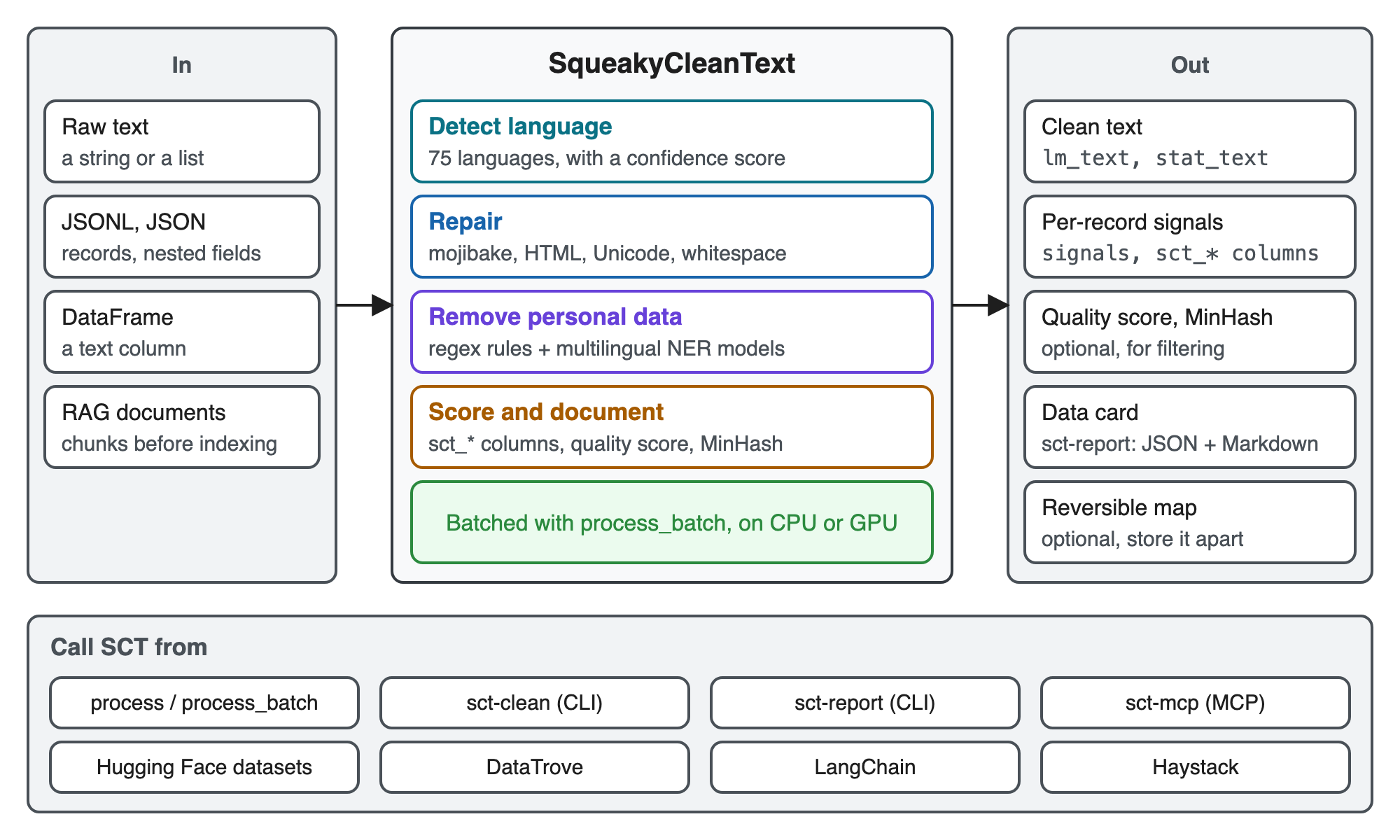
SqueakyCleanText helps people prepare text datasets for sharing, LLM training, fine-tuning or RAG, with language detection in 75 languages. It masks the personal details it finds and repairs broken text. Works with JSONL files, Hugging Face datasets and DataTrove jobs, on CPU or GPU.
in:   I’m Anna Berg & my mail is anna@example.se. Order 4711 ships on 2024-05-01.
out:  I'm <PERSON> & my mail is <EMAIL>. Order 4711 ships on 2024-05-01.
      sct_language=ENGLISH  sct_pii_count=2  sct_pii_types=['EMAIL', 'PERSON']

in:   Bel +31 20 123 4567 voor Jan de Vries.
out:  Bel <PHONE> voor <PERSON>.
      sct_language=DUTCH  sct_pii_count=2  sct_pii_types=['PERSON', 'PHONE']
Review cleaned text before sharing sensitive data; some personal details can be missed.
Documentation: https://rhnfzl.github.io/SqueakyCleanText/
What it does
One call runs these stages. Each one is a config field with a safe default, so you can switch it off.
-
Detect the language. One of 75 languages, with a confidence score. Pin it or limit it when you know.
-
Repair the text. Fixes mojibake and HTML entities (ftfy), folds styled characters, tidies whitespace, and can replace HTML tags, numbers and dates with tags.
-
Remove personal data. Regex rules (emails, phones, URLs, IPs, IBAN and card numbers) and an ensemble of multilingual NER models (names, places, organisations). Found values become:
- tags such as
<PERSON>(default), - realistic fake values (
synthetic), or - reversible placeholders
<PERSON_0>plus a map you store apart.
SCT ships no word lists; pass your own terms to always mask (
custom_deny_terms), never mask (custom_allow_terms), or your own labelled regex (custom_patterns). - tags such as
-
Score and document. Every result has value-free
signals. Turn them intosct_*columns (language, PII share, warnings; optional quality score and MinHash for near-duplicate removal) and a data card withsct-report(docs/SCORE.md). -
Scale.
process_batchruns documents in threads and batches the NER calls, on CPU (ONNX Runtime, no PyTorch needed) or an NVIDIA GPU. Adapters for Hugging Facedatasets, DataTrove, LangChain, Haystack and MCP.
SCT finds most personal data, not all of it. Check its output before you publish sensitive data.
Install
pip install squeakycleantext
Python 3.12 or newer. Add extras for what you use, for example pip install "squeakycleantext[datasets,gpu]":
| Extra | Why you need it |
|---|---|
datasets, datatrove |
Clean Hugging Face datasets or DataTrove pipelines |
langchain, haystack |
Clean documents in RAG pipelines |
gpu |
Run NER on an NVIDIA GPU |
synthetic |
Replace personal data with fake values |
score |
MinHash signatures for near-duplicate removal |
gliner |
Your own entity labels, and ner_mode="pii" (58 PII labels) |
mcp |
Run SCT as an MCP server for AI assistants |
All extras: docs/INSTALL.md.
Quickstart
For training and RAG data, use the training preset. It repairs the text and replaces personal data. Numbers, dates, HTML, case, line breaks and code stay as written.
from sct import TextCleaner, preset_config
from sct.score import score_record

cleaner = TextCleaner(cfg=preset_config("training"))
for r in cleaner.process_batch([
    "I’m Anna Berg & my mail is anna@example.se. Order 4711 ships on 2024-05-01.",
    "Bel +31 20 123 4567 voor Jan de Vries.",
]):
    row = score_record(r)
    print(r.lm_text)
    print(row["sct_language"], row["sct_pii_count"], row["sct_pii_types"])
# -> I'm <PERSON> & my mail is <EMAIL>. Order 4711 ships on 2024-05-01.
# -> ENGLISH 2 ['EMAIL', 'PERSON']
# -> Bel <PHONE> voor <PERSON>.
# -> DUTCH 2 ['PERSON', 'PHONE']
The first run downloads the NER models.
A whole Hugging Face dataset (datasets extra). clean_dataset wraps Dataset.map: batch_size, num_proc and other map arguments pass through. output="new_column" keeps the original text next to the cleaned text_clean, and score=True adds the sct_* columns.
from datasets import Dataset
from sct.integrations.hf import clean_dataset

if __name__ == "__main__":
    ds = Dataset.from_dict({"text": ["Mail jan@example.nl", "Call Maria Chen on +44 20 7946 0958."]})
    ds = clean_dataset(ds, columns=["text"], output="new_column", score=True, num_proc=2)
    print(ds[1]["text_clean"], ds[1]["sct_pii_types"])
    # -> Call <PERSON> on <PHONE>. ['PERSON', 'PHONE']
Full cleanup for classic ML. The default config (TextCleaner()) also replaces ID-shaped numbers, dates and HTML, and stat_text gives a lower-cased version without stopwords and punctuation:
from sct import TextCleaner

result = TextCleaner().process("I’m Anna Berg & my mail is anna@example.se. Order 4711 ships on 2024-05-01.")
print(result.lm_text)    # -> I'm <PERSON> & my mail is <EMAIL>. Order <NUMBER> ships on <DATE>.
print(result.stat_text)  # -> person mail email number ships date
Use it in your data pipeline
DataTrove (datatrove extra). Put SCT after your language and quality filters, so the NER step only sees documents you keep:
from datatrove.executor import LocalPipelineExecutor
from datatrove.pipeline.readers import JsonlReader
from datatrove.pipeline.writers import JsonlWriter
from sct.integrations.datatrove import SCTCleaner

if __name__ == "__main__":
    LocalPipelineExecutor(
        pipeline=[JsonlReader("raw/"), SCTCleaner(), JsonlWriter("clean/")],
        tasks=4,
        workers=2,
    ).run()
Everything else:
| Where | Usage | Docs |
|---|---|---|
| PDF extraction | extract_document and clean_document |
DOCUMENTS |
| LangChain | SCTDocumentTransformer().transform_documents(docs) |
INTEGRATIONS |
| Haystack | pipe.add_component("sct", SCTDocumentCleaner()) |
INTEGRATIONS |
| Ray, Spark, Polars, DuckDB, dlt, Daft | clean_columns(handle, batch) |
RECIPES |
| JSON, DataFrames, RAG chunks, streams | process_json(cleaner, value), WindowedStreamingRedactor(cleaner) |
ADAPTERS |
| Command line | printf 'Email maria@example.com' | sct-clean --no-ner |
ADAPTERS |
| Data card for a file | sct-report data.jsonl --text-column text --out report.json --card card.md |
SCORE |
| AI assistants | sct-mcp (MCP server, mcp extra) |
MCP |
The framework adapters use the training preset unless you pass a config, so their output keeps numbers, dates, HTML and case. They build one cleaner per worker process and reject reversible mode, as do the streaming redactors and the MCP server. Plan for 5 to 7 GB of RAM per worker with the default NER ensemble.
How it works
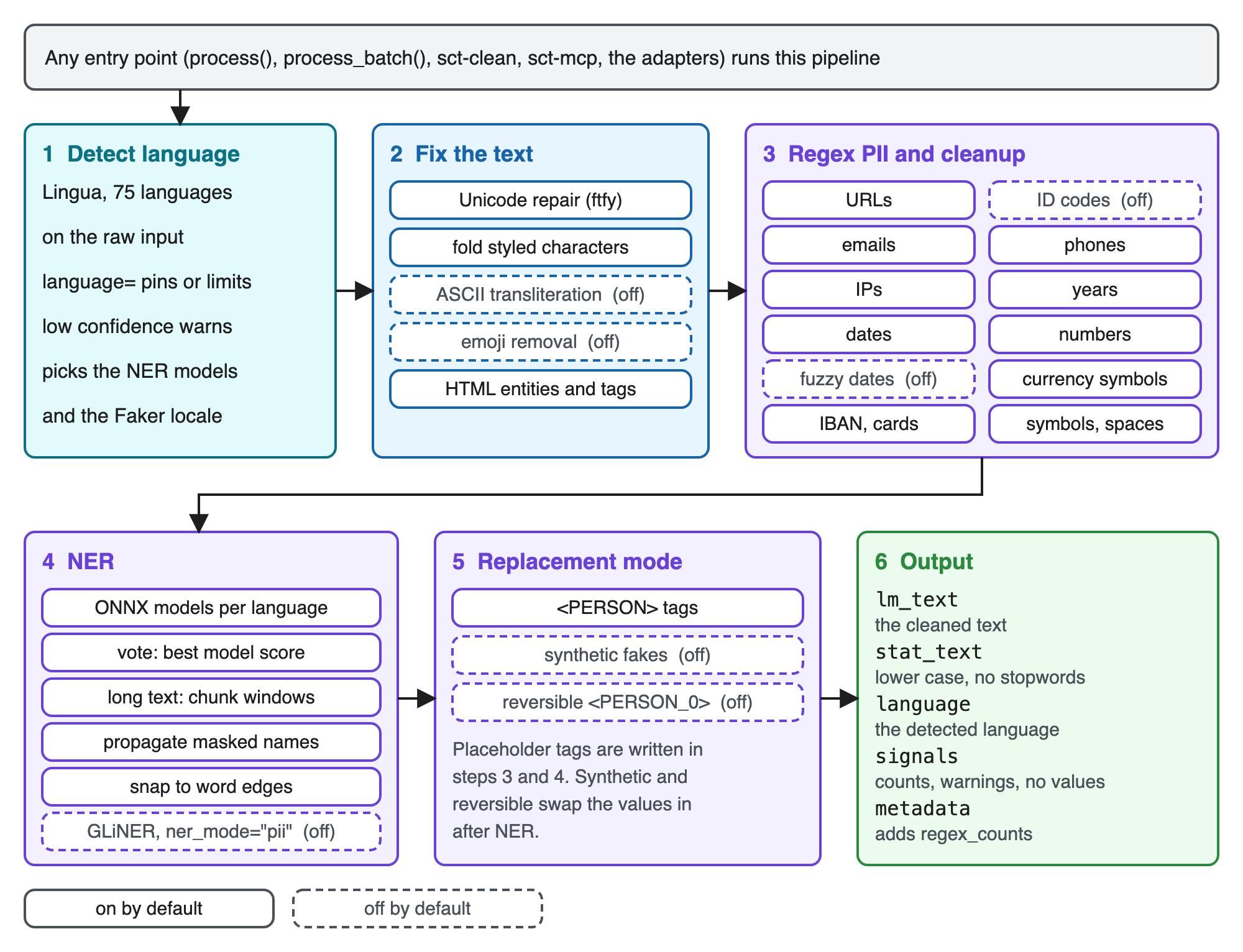
The diagram as text
- Entry points: any of them (
process(),process_batch(),sct-clean,sct-mcp, the adapters and the streaming redactors) runs the same pipeline. - 1 Detect language: Lingua, 75 languages, on the raw input. Pin it or limit it with
language=. Low confidence adds a warning. The language picks the NER models and the Faker locale. - 2 Fix the text: Unicode repair (ftfy), styled-character folding, HTML entities and tags. ASCII transliteration and emoji removal are off by default.
- 3 Regex PII and cleanup, in this order: URLs, emails, IPs, dates, fuzzy dates (off), IBANs and cards (checksums), ID codes (off), phones, years, numbers, currency symbols, then isolated letters, isolated symbols (with short bracket and brace content), and whitespace. Counted in
regex_counts. - 4 NER: ONNX models per language, a vote that keeps a span when its best model score passes the threshold, chunk windows for long text, propagation of masked names to their other copies, and span edges snapped to word edges. GLiNER and
ner_mode="pii"are opt in. - 5 Replacement mode:
<PERSON>tags by default; synthetic fakes or reversible<PERSON_0>with a map (or aTokenStorereference) are opt in. The map holds personal data. Placeholder tags are written in steps 3 and 4; synthetic and reversible swap the values in after NER. - 6 Output:
lm_text,stat_text(lower case, no stopwords or punctuation),language, value-freesignals, andmetadatawithregex_counts. - Across all stages (not drawn):
process_batchruns documents in threads and batches NER across documents (ner_batch_size); NER runs on CPU, CUDA or, for torch and GLiNER, the Apple GPU (ner_device='mps', opt-in); thetrainingpreset keeps numbers, dates and HTML.
Every step is a TextCleanerConfig field (docs/CONFIG.md). The diagrams are built by scripts/diagrams/; open the .excalidraw files in resources/ to view them in Excalidraw.
From 0.9.0, configure cleaners with TextCleanerConfig and set document concurrency with max_workers.
Deprecated config globals, ner_models_list, the worker batch_size alias and cleaner helper properties are removed.
What you get back
process and process_batch return a ProcessResult:
lm_text: the cleaned text, sentences intact, for LLMs, RAG and training.stat_text: lower-cased, without stopwords and punctuation, for classic ML models.language: the detected language.signals: a value-free view with the same keys for every input: language and confidence,pii_count,pii_share,pii_types,sensitive(pii_count > 0), warnings and the NER models that ran. Safe to log or store next to the text.metadata: the same counts, plus raw values only when you ask for them (the reversible map, orfindingswithinclude_entities=True). Keep those out of logs.
score_record turns a result into flat sct_* columns for filtering and data cards. ScoreConfig adds an optional quality score and a MinHash signature. Fields: docs/API.md, columns: docs/SCORE.md.
| PII mode | Output | Use it for |
|---|---|---|
placeholder (default) |
<PERSON> lives in <LOCATION>. |
Training and RAG data |
synthetic (synthetic extra) |
Fake values, for example Patty Hunter lives in East Bobbyfurt. (the same document always gets the same fakes) |
Data that must still read naturally |
reversible |
<PERSON_0> lives in <LOCATION_0>. plus a map |
Sending text to an LLM and restoring the answer |
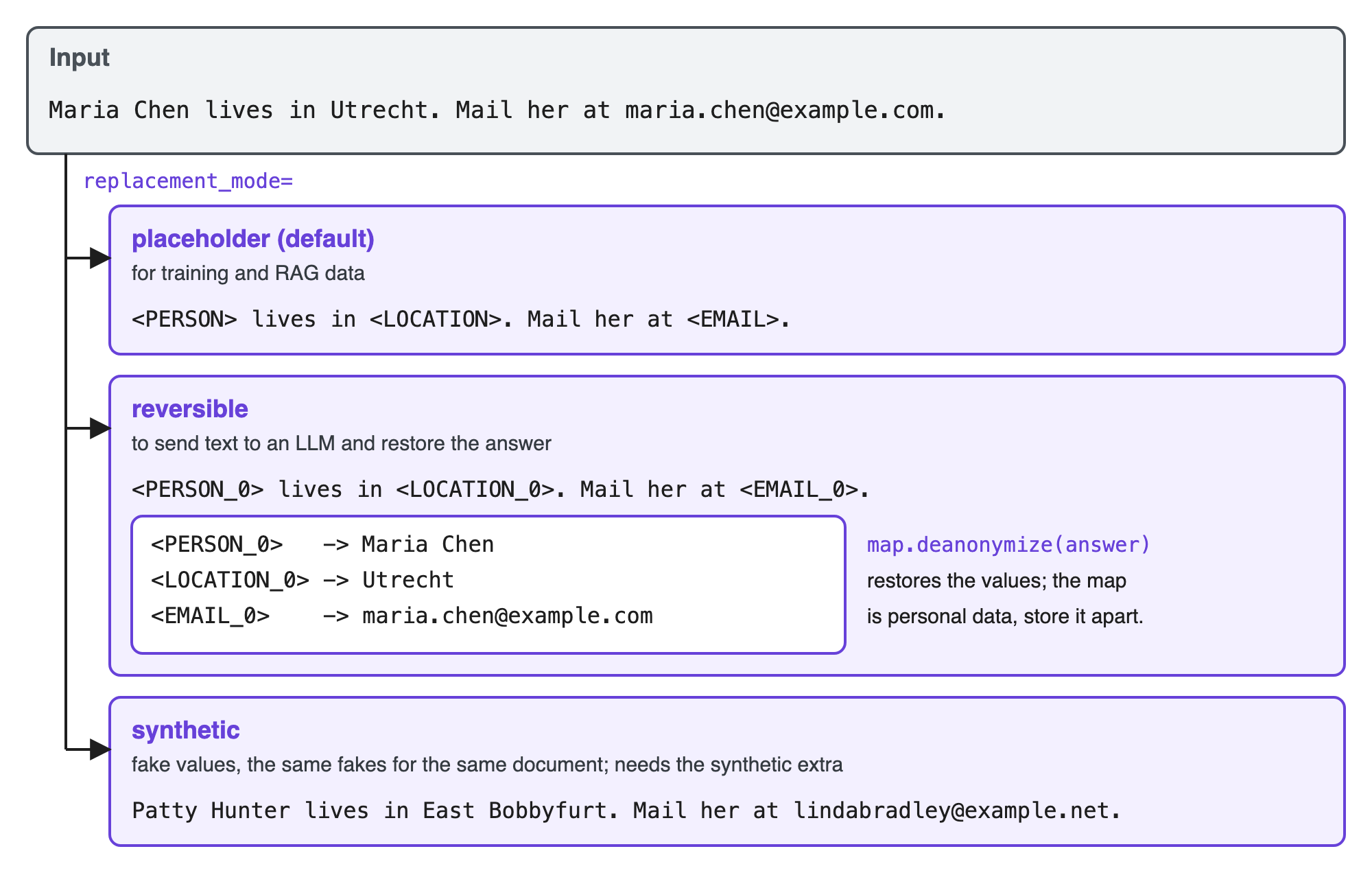
Modes, privacy policies and more PII types (ner_mode="pii"): docs/REPLACEMENT_MODES.md, docs/PRIVACY.md, docs/NER_BACKENDS.md.
One policy across detectors (opt-in)
Unified processing lets you apply the same handling rules to format matches and model findings. Existing callers keep pii_processing="legacy" by default.
from sct import TextCleaner, TextCleanerConfig, UnifiedPrivacyPolicy, HandlingRule

cleaner = TextCleaner(
    TextCleanerConfig(pii_processing="unified", check_ner_process=False),
    unified_policy=UnifiedPrivacyPolicy("contact-policy", "1", {
        "EMAIL": HandlingRule(action="redact"),
    }),
)
result = cleaner.process("Contact alice@example.com")
assert "alice@example.com" not in result.lm_text
All selected detectors inspect the same canonical text before PII replacement. use_mode follows the placeholder, synthetic or reversible mode. keep affects PII replacement only. redact emits <REDACTED> and never saves that value in the reversible map. Protection wins over overlapping keep decisions; redaction wins over other protection. Unknown scores protect by default, or fail with unknown_score_action="error".
A nonempty detector_specs tuple selects the complete detector set from an application-owned DetectorRegistry. Empty specs select the configured built-in regex rules and native NER when check_ner_process=True. Native registry loading requires allow_network_detectors=True because model artifacts may need downloading. External-only selection does not initialize native NER. Separately requested document classification still runs and also requires network permission in unified mode. Legacy model-loading behavior stays unchanged.
metadata["findings_v2"] contains value-free canonical positions, original-input ranges, mapping quality and policy decisions. counts_v2 separates detector hits after configured allow-term filtering from resolved replacements; provenance_v2 records detector and policy identities. Legacy counters stay empty in unified mode. Unified signals add version=2, counts_v2, coverage_v2 and provenance_v2. CLI/MCP summaries distinguish detector hits from rendered replacements. coverage_v2 reports source coverage quality and lower/upper bounds. Non-exact coverage leaves pii_chars and pii_share as None; score summaries place these shares in an explicit unknown bucket. Only actual built-in regex formatting findings receive the non-PII format exclusion; native, external and caller-declared dates remain sensitive.
Source mappings use Unicode code-point offsets and report exact, covering or unavailable. Complex built-in repairs can cover the whole input. Opaque custom callbacks make mapping unavailable, even when they return unchanged text. source_mapping="require_source" rejects those callbacks. These ranges do not describe original PDF bytes.
process(..., context=DetectionContext(...)), process_batch(..., contexts=...) and aprocess_batch(..., contexts=...) accept caller context in unified mode. Batch contexts must match input count and order. Buffered streaming uses this whole-document path; windowed streaming and browser manifests reject unified mode.
include_entities=True explicitly adds sensitive findings_v2_values, linked by finding_index to canonical findings. This includes values whose output was redacted. Keep this audit payload and reversible maps out of logs. They are absent by default, apart from the map explicitly requested through reversible mode.
Custom callbacks need migration review. Legacy callbacks run after regex replacement and before NER.
Unified callbacks run before all detection, so callbacks that depend on <EMAIL> or other rendered markers receive different input.
See configuration and rollback.
Caller-declared fields (opt-in)
Declare exact fields when a record needs protection beyond text detection. SCT does not infer meaning from field names.
from sct import FieldRule, FieldSchema, process_json

schema = FieldSchema("contacts", "1", (
    FieldRule(("name",), ("PERSON",), "protect_value"),
))
assert process_json(cleaner, {"name": "May", "status": "May"}, schema=schema).value == {
    "name": "<PERSON>", "status": "May",
}
Schemas require unified processing. Paths select original keys and list positions. Missing fields and None remain unchanged; selected containers fail. Whole-value protection also accepts finite numeric and boolean scalars. Default non-string handling stays unchanged. Protection uses the existing policy and replacement modes. Conflicting keep decisions, score errors, allow terms or disabled tags fail. Unknown scores with unknown_score_action="protect" remain compatible with thresholds. Explicit field types win equal-span ties after action priority.
Hints require providers that support context and the declared types. Presidio receives explicit declared types as context; ONNX-only providers reject required hints. DataFrame paths use (column_label,) across a column or (row_label, column_label) for a cell. Conflicting overlapping declarations fail. Framework paths use (column_name,) per record. RAG paths use ("text",) or ("metadata", ...). Selected missing DataFrame cells remain unchanged. Masking numeric cells changes only the copied output column to object dtype. Unsupported path shapes fail.
Unified findings use positional references without original keys or labels. Schema-match paths and caller context stay out of signals and provenance. MCP full detail excludes sensitive value payloads. Framework constructors accept a trusted module-level registry_factory; workers pickle its reference and rebuild per process. Haystack data resolves only application-registered factory references. Protect serialized pipeline configuration, which can contain caller schema/context identifiers.
Applications register schemas through CLI main(..., schemas=...) or create_mcp_server(..., schemas=...). Requests supply only exactly registered data-only schemas. CLI exposes --processing unified --schema '<JSON>'; --signals adds versioned counts and a summary. Requests cannot import Python factories. Existing adapter restrictions on reversible mode remain.
Speed and hardware
Default config (full multilingual NER ensemble), release benchmark documents (up to about 900 characters), SCT 0.8.0, on a workstation CPU and high-end GPUs, median of 3 runs. 0.8.1 runs at the same speed.
| Workload | Hardware | Docs/s |
|---|---|---|
process, one document at a time |
16 CPU cores | 5.0 |
process_batch, short documents, 16 workers |
16 CPU cores | 15.5 |
process_batch, short documents, 16 workers |
64 CPU cores | 29.2 |
process_batch, short documents, full ensemble |
3 GPUs (models split across them) | 130 |
process_batch, short documents, English only (2 models) |
1 GPU | 646 |
The full ensemble needs about 12 to 16 GB of free memory on one GPU; English only needs 3 to 5 GB. As a rough estimate from this table, 1 million short documents take about 26 minutes English-only on one GPU, about 2 hours with the full ensemble on 3 GPUs, and about 10 hours on 64 CPU cores.
NER is the slow stage. Turn it off (check_ner_process=False) for regex-only cleaning, or limit language= to load fewer models. Hardware advice and GPU setup: docs/PERFORMANCE.md.
Quality
Measured on open datasets with benchmarks/.
The SCT v0.8.2 comparison with other PII tools shows paired recall, precision and exposure results, with uncertainty intervals. It measures PII configurations rather than the whole processing pipeline. The tested version is v0.8.2, not v0.8.3.
The released v0.7.1 versus v0.8.3 comparison includes all 12 PII/long-document datasets, repeated CPU speed runs, and charts. Strict span F1 improves on every dataset. Unsupported-language false answers and TAB direct-identifier coverage worsen. Runtime versions differ, so the speed results do not isolate SCT code changes.
- Cleaning (FineWeb-2 with injected noise, default config): 100% of HTML, 99.6% of mojibake and 100% of URLs removed.
- Language detection (WiLI): 95.1% accuracy over 7,200 documents.
- PII (12 open PII datasets, about 40 languages): the 0.8.1 release branch leaked fewer values than 0.8.0 on every dataset, for example 18.1% to 8.2% on REDACT (comparison, pre-release commit
2078e8c4). - Multilingual PII eval (220 records, 11 languages): 0.93 recall, 0.95 precision (docs/MULTILINGUAL_EVAL.md).
Test your own data or model with the evaluation harness (docs/EVALUATION.md).
Languages
Language detection covers 75 languages. Full NER models cover English, Dutch, German and Spanish. The other languages use the multilingual WikiNEural model with the English model, or a model you bring with ner_models. Full list: docs/LANGUAGES.md.
Limits and design principles
- Safe defaults, every choice configurable. Each behaviour is a config field; nothing is forced.
- No guarantee that all PII is found. Models miss entities, mostly organisations and non-Latin scripts. Review output before you publish it.
- Declared fields need explicit rules. Use a caller-owned schema to protect known PII fields; unselected fields remain unchanged.
- Reversible maps are personal data. Anyone with the map can restore the values. Store maps apart from the cleaned data, with access control.
- Synthetic data is not anonymisation. Fake values keep the data useful; they do not make it anonymous in a legal sense.
- Offsets name their text stage. Legacy findings use post-regex positions. Unified findings use canonical positions and explicit source mapping quality.
Detailed known limits: docs/limits.md.
Opt-in document and corpus workflows
Users can combine extraction, unified detection, encrypted references and corpus selection without changing legacy defaults. Document and framework adapters use non-reversible output; direct text processing can return encrypted map references. The original documents and private corpus checkpoints remain caller-owned sensitive data.
| Capability | Entry point and limit |
|---|---|
| Encrypted references | EncryptedSQLiteTokenStore from sct.token_stores; keys and authorization remain application-owned |
| Corpus selection | analyse_records and select_records from sct.corpus; report-only by default, explicit basis required for removal |
| Native replay | curate_resumable; identity/checksum validation and private checkpoints, without exactly-once guarantees |
| PDF extraction | extract_document and clean_document; prepared local Docling assets, extracted-text protection only |
| Credential formats | Optional secrets detector; four syntactic categories, not credential validity |
| Language uncertainty | language_policy='abstain'; explicit thresholds and unknown-language action |
| Detector routing | routing_policy='always_run' stays default; calibrated cascade remains experimental |
See the combined acceptance evidence for the tested profiles. Trained Torch and ONNX scores agree on the parity controls. The synthetic gibberish control scored highest, so quality-filter accuracy remains unverified.
Documentation
| Topic | Where |
|---|---|
| Install, extras, speed and hardware | docs/INSTALL.md, docs/PERFORMANCE.md |
| Every config field, presets, language options | docs/CONFIG.md |
TextCleaner, ProcessResult, signals |
docs/API.md |
| Data pipelines, other engines, MCP server | docs/INTEGRATIONS.md, docs/RECIPES.md, docs/MCP.md |
| JSON, DataFrame, RAG, CLI, streaming, OCR | docs/ADAPTERS.md |
Score columns, quality, MinHash, data cards, sct-report |
docs/SCORE.md |
| NER backends, GLiNER, PII mode | docs/NER_BACKENDS.md |
| Encrypted local token maps | docs/TOKEN_STORES.md |
Replacement modes, privacy policies, TokenStore |
docs/REPLACEMENT_MODES.md, docs/PRIVACY.md |
| Evaluation | docs/EVALUATION.md, docs/MULTILINGUAL_EVAL.md |
| Languages and adding a language | docs/LANGUAGES.md, docs/ADDING_LANGUAGES.md |
| The whole API in one file, for AI coding assistants | llms.txt |
| Release notes | CHANGELOG.md |
New in 0.8.1: fewer leaks at the same speed, <IBAN> and <CARD> tags, and JSON and longer bracketed text survive cleanup. Some defaults changed; each has a setting to switch it back (CHANGELOG.md).
Contributing
Issues and pull requests are welcome. Read AGENTS.md first: model mistakes are fixed with model-driven rules, never with word lists, and every behaviour stays configurable.
Citation
@software{fazal_squeakycleantext,
  author = {Fazal, Rehan},
  title = {SqueakyCleanText},
  url = {https://github.com/rhnfzl/SqueakyCleanText},
  version = {0.10.0},
  year = {2026}
}
License and acknowledgements
MIT. See LICENSE. The package took inspiration from clean-text. It builds on ftfy, Lingua, ONNX Runtime and the NER models listed in docs/NER_BACKENDS.md.
1 maintainer

Metadata
1 maintainer
Release files for SqueakyCleanText 0.10.0
For a detailed explanation of source distributions (sdists) and built distributions (wheels), please see the package formats documentation.
Source distribution (sdist)
| File | Size | Uploaded | Provenance | Actions |
|---|---|---|---|---|
| squeakycleantext-0.10.0.tar.gz | 505.9 kB | With provenance | Details for squeakycleantext-0.10.0.tar.gz |
Built distribution (wheel)
| File | Interpreter | ABI | Platform | Actions Reset |
|---|---|---|---|---|
| squeakycleantext-0.10.0-py3-none-any.whl | Python 3 | none | any | Details for squeakycleantext-0.10.0-py3-none-any.whl |
Total release size: 737.1 kB
Release files / squeakycleantext-0.10.0.tar.gz
| Download URL | squeakycleantext-0.10.0.tar.gz |
|---|---|
| Size | 505.9 kB |
| Tags | Source |
|
SHA-256 checksum How to use checksums |
2b5f4d7b474f1ca074798ccd6bea27bf4f69374917034bb630c04c954a683c42
|
|
BLAKE2b-256 checksum How to use checksums |
d2ae6b8f9821968f689e6971bd6a363be95fb9223cd17e8f0cc58a4ffc9bc300
|
| Upload date | |
|
Uploaded using Trusted Publishing? What is trusted publishing? |
Yes |
| Uploaded via |
twine/7.0.0 CPython/3.13.16
|
Provenance
Provenance describes where a file came from. On PyPI, provenance is shared via attestations, which provide a verifiable record of the build or publishing details. View details, limitations and caveats.


PyPI Publish Attestation
PyPI verified that this artifact, at this checksum, originated from the publisher listed below.
Signed by GitHub Actions, verified by PyPI on Nov 10, 2026.
Transparency logRelease files / squeakycleantext-0.10.0-py3-none-any.whl
| Download URL | squeakycleantext-0.10.0-py3-none-any.whl |
|---|---|
| Size | 231.2 kB |
| Tags | Python 3 |
|
SHA-256 checksum How to use checksums |
87fb2ea75ac9b724073b1ea09a0f7fed451a50c455995b8941a33bc3bd845507
|
|
BLAKE2b-256 checksum How to use checksums |
d983e5f4becbaedd12a69586d86437346f2cea3cd9a427288a0f99374c46137b
|
| Upload date | |
|
Uploaded using Trusted Publishing? What is trusted publishing? |
Yes |
| Uploaded via |
twine/7.0.0 CPython/3.13.16
|
Provenance
Provenance describes where a file came from. On PyPI, provenance is shared via attestations, which provide a verifiable record of the build or publishing details. View details, limitations and caveats.
PyPI Publish Attestation
PyPI verified that this artifact, at this checksum, originated from the publisher listed below.
Signed by GitHub Actions, verified by PyPI on Nov 10, 2026.
Transparency logSecurity for SqueakyCleanText 0.10.0
Provenance
Provenance describes where a file came from. On PyPI, provenance is shared via attestations, which provide a verifiable record of the build or publishing details. View details, limitations and caveats.
Full provenance
Both files in this release have been uploaded with provenance metadata.
Attestation for squeakycleantext-0.10.0.tar.gz
PyPI Publish Attestation
PyPI verified that this artifact, at this checksum, originated from the publisher listed below.
Signed by GitHub Actions, verified by PyPI on Nov 10, 2026.
Transparency logA note on package security
PyPI is a repository for distributing packages, not a service for auditing them. While third-party security researchers and our staff do their best to detect and remove malicious packages, PyPI cannot guarantee the quality, security or suitability of any given package.
To learn more about protecting yourself from malicious actors, visit our package security documentation.














