





A configurable memory-efficient optimizer for PyTorch. It combines fused CUDA kernels with state-specific low-precision storage across Adam-style, factored Adafactor, CAME, and APOLLO paths. Non-negative states can use Adaptive Log-Space (al8 / al16) quantization, while signed momentum and CAME confidence precision are configured independently.
📄 Paper
Beyond Dense Adam States: Adaptive Log-Space Quantization for Memory-Efficient Optimizers · PDF · Artifacts
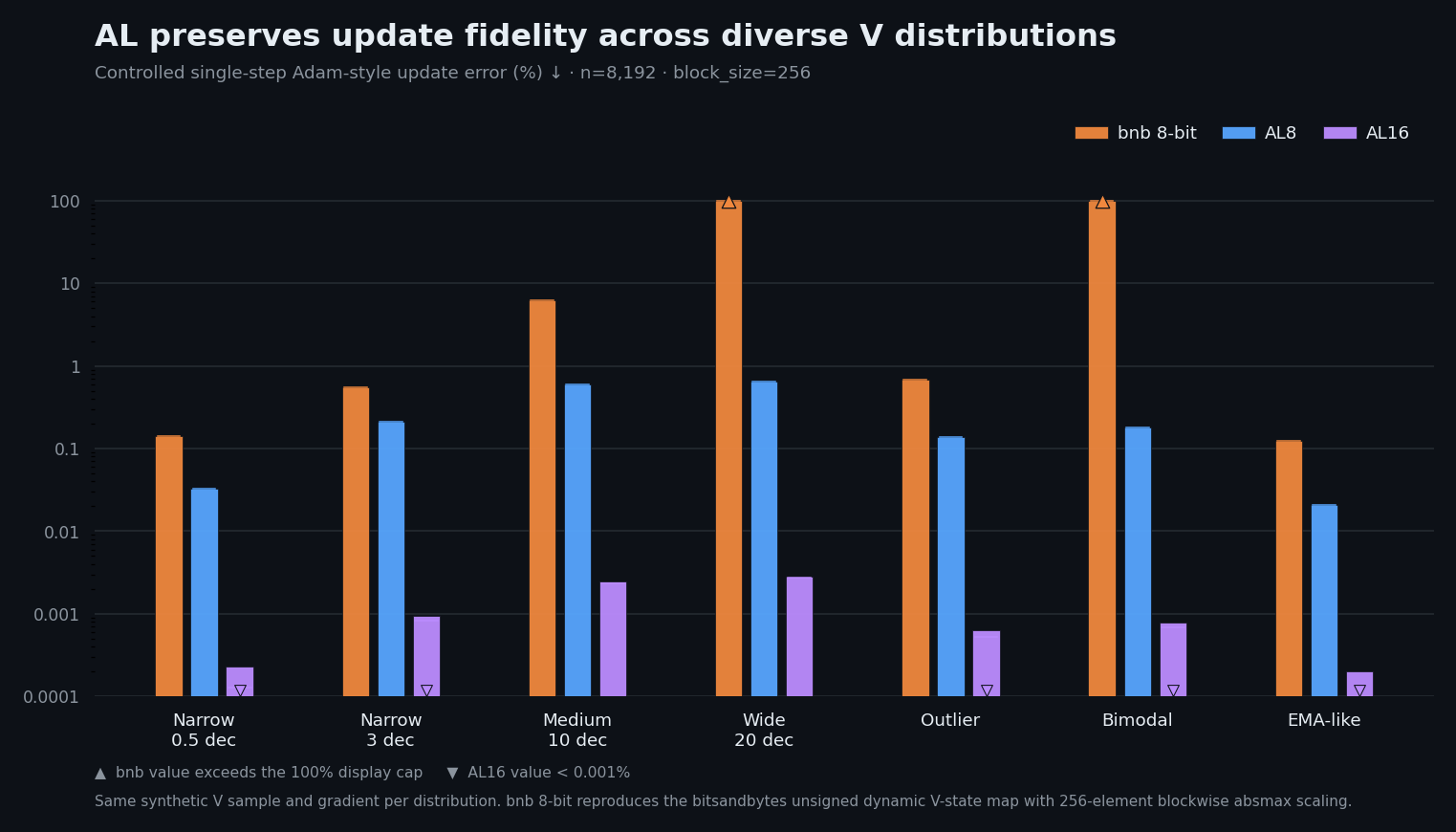
📐 Adaptive Log-Space (AL)
Adaptive nonzero range — each block fits its own
[ℓ_min, ℓ_max]to the observed positive values instead of sharing one fixed global log range.
Exact-zero preservation — code zero is reserved exclusively for exact zero, givingq = 0 ⇔ x = 0.
AL8 / AL16 —al8provides 255 nonzero codes;al16provides 65,535. The markers in the animation are schematic.
State-specific storage — signed momentum uses an independent encoding, and CAME confidence states can use a different precision from the second moment.

⚡ Key Features
- Adaptive Log-Space Quantization:
al8/al16storage for non-negative optimizer states, with per-block adaptive logarithmic ranges and an exact-zero code. - Fused CUDA Kernels: Combines dequantization, EMA updates, Warp-Shuffle reductions, parameter updates, and requantization in fused CUDA paths where supported, reducing memory traffic and optimizer-step overhead.
- Configurable First-Moment: Stores the optional first moment (
beta1) using configurable 4-bit / 8-bit formats or full FP32 precision. - CAME Confidence Guidance: Optional confidence-guided updates with confidence-state precision configurable independently from the second-moment state.
- APOLLO Subspace Projection: Opt-in low-rank projected-gradient path that maintains adaptive statistics in projected space while reducing optimizer-state storage.
- Fira Norm-Growth Limiter: Regulates the relative growth of update norms to suppress destructive gradient spikes, available as an optional stabilizer across update paths.
- Zero CPU-GPU Sync: Avoids implicit CPU-GPU synchronization in the optimizer control flow, keeping the GPU pipeline from blocking.
- Cross-Platform JIT: JIT-compiles the CUDA extension locally on Windows and Linux, with a pure PyTorch fallback when CUDA compilation is unavailable.
📊 Performance
TinyLlama-1.1B · WikiText-103 · 20K steps · batch_size=4 · seq_len=512 · BF16 compute / FP32 model parameters · single NVIDIA RTX 3090 Ti · seed 921.
| Path | Group | Variant | M | V | C | BV | PPL ↓ | Peak ↓ | State ↓ | tok/s ↑ |
|---|---|---|---|---|---|---|---|---|---|---|
| AdamW | G0 | PyTorch | FP32 | FP32 | – | – | 72.48 | 21046.0 | 8392.7 | 2502 |
| AdamW | G0 | bnb8 | bnb8 | bnb8 | – | 256 | 73.54 | 10608.6 | 2131.8 | 2640 |
| AdamW | G0 | Ours | UF8 | AL8 | – | 2048 | 72.90 | 10596.8 | 2119.2 | 2960 |
| CAME | G0 | Official | FP32 | FP32 | FP32 | – | 86.68 | 13428.5 | 4203.2 | 1866 |
| CAME | G0 | Ours | UF8 | AL8 | AL8 | 2048 | 90.19 | 9509.0 | 1068.0 | 2432 |
| CAME | G0 | Ours | UF8 | AL8 | FP32 | 2048 | 88.41 | 9510.0 | 1070.3 | 2423 |
| CAME | G0 | Ours | UF8 | AL16 | AL16 | 2048 | 86.16 | 9510.8 | 1069.8 | 2428 |
| Adafactor | G0 | HF | – | FP32 | – | – | 77.56 | 8934.7 | 3.6 | 2206 |
| Adafactor | G0 | Ours | – | AL8 | – | 256 | 78.72 | 8442.6 | 1.2 | 2740 |
| Adafactor | G0 | Ours | – | AL8 | – | 2048 | 79.36 | 8442.7 | 1.3 | 2734 |
| Adafactor | G1 | Ours | – | AL8* | – | 256 | 78.15 | 8999.2 | 1.4 | 2708 |
| APOLLO | G0 | Official | FP32 | FP32 | – | – | 74.68 | 11560.2 | 2078.7 | 2331 |
| APOLLO | G0 | Ours | UF8 | AL8 | – | 2048 | 75.24 | 9338.2 | 756.3 | 2077 |
Benchmark notes — Memory is MiB. M, V, and C denote first-moment, second-moment, and CAME confidence-state storage; B<sub>V</sub> is the non-negative-state block size (momentum blocks use 256).
Peak is PyTorch maximum allocated CUDA memory; State is live CUDA tensor storage owned by the optimizer; throughput is Hugging Face Trainer input tokens/s. bnb8 is the evaluated bitsandbytes 8-bit state encoding; AL8* uses G1 protection for selected sensitive tensors while the main factored state remains AL8.
APOLLO memory fields use a matching 1K v0.4.4 refresh; PPL and throughput remain from the 20K v0.4.3 run.
📦 Installation
This project uses JIT (Just-In-Time) compilation.
Please ensure torch and ninja are installed, and a CUDA compiler (such as MSVC or GCC) is available in your environment.
If CUDA compilation fails, the optimizer will automatically fall back to the pure PyTorch implementation.
From PyPI
pip install -U adafactor8bit
From Source
pip install git+https://github.com/yanfeiwong/adafactor-8bit.git
🚀 Quick Start
Using it is as simple as using a standard PyTorch optimizer.
from adafactor8bit import Adafactor8Bit

optimizer = Adafactor8Bit(model.parameters(), lr=1e-3)
For other optimizer presets, use build_param_groups() to get started with automatic grouping. Available presets include AdamW, Adafactor, RMSprop, CAME, APOLLO, and SGD.
For example, to use AdamW:
from adafactor8bit import build_param_groups

groups = build_param_groups(
    model,
    preset="adamw",
    grouping="auto",
)
AdamW_optimizer = Adafactor8Bit(groups, lr=1e-4, weight_decay=1e-2)
The default automatic grouping gives normalization parameters and biases unquantized states with no weight decay. You can customize individual groups as needed.
For more complete examples, including preset selection and grouping options, see the examples folder.
🛠️ Advanced Example
Show topology-aware grouping example
Here we demonstrate a hybrid grouping strategy for complex hybrid architectures (e.g., Vision-Language Models, Diffusion UNets) to achieve stable and efficient training.
📌 The following strategies are applied:
| Layer Type | Strategy |
|---|---|
| 1D / Sensitive Parameters (Norms, Biases) | No quantization, no weight decay. |
| Embedding Layers | factored=False, scale_parameter=False, d=0.0, beta1=None → Momentum-free Adam-style scaling. Paired with an Adam-style learning rate, this allows for fine-grained, per-token updates while avoiding cold-token interference. |
| LM Head | 8-bit quantization, factored=False, scale_parameter=False, d=0.0, beta1=0.9 → Adam-style with momentum. Avoids factored distortion for the final output projection. |
| 2D Weights (APOLLO targets) (e.g., Attn, MLP) | 8-bit quantization, weight decay, APOLLO path. Continuously switching random subspace projection captures comprehensive gradient information. |
| 2D Weights (Others) | Default Adafactor path (factored), 8-bit quantization, weight decay. |
| >2D Weights (Conv2d, etc.) | 8-bit quantization, weight decay, Full-Rank & No RMS Scaling (factored=False, scale_parameter=False). Trades some VRAM to preserve spatial structures for finer optimization. |
Implementation:
from adafactor8bit import Adafactor8Bit

# Define learning rates
lr = 1e-3
lr_adam = 1e-4 # For Embedding and N-D layers, we use an Adam-style learning rate

apollo_targets = ["attn", "mlp"]

def get_param_groups(model, lr_adam, weight_decay, apollo_rank=256):
    group_1d, group_embed, group_lm_head, group_apollo, group_2d, group_nd = [], [], [], [], [], []

    for name, param in model.named_parameters():
        if not param.requires_grad: continue

        is_1d = param.ndim <= 1 or "bias" in name or "norm" in name
        # Match true Token Embeddings, excluding Position and Time Embeddings
        is_embedding = ("embed" in name.lower()
                        and "position" not in name.lower()
                        and "pos_embed" not in name.lower()
                        and "time" not in name.lower())
        is_lm_head = param.ndim == 2 and "lm_head" in name.lower()
        is_apollo_target = param.ndim == 2 and any(t in name for t in apollo_targets)

        if is_1d:
            group_1d.append(param)
        elif is_embedding:
            group_embed.append(param)
        elif is_lm_head:
            group_lm_head.append(param)
        elif is_apollo_target:
            group_apollo.append(param)
        elif param.ndim == 2:
            group_2d.append(param)
        else:
            group_nd.append(param)

    # Common configuration for Adam-style groups (element-wise, no RMS scaling, no clipping)
    adam_style = {
        "factored": False,         # full-rank V
        "scale_parameter": False,  # no parameter RMS scaling
        "d": 0.0,                  # no RMS clipping
        "beta3": None,             # CAME requires factored=True
        "apollo_rank": 0,
        "lr": lr_adam,
    }

    return [
        # 1. 1D / Sensitive: FP32, No Weight Decay
        {"params": group_1d, "weight_decay": 0.0, "quantize": False, "apollo_rank": 0},

        # 2. Embeddings: Momentum-free Adam-style scaling
        {
            "params": group_embed,
            "weight_decay": 0.0,
            "quantize": False,
            "beta1": None,             # Momentum-free
            **adam_style,
        },

        # 3. LM Head: Adam-style with momentum (avoid factored distortion)
        {
            "params": group_lm_head,
            "weight_decay": 0.0,
            "quantize": True,
            "beta1": 0.9,
            **adam_style,
        },

        # 4. 2D Weights (APOLLO targets): 8-bit quantization, APOLLO low-rank projection
        {
            "params": group_apollo,
            "weight_decay": weight_decay,
            "quantize": True,
            "apollo_rank": apollo_rank,
            "beta1": 0.9,              # Remove if minimizing optimizer memory is the priority.
        },

        # 5. 2D Weights (Others): Default Adafactor path (factored), 8-bit quantization
        {
            "params": group_2d,
            "weight_decay": weight_decay,
            "quantize": True,
        },

        # 6. >2D Weights: 8-bit quantization, Weight Decay, Full-Rank
        {
            "params": group_nd,
            "weight_decay": weight_decay,
            "quantize": True,
            "beta1": 0.9,
            **adam_style,
        },
    ]

model = MyModel().cuda()
optimizer = Adafactor8Bit(
    get_param_groups(model, lr_adam=lr_adam, weight_decay=1e-2, apollo_rank=256),
    lr=lr,
    # For continual learning or when using an external LR scheduler
    relative_step=False,              # Disable internal LR scheduling
    beta2=0.999,                      # Lock EMA window to prevent "blunting" over steps
    enable_fira_for_adafactor=True    # Enable Fira Limiter for all non-APOLLO paths
)

# Training loop...
Prefer an external configuration? See optimizer_from_config.py and custom_policy.json.
⚙️ Advanced Configuration
Show advanced configuration options
Continual Learning (beta2 & relative_step)
By default, Adafactor's second-moment decay rate dynamically decays with the training step, and the internal learning rate schedule (relative_step) scales the learning rate accordingly.
For endless fine-tuning or lifelong learning, this often leads to overly small learning rates and "blunted" second-moment estimates. To avoid these issues and keep the optimizer responsive:
- Set
relative_step=Falseto disable the built-in LR schedule (allowing you to use an external scheduler). - Set
beta2=0.999to lock the EMA window (similar to Adam).
Decoupled Weight Decay (scale_weight_decay=False)
By default, Adafactor's weight decay is coupled with the parameter's RMS scale.
- If you prefer the AdamW-style decoupled weight decay, set
scale_weight_decay=False.
Fira Limiter
The Norm-Growth Limiter limits the relative increase of update norms to suppress destructive gradient spikes.
enable_fira_for_apollo: Defaults toTrue. The APOLLO path applies the limiter by default to guard against sudden gradient rises in the low-rank subspace.enable_fira_for_adafactor: Defaults toFalse. Enables the limiter for the non-APOLLO paths.fira_margin: Defaults to0.01. The tolerance margin for norm growth, shared by both switches. The limiter activates only when the current update norm grows by more than this margin (e.g.,0.01= 1%) compared to the previous step.
Full-Rank and Factorized Variance (factored)
By default, Adafactor factorizes the second moment of $\ge$ 2D tensors into row and column statistics (factored=True) to minimize state memory. Setting factored=False switches to full element-wise variance (similar to RMSProp), while still retaining Adafactor's update RMS clipping mechanism (controlled by the d parameter). This configuration can be useful in the following scenarios:
- Convolution Weights (>2D): Setting
factored=Falsemaintains independent variance for each spatial position in the convolution kernel, enabling finer per-element gradient scaling. - Sparse Embeddings: Combining
factored=False,scale_parameter=False,d=0.0and a lower learning rate creates a momentum-free adaptive optimizer. This allows for fine-grained, per-token updates while avoiding cold-token interference.
No-Compiler Environments (use_cuda_kernel=False)
If you are in an environment without a CUDA compiler and want to bypass JIT compilation entirely:
- Set
use_cuda_kernel=Falseto fall back to the pure PyTorch implementation.
BF16 Master Weight Training
BF16 parameters use half the storage of FP32 parameters. Set stochastic_round_writeback=True to help small updates accumulate over training. See bf16_master_weight_training.py for a complete example.
🌌 APOLLO Low-Rank Subspace Projection
Show APOLLO configuration and notes
Enable the APOLLO path to compute gradient scaling factors in a memory-efficient low-rank subspace. Compared to Adafactor's standard row/column factorization (which assumes spatial independence), APOLLO uses random subspace projection to capture cross-dimensional covariance information while keeping memory overhead low.
-
apollo_rank: The target rank for the projection subspace. The default is0(disabled).- The official APOLLO GitHub repository recommends a rank of
256for 1B and 7B models. - The LLaMA-Factory default is
16. - Setting this to
1(APOLLO-Mini style) minimizes the low-rank state (saves even more VRAM than the Adafactor path). The original APOLLO-Mini relies on the first-moment (beta1) to smooth out projection noise. To replicate this, setbeta1=0.9alongsideapollo_rank=1.
- The official APOLLO GitHub repository recommends a rank of
-
apollo_scale: Heuristic scale parameter used to compensate for approximation error introduced by low-rank gradient scaling. The implementation appliessqrt(apollo_scale)to the resulting scaling factor. Defaults to 1.0. -
apollo_scale_type: Determines how the scaling factor is applied.'channel'applies it per channel (Standard APOLLO), while'tensor'applies it globally (APOLLO-Mini). -
apollo_update_proj_gap: Steps between projection matrix refreshes. Defaults to200. -
apollo_factorize(Experimental): Applies Adafactor-style row/column factorization within the low-rank subspace to further reduce state memory overhead.
🧊 CAME Confidence-Guided Updates
Show CAME configuration and tuning
Enable the CAME (Confidence-guided Adaptive Memory Efficient Optimization) path to add a confidence estimation stage after momentum accumulation:
Adaptive Scaling ($V$) → Momentum Accumulation ($M$) → Confidence Weighting ($C$)
Key Parameters & Tuning
The confidence stage measures the consistency between the current update direction and historical momentum, adaptively suppressing highly oscillatory updates.
beta3: EMA decay coefficient for the confidence matrix. Requiresbeta1(momentum) andfactored=True. Defaults toNone(disabled).- Learning Rate: The official CAME implementation recommends 0.5–0.9× the AdamW learning rate (see official tuning guide). To align with the original CAME behavior in this library, disable Adafactor's RMS scaling (
scale_parameter=False) and setd=1.0(which corresponds to CAME'sclip_threshold). - Warmup: Since the confidence matrix is zero-initialized without bias correction, a learning rate warmup is recommended to safely establish the confidence baseline.
- Choosing
beta3:beta3should generally be larger thanbeta2so the confidence estimate evolves more slowly than the variance estimate. A practical starting range is 0.9995–0.99995 whenbeta2=0.999.
Configuration Example
To replicate "vanilla" CAME (stripping Adafactor's native modifications), you can use the following configuration:
{
    "params": param_group,
    "lr": lr,                           # Original CAME recommends 0.5-0.9x AdamW LR
    "beta1": 0.9,
    "beta2": 0.999,
    "beta3": 0.9999,                    # Enable CAME confidence guidance
    "apollo_rank": 0,                   # Set to 0 for vanilla CAME. (Set >0 to enable APOLLO+CAME fusion)
    "weight_decay": weight_decay,
    "scale_weight_decay": False,
    "scale_parameter": False,           # Disable Adafactor RMS scaling to align with vanilla CAME
    "d": 1.0,
    "relative_step": False,
},
📈 Learning Rate Guide for Beginners
Show learning-rate guidance
If you are migrating from optimizers like AdamW, Adafactor's learning rate behavior might feel a bit different. This is mainly due to the scale_parameter option.
-
scale_parameter=True(default) Because of RMS scaling, a very smalllr(e.g.,1e-5) often leads to extremely slow progress. Start withlr=1e-3and adjust in the range1e-4–5e-3if needed. -
scale_parameter=FalseDisables RMS scaling, making the update scale more similar to AdamW. Use the learning rates you're familiar with for AdamW and tune as usual. (Note: the second moment is still factorized, so behavior is not identical.)
These are safe starting points. Always validate on your own task and batch size.
📌 Implementation Differences from Reference Optimizers
To maintain a unified and robust framework, some algorithmic paths have implementation-level differences compared to their original standalone repositories:
- APOLLO: Uses deterministic per-state seed allocation and an optimizer-level seed counter for projection matrix management.
- Adafactor: When
beta1is enabled, the momentum update ordering differs from the Hugging Face implementation.
🎓 Acknowledgements
This project builds upon the foundational work of several researchers and open-source communities. Sincere thanks to the following for their invaluable contributions:
Core Algorithm & Optimizer Design
- Noam Shazeer & Mitchell Stern for proposing the original Adafactor algorithm (Adafactor: Adaptive Learning Rates with Sublinear Memory Cost).
- Tim Dettmers for the inspiration from 8-bit block-wise quantization (8-BIT OPTIMIZERS VIA BLOCK-WISE QUANTIZATION) and the bitsandbytes library.
- Hanqing Zhu, Zhenyu Zhang, et al. for the APOLLO algorithm (APOLLO: SGD-Like Memory, AdamW-level Performance).
- Xi Chen, Kaituo Feng, et al. for the Norm-Growth Limiter mechanism in Fira (Fira: Can We Achieve Full-rank Training of LLMs Under Low-rank Constraint?).
- Yang Luo, et al. for the confidence-guided strategy in CAME (CAME: Confidence-guided Adaptive Memory Efficient Optimization).
Quantization & Implementation
- The QLoRA Team for their work on memory-efficient fine-tuning and quantization techniques (QLoRA: Efficient Finetuning of Quantized LLMs).
- The PyTorch AO Team for their work on 4-bit optimizer states, validating distribution-aware quantization for optimizer moments.
- The PyTorch Team for providing the foundational optimizer implementation and the C++ Extension toolchain.
Technical Review & Discussion
- Qwen, DeepSeek, ChatGPT, and ChatGLM for technical discussions and code reviews on CUDA optimization, memory safety, cross-platform compilation, and implementation design.
📝 Citation
@misc{wang2026beyond,
  title         = {Beyond Dense Adam States: Adaptive Log-Space Quantization for Memory-Efficient Optimizers},
  author        = {Yan Wang},
  year          = {2026},
  eprint        = {2608.22322},
  archivePrefix = {arXiv},
  primaryClass  = {cs.LG},
  url           = {https://arxiv.org/abs/2608.22322}
}
🏛️ License
The project is released under the MIT License.
⭐ Star the Project
If this optimizer has been useful in your work, consider giving the repository a star. It helps others discover the project and supports future development.
1 maintainer

Metadata
1 maintainer
Release files for adafactor8bit 0.4.5
For a detailed explanation of source distributions (sdists) and built distributions (wheels), please see the package formats documentation.
Source distribution (sdist)
| File | Size | Uploaded | |
|---|---|---|---|
| adafactor8bit-0.4.5.tar.gz | 78.9 kB | Details |
Built distribution (wheel)
| File | Interpreter | ABI | Platform | Reset |
|---|---|---|---|---|
| adafactor8bit-0.4.5-py3-none-any.whl | Python 3 | none | any | Details |
Total release size: 149.8 kB
Release files / adafactor8bit-0.4.5.tar.gz
| Download URL | adafactor8bit-0.4.5.tar.gz |
|---|---|
| Size | 78.9 kB |
| Tags | Source |
|
SHA-256 checksum How to use checksums |
f9a56abec22a875d8d1cc641bde7d7a643fc1a6be6eeed0f321fda262cf4be31
|
|
BLAKE2b-256 checksum How to use checksums |
6937368bd9786a7180c384c21d539c52a9689edf3f632a0169fc176157bb31c6
|
| Upload date | |
|
Uploaded using Trusted Publishing? What is trusted publishing? |
No |
| Uploaded via |
twine/6.2.0 CPython/3.13.9
|
Release files / adafactor8bit-0.4.5-py3-none-any.whl
| Download URL | adafactor8bit-0.4.5-py3-none-any.whl |
|---|---|
| Size | 70.9 kB |
| Tags | Python 3 |
|
SHA-256 checksum How to use checksums |
29159e1144abb1c95c5403bd09b0affb0959260041df581ea8cb61d252ba47e8
|
|
BLAKE2b-256 checksum How to use checksums |
8c184065cbf0aa486b603d7f262eb153386d50272c0b861ba2662e40fb4d4bb6
|
| Upload date | |
|
Uploaded using Trusted Publishing? What is trusted publishing? |
No |
| Uploaded via |
twine/6.2.0 CPython/3.13.9
|














