

ADscan - Active Directory Pentesting Tool for Linux, macOS and Windows





Free Active Directory pentesting CLI for pentesters, red teamers and security consultants. Recon, Kerberoasting, ADCS and DCSync in one terminal, with the attack path to Domain Admin mapped as you go.
Quick start | Docs | HTB Forest walkthrough | Sample client report | Free first PRO assessment for firms | Discord
ADscan covers 108 Active Directory attack techniques in a single workflow, from unauthenticated recon to AS-REP roasting, ADCS/ESC exploitation, credential harvesting and native attack-path analysis. It is free and source-available under the Business Source License 1.1.
pipx install adscan   # Linux or macOS, with Docker running
adscan install        # pulls the runtime image, needs 15 GB free
adscan start          # then type start_unauth
On Windows there is nothing to install. Download adscan.exe from the latest release and run it, no Docker and no Python needed. The Quick Start below has the details.
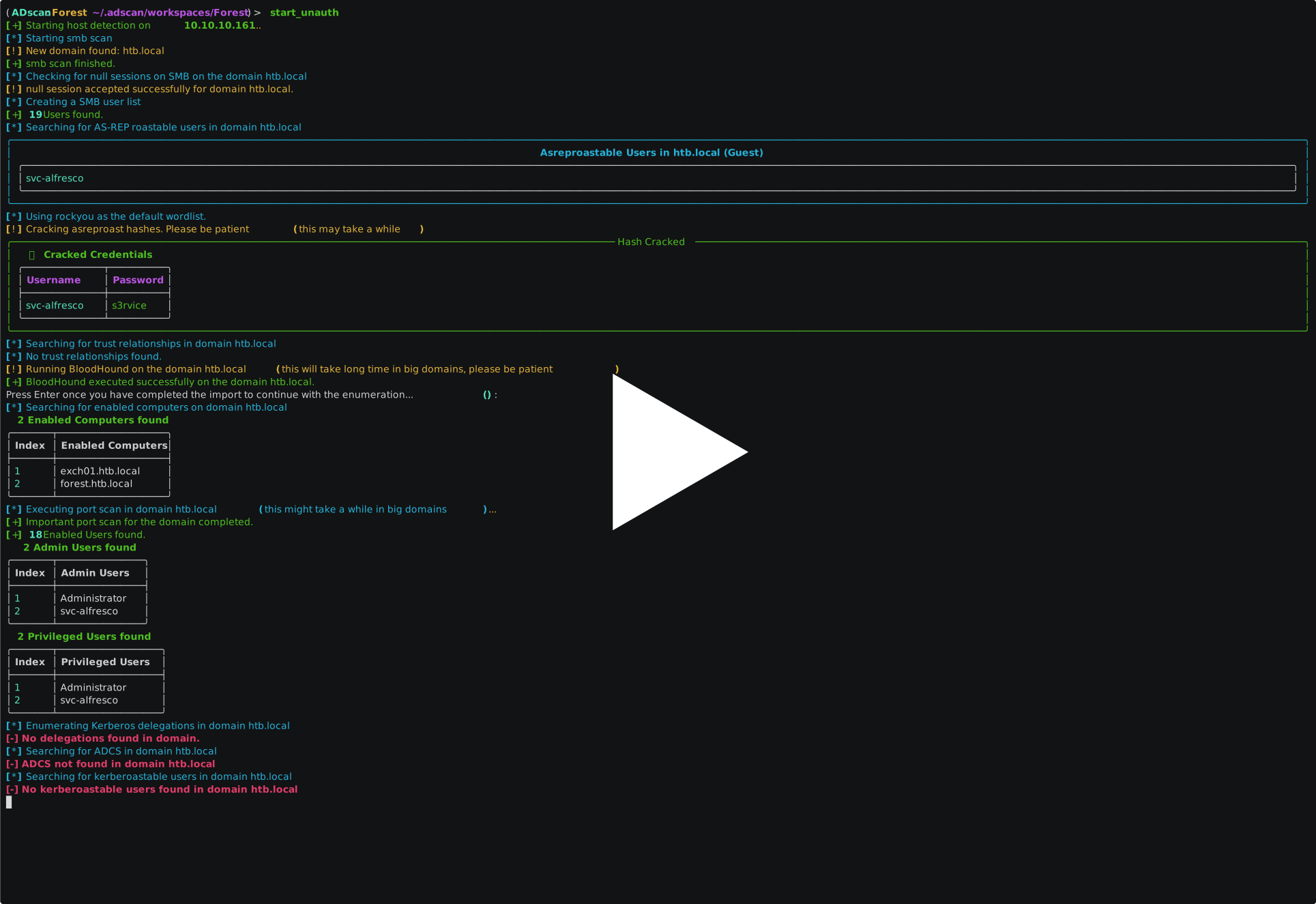
A real run with no cuts. ADscan takes HTB Forest from zero access to Domain Admin in about 3 minutes, unattended.
Table of Contents
- Quick Start
- ADscan vs Alternatives
- Kerberoasting, ADCS and AD Attack Coverage
- Common Pentest Workflows
- Usage Examples
- Want the Full Client Report?
- Requirements
- FAQ
- Developer Setup
- Contributing
- Author
- License
Quick Start
On Linux or macOS, ADscan runs inside Docker, so you need Docker Engine installed and running, and about 12 GB of free disk for the runtime image (the installer requires 15 GB free before it will pull).
docker version   # if this fails, install Docker first
pipx install adscan
adscan install
adscan start
On Windows there is no Docker and no Python to install. Download adscan.exe from the latest GitHub release, unblock it once (Unblock-File .\adscan.exe in PowerShell) and run it. It is one self-contained file that carries its own runtime and tools, so it works on a hardened, locked-down host. That is the usual assumed-breach scope, where your only foothold is a domain-joined Windows box.
The installation guide has Docker install steps for each distribution and the full Windows walkthrough.
Once inside the shell, start an unauthenticated recon:
(ADscan) > start_unauth
This discovers domain controllers, SMB exposure, null sessions, and roastable accounts without credentials. From there, run start_auth with a domain user to enumerate LDAP, collect BloodHound data, and build the attack graph.
One command instead of the shell (PRO)
adscan ci runs the whole pipeline non-interactively: preflight, recon, enumeration, exploitation, reporting, no prompts. Same engine, no shell. It is a PRO capability, because automation and unattended runs are what you pay for. The free LITE tier gives you the full interactive adscan start shell on every platform.
# Authenticated scan of a domain, under the Audit built-in policy
adscan ci auth --policy audit --interface eth0 \
  --domain corp.local --dc-ip 10.0.0.1 -u alice -p 'S3cr3t!'

# Unauthenticated sweep of a lab
adscan ci unauth --policy lab_ctf --interface eth0 --dc-ip 10.0.0.1
The auth/unauth positional and --policy are required. The scan policy decides what runs and the scan pace: lab_ctf, audit, production_sensitive, or one you saved (adscan policy list, adscan policy create). --pacing and --pace-profile are optional; without them the run uses the policy's own pace. adscan ci --help lists the rest.
adscan ci makes every decision the interactive shell would ask you about, so it's built for pipelines, lab automation, and unattended engagement runs. For client work where you want to review each decision, the interactive adscan start shell (free on LITE) is the supported path.
ADscan vs Alternatives
Most AD pentesters use 5-8 separate tools. ADscan replaces the chain:
| ADscan | NetExec/CrackMapExec | Certipy | Impacket | BloodHound CE | |
|---|---|---|---|---|---|
| Platform | Linux/Win | Linux/Win | Linux | Linux | Linux/Win |
| AD enumeration | Full | Partial | No | Partial | No |
| Kerberoasting | Yes | Yes | No | Yes | No |
| AD CS ESC1–ESC17 | Yes (13 auto, 4 detected) | No | Yes (manual) | No | No |
| Attack paths | Native graph | No | No | No | Yes |
| DCSync | Yes | Yes | No | Yes | No |
| Single workflow | Yes | No | No | No | No |
| Compliance reports | PRO tier | No | No | No | No |
ADscan is not a replacement for every tool in every scenario. It is the fastest path from credentials to a documented attack chain in a single terminal session.
Kerberoasting, ADCS and AD Attack Coverage
ADscan covers 108 Active Directory attack techniques across the kill chain, 69 of them executed end to end. The full technique coverage table lists every one, generated from the product catalog and mapped to MITRE ATT&CK.
Common Pentest Workflows
- CTF and lab auto-pwn: reproduce HTB Forest, Active, and Cicada attack chains from the docs.
- Unauthenticated AD recon: discover domains, DNS, SMB exposure, null sessions, users, and roastable accounts.
- Authenticated enumeration: collect LDAP, SMB, Kerberos, ADCS, attack-graph data, and credential exposure.
- Privilege escalation: execute Kerberoasting, AS-REP Roasting, DCSync, GPP password, ADCS, and local credential workflows.
- Evidence handling: keep workspaces isolated and export findings to TXT/JSON for reports.
Usage Examples
Unauthenticated recon:
adscan start
# Inside the ADscan shell:
start_unauth
Discovers domain controllers, DNS, SMB null sessions, and roastable accounts without credentials.
Authenticated scan with BloodHound collection:
# Inside the ADscan shell (after start_auth):
start_auth
Collects LDAP data, builds the attack graph, and identifies Kerberoasting targets, ADCS misconfigurations, and privilege escalation paths.
More walkthroughs:
Want the Full Client Report?

The PRO deliverable is an audit-ready PDF an executive and a sysadmin can both act on: a posture score, attack-path analysis, and per-framework compliance mapping. The pages above come from a sample engagement against a lab domain.
ADscan LITE gives you enumeration, attack paths, and findings in the terminal. ADscan PRO turns them into three client-ready PDFs in 90 seconds:
- Security Assessment Report: the risk narrative, attack chains, and posture score a CISO and board can act on
- AD Hardening Playbook: a 30-day remediation roadmap with effort and ownership per item
- AD Control Coverage Report: your findings mapped to ENS, NIS2, ISO 27001, DORA, PCI DSS and CIS Benchmark for the auditor
Your first PRO assessment is free for a consultancy with a dated client engagement. Request it at adscanpro.com/pro
Requirements
| OS | Linux (Debian/Ubuntu/Kali/Parrot) or macOS with Docker Desktop; or Windows via the native self-contained bundle (no Docker, no Python) |
| Docker | Required on Linux/macOS (Docker Engine; Compose is no longer needed). Not used by the Windows bundle |
| Disk | Linux/macOS: 15 GB free before install, runtime image roughly 12 GB unpacked. Windows bundle: a few hundred MB |
| Privileges | Linux/macOS: docker group or sudo. Windows: runs as a normal domain user, no local admin required |
| Network | Internet to pull the image or download the bundle, plus the target network |
FAQ
Does ADscan work without a Windows machine?
Yes. On Linux (or macOS) ADscan runs entirely inside Docker. No Windows VM, no RDP, no agent installation required. It connects to your target AD environment over the network using standard protocols (LDAP, SMB, Kerberos).
Does ADscan run natively on Windows?
Yes. adscan.exe from the latest GitHub release is a self-contained Windows build. It needs no Docker, no Python install and no local admin. It carries its own runtime and tools, so it works on a hardened, locked-down host, which is the usual assumed-breach scope where your only foothold is a domain-joined Windows box. The same engine runs on both platforms; only the packaging differs. On Windows without a GPU, password cracking falls back to CPU automatically, and the port scan runs in-process (no Npcap driver needed).
Is ADscan safe to run in production Active Directory environments?
ADscan LITE is read-only by default for enumeration. Exploitation steps (Kerberoasting, credential dumping, DCSync) require explicit operator confirmation. Run it in a test window with your client's written authorization. See the security policy for responsible use guidelines.
How is ADscan different from BloodHound?
BloodHound is a graph analysis tool that requires separate data collection (SharpHound or AzureHound). ADscan collects data, builds the attack graph, and executes the attack chain from one terminal. LITE includes native graph collection compatible with BloodHound CE. PRO adds algorithmic attack path auto-exploitation.
Is ADscan open source?
No. ADscan is free and source-available under the Business Source License 1.1, which is not an OSI-approved open-source license. You can read, modify and redistribute the code, and use it at no cost on your own pentests, paid client work included. What the license rules out is offering ADscan to third parties as a hosted or embedded product that competes with the paid version. Each version converts to Apache 2.0 on its Change Date, 2029-02-01.
Developer Setup
uv sync --extra dev
uv run adscan --help
uv run adscan version
Quality checks:
uv run ruff check adscan_core adscan_launcher adscan_internal
uv run pytest -m unit
Contributing
Bug reports, lab reproductions, command-output samples, and focused pull requests are welcome. See CONTRIBUTING.md for the PR workflow and required checks.
Enterprise support: hello@adscanpro.com
Author
Built by Yeray Martin Dominguez, a working AD pentester. I share a new Active Directory attack technique most weeks. Follow along on LinkedIn or X.
License
Source available under the Business Source License 1.1.
- Use freely for pentesting (personal or paid engagements)
- Read, modify, and redistribute the source code
- Cannot create a competing commercial product
- Converts to Apache 2.0 on 2029-02-01
(c) 2024-2026 Yeray Martin Dominguez | adscanpro.com
1 maintainer

Metadata
1 maintainer
Release files for adscan 15.0.0
For a detailed explanation of source distributions (sdists) and built distributions (wheels), please see the package formats documentation.
Source distribution (sdist)
| File | Size | Uploaded | Provenance | Actions |
|---|---|---|---|---|
| adscan-15.0.0.tar.gz | 1.8 MB | Without provenance | Details for adscan-15.0.0.tar.gz |
Built distribution (wheel)
| File | Interpreter | ABI | Platform | Actions Reset |
|---|---|---|---|---|
| adscan-15.0.0-py3-none-any.whl | Python 3 | none | any | Details for adscan-15.0.0-py3-none-any.whl |
Total release size: 3.8 MB
Release files / adscan-15.0.0.tar.gz
| Download URL | adscan-15.0.0.tar.gz |
|---|---|
| Size | 1.8 MB |
| Tags | Source |
|
SHA-256 checksum How to use checksums |
6473f12ce3ddd5eb1883a39dd6db9e76784896b4b1220552a4d9cb04c26ddef7
|
|
BLAKE2b-256 checksum How to use checksums |
4ab22961f2fccdad8cfb1732397cad76bc32d234c23cf6e8af60babc68f970ed
|
| Upload date | |
|
Uploaded using Trusted Publishing? What is trusted publishing? |
No |
| Uploaded via |
twine/7.0.0 CPython/3.13.14
|
Release files / adscan-15.0.0-py3-none-any.whl
| Download URL | adscan-15.0.0-py3-none-any.whl |
|---|---|
| Size | 2.0 MB |
| Tags | Python 3 |
|
SHA-256 checksum How to use checksums |
f1ebd2f441ad1de52fef7f1d89619b336506c99275c25141cd84ee709cb6e639
|
|
BLAKE2b-256 checksum How to use checksums |
a712cf32097f3487412f2f4fb4188d7abce2f1d27e12d929898f64459e8f80fe
|
| Upload date | |
|
Uploaded using Trusted Publishing? What is trusted publishing? |
No |
| Uploaded via |
twine/7.0.0 CPython/3.13.14
|
Security for adscan 15.0.0
Provenance
Provenance describes where a file came from. On PyPI, provenance is shared via attestations, which provide a verifiable record of the build or publishing details. View details, limitations and caveats.
No provenance found
None of the files in this release were uploaded with provenance metadata.
A note on package security
PyPI is a repository for distributing packages, not a service for auditing them. While third-party security researchers and our staff do their best to detect and remove malicious packages, PyPI cannot guarantee the quality, security or suitability of any given package.
To learn more about protecting yourself from malicious actors, visit our package security documentation.














