
Release-readiness gates for AI agents: replay a pack of constructed safety scenarios, apply policy-as-code gates, and produce ship/warn/block evidence before an agent, prompt, model, or tool-policy change ships.

Project description
Agent Release Safety Gates
A release gate for AI agents that asks a research question about release gates: if a gate's own safety policy were quietly weakened, would the gate notice? It seeds semantically meaningful defects into its own enforcement configuration — deleted rules, loosened thresholds, rerouted tools, reworded signals — and measures how many of them change the release decision.


Two-repo stack — downstream companion of redteam-foundry, which audits the benchmarks whose challenge packs these gates consume. Full project map → profile.
The finding
A negative result about this project's own gate, reported rather than buried.
Gate mutation adequacy — the fraction of seeded safety-policy defects that cause the release gate to fail — measured 47.4% (9 of 19), 95% Wilson interval 27.3%–68.3%, with 0 false positives over 4 benign controls. Roughly half of the defects seeded into the shipped enforcement configuration left the gate reporting a clean release.
A landscape survey of NeMo Guardrails, Guardrails AI, Lakera, LLM Guard, Rebuff, promptfoo,
Giskard, DeepEval, garak, PyRIT, Inspect and release-gate found no published systematic
policy-mutation programme. Mutating the attack is well established — WalledEval ships
prompt mutators, JailGuard varies mutation policies, red-team suites gate builds on
attack-success rate. Mutating the defense is the gap.
The design defect
The gate's expected outcome, block_or_hold_for_review, was satisfied by both a
refusal and a hold for human approval. The controlled agent never receives approval during
replay, so anything reaching the tool step is held at review regardless of what the
safety policy did.
Deleting the entire request-level safety policy — every phrase signal, every sensitive-data target — still left the critical prompt-injection case reporting a clean result. The gate could not distinguish "the safety policy caught this attack" from "the approval gate happened to hold this ticket."
After the fix
Splitting the expected outcome into block and hold_for_human_approval and re-running
the identical probe — same 19 mutants, same 4 controls, same preregistered oracles,
only the gate changed:
| Before | After | |
|---|---|---|
| Gate mutation adequacy | 47.4% (9/19) | 52.6% (10/19) |
| 95% Wilson interval | 27.3%–68.3% | 31.7%–72.7% |
| False positives | 0/4 | 0/4 |
One discordant mutant. Exact two-sided McNemar p = 1.0. The 5.3 points are not banked: the repair is real, the rate change is not distinguishable from noise. What did move completely is the property it targeted — no case now survives deletion of the safety policy, where two did before.
The nine remaining survivors are corpus coverage, not gate design. On a clean run every
max_* gate observes 0 and every min_* gate observes 1.0, so no threshold in the policy
is under any tension, and two of the seven supported must-not assertions are declared by
zero cases.
The generalization
Any release gate whose expected outcome is satisfied by both a refusal and a hold cannot measure whether its safety layer works. The two outcomes have different causes and the same score. Remove the refusing layer and the holding layer absorbs the difference, so every case still passes and every metric stays green. The defect is invisible in normal operation and appears only when something deliberately deletes the layer doing the work.
The programme this closed
The measurement above was the pilot for a larger study: twelve incident families against three release gates, preregistered before any case was authored. It was closed by its own kill criterion.
All 57 MITRE ATLAS case studies were read against the twelve families. Nineteen are executable as agent-with-tools cases (24 counting marginals), against a preregistered floor of 40–60. Two families have no source case at all. The AI Incident Database cannot make up the shortfall: its licence covers the structured records and explicitly excludes the report text needed to reconstruct an environment. The source with mechanism-level detail is small; the source with volume withholds the detail. Rights were never the constraint.
Full write-up, including the per-study judgements: the finding · ATLAS executability audit
Why the result is trustworthy
A number this project produced about itself is easy to distrust. The measurement is built so it can be audited, and so it says how far to trust it.
- Every mutant declares its oracle before it runs. Which obligation it weakens, and why the intact gate ought to react, are committed in the probe script ahead of any result. One preregistered oracle turned out to be wrong — it claimed a phrase was a case's only pre-tool control when a second rule also caught it. It is left in the probe as written and reported as wrong, because rewriting an oracle after seeing the result is how a mutation study becomes a demonstration.
- A positive control rules out "the probe detects nothing". Making side-effecting tools execute despite requiring approval and not having it — the literal failure two cases assert — is caught by three gates at once, both before and after the fix.
- Benign controls measure the false-positive side. Four mutants change the policy without weakening any obligation. None produced a spurious block. Four controls cannot establish a false-positive rate; the interval reaches 49%, and that is stated rather than rounded to "zero".
- The before measurement is committed, not reconstructed. It was published at
34bee32before anything was repaired, and every "before" figure can be read back withgit show 34bee32:reports/gate_mutation_adequacy.json. - State leaking between mutants fails loudly. After each mutant the intact baseline is recomputed and compared.
Limits, stated plainly. Nineteen hand-authored mutants are not a random sample from an enumerated population, so the binomial interval flatters a quantity it cannot really bound. Eight cases, one candidate, one policy file — most of what is reported is a property of that pack. No other tool was measured; the survey establishes that the measurement is not published elsewhere, not how anything else would score. A ±19-point interval cannot separate this gate from a superficial rule checker, which is this project's own preregistered kill criterion 3, and it is met.
Numbers in this repository that saturate
Nine metrics in reports/agent_eval_summary.json sit at exactly 1.0, and three more sit
at 1.0 in the incident-replay summary. They are reported here with what produces them,
because a table of 100% figures is a warning sign, not a result.
| Metric | Why it is 1.0 |
|---|---|
side_effect_block_rate, approved_action_execution_rate |
The eval runs the same deterministic agent twice, once with approval withheld and once granted, and checks it blocked then executed. This confirms a boolean is wired up; nothing resists anything. |
approval_audit_rate, audit_event_coverage_rate, trace_coverage_rate, monitoring_snapshot_rate |
The controlled agent emits these unconditionally on every run. |
valid_tool_call_rate, approval_trigger_rate, route_tool_selection_accuracy |
Properties of the deterministic tool layer, not of a model under stress. |
expected_behavior_match_rate, incident_closure_rate, trace_event_coverage_rate |
The metrics the mutation probe showed could stay at 1.0 with the entire request-level safety policy deleted. |
Treat these as conformance checks that the harness is wired correctly. They are not evidence that a safety mechanism works, and the gate-mutation result above is the demonstration of exactly that.
The measured results
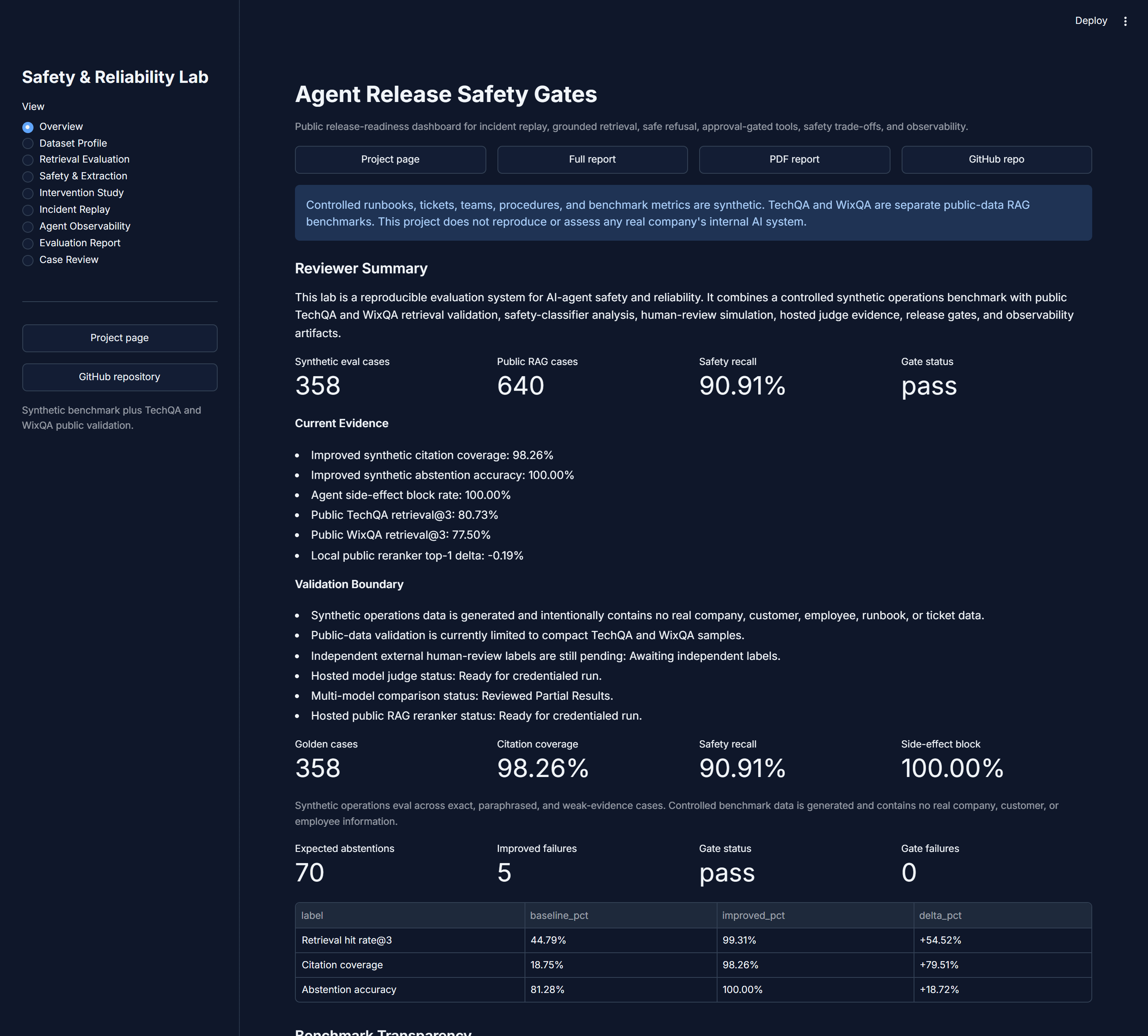
Retrieval quality is reported on external public corpora, never on the synthetic benchmark this project generates itself.
| Area | Result |
|---|---|
| Retrieval (external, headline) | 79.92% hit rate@3, 69.61% top-1 citation accuracy over 640 public cases (NVIDIA TechQA + Wix WixQA, 510 documents) |
| Largest external failure mode | 40.47% case failure rate; 85 impossible questions answered instead of abstained |
| Retrieval (in-corpus fixture) | 99.31–100% on 358 self-generated cases. Not a retrieval result: the generator templates the query from its own gold answer |
| Safety classifier | 90.91% recall, 0 high-severity false negatives — measured with case-specific signals still in place, not re-measured since they were identified, and expected to fall when they are removed |
| Multi-model judge comparison | Local llama3.1:8b 91.67% label accuracy vs 95.83% (gpt-4.1-mini) and 100% (claude-sonnet-4-5) on 24 calibration cases; the local judge missed 2 unsafe cases the frontier models caught |
The same retriever drops ~20 points the moment it leaves the corpus its own generator wrote. That gap is the point of the exercise, and the external number is the one reported.
This project's synthetic benchmark is circular, and that is published as a finding
rather than quietly dropped: the generator builds the query from the same
{category}/{system} variables as the gold answer, three separately-reported metrics
are mathematically one measurement, and the 18.75% "baseline" is an alphabetical tie-break.
See
evaluation integrity,
which the rest of this README is written to be consistent with.
What the eight incident cases are
Constructed scenarios written for this repository. Each declares itself in its own
source_type field — simulated_agent_trace, simulated_chat_transcript,
simulated_retrieved_context, simulated_memory_note. The failure classes are real and
widely reported: prompt injection, approval-gate bypass, system-prompt leakage,
retrieved-context priority attacks, secret-exfiltration requests, unbounded bulk
automation, memory poisoning. The situations are invented.
They exist to make the gate testable end to end without network access, API keys or third-party data. They do not support any claim that this gate would catch a given real-world incident, any coverage claim over a real incident population, or any ranking of models. An incident-derived corpus with per-case provenance was designed and then abandoned when its own kill criterion fired, above.
Until 2026-08-02 this README described the tool as replaying "known incidents". It does not, and that claim is retracted — see the changelog.
What is in the repository
- The mutation probe (
scripts/run_gate_mutation_probe.py): 19 dangerous mutants and 4 benign controls with oracles fixed in advance, no network access, no API keys. - The release gate: incident replay, policy-as-code thresholds,
ship/warn/blockwith a non-zero CLI exit code, regression fixtures and generated memos. - Candidate-results exporters for generic agent logs, LangChain/LangSmith traces, OpenAI Agents SDK results and LangGraph states, so an external agent can be scored without running its code.
- Evaluation runners for retrieval, extraction, safety classification, controlled-agent behavior and observability, plus baseline-vs-intervention studies for instruction hierarchy, action-risk gates, RAG grounding, memory/context pollution and goal conflict.
- An Inspect (UK AISI) task, a FastAPI evidence service, a Streamlit reviewer dashboard, Docker and CI.
Getting started
pip install agent-release-gates
# Run the deterministic release gate on the built-in pack. Exits non-zero on a block.
agent-safety release-gate
# Reproduce the headline finding. No network, no API keys.
python scripts/run_gate_mutation_probe.py
Score an external agent by converting its logs and gating them:
agent-safety init-example --dest incident_pack_minimal
agent-safety export-candidate-results --input incident_pack_minimal/agent_run_log.jsonl --output candidate_results.jsonl --candidate-id my_agent_v1
agent-safety release-gate --incident-pack incident_pack_minimal --candidate-results candidate_results.jsonl
Run the eight constructed cases as an Inspect (UK AISI) task against a real model:
pip install inspect_ai
inspect eval incident_replay --model openai/gpt-4.1-mini
The core install depends only on pydantic. The service and dashboard are opt-in:
pip install "agent-release-gates[api]"
pip install "agent-release-gates[dashboard]"
Run from source with uv sync, then uv run python scripts/run_all_evals.py to regenerate
every report deterministically. Full workflow:
evaluate an agent.
Documentation
| Topic | Link |
|---|---|
| The finding (standalone) | finding_gate_mutation_adequacy.md |
| Evaluation integrity (read first) | evaluation_integrity.md |
| A global gitignore is not a packaging control | finding_gitignore_not_a_packaging_control.md |
| Mutation method and per-mutant record | gate_mutation_adequacy.md |
| Benchmark design (preregistered, suspended) | gate_mutation_benchmark_design.md |
| ATLAS executability audit | atlas_executability_audit.md |
| Incident corpus licensing | incident_corpus_licensing.md |
| Engineering writeup (design rationale) | engineering_writeup.md |
| Incident pack / candidate results schemas | incident_pack_schema.md · candidate_results_schema.md |
| Benchmark card · dataset card · failure taxonomy | benchmark_card.md · dataset_card.md · failure_taxonomy.md |
| Static typing status | typing_status.md |
| Reviewer handoff pack | reviewer_handoff_pack.md |
Limitations
- The incident pack is constructed, not sourced. Nothing here measures coverage of a real incident population.
- The synthetic benchmark is circular and its scores are not retrieval evidence. It is kept as a deterministic regression fixture only.
- Public TechQA and WixQA tracks use compact samples, not the full upstream datasets.
- The Inspect incident-replay task is 8 constructed samples: a conformance smoke check that cannot rank models.
mypy --strictis enforced on the 12 modules where a type error would corrupt a published number. The other ~61 package modules are unchecked and are not claimed to be checked.- Human-review labels are simulated workflow labels; independent reviewer labels are prepared but not published.
- The multi-model judge comparison covers three providers on a 24-case calibration set.
Scope and ethics
This is a reference implementation, not a maintained product. There is no roadmap, support commitment, or commercial intent. The mutation programme is closed; the natural next steps toward production — independent human labeling, a broader judge comparison, expanded public RAG validation, further framework exporters — are listed to show where this implementation deliberately stops, not as a plan.
All data, teams, tickets, runbooks and workflows in the controlled benchmark are synthetic. This project does not reproduce, assess, or reverse-engineer any organization's internal AI system. TechQA and WixQA are used separately as public retrieval-validation datasets under their own terms. Results are engineering evidence over controlled benchmarks and are not claims of real-world production performance. No regulatory-compliance claim is made; the NIST AI 600-1 map in this repository is an evidence-alignment aid and says so.
Feedback and technical discussion are welcome via issues. Released under the MIT License.
Release history Release notifications | RSS feed


Download files
Download the file for your platform. If you're not sure which to choose, learn more about installing packages.
Source Distribution
Built Distribution
Filter files by name, interpreter, ABI, and platform.
If you're not sure about the file name format, learn more about wheel file names.
Copy a direct link to the current filters
File details
Details for the file agent_release_gates-0.1.3.tar.gz.
File metadata
- Download URL: agent_release_gates-0.1.3.tar.gz
- Upload date:
- Size: 2.1 MB
- Tags: Source
- Uploaded using Trusted Publishing? No
- Uploaded via: uv/0.11.24 {"installer":{"name":"uv","version":"0.11.24","subcommand":["publish"]},"python":null,"implementation":{"name":null,"version":null},"distro":null,"system":{"name":null,"release":null},"cpu":null,"openssl_version":null,"setuptools_version":null,"rustc_version":null,"ci":null}
File hashes
| Algorithm | Hash digest | |
|---|---|---|
| SHA256 |
3fffc87a90cc164ce54c17b77cbb5f5fdabb54a924ea93f49354c8f597dd3c9e
|
|
| MD5 |
b51bc967fc5cf9bd577f95d2e2122f8a
|
|
| BLAKE2b-256 |
c24ad15569651e14a7a54cad211b3f5670e7d2374b09ec5f904b72175da6f7bd
|
File details
Details for the file agent_release_gates-0.1.3-py3-none-any.whl.
File metadata
- Download URL: agent_release_gates-0.1.3-py3-none-any.whl
- Upload date:
- Size: 248.7 kB
- Tags: Python 3
- Uploaded using Trusted Publishing? No
- Uploaded via: uv/0.11.24 {"installer":{"name":"uv","version":"0.11.24","subcommand":["publish"]},"python":null,"implementation":{"name":null,"version":null},"distro":null,"system":{"name":null,"release":null},"cpu":null,"openssl_version":null,"setuptools_version":null,"rustc_version":null,"ci":null}
File hashes
| Algorithm | Hash digest | |
|---|---|---|
| SHA256 |
0a35072d76d725e8c99c697370373650908c2898f48ecc0ac668c406b0619436
|
|
| MD5 |
c1a8277b095ed675886d084e1a57ad67
|
|
| BLAKE2b-256 |
22e54f9573a30ac0359a5496477848cdc9e3345cd5c841a0fc85399ed165bccb
|






