


🤖 🚀 Agent Runtimes



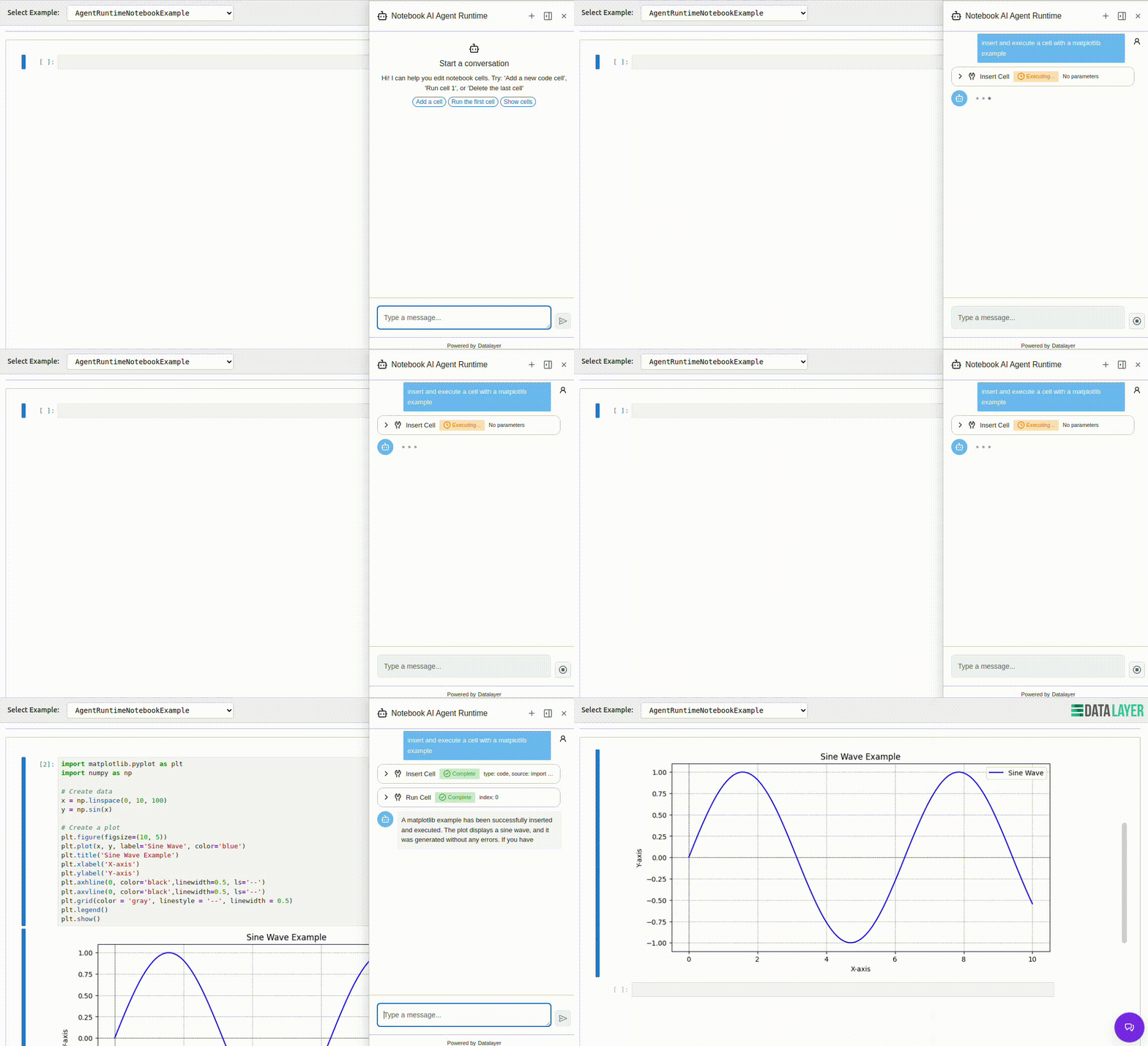
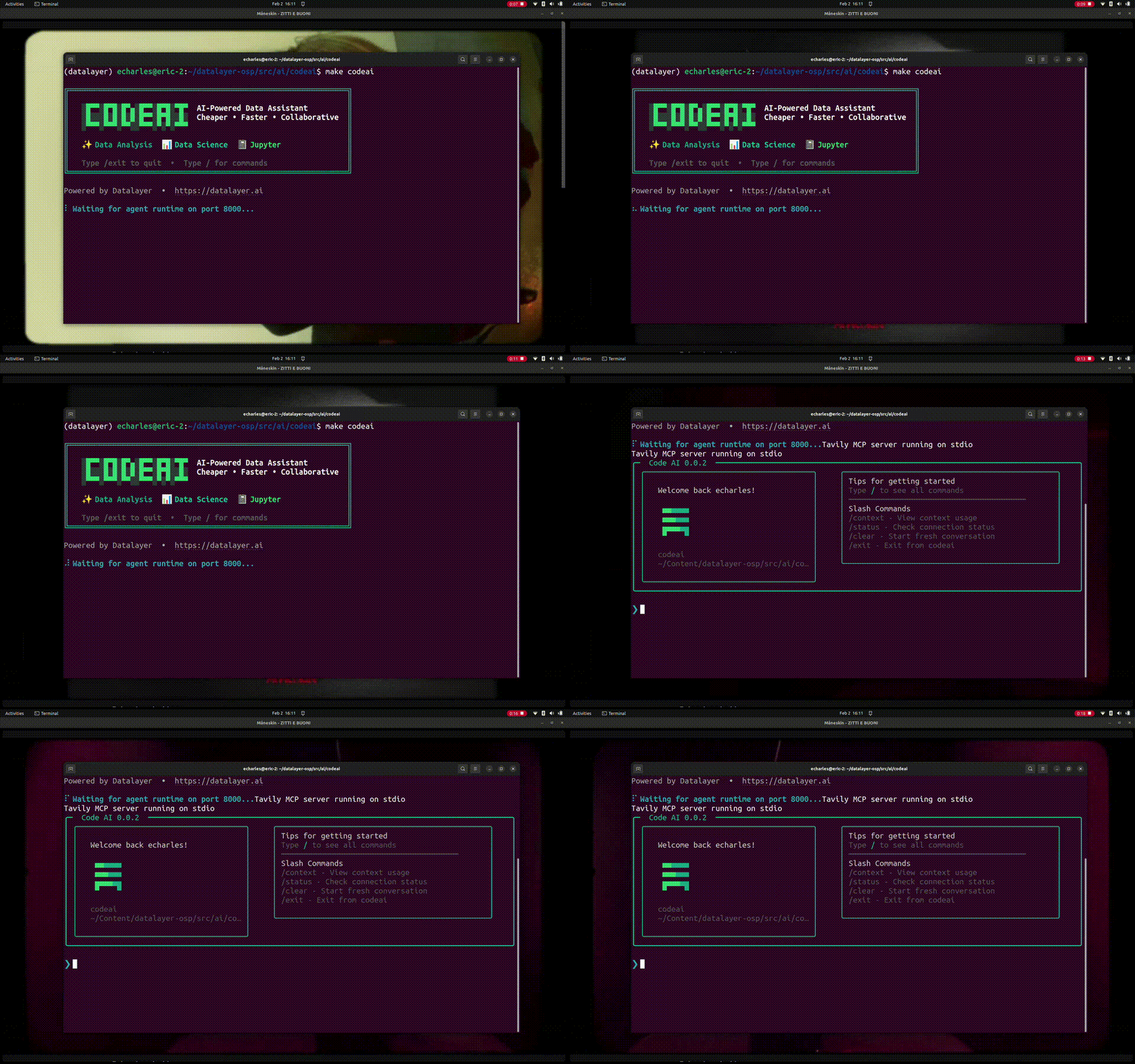
Agent Runtimes is a unified library for deploying, managing, and interacting with AI agents across multiple protocols and frameworks. It provides both a Python server for hosting agents and React components for seamless integration into web and desktop applications.
What is Agent Runtimes?
Agent Runtimes solves the complexity of deploying AI agents by providing:
-
Protocol Abstraction: One agent, multiple protocols - deploy your agent once and access it through ACP, Vercel AI SDK, AG-UI, MCP-UI, or A2A without changing your code.
-
Framework Flexibility: Write agents using your preferred framework (Pydantic AI, LangChain, Jupyter AI) while maintaining a consistent API.
-
Cloud Runtime Management: Built-in integration with Datalayer Cloud Runtimes for launching and managing compute resources with Zustand-based state management.
-
UI Components: Pre-built React components (ChatBase, ChatSidebar, ChatFloating) that connect to agents and execute tools directly in the browser.
-
Tool Ecosystem: Seamless integration with MCP (Model Context Protocol) tools, custom tools, and built-in utilities for Jupyter notebooks and Lexical documents.
🌟 Features
Agent Node
- Central registration: Agent nodes register and heartbeat to Datalayer Runtimes APIs.
- Node configuration: Runtime mode (
private,shared,sleep) and sharing metadata are tracked per node. - Tunnel routing: Agent nodes maintain a tunnel with Datalayer Runtimes to route chat messages between central UI and nodes.
- Dedicated UI: Agent Node list/detail UX is available for node observability and operations.
- End-to-end sync: Local node state can be synchronized to central services for fleet visibility.
Multi-Protocol Support
- ACP (Agent Client Protocol): WebSocket-based standard protocol
- Vercel AI SDK: Compatible with Vercel's AI SDK for React/Next.js
- AG-UI: Lightweight web interface (Pydantic AI native)
- MCP-UI: Interactive UI resources protocol with React/Web Components
- A2A: Agent-to-agent communication
Multi-Agent Support
- Pydantic AI: Type-safe agents (fully implemented)
- LangChain: Complex workflows (adapter ready)
- Jupyter AI: Notebook integration (adapter ready)
Built-in Features
- 🔌 Flexible Architecture: Easy to add new agents and protocols
- 🛠️ Tool Support: MCP, custom tools, built-in utilities
- 📊 Observability: OpenTelemetry integration
- 💾 Persistence: DBOS support for durable execution
- 🔒 Context Optimization: LLM context management
Runtime, Snapshot, and Evals Workflows
The runtime-oriented examples and CLI workflows migrated from datalayer-core now live here.
Python Runtime Quickstart
from agent_runtimes.client import RuntimeClient

client = RuntimeClient()

# Execute code in a managed runtime
with client.create_runtime() as runtime:
    response = runtime.execute("print('Hello from Datalayer!')")
    print(response.stdout)
Runtime and Snapshot CLI
# List available runtimes
datalayer runtime list

# Create a new runtime
datalayer runtime create ai-env --given-name my-runtime-123

# Execute a script in a runtime
datalayer runtime exec my-script.py --agent <agent-id>

# Create a snapshot from a runtime but do not terminate the runtime
datalayer snapshots create <pod-name> my-snapshot 'AI work!' False
Subscription and Credits CLI
# End-user billing view
datalayer subscriptions show
datalayer subscriptions available
datalayer subscriptions move
datalayer subscriptions topups
datalayer subscriptions dry-run

# Organization and team credits visibility
datalayer usage org-overview --organization-uid <org_uid>
datalayer usage team-overview --team-uid <team_uid>

# Monitoring-driven credit management
datalayer usage org-monitor --organization-uid <org_uid> --window-hours 24
datalayer usage team-monitor --team-uid <team_uid> --window-hours 24

# Credits transfer operations (owners/admins)
datalayer usage org-allocate-team --organization-uid <org_uid> --team-uid <team_uid> --amount 50
datalayer usage org-revoke-team --organization-uid <org_uid> --team-uid <team_uid> --amount 20
datalayer usage team-allocate-member --team-uid <team_uid> --member-uid <member_uid> --amount 15
datalayer usage team-revoke-member --team-uid <team_uid> --member-uid <member_uid> --amount 5
Evals CLI (Multi-Agentspec)
Use comma-separated agentspec ids to create one experiment per agentspec variant:
# Creates one experiment per agentspec in the list
agent-runtimes evals experiments create my-exp \
  --evalset-id <evalset_id> \
  --agent-spec-ids example-evals,example-evals-nocodemode,example-custom
Generate a comparison report:
agent-runtimes evals report <evalset_id> --run-limit 50 --export
How to interpret grouped comparisons in the report:
Within-Agentspec Pairwise Latest-Pass Deltas: compares experiments using the same agentspec id.Cross-Agentspec Pairwise Latest-Pass Deltas: compares experiments using different agentspec ids.- Pairwise sections compute all combinations for the selected experiments, not just two agentspecs.
Examples
The examples demonstrate how to use the Agent Runtimes functionality in various scenarios and frameworks.
Install
make examples starts both the Python agent server and the Vite dev server,
so you need both stacks installed once:
# 1. Node dependencies for the React examples + Vite dev server.
npm install

# 2. Python package (editable) for the local agent-runtimes server.
#    Use a virtualenv or conda env of your choice.
pip install -e .
Optional extras (declared in pyproject.toml):
pip install -e ".[examples]"   # extra agent framework deps used by examples
pip install -e ".[test]"       # pytest and test utilities
pip install -e ".[cli]"        # CLI dependencies
pip install -e ".[chat]"       # chat-related extras
pip install -e ".[docs]"       # docs build dependencies
Run
make examples
Agent Node development (UI + server)
For focused Agent Node development, run:
make agent-node
This target starts both:
- the local Python server on port
8765 - the Vite page for
html/agent-node.html
Use this mode to iterate on Agent Node configuration flows and central registration behavior.
Expected central visibility semantics:
- show all nodes owned by the current user,
- show other users' nodes only when mode is
shared.
Agent Node against local services (plane local)
To run Agent Node with local service URLs preconfigured, use:
make agent-node-local
This target applies the PLANE_LOCAL_*_URL mappings and exports both
DATALAYER_* and VITE_* variables so Agent Node sync/tunnel and UI calls are
wired to local services.
Prerequisites:
- Start the local Plane stack (
plane local). - Export
DATALAYER_API_KEYfor authenticated registration/tunnel calls.
Override any local service URL if needed:
PLANE_LOCAL_RUNTIMES_URL=http://localhost:19500 make agent-node-local
Docker build notes
Docker image build and release notes were moved to:
By default, make examples boots the local Vite dev server with every
Datalayer service URLs set to local defaults for agent execution:
| Variable | Default | Notes |
|---|---|---|
VITE_BASE_URL |
http://localhost:8765 |
Local agent-runtimes server (/api/v1/agents/*) |
VITE_BASE_URL_NO_CODEMODE |
http://localhost:8765 |
Local no-codemode agent endpoint |
VITE_BASE_URL_CODEMODE |
http://localhost:8766 |
Local codemode agent endpoint |
This is the local-first workflow used during development. It avoids accidental
remote calls for the core agent routes even if your shell exports
DATALAYER_*_URL values.
Running with explicit production URLs
If you want to force production URLs for Datalayer services, use:
make examples:prod
This mode uses the DATALAYER_*_URL convention from
datalayer-core (specifically datalayer_core/utils/urls.py)
and propagates those values to the Vite HTML placeholders.
Override any URL on the command line:
make examples:prod DATALAYER_URL=https://prod2.datalayer.run
Running against a local plane local stack
If you are developing against a local Plane (plane local), use:
make examples:proxy
This points each DATALAYER_*_URL at the matching localhost port exposed by
plane local (see services/plane/datalayer_plane/sbin/local.sh):
| Variable | Default port |
|---|---|
PLANE_LOCAL_IAM_URL |
http://localhost:9700 |
PLANE_LOCAL_RUNTIMES_URL |
http://localhost:9500 |
PLANE_LOCAL_SPACER_URL |
http://localhost:9900 |
PLANE_LOCAL_LIBRARY_URL |
http://localhost:9800 |
PLANE_LOCAL_MANAGER_URL |
http://localhost:2100 |
PLANE_LOCAL_AI_AGENTS_URL |
http://localhost:4400 |
PLANE_LOCAL_AI_INFERENCE_URL |
http://localhost:4450 |
PLANE_LOCAL_MCP_SERVERS_URL |
http://localhost:4111 |
PLANE_LOCAL_GROWTH_URL |
http://localhost:6660 |
PLANE_LOCAL_SUCCESS_URL |
http://localhost:3300 |
PLANE_LOCAL_STATUS_URL |
http://localhost:4785 |
PLANE_LOCAL_SUPPORT_URL |
http://localhost:2200 |
Override any port on the command line, e.g.:
PLANE_LOCAL_IAM_URL=http://localhost:9701 make examples:proxy
On the main page, you’ll find an example gallery (cards) that break things down into practical building blocks:
- UX patterns (aka GenUI) with protocols like A2UI and AG-UI
- Interactive or triggered workflows
- Agent Identity and Controls with guardrails, monitoring, tool approvals
- Programmatic tooling with Sandbox and Codemode for MCP and Skills
- Outputs and Notifications
- Real-time collaboration with users, subagents, and multi-agent teams
- Custom agents built from Agentspecs
- ...
Each of these concerns deserves more than a one-off solution—they need deep, composable, and pluggable implementations.
Documentation
The detailed guides for architecture, use cases, interactive chat, key concepts, and runtime configuration are now in Docusaurus docs:
Agentspecs
Generated catalogs are produced via:
make specs
Generation scripts are under scripts/codegen, and outputs are written to:
- Python: agent_runtimes/specs
- TypeScript: src/specs
1 maintainer

Download files
Download the file for your platform. If you're not sure which to choose, learn more about installing packages.
Source Distributions
Built Distribution
Filter files by name, interpreter, ABI, and platform.
If you're not sure about the file name format, learn more about wheel file names.
Copy a direct link to the current filters
File details
Details for the file agent_runtimes-1.0.19-py3-none-any.whl.
File metadata
- Download URL: agent_runtimes-1.0.19-py3-none-any.whl
- Upload date:
- Size: 15.3 MB
- Tags: Python 3
- Uploaded using Trusted Publishing? No
- Uploaded via:
twine/6.2.0 CPython/3.13.11
File hashes
| Algorithm | Hash digest | |
|---|---|---|
| SHA256 |
db6a60c04b099076004136848ef3c761e40bcf09f6fdb4d98db09361c20c9dd7
|
|
| MD5 |
197725bef2ad69a0dd3494dcc9b69cfd
|
|
| BLAKE2b-256 |
7708b88371d3f74983d467833fb341f0de0f7d7707c542996bfaa678c76f62a6
|







