
AgentEnsemble
Build, orchestrate, trace, and test multi-agent LLM systems in Python.
ReAct, RAG, router, planner, workflow graphs, swarms, debates, and pipelines, with sessions, tracing, retries, and human-in-the-loop approval built in.





AgentEnsemble is a framework for building and orchestrating AI agent systems, designed for clarity, extensibility, and production use. It covers similar ground to LangGraph, CrewAI, and AutoGen.
Installation
pip install agentensemble                 # core: agents, orchestration, graphs, memory, tracing
pip install "agentensemble[search]"       # + DuckDuckGo / Serper web search for SearchTool
pip install "agentensemble[rag]"          # + Chroma, sentence-transformers, loaders for RAGTool
pip install "agentensemble[observability]" # + LangSmith / OpenTelemetry
pip install "agentensemble[all]"          # everything above
Requires Python 3.10+.
Quick start (no API key needed)
Graph workflows, state-graph agents, and the planner run without any LLM:
from agentensemble import WorkflowGraph


def analyze(s):
    return {"context": {**s.get("context", {}), "done": True}, "current_node": "summarize"}


def summarize(s):
    return {"result": f"Summary for: {s['query']}", "current_node": "end"}


graph = (
    WorkflowGraph(entry="start", exit_nodes=["end"])
    .add_node("start", lambda s: {"current_node": "analyze"})
    .add_node("analyze", analyze)
    .add_node("summarize", summarize)
    .add_edge("start", "analyze")
    .add_edge("analyze", "summarize")
    .add_edge("summarize", "end")
)
print(graph.run("What is multi-agent AI?")["result"])
# Summary for: What is multi-agent AI?
LLM-powered agents (ReActAgent, HybridAgent, RouterAgent, StructuredAgent) work with
OpenAI or Mistral. The provider is picked from your environment: OpenAI if
OPENAI_API_KEY is set, otherwise Mistral if MISTRAL_API_KEY is set. You can also pass any
LLMProvider explicitly via llm=...:
from agentensemble import ReActAgent
from agentensemble.llm import OpenAILLMProvider, MistralLLMProvider

agent = ReActAgent(tools=[...], llm=OpenAILLMProvider(model="gpt-4.1-mini"))
agent = ReActAgent(tools=[...], llm=MistralLLMProvider(model="mistral-small-latest"))
Configuration
| Variable | Purpose |
|---|---|
OPENAI_API_KEY |
Enables the OpenAI provider (preferred when set). |
OPENAI_MODEL |
Optional default model for OpenAILLMProvider (default: gpt-4.1-mini). Reasoning models such as gpt-5-mini work too; temperature is left at the API default for them. |
OPENAI_BASE_URL |
Optional OpenAI-compatible endpoint (Azure OpenAI proxy, vLLM, LM Studio, ...). |
MISTRAL_API_KEY |
Enables the Mistral provider (used when no OpenAI key is set). |
MISTRAL_MODEL |
Optional default model for MistralLLMProvider (default: mistral-large-latest). Use e.g. mistral-small-latest if your plan doesn't include the large model. |
AGENTENSEMBLE_LLM_PROVIDER |
Optional. Force openai or mistral when both keys are set. |
SERPER_API_KEY |
Optional. When set, SearchTool() uses Serper; otherwise it falls back to DuckDuckGo (needs the search extra). |
Copy .env.example to .env and fill in your keys (KEY=value, no spaces around =); the
package loads .env automatically via python-dotenv.
Without an API key, LLM agents can still be constructed (and inspected or registered); calling
run() raises a clear RuntimeError explaining how to configure an LLM.
Design Philosophy
- Modular — Agents, tools, orchestration, and memory are decoupled
- Async-first —
run()andarun()on all agents; parallel execution viaasyncio.gather - Provider-agnostic — one LLM interface, OpenAI and Mistral built in
- Production patterns — Runner, retries, hooks, tracing, session memory
Architecture
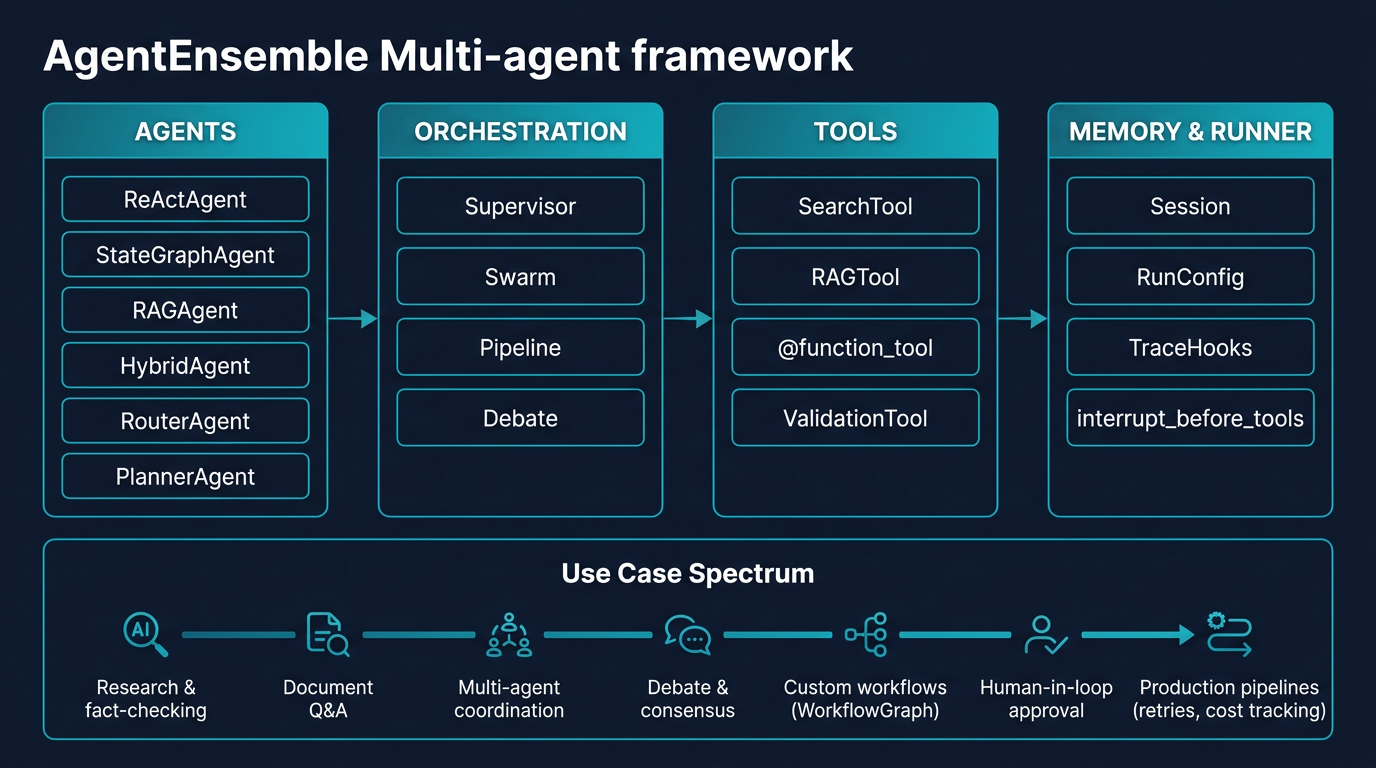
Framework layers
┌──────────────────────────────────────────────────────────────────────────────────────────┐
│                              AgentEnsemble — Layered Architecture                          │
├─────────────────┬─────────────────────┬─────────────────────┬────────────────────────────┤
│     AGENTS      │   ORCHESTRATION      │       TOOLS         │    MEMORY & RUNNER          │
├─────────────────┼─────────────────────┼─────────────────────┼────────────────────────────┤
│ ReActAgent      │ Supervisor          │ SearchTool          │ Session (InMemory, SQLite)  │
│ StateGraphAgent │ Swarm (parallel)    │ RAGTool             │ RunConfig, RunHooks        │
│ RAGAgent        │ Pipeline (seq)     │ @function_tool      │ TraceHooks (usage, cost)    │
│ HybridAgent     │ Debate (consensus)  │ ValidationTool      │ interrupt_before_tools      │
│ RouterAgent     │ Ensemble + Router   │ ToolRegistry         │ retries, session memory     │
│ PlannerAgent    │ WorkflowGraph       │                     │                             │
└─────────────────┴─────────────────────┴─────────────────────┴────────────────────────────┘
         │                    │                    │                         │
         └────────────────────┴────────────────────┴─────────────────────────┘
                                          │
                              ┌───────────▼───────────┐
                              │   Use Case Spectrum   │
                              └───────────────────────┘
Use case spectrum
| Layer | Use cases |
|---|---|
| Research & fact-checking | ReActAgent + SearchTool; Swarm for parallel verification |
| Document Q&A | RAGAgent + RAGTool; index URLs, ask questions |
| Multi-agent coordination | Supervisor, Swarm, Pipeline; RouterAgent for LLM-based selection |
| Debate & consensus | DebateOrchestrator; solvers propose → aggregator votes |
| Custom workflows | WorkflowGraph (DAG), StateGraphAgent (nodes), PlannerAgent (decompose) |
| Human-in-loop | interrupt_before_tools — pause before sensitive tools, resume with approval |
| Production pipelines | Runner + RunConfig, retries, TraceHooks (usage/cost), Session memory |
LLM quick start
pip install "agentensemble[search]"
export OPENAI_API_KEY=...      # or: export MISTRAL_API_KEY=...
from agentensemble import ReActAgent, SearchTool, Runner

agent = ReActAgent(name="research", tools=[SearchTool()], max_iterations=5)
result = Runner.run(agent, "What are the latest AI breakthroughs in 2024?")
print(result["result"])
Setup: Copy .env.example to .env and add your keys. Use KEY=value format (no spaces around =).
Examples — Code + Output
Each example is runnable. Requires OPENAI_API_KEY or MISTRAL_API_KEY (and the search extra for SearchTool; SERPER_API_KEY is optional). Outputs below are from the author's runs; LLM answers will vary.
1. ReActAgent — LLM decides when to search
from agentensemble import ReActAgent, SearchTool

agent = ReActAgent(name="research", tools=[SearchTool()], max_iterations=5)
result = agent.run("Who won the 2024 Nobel Prize in Physics?")
print(result["result"])
Output:
The 2024 Nobel Prize in Physics was awarded jointly to John J. Hopfield and
Geoffrey E. Hinton for their foundational discoveries and inventions that
enable machine learning with artificial neural networks.
2. Custom @function_tool — Add your own tools
from agentensemble import ReActAgent, SearchTool, function_tool


@function_tool(description="Get current weather for a city")
def get_weather(city: str) -> str:
    return f"Weather in {city}: 72°F, partly cloudy"


agent = ReActAgent(tools=[SearchTool(), get_weather], max_iterations=4)
result = agent.run("What is the weather in Paris?")
print(result["result"])
Output:
The current weather in Paris is 72°F (22°C) with partly cloudy conditions.
3. HybridAgent — LLM routes SEARCH → RAG → VALIDATE → ANSWER
from agentensemble import HybridAgent, SearchTool

agent = HybridAgent(tools=[SearchTool()], max_iterations=5)
result = agent.run("What are the key trends in AI agents in 2024?")
print(result["result"][:300], "...")
print("Actions:", result["metadata"]["actions_taken"])
Output:
1. Multi-Modal AI Models Redefined Possibilities · 2. AI Agents Stepping Into
the Spotlight · 3. AI's Bold Move into Video Creation · 4. Rise of Open-Source AI...
Actions: ['SEARCH', 'SEARCH', 'RAG', 'VALIDATE', 'ANSWER']
4. Swarm — Parallel agents (multiple perspectives)
from agentensemble import ReActAgent, SwarmOrchestrator, SearchTool

researcher = ReActAgent(name="researcher", tools=[SearchTool()], max_iterations=2)
fact_checker = ReActAgent(name="fact_checker", tools=[SearchTool()], max_iterations=2)

swarm = SwarmOrchestrator(agents={"researcher": researcher, "fact_checker": fact_checker})
result = swarm.perform("What is the capital of France?")
for name, r in result["results"].items():
    print(f"{name}: {r['result'][:80]}...")
Output:
researcher: The capital of France is Paris.
fact_checker: The capital of France is Paris.
5. Pipeline — Sequential (search → summarize)
from agentensemble import ReActAgent, PipelineOrchestrator, SearchTool

searcher = ReActAgent(name="searcher", tools=[SearchTool()], max_iterations=2)
summarizer = ReActAgent(name="summarizer", tools=[], max_iterations=1)

pipeline = PipelineOrchestrator(agents={"searcher": searcher, "summarizer": summarizer})
result = pipeline.perform("Summarize the top 3 AI breakthroughs in 2024")
print(result["final_result"]["previous_result"][:250], "...")
Output:
1. Multimodal AI Advancements (GPT-4o, Gemini 1.5) · 2. AI Agents Stepping Into
the Spotlight · 3. AI's Bold Move into Video Creation...
6. Debate — Multi-agent consensus for reasoning
from agentensemble import ReActAgent, DebateOrchestrator

solver1 = ReActAgent(name="solver_1", tools=[], max_iterations=1)
solver2 = ReActAgent(name="solver_2", tools=[], max_iterations=1)
aggregator = ReActAgent(name="aggregator", tools=[], max_iterations=1)

debate = DebateOrchestrator(solvers=[solver1, solver2], aggregator=aggregator, rounds=2)
result = debate.debate("What is 15 * 7?")
print("Proposals:", result["proposals"])
print("Final:", result["result"])
Output:
Proposals: ['15 × 7 = 105', '15 × 7 equals 105']
Final: 15 × 7 equals 105.
7. Router + Ensemble — LLM picks the best agent
from agentensemble import ReActAgent, RouterAgent, Ensemble, SearchTool

researcher = ReActAgent(name="researcher", tools=[SearchTool()], max_iterations=2)
validator = ReActAgent(name="validator", tools=[SearchTool()], max_iterations=2)

router = RouterAgent(agents={"researcher": researcher, "validator": validator})
ensemble = Ensemble(
    conductor="supervisor", agents={"researcher": researcher, "validator": validator}, router=router
)
result = ensemble.perform("Latest developments in quantum computing")
for name, r in result["results"].items():
    print(f"Routed to {name}: {r['result'][:120]}...")
Output:
Routed to researcher: Here are the latest developments in quantum computing:
1. Hardware Advances · 2. Fault-tolerant quantum computing...
8. Planner — Decompose task → executor runs subtasks
from agentensemble import PlannerAgent, StateGraphAgent


def worker(state):
    return {"result": f"Processed: {state.query}"}


executor = StateGraphAgent(name="worker", nodes={"start": worker})
executor._route = lambda s, c: "end"

planner = PlannerAgent(executor=executor, max_subtasks=3)
result = planner.run("Research and compare LangGraph vs CrewAI")
print("Subtasks:", result["metadata"]["subtasks"])
print("Result:", result["result"][:200], "...")
Output:
Subtasks: ['Search for information about: Research and compare LangGraph vs CrewAI',
           'Summarize key findings from: Research and compare LangGraph vs CrewAI']
Result: Processed: Search for information... --- Processed: Summarize key findings...
9. WorkflowGraph — Custom DAG with nodes and edges
from agentensemble import WorkflowGraph


def analyze(s):
    return {"context": {**s.get("context", {}), "done": True}, "current_node": "summarize"}


def summarize(s):
    return {"result": f"Summary for: {s['query']}", "current_node": "end"}


graph = (
    WorkflowGraph(entry="start", exit_nodes=["end"])
    .add_node("start", lambda s: {"current_node": "analyze"})
    .add_node("analyze", analyze)
    .add_node("summarize", summarize)
    .add_edge("start", "analyze")
    .add_edge("analyze", "summarize")
    .add_edge("summarize", "end")
)
result = graph.run("What is multi-agent AI?")
print(result["result"])
Output:
Summary for: What is multi-agent AI?
10. Runner + RunHooks + InMemorySession — Production-ready execution
from agentensemble import ReActAgent, Runner, RunConfig, RunHooks, InMemorySession, SearchTool

session = InMemorySession(session_id="chat-1")
agent = ReActAgent(name="chatbot", tools=[SearchTool()], session=session, max_iterations=3)


def on_start(q, _):
    print(f"→ User: {q[:50]}...")


def on_end(r):
    print(f"← Agent: {r['result'][:80]}...\n")


config = RunConfig(hooks=RunHooks(on_start=on_start, on_end=on_end))

Runner.run(agent, "What is the capital of Japan?", config=config)
Runner.run(agent, "What about its population?", config=config)  # Remembers context
Output:
→ User: What is the capital of Japan?...
← Agent: The capital of Japan is Tokyo.

→ User: What about its population?...
← Agent: Tokyo's population is approximately 14 million...
11. TraceHooks — Observability, token usage, cost estimation
from agentensemble import ReActAgent, Runner, RunConfig, TraceHooks, SearchTool

agent = ReActAgent(name="research", tools=[SearchTool()], max_iterations=3)
hooks = TraceHooks()

config = RunConfig(trace_hooks=hooks)
result = Runner.run(agent, "Who won the 2024 Nobel Prize in Physics?", config=config)

print(result["result"][:100], "...")
print("Usage:", result["metadata"].get("total_usage"))
print("Cost (USD):", result["metadata"].get("cost_usd"))
print("Events:", [e.type.value for e in hooks.events])
Output:
The 2024 Nobel Prize in Physics was awarded jointly to John J. Hopfield and Geoffrey E. Hinton...
Usage: {'input_tokens': 1247, 'output_tokens': 89, 'total_tokens': 1336}
Cost (USD): 0.00293
Events: ['run_start', 'llm_start', 'llm_end', 'tool_start', 'tool_end', 'llm_start', 'llm_end', 'run_end']
12. Human-in-loop — Pause before sensitive tools, resume with approval
from agentensemble import ReActAgent, Runner, RunConfig, function_tool


@function_tool(description="Execute a payment")
def execute_payment(amount: float, recipient: str) -> str:
    return f"Paid ${amount} to {recipient}"


agent = ReActAgent(tools=[execute_payment], max_iterations=2)
config = RunConfig(interrupt_before_tools=["execute_payment"])

result = Runner.run(agent, "Pay $50 to Alice", config=config)

if result.get("__interrupted__"):
    print("Paused for approval:", result["pending_tool"])
    # Simulate human approval
    result = Runner.run(
        agent, "...", config=config, resume=result["run_state"], resume_value="Paid $50 to Alice"
    )
print(result["result"])
Output:
Paused for approval: {'name': 'execute_payment', 'arguments': {'amount': 50.0, 'recipient': 'Alice'}}
Paid $50 to Alice
13. RAGAgent — Document Q&A (optional: pip install agentensemble[rag])
from agentensemble import RAGAgent, RAGTool

rag_tool = RAGTool()
rag_tool.index_documents(["https://example.com/doc"])  # Index from URLs

agent = RAGAgent(name="doc_qa", tools=[rag_tool], fallback_strategies=2)
result = agent.run("What is task decomposition?")
print(result["result"][:200], "...")
Output:
Task decomposition is the process of breaking complex tasks into smaller,
manageable subtasks that can be executed by specialized agents...
14. StructuredAgent — Pydantic output (optional: langchain>=1.1)
from pydantic import BaseModel, Field
from agentensemble import StructuredAgent


class ProductReview(BaseModel):
    product: str = Field(description="Product name")
    rating: int = Field(description="1-5 stars")
    summary: str = Field(description="Brief summary")


agent = StructuredAgent(response_format=ProductReview)
result = agent.run("Review: iPhone 15 Pro - 5 stars, excellent camera and battery")
print(result["structured_response"])
Output:
ProductReview(product='iPhone 15 Pro', rating=5, summary='Excellent camera and battery')
Creative combo — Research pipeline (Planner + Swarm + Debate + Runner)
from agentensemble import (
    ReActAgent,
    PlannerAgent,
    StateGraphAgent,
    SwarmOrchestrator,
    DebateOrchestrator,
    Runner,
    RunConfig,
    RunHooks,
    SearchTool,
)

# 1. Executor: ReActAgent with search
executor = ReActAgent(name="researcher", tools=[SearchTool()], max_iterations=3)

# 2. Planner decomposes → runs subtasks via executor
planner = PlannerAgent(executor=executor, max_subtasks=2)
plan_result = planner.run("Compare LangGraph vs CrewAI vs AutoGen")

# 3. Swarm: parallel research + fact-check
researcher = ReActAgent(name="r", tools=[SearchTool()], max_iterations=2)
checker = ReActAgent(name="c", tools=[SearchTool()], max_iterations=2)
swarm = SwarmOrchestrator(agents={"r": researcher, "c": checker})
swarm_result = swarm.perform("Top 3 AI agent frameworks 2024")

# 4. Debate: consensus on a fact
s1 = ReActAgent(name="s1", tools=[], max_iterations=1)
s2 = ReActAgent(name="s2", tools=[], max_iterations=1)
agg = ReActAgent(name="agg", tools=[], max_iterations=1)
debate = DebateOrchestrator(solvers=[s1, s2], aggregator=agg, rounds=2)
debate_result = debate.debate("What is 12 * 8?")

# 5. Runner with hooks
hooks = RunHooks(on_start=lambda q, _: print(f"Running: {q[:40]}..."))
result = Runner.run(executor, "Who won 2024 Nobel Physics?", RunConfig(hooks=hooks))

print("Planner:", plan_result["result"][:100], "...")
print("Swarm agents:", list(swarm_result["results"].keys()))
print("Debate answer:", debate_result["result"])
print("Runner:", result["result"][:80], "...")
Output:
Running: Who won 2024 Nobel Physics?...
Planner: Processed: Search for information... --- Processed: Summarize key findings...
Swarm agents: ['r', 'c']
Debate answer: 12 × 8 equals 96.
Runner: The 2024 Nobel Prize in Physics was awarded to John J. Hopfield and Geoffrey E. Hinton...
Run full showcase
pip install agentensemble[search]
PYTHONPATH=. python examples/showcase_all.py
Runs all demos with real API calls.
Core Components
Agents
| Agent | Use Case | LLM |
|---|---|---|
| ReActAgent | Research, tool use, reasoning | Yes |
| StateGraphAgent | Custom node workflows | No |
| RAGAgent | Document Q&A | Optional |
| HybridAgent | Search → RAG → Validate | Optional |
| RouterAgent | Route to best agent | Optional |
| PlannerAgent | Task decomposition | No |
Orchestration
| Pattern | Description |
|---|---|
| Supervisor | Central coordinator; optional router for LLM-based agent selection |
| Swarm | Parallel execution via asyncio.gather |
| Pipeline | Sequential agent workflow |
| Debate | Solvers propose → feedback → aggregator votes |
Tools
@function_tool— Decorate functions for automatic schemaSearchTool— Serper or DuckDuckGoRAGTool— Document indexing and retrievalValidationTool— Quality checksToolRegistry— Dynamic tool management
Memory & Runner
- Session —
InMemorySession,SQLiteSessionfor multi-turn context - Runner —
Runner.run(),Runner.arun()withRunConfig,RunHooks, retries - TraceHooks — Observability: run/LLM/tool events, token usage, cost estimation
- Human-in-loop —
interrupt_before_tools=["pay", "send_email"]to pause for approval
Project Structure
agentensemble/
├── agents/         # ReAct, StateGraph, RAG, Hybrid, Structured
├── core/           # AgentProtocol, RunnableProtocol
├── llm/            # LLMProvider, OpenAILLMProvider, MistralLLMProvider, get_default_provider
├── memory/         # Session, InMemorySession, SQLiteSession
├── orchestration/  # Ensemble, Supervisor, Swarm, Pipeline, Debate
├── tools/          # Tool protocol, @function_tool, built-ins
├── router/         # RouterAgent (LLM-based routing)
├── planner/        # PlannerAgent (task decomposition)
├── graph/          # WorkflowGraph (composable workflows)
├── tracing/        # TraceHooks, TraceEvent
├── testing/        # Benchmark, AgentComparison, Metrics
└── runner.py       # Runner, RunConfig, RunHooks
Comparison
| Feature | AgentEnsemble | LangGraph | CrewAI | AutoGen |
|---|---|---|---|---|
| Multi-provider LLM | OpenAI, Mistral (extensible) | Any | Any | Any |
| Async API | arun() everywhere |
Yes | Yes | Yes |
| Router agents | RouterAgent | Manual | Yes | Manual |
| Planner pattern | PlannerAgent | Manual | Yes | Manual |
| Graph workflows | WorkflowGraph, StateGraph | Native | No | No |
| Debate pattern | DebateOrchestrator | Manual | Yes | Yes |
| Session memory | InMemory, SQLite | Checkpointer | No | No |
| Observability | TraceHooks, usage, cost | LangSmith | No | No |
| Human-in-loop | interrupt_before_tools | interrupt() | No | No |
Production Use
- Retries:
RunConfig(max_retries=2, retry_on=(RateLimitError, TimeoutError)) - Session:
Runner.run(agent, query, config=RunConfig(session=SQLiteSession())) - Tracing:
RunConfig(trace_hooks=TraceHooks())— captures run/LLM/tool events, usage, cost - Human-in-loop:
RunConfig(interrupt_before_tools=["pay"])— pause before sensitive tools; resume withRunner.run(agent, ..., resume=run_state, resume_value="Approved") - Benchmarks:
AgentComparison,Benchmark.research_tasks(),Metrics
Documentation
- Showcase — Run the features end to end with real API calls
- Changelog
- Examples —
quickstart,react_llm,swarm,pipeline,streaming,debate,rag,research_agent,graph_workflow,runner,structured_output - Roadmap — Planned improvements
Contributing
Contributions are welcome. See CONTRIBUTING.md and the Code of Conduct.
git clone https://github.com/irfanalidv/AgentEnsemble.git && cd AgentEnsemble
pip install -e ".[dev]"
ruff check . && ruff format --check . && pytest
Security issues: please follow SECURITY.md.
License
MIT — see LICENSE.
1 maintainer

Metadata
1 maintainer
Release files for agentensemble 0.5.0
For a detailed explanation of source distributions (sdists) and built distributions (wheels), please see the package formats documentation.
Source distribution (sdist)
| File | Size | Uploaded | Provenance | Actions |
|---|---|---|---|---|
| agentensemble-0.5.0.tar.gz | 66.1 kB | Without provenance | Details for agentensemble-0.5.0.tar.gz |
Built distribution (wheel)
| File | Interpreter | ABI | Platform | Actions Reset |
|---|---|---|---|---|
| agentensemble-0.5.0-py3-none-any.whl | Python 3 | none | any | Details for agentensemble-0.5.0-py3-none-any.whl |
Total release size: 132.2 kB
Release files / agentensemble-0.5.0.tar.gz
| Download URL | agentensemble-0.5.0.tar.gz |
|---|---|
| Size | 66.1 kB |
| Tags | Source |
|
SHA-256 checksum How to use checksums |
58e535d7b06104490bf14bd10172c6b1cf0a2e41da23562a3bc454fbdd78f867
|
|
BLAKE2b-256 checksum How to use checksums |
1eef6581f1f7aece0792c22641d5b61afe9f8104004571e7bf4c82c169c86b69
|
| Upload date | |
|
Uploaded using Trusted Publishing? What is trusted publishing? |
No |
| Uploaded via |
twine/7.0.0 CPython/3.11.7
|
Release files / agentensemble-0.5.0-py3-none-any.whl
| Download URL | agentensemble-0.5.0-py3-none-any.whl |
|---|---|
| Size | 66.1 kB |
| Tags | Python 3 |
|
SHA-256 checksum How to use checksums |
e28c30c9d7dede6206c6925902e7d443e43da687ef9dd264e1e04ce96ad0c21e
|
|
BLAKE2b-256 checksum How to use checksums |
5f88fc653dddac23b4e3ccf605fc743c10d000dfeeb17a3e188318f7a65b1066
|
| Upload date | |
|
Uploaded using Trusted Publishing? What is trusted publishing? |
No |
| Uploaded via |
twine/7.0.0 CPython/3.11.7
|
Security for agentensemble 0.5.0
Provenance
Provenance describes where a file came from. On PyPI, provenance is shared via attestations, which provide a verifiable record of the build or publishing details. View details, limitations and caveats.
No provenance found
None of the files in this release were uploaded with provenance metadata.
A note on package security
PyPI is a repository for distributing packages, not a service for auditing them. While third-party security researchers and our staff do their best to detect and remove malicious packages, PyPI cannot guarantee the quality, security or suitability of any given package.
To learn more about protecting yourself from malicious actors, visit our package security documentation.














