
AgentEnsemble
Build, orchestrate, trace, and test multi-agent LLM systems in Python, with OpenAI or Mistral.







Why AgentEnsemble
Most agent projects need the same handful of pieces: a tool-calling loop, a way to combine
several agents, memory between turns, a pause before risky actions, and visibility into tokens
and cost. AgentEnsemble gives you those pieces as small, plain-Python classes behind one
run() / arun() interface, so you can start with one agent and grow into routers, pipelines,
swarms and debates without changing how you call them. LangChain is used only inside the LLM
providers; agents, tools and results are your own objects and plain dicts.
Features
| Area | What you get |
|---|---|
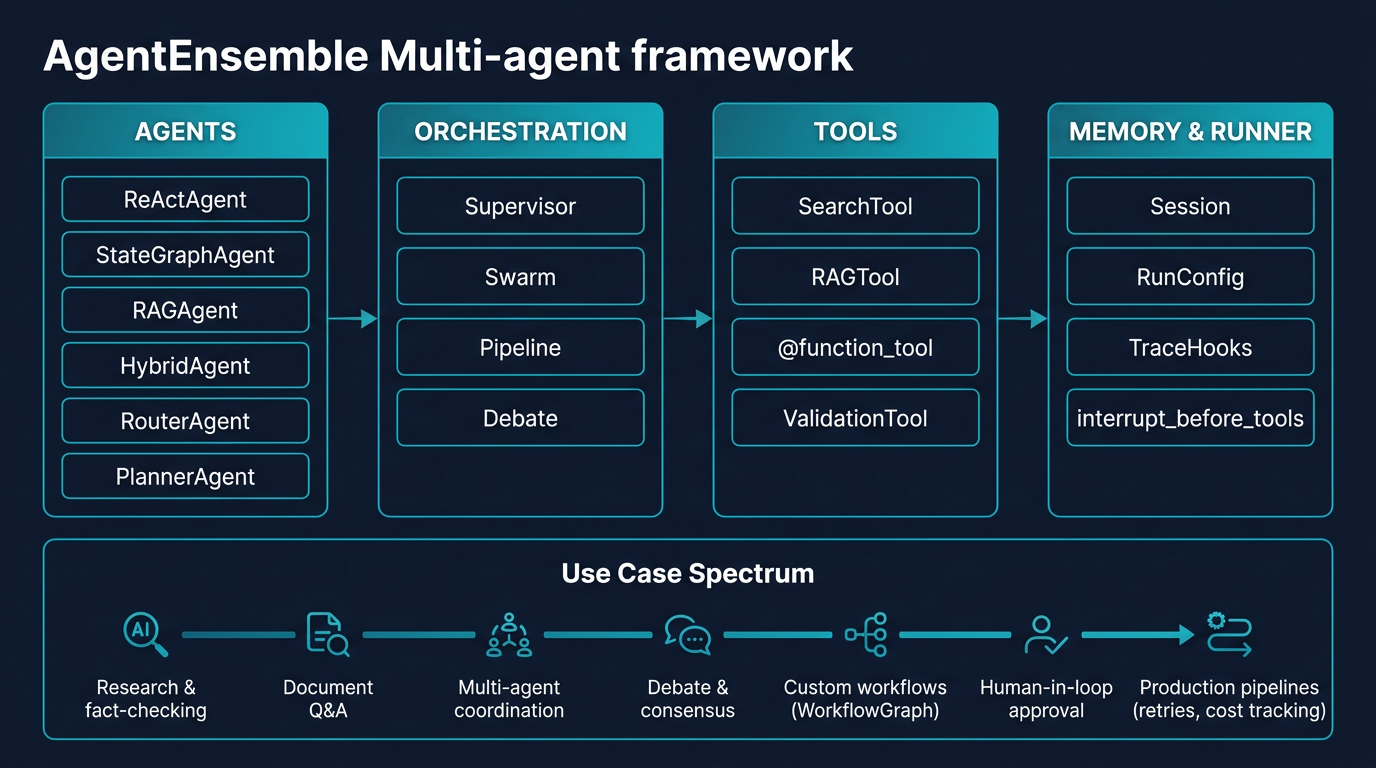
| Agents | ReActAgent (native tool calling), HybridAgent (search → RAG → validate), RAGAgent, StructuredAgent (Pydantic output), StateGraphAgent, RouterAgent, PlannerAgent |
| Orchestration | Ensemble with supervisor / swarm (parallel) / pipeline modes, DebateOrchestrator, WorkflowGraph with conditional edges |
| Tools | @function_tool (JSON schema from type hints), SearchTool (Serper or DuckDuckGo), RAGTool (URLs or local text), ScraperTool (httpx or Playwright), ValidationTool, ToolRegistry |
| LLM providers | OpenAI and Mistral built in, picked from the environment (OpenAI first); any LLMProvider subclass works |
| Runtime | Runner + RunConfig: sessions (InMemorySession, SQLiteSession), retries, lifecycle hooks, human-in-the-loop interrupts |
| Observability | TraceHooks events for runs, LLM calls and tools, token usage, cost estimates, astream() events for UIs |
| Evaluation | AgentComparison, Benchmark, Metrics to compare agents on the same tasks |
| Quality | Typed (py.typed, mypy-clean), tested with fake LLMs (no network in CI), Python 3.10 to 3.13 |
Install
pip install agentensemble # or: uv add agentensemble
| Extra | Adds | Install |
|---|---|---|
search |
DuckDuckGo (ddgs) and Serper backends for SearchTool |
pip install "agentensemble[search]" |
rag |
Chroma, sentence-transformers, text splitters, BeautifulSoup for RAGTool |
pip install "agentensemble[rag]" |
observability |
LangSmith and OpenTelemetry API | pip install "agentensemble[observability]" |
all |
All of the above | pip install "agentensemble[all]" |
Quickstart
Needs OPENAI_API_KEY (or MISTRAL_API_KEY) in the environment or a .env file.
from agentensemble import ReActAgent, function_tool


@function_tool(description="Look up the shipping status of an order by id")
def order_status(order_id: str) -> str:
    return {"A100": "shipped", "B200": "processing"}.get(order_id, "not found")


agent = ReActAgent(tools=[order_status])  # OpenAI if OPENAI_API_KEY is set, else Mistral
result = agent.run("Has order A100 shipped yet?")
print(result["result"])
print(result["metadata"])
Output from a run with gpt-4.1-mini (model wording varies):
Yes, order A100 has shipped.
{'iterations': 1, 'tool_calls': 1, 'agent': 'react_agent', 'total_usage': {'input_tokens': 439, 'output_tokens': 24, 'total_tokens': 463}, 'cost_usd': 0.00021400000000000002}
No key yet? Graph workflows run without an LLM, and every script in
examples/ marked "offline"
runs with a built-in rule-based stand-in model:
from agentensemble import WorkflowGraph

graph = (
    WorkflowGraph(entry="classify")
    .add_node("classify", lambda s: {"context": {"refund": "refund" in s["query"].lower()}})
    .add_node("refund", lambda s: {"result": "Routed to the refunds team"})
    .add_node("general", lambda s: {"result": "Routed to general support"})
    .add_edge("classify", "refund", lambda s: s["context"]["refund"])
    .add_edge("classify", "general")
)
out = graph.run("I want a refund for my order")
print(out["result"], out["metadata"]["nodes_visited"])
# Routed to the refunds team ['classify', 'refund']
How it works
flowchart LR
    App["Your code"] --> Runner["Runner.run / arun<br/>RunConfig: session, retries,<br/>hooks, interrupts"]
    Runner --> Orchestration["Ensemble · DebateOrchestrator<br/>RouterAgent · PlannerAgent"]
    Runner --> Agent
    Orchestration -->|"agent.arun(query)"| Agent["Agents<br/>ReActAgent · HybridAgent<br/>RAGAgent · StructuredAgent"]
    Agent -->|"LLMMessage list + ToolSchema list"| Provider["LLMProvider<br/>OpenAILLMProvider · MistralLLMProvider<br/>or your own"]
    Provider -->|"LLMResponse: content / tool_calls / usage"| Agent
    Agent -->|"ainvoke_tool(name, args)"| Tools["Tools<br/>@function_tool · SearchTool · RAGTool<br/>ScraperTool · ValidationTool"]
    Agent <-->|"load / save turn"| Session["Session<br/>InMemorySession · SQLiteSession"]
    Agent -->|"TraceEvent"| Trace["TraceHooks<br/>usage · cost · timings"]
One ReActAgent turn, including the optional human approval step:
sequenceDiagram
    participant R as Runner
    participant A as ReActAgent
    participant S as Session
    participant L as LLMProvider
    participant T as Tool
    R->>A: arun(query, run_config, session)
    A->>S: get_messages(limit=20)
    A->>L: agenerate(system + history + query, tools)
    L-->>A: tool_calls
    alt tool listed in interrupt_before_tools
        A-->>R: {"__interrupted__": True, "run_state", "pending_tool"}
        R->>A: arun(..., resume=run_state, resume_value=approved_result)
    else
        A->>T: ainvoke_tool(name, arguments)
        T-->>A: result (errors are returned as text)
    end
    A->>L: agenerate(... + tool results), no tools
    L-->>A: final answer
    A->>S: add_messages(user, tool exchange, answer)
    A-->>R: {"result": ..., "metadata": {iterations, tool_calls, total_usage, cost_usd}}
Design decisions
- One provider interface. Agents only see
LLMProvider.generate/agenerateand Pydantic message models (agentensemble/llm/interface.py). The OpenAI and Mistral providers share one LangChain adapter (llm/langchain_base.py); adding a provider means subclassingLLMProviderorLangChainChatProvider. - Native tool calling. Tools are described by JSON schemas (inferred from type hints by
@function_tool) and called through the model's function-calling API, not parsed from text. - Bounded tool use per turn. After the first round of tool results in a turn, the model is
asked to answer without tools. This keeps cost and latency predictable;
max_iterationscaps the loop as well. - Async first. Every agent has
arun();run()wraps it withasyncio.run(). Providers rebuild their HTTP client when used on a new event loop, so repeated sync calls work. - Plain results. Agents return
{"result": str, "metadata": dict}. The human-in-the-looprun_stateis a JSON-serialisable dict, so a paused run can be stored and resumed later. - Usable without keys. LLM agents can be constructed, inspected and registered without an
API key;
run()raises a clearRuntimeErroruntil a provider is configured.
Module map
agentensemble/
├── agents/         ReActAgent, HybridAgent, RAGAgent, StateGraphAgent, StructuredAgent, BaseAgent
├── llm/            LLMProvider, OpenAILLMProvider, MistralLLMProvider, get_default_provider
├── tools/          @function_tool, SearchTool, RAGTool, ScraperTool, ValidationTool, ToolRegistry
├── orchestration/  Ensemble, Supervisor/Swarm/PipelineOrchestrator, DebateOrchestrator
├── router/         RouterAgent (LLM picks an agent via a constrained tool call)
├── planner/        PlannerAgent (rule-based decomposition; override _decompose for LLM planning)
├── graph/          WorkflowGraph, Edge
├── memory/         Session protocol, InMemorySession, SQLiteSession
├── tracing/        TraceHooks, TraceEvent, estimate_cost
├── testing/        AgentComparison, Benchmark, Metrics
├── utils/          get_chat_model, get_default_embeddings, provider helpers
└── runner.py       Runner, RunConfig, RunHooks
Use cases and examples
Runnable scripts in examples/.
The first four run offline (no key) and switch to OpenAI or Mistral when a key is set; pass
--offline to force offline mode.
| Script | Use case | Needs |
|---|---|---|
customer_support_rag.py |
Answer customer questions from a help-center FAQ with RAGTool.index_texts and ReActAgent |
[rag] extra; offline |
support_ticket_triage.py |
Route tickets with WorkflowGraph; a ValidationTool gate escalates bad refund replies |
offline |
order_assistant_approval.py |
Order bot with SQLiteSession memory, TraceHooks, and human approval before refunds |
offline |
sales_csv_analyst.py |
Answer revenue questions over a CSV with deterministic @function_tool analytics |
offline |
graph_workflow_example.py, runner_example.py, research_agent_example.py |
Graphs, Runner hooks, planner → router → executor |
offline |
react_llm_example.py, swarm_example.py, debate_example.py, streaming_example.py, showcase_all.py |
Search agents, parallel swarm, debate, streaming events, full tour | API key (+ [search]) |
Recipes (need OPENAI_API_KEY or MISTRAL_API_KEY)
Human approval before a sensitive tool
from agentensemble import ReActAgent, RunConfig, Runner, function_tool


@function_tool(description="Send money to a recipient")
def execute_payment(amount: float, recipient: str) -> str:
    return f"Paid ${amount:.2f} to {recipient}"


agent = ReActAgent(tools=[execute_payment])
config = RunConfig(interrupt_before_tools=["execute_payment"])

result = Runner.run(agent, "Pay $50 to Alice", config=config)
if result.get("__interrupted__"):
    pending = result["pending_tool"]  # {'name': 'execute_payment', 'arguments': {...}}
    approved = execute_payment.run(**pending["arguments"])  # after a human says yes
    result = Runner.run(
        agent,
        "Pay $50 to Alice",
        config=config,
        resume=result["run_state"],
        resume_value=approved,
    )
print(result["result"])
Multi-turn memory
from agentensemble import InMemorySession, ReActAgent, RunConfig, Runner

agent = ReActAgent(name="chatbot")
config = RunConfig(session=InMemorySession("chat-1"))  # or SQLiteSession("chat-1", db_path=...)
Runner.run(agent, "My name is Priya and I live in Lisbon.", config=config)
print(Runner.run(agent, "Which city do I live in?", config=config)["result"])  # ... Lisbon.
Route to the right specialist
from agentensemble import ReActAgent, RouterAgent

router = RouterAgent(
    agents={"billing": ReActAgent(name="billing"), "tech_support": ReActAgent(name="tech_support")}
)
out = router.run("I was charged twice for my subscription this month")
print(out["metadata"]["routed_to"])  # billing
Structured output
from pydantic import BaseModel, Field
from agentensemble import StructuredAgent


class ProductReview(BaseModel):
    product: str = Field(description="Product name")
    rating: int = Field(description="1-5 stars")
    summary: str = Field(description="Brief summary")


agent = StructuredAgent(response_format=ProductReview)
result = agent.run("Review: Acme X1 headphones - 4 stars, great sound, short battery life")
print(result["structured_response"])
# product='Acme X1 headphones' rating=4 summary='Great sound quality but battery life is short.'
Parallel swarm and debate (ReActAgent(tools=[]) answers from the model alone)
from agentensemble import DebateOrchestrator, ReActAgent, SwarmOrchestrator

swarm = SwarmOrchestrator(
    agents={"optimist": ReActAgent(name="optimist"), "skeptic": ReActAgent(name="skeptic")}
)
views = swarm.perform("Should a 5-person startup self-host its LLM?")

debate = DebateOrchestrator(
    solvers=[ReActAgent(name="s1"), ReActAgent(name="s2")],
    aggregator=ReActAgent(name="judge"),
    rounds=2,
)
print(debate.debate("A bat and a ball cost $1.10; the bat costs $1 more. Ball price?")["result"])
Tracing, usage and cost
from agentensemble import ReActAgent, RunConfig, Runner, TraceHooks

hooks = TraceHooks(on_event=lambda e: print(e.type.value, e.duration_ms))
result = Runner.run(ReActAgent(), "Hello!", config=RunConfig(trace_hooks=hooks))
print(result["metadata"].get("total_usage"), result["metadata"].get("cost_usd"))
Configuration
Environment variables (a .env file in the working directory is loaded automatically; see
.env.example):
| Variable | Purpose | Default |
|---|---|---|
OPENAI_API_KEY |
Enables OpenAI; preferred when set | none |
OPENAI_MODEL |
Default model for OpenAILLMProvider. Reasoning models (o*, gpt-5*) run at the API's default temperature |
gpt-4.1-mini |
OPENAI_BASE_URL |
OpenAI-compatible endpoint (vLLM, LM Studio, proxies) | OpenAI |
MISTRAL_API_KEY |
Enables Mistral; used when no OpenAI key is set | none |
MISTRAL_MODEL |
Default model for MistralLLMProvider |
mistral-large-latest |
AGENTENSEMBLE_LLM_PROVIDER |
Force openai or mistral |
auto |
SERPER_API_KEY |
SearchTool() uses Serper when set, else DuckDuckGo |
none |
Main options
| Where | Option | Default | Meaning |
|---|---|---|---|
ReActAgent / HybridAgent |
llm= |
from env | Any LLMProvider instance |
max_iterations= |
10 / 15 | Upper bound on loop steps | |
session= |
None |
Session used when none is passed via RunConfig |
|
RunConfig |
session, hooks, trace_hooks |
None |
Memory, lifecycle callbacks, tracing |
interrupt_before_tools |
None |
Tool names that pause the run for approval | |
max_retries, retry_on |
0, (Exception,) |
Retry policy for the whole run | |
RAGTool |
embeddings=, vector_store= |
env provider, in-memory | Bring your own embeddings or store |
chunk_size, chunk_overlap, fetch_timeout |
1000, 200, 30 s | Splitting and URL loading | |
ScraperTool |
provider, timeout, max_chars |
"simple", 15 s, 20000 |
httpx or Playwright fetch |
WorkflowGraph |
entry, exit_nodes, max_steps |
"start", ["end"], 50 |
Graph execution limits |
API overview
| Object | Kind | Summary |
|---|---|---|
ReActAgent(tools, llm, session, max_iterations) |
agent | Tool-calling loop; run, arun, astream |
HybridAgent(tools, llm, early_stopping) |
agent | LLM (or fixed) routing over search / RAG / validate |
RAGAgent(tools, fallback_strategies) |
agent | Queries a RAGTool, retries with query variations |
StructuredAgent(response_format, model, tools) |
agent | Returns a Pydantic object in structured_response |
StateGraphAgent(nodes) / WorkflowGraph(nodes, edges) |
graph | Function nodes with routing and conditional edges |
RouterAgent(agents, llm) |
agent | Picks one agent per query; route_only() for Ensemble |
PlannerAgent(executor, max_subtasks) |
agent | Splits a task into subtasks and runs them |
Ensemble(agents, conductor, router) |
orchestration | "supervisor", "swarm" (parallel) or "pipeline" |
DebateOrchestrator(solvers, aggregator, rounds) |
orchestration | Proposals, refinement rounds, aggregator decision |
Runner.run / arun(agent, input, config) |
runtime | Applies RunConfig: session, hooks, retries, interrupts |
function_tool(name, description) |
tools | Decorator turning a typed function into a tool |
SearchTool, RAGTool, ScraperTool, ValidationTool |
tools | Built-in tools |
InMemorySession, SQLiteSession |
memory | Conversation history stores |
TraceHooks, TraceEvent, estimate_cost |
tracing | Events, token usage, USD estimates from list prices |
get_default_provider(), OpenAILLMProvider, MistralLLMProvider |
llm | Provider selection and implementations |
AgentComparison, Benchmark, Metrics |
evaluation | Run agents on the same cases and compare |
Research and references
- ReAct (
ReActAgent): S. Yao, J. Zhao, D. Yu, N. Du, I. Shafran, K. Narasimhan, Y. Cao. ReAct: Synergizing Reasoning and Acting in Language Models. ICLR 2023. AgentEnsemble runs the reason / act / observe loop through native function calling instead of text parsing. - Multi-agent debate (
DebateOrchestrator): Y. Du, S. Li, A. Torralba, J. B. Tenenbaum, I. Mordatch. Improving Factuality and Reasoning in Language Models through Multiagent Debate. ICML 2024. Solvers see each other's answers for several rounds before an aggregator decides. - Retrieval-augmented generation (
RAGTool,RAGAgent): P. Lewis et al. Retrieval-Augmented Generation for Knowledge-Intensive NLP Tasks. NeurIPS 2020. Here the retriever is a LangChain vector store and the retrieved passages are handed to the agent's LLM.
When to use it
AgentEnsemble fits when you want readable agent code with a small API, OpenAI or Mistral, and built-in sessions, tracing and approvals, without adopting a large framework. If you need durable, checkpointed graph execution across processes, a very large integration catalogue, or a provider other than OpenAI-compatible endpoints and Mistral out of the box, a larger framework such as LangGraph may suit you better; AgentEnsemble agents can still be called from it, since they are plain Python objects.
Roadmap
- LLM-based planning in
PlannerAgent(today it is rule-based;_decomposecan be overridden). - Optional multi-round tool use per turn in
ReActAgent. - Token-level streaming in
astream()(today it streams step events). - Async-native
SQLiteSessionand a Redis session. - Anthropic and other providers through the same
LLMProviderinterface.
Contributing, security, citation, license
- Contributions are welcome: see CONTRIBUTING.md
and the Code of Conduct.
CI runs
ruff check,ruff format --check,mypy agentensembleandpytest --covon Python 3.10 to 3.13. - Report vulnerabilities as described in SECURITY.md.
- If you use AgentEnsemble in research, please cite it with CITATION.cff (GitHub's "Cite this repository" button reads it).
- Changes are listed in the CHANGELOG.
- MIT licensed: see LICENSE.
1 maintainer

Metadata
1 maintainer
Release files for agentensemble 0.6.0
For a detailed explanation of source distributions (sdists) and built distributions (wheels), please see the package formats documentation.
Source distribution (sdist)
| File | Size | Uploaded | Provenance | Actions |
|---|---|---|---|---|
| agentensemble-0.6.0.tar.gz | 78.5 kB | Without provenance | Details for agentensemble-0.6.0.tar.gz |
Built distribution (wheel)
| File | Interpreter | ABI | Platform | Actions Reset |
|---|---|---|---|---|
| agentensemble-0.6.0-py3-none-any.whl | Python 3 | none | any | Details for agentensemble-0.6.0-py3-none-any.whl |
Total release size: 149.1 kB
Release files / agentensemble-0.6.0.tar.gz
| Download URL | agentensemble-0.6.0.tar.gz |
|---|---|
| Size | 78.5 kB |
| Tags | Source |
|
SHA-256 checksum How to use checksums |
95091f46cda5ffcad8b9bf122c1587b4e1818683b673302d93e762a7cb7f13a1
|
|
BLAKE2b-256 checksum How to use checksums |
6cb86a0b8e2516adce5d3f9b9892d7c39511c707292caba53d1aef9d4b652cb1
|
| Upload date | |
|
Uploaded using Trusted Publishing? What is trusted publishing? |
No |
| Uploaded via |
twine/7.0.0 CPython/3.11.7
|
Release files / agentensemble-0.6.0-py3-none-any.whl
| Download URL | agentensemble-0.6.0-py3-none-any.whl |
|---|---|
| Size | 70.6 kB |
| Tags | Python 3 |
|
SHA-256 checksum How to use checksums |
2c3aee2e41536bc2e09f959ebc173ddaaa077c850388bae015643986687dba8a
|
|
BLAKE2b-256 checksum How to use checksums |
4896543c60f7039d640797960b9c8e567cdbbc6300d8739a0099a632e92e9949
|
| Upload date | |
|
Uploaded using Trusted Publishing? What is trusted publishing? |
No |
| Uploaded via |
twine/7.0.0 CPython/3.11.7
|
Security for agentensemble 0.6.0
Provenance
Provenance describes where a file came from. On PyPI, provenance is shared via attestations, which provide a verifiable record of the build or publishing details. View details, limitations and caveats.
No provenance found
None of the files in this release were uploaded with provenance metadata.
A note on package security
PyPI is a repository for distributing packages, not a service for auditing them. While third-party security researchers and our staff do their best to detect and remove malicious packages, PyPI cannot guarantee the quality, security or suitability of any given package.
To learn more about protecting yourself from malicious actors, visit our package security documentation.














