
This release has been yanked by its maintainers, and will be ignored by installers, except when explicitly specified.
Consider using release 1.0.0rc5 instead.
Reason given by maintainers: superseded by 1.0.0b1
agentic-dev-loop
Turn an LLM into a gated, sandboxed, resumable construction loop over your codebase.
Describe your pipeline in one YAML file - agent steps, mechanical test gates, and
trusted actions - and agentic-dev-loop runs it end to end: agent and command steps get
kernel-level sandboxing via Docker, verdicts route the graph, every boundary is
checkpointed, and nothing gets committed until every gate passes.
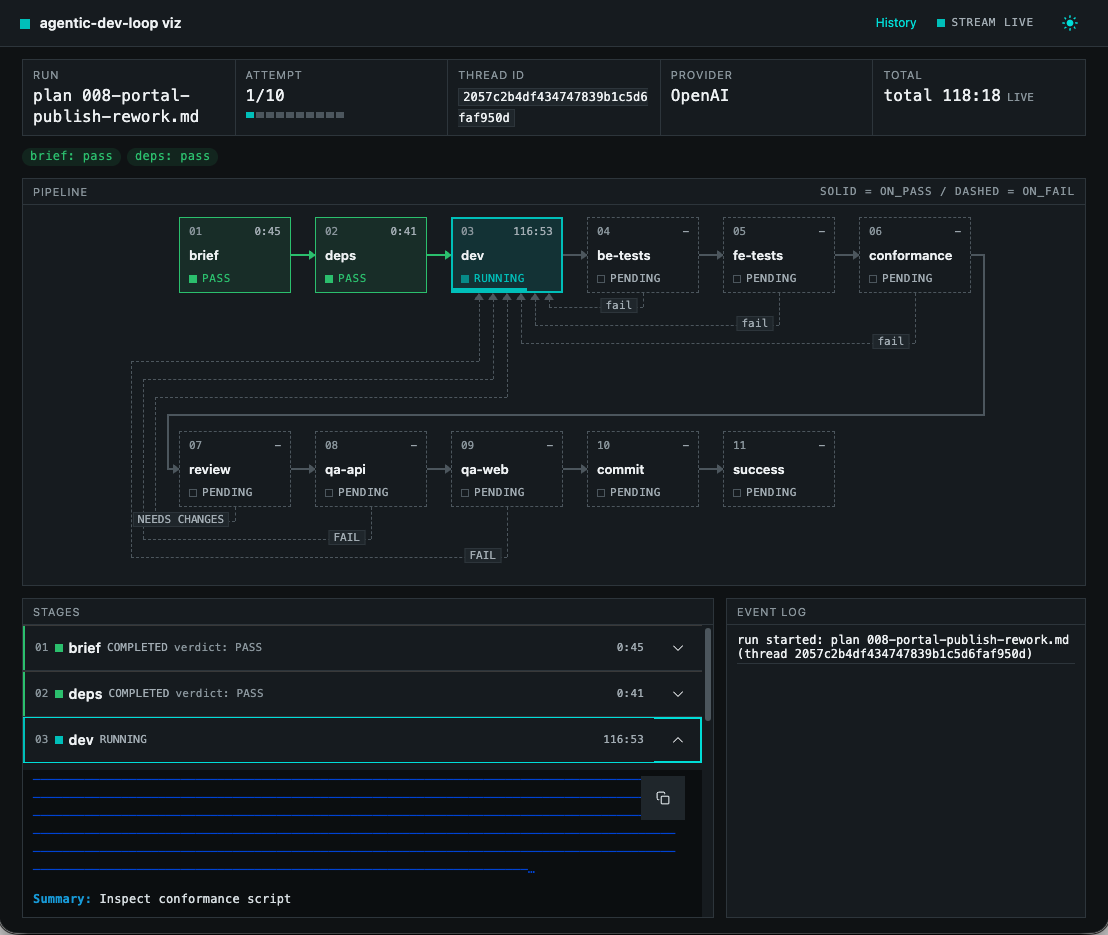
- A tool, not a wiring project. One CLI entry point, opinionated defaults, fixed safety policies. You write the pipeline and the agent definitions - nothing else.
- Deterministic. Same pipeline + same state → same routing. Verdicts are parsed from files, retries are bounded, nothing is best-effort.
- Sandboxed by default. The agent's shell and every command step run inside an always-on Docker sandbox. There is no opt-out.
How it fits together
The loop is five layers. You author the first two; the engine owns the rest.
| Layer | What it is | Who authors it |
|---|---|---|
| Pipeline | One pipeline.yaml declaring the stage graph: agent steps, mechanical command gates, verdict routing, retry loops, and per-step isolation. |
You |
| Agent prompts | Markdown prompt files with YAML frontmatter (<name>.agent.md) defining each agent's role, rules, sandbox notes, and tools. |
You |
| Sandbox | Every agent shell and command step runs in a Docker container: no network access by default, writes only to declared mounts:, and no .git - steps run against a fresh export. If no sandbox is available, the run stops instead of degrading. |
Engine |
| Dev image | The digest-pinned dev image pulled on first run. The supply-chain check refuses to continue on a digest mismatch. | Engine |
| Extensions | Optional plugins: your own actions, tools, and document loaders, loaded from outside the workspace. | You (optional) |
Every run is crash-safe (interrupt and resume from the exact checkpoint), watchable in a live browser graph view, and gated: nothing gets committed until every stage passes. The fixed policies are part of the product - fail fast on missing config or secrets, no silent fallbacks, verdicts only from artifacts, bounded retries, and a single clean-worktree-gated commit point.
Supported platforms
The engine is plain Linux under the hood and runs wherever a compliant Docker engine does:
| Platform | Support |
|---|---|
| Linux | Native. Docker Engine, OrbStack, Colima, or podman with docker compat. |
| macOS | Native. Docker Desktop, OrbStack, or Colima. |
| Windows | Via WSL2 (Ubuntu distro). Enable Docker Desktop's WSL integration (or run Docker Engine inside the distro) and keep the repo on the WSL filesystem (~/dev/...), not /mnt/c - bind-mounting a 9p path into containers breaks permissions and is slow. |
Quick start
Prerequisites
| Requirement | Detail |
|---|---|
| Python | ≥ 3.12 |
| Docker engine | Engine API ≥ 1.43 (Engine 24). Any compliant engine works - Docker Desktop, OrbStack, Colima, Rancher Desktop, podman docker-compat. On Windows, run under WSL2: the repo must live on the WSL filesystem, not /mnt/c. |
| LLM API key | The env var named by your pipeline's api_key_env (e.g. OPENAI_API_KEY) must be set - a missing key fails fast, naming it. Alternatively, agentic-dev-loop copilot-login authenticates a Copilot subscription (see LLM providers). |
pipx install agentic-dev-loop
agentic-dev-loop --version
Install with pipx: the engine's venv lives outside the workspace, so it is unmounted from the sandbox and never agent-writable. On the first run the engine pulls the digest-pinned dev image and verifies its digest. Setup details and troubleshooting live in docs/setup.md.
cd <your-repo>
agentic-dev-loop init --profile python                     # writes the pipeline + agents (see below)
export OPENAI_API_KEY=...                                  # whatever api_key_env names
agentic-dev-loop agentic-dev-loop/pipeline.yaml --dry-run  # validate - no LLM, no Docker
agentic-dev-loop agentic-dev-loop/pipeline.yaml            # run it
Running a pipeline
| Flag | Effect |
|---|---|
--dry-run |
Full load-and-validate pass, then print the resolved plan. No LLM, no Docker, no state writes, no API key. Exit 0 on a clean load. |
--resume <thread-id> |
Continue the latest checkpoint of a previous run (crash, Ctrl-C, exhaustion) with all accumulated notes intact. |
--max-attempts <n> |
Override the pipeline's max_attempts. |
--no-viz / --viz-port <port> |
Suppress the live graph view / set a preferred port (default 8321; falls back to a free port when busy). |
Exit code is 0 on pipeline success, 1 otherwise.
Other commands:
agentic-dev-loop run-status <pipeline>renders the latest run as a mermaid flowchart with the current step highlighted, reading the run-state checkpoint database directly.run-status --installinstalls the bundled/run-statuscommand into OpenCode.agentic-dev-loop containersinspects the engine's sandbox containers and networks from the host;containers --reapremoves registry-owned orphans whose owner process is dead. A SIGTERM to a running pipeline still closes the sandbox; SIGKILLed runs are reclaimed by the startup reaper on the next run or bycontainers --reap.
What a run looks like (the shipped self-loop example):
flowchart LR
    dev["agent: dev"] --> test{{"test gate"}} --> review["agent: review"] --> qa["agent: qa"] --> commit["action: commit"]
    test -- fail --> dev
    review -- fail --> dev
    qa -- fail --> dev
- dev - the dev agent works with full context (loaded docs + shared files).
Its edits are untracked; only declared
produces:files are hygiene-tracked. - test - a mechanical command step runs the suite inside the sandbox.
Exit 0 moves on; anything else rewinds to
devwith the failing output. - review / qa - verdict agents finish by calling the
record_verdicttool; the validated tool call routes the graph.failrewinds todevand consumes an attempt. - commit - the single commit point fires only when all gates passed and the worktree was clean at start.
- success - committed; or failure when attempts are exhausted.
LLM providers
The engine speaks OpenAI-compatible wire format throughout, so every step, profile, and gate works identically on either provider style:
| Provider | Setup |
|---|---|
| Any OpenAI-compatible endpoint | API key via api_key_env + base_url in the llm: block: DeepSeek, OpenAI, or any OpenAI-compatible API. |
| GitHub Copilot subscription | agentic-dev-loop copilot-login once, then point the llm: block at https://api.githubcopilot.com with the file-backed token. |
# OpenAI-compatible endpoint (any provider)
llm:
  model: openai/deepseek-v4-pro
  base_url: https://api.deepseek.com
  api_key_env: OPENAI_API_KEY
# GitHub Copilot subscription
llm:
  model: openai/gpt-5.6-luna        # pro tier; gpt-4.1 is the lite tier
  base_url: https://api.githubcopilot.com
  api_key_secret:
    from: file
    key: ~/.agentic-dev-loop/auth/copilot.json
    json_key: access_token
  headers:
    Copilot-Integration-Id: vscode-chat
    Editor-Version: vscode/1.94.0
    Openai-Intent: conversation-panel
Copilot specifics:
- The
openai/prefix on model names is required - it forces the OpenAI-compatible route through the gateway. gpt-4.1(lite tier) rejects anyreasoning_effort, so lite-tier steps set none.- Some models on this endpoint do not work for agent steps. The current working set, the token lifecycle, and known endpoint limitations are in docs/setup.md.
pipeline.yaml
name: my-construction-loop
extensions:
  - agentic_dev_loop.engine.extensions.aidlc:AidlcExtension   # bundled AI-DLC doc loader
additional_files:
  - ../README.md                                       # shared context for every agent step

llm:
  model: openai/deepseek-v4-pro
  base_url: https://api.deepseek.com
  api_key_env: OPENAI_API_KEY
  # reasoning_effort: medium                        # optional: low | medium | high | xhigh | none

# Named LLM profiles: a step names one with `llm: <name>` to move the whole
# profile (model, endpoint, key, effort default) together. The `llm:` block
# above remains the default.
# llms:
#   review:
#     model: openai/deepseek-v4-pro
#     base_url: https://api.deepseek.com
#     api_key_env: REVIEW_API_KEY
#     reasoning_effort: xhigh

max_attempts: 10                                        # CLI --max-attempts overrides
agents_dir: sdk_agents                                  # your <name>.agent.md files

steps:
  - name: brief
    reasoning_effort: medium
    brief_inputs:
      include: [AGENTS.md, coding-standards-ddd.yaml]
      sections: [Repo rules digest, Unit scope digest, Environment facts, Open risks]
      env_facts: ["the workspace is an export with no .git; verify with find/ls, never git status"]
    on_pass: dev

  - name: dev
    agent: dev
    produces: implementation-summary.md
    terminal_timeout: 900
    # forbidden_commands: ["npm install", "npm ci"]      # per-step tool deny-list; engine defaults are git mutations + docker
    on_pass: test

  - name: test
    command: .venv-sandbox/bin/python -m pytest tests/ -q -m "not docker"
    setup: python -m venv .venv-sandbox && .venv-sandbox/bin/pip install -e ".[dev]"
    timeout: 600
    on_pass: review
    on_fail: { goto: dev, retry: true }

  - name: review
    agent: review
    artifact: review-findings.md
    verdicts: { pass: APPROVED, fail: NEEDS CHANGES }
    # reasoning_effort: xhigh                        # per-step override of the effective profile's effort
    # llm: review                                    # select a named `llms:` profile for this step
    on_pass: qa
    on_fail: { goto: dev, retry: true }

  - name: qa
    agent: qa
    artifact: qa-report.md
    verdicts: { pass: PASS, fail: FAIL }
    max_iterations: 100
    finalize_nudge_turns: 10
    on_pass: commit
    on_fail: { goto: dev, retry: true }

  - name: commit
    action: commit
    params: { message: "feat: construct {subject} (agent dev loop)" }
| Key | Notes |
|---|---|
agent: / command: / action: / brief_inputs: |
Exactly one per step. Agents live in agents_dir as <name>.agent.md; commands run sandboxed (mechanical, never an LLM call). commit is the sole host-side built-in action; consumer actions are sandbox-executed scripts (see Host boundary). |
produces: / artifact: + verdicts: |
Hygiene-tracked outputs vs structured-verdict routing. The verdict comes from a validated record_verdict tool call, never from prose; stale artifacts are deleted at each attempt start. |
brief_inputs: |
A native brief step: { include: [<paths/globs>], env_facts: [<strings>], sections: [<headings>] }. It digests the included docs into an engine-owned attempt-brief.md that later agents read, and re-runs only when its inputs change. |
on_pass: / on_fail: |
A step name, terminal success/failure, or {goto: X, retry: true}. No loops happen unless you write them. |
env: / setup: / network: |
env: declares step vars (fixed safe base + declared vars only); setup: runs fresh at every step boundary in a one-shot provision container targeting the export (command or agent steps; network ON); network: true grants egress scoped by egress: (default off) - see Per-stage networking. |
mounts: / egress: |
Per-step workspace isolation. mounts: lists {path, mode} entries (rw/ro, default ro), strict-by-default: empty/missing mounts nothing, and only declared-rw paths sync back to the repo. egress: names the hosts a networked step may reach ({class, presets, targets}). See docs/setup.md. |
secrets: (top-level) / step secrets: |
Declares secret refs only - never values; each step opts in to the refs it needs. Resolved host-side and injected into that step's exec env only. See Secrets. |
profile: (top-level) |
Names a bundled toolchain profile (python, dotnet-node) or a consumer profile file path, merged at load time: isolation key-wise with the pipeline winning, caches unioned profile-first. |
isolation: (optional) |
Configures the sandbox - image override, resource caps, allow_git_mutations, seccomp_profile. It can never disable it. See browser sandbox. |
terminal_timeout: |
Optional agent-step per-action timeout in seconds; overrides the SDK tool default. |
finalize_nudge_turns: |
Optional agent-step final-response nudge; requires max_iterations: and must be less than it. |
deps_policy: / lockfiles: |
locked (default) or open. The human-owned lockfile is the source of truth under locked; see Dependency policy. |
caches: / sync_excludes: |
Top-level run-wide lists. caches: names toolchain cache dirs bind-mounted rw from host-side stores (a setup: hook can warm them); sync_excludes: names non-gitignored scratch paths skipped from export and sync-back. |
merge_on_conflict: |
Top-level list of append-style logs. A concurrent host edit to a listed path is union-merged instead of raising; see Sync-back conflicts. |
llms: (top-level) / step llm: / reasoning_effort: |
Named LLM profiles, each a full LlmConfig; a step selects one whole with llm: <name>. reasoning_effort (low/medium/high/xhigh/none) is opt-in on the llm block, a profile, or a step. See Reasoning effort. |
Banned commands (forbidden_commands:)
forbidden_commands: is a per-step list of regex patterns checked against
every agent command before any shell spawn; a match returns a structured
[forbidden: <label>] observation instead of running. The engine defaults
(git mutations and docker) always apply and have no disable switch; a
toolchain profile may add tool-specific rules (for example the python
recipe denies pip install, uv add, and pip-compile on agent steps).
Command steps bypass the filter by design.
Reasoning effort (opt-in)
reasoning_effort is an opt-in latency dial on the pipeline llm block, a
named llms: profile, and individual agent steps. Unset means reasoning is
off - the field is forwarded as none and reasoning is stripped from requests.
A thinking model without an effort level is invalid config and fails fast
with an actionable engine error rather than a provider 400. A step's value
overrides the effective profile's value.
Recommended lane defaults (guidance only, not enforced):
| Lane | reasoning_effort | Why |
|---|---|---|
| brief | medium | digest and classify, no design work |
| dev | high | the most demanding construction work |
| qa | medium | classification discipline must stay reliable |
| review | xhigh | highest stakes: a missed detection sails past the last gate into commit |
Secrets
Secret values never belong in the pipeline yaml, the workspace, or state_dir.
Declare the refs at the top level and opt each step into the refs it needs:
secrets:                              # refs only - never values
  kinde-client-secret:                # ref name (arbitrary)
    from: env                         # provider name
    key: KINDIE_CLIENT_SECRET         # provider-specific locator
  r2-keys:
    from: env
    key: R2_KEYS

steps:
  - name: qa
    agent: qa
    secrets: [kinde-client-secret, r2-keys]
- The engine resolves every declared ref host-side at run start; a missing variable, unknown provider, or undeclared ref fails fast, naming the ref. A resolved secret reaches only the steps that list it.
- Prefer a mechanical
commandstep for secret-consuming work so the LLM and the secret never meet; anagentstep holds a secret only when its job genuinely requires it. .env*ban. At run start the workspace root is scanned for.env*files; any hit fails fast, naming the files. The convention fixtures.env.example,.env.template, and.env.sampleare whitelisted.- Output scrubbing. Resolved secret values are scrubbed from every
engine-written output - captured step output, retry notes, artifacts, and
state_dirfiles. from: filereads a host file (keyis the path, optionaljson_keyselects a JSON field); thellm:block accepts exactly one ofapi_key_envorapi_key_secret. See docs/setup.md.
Per-stage networking
The sandbox is network-off by default. A step that legitimately needs egress
declares network: true and names exactly what it may reach:
steps:
  - name: fetch-docs
    command: curl -fsSL https://example.com/spec.json -o spec.json
    mounts: [{ path: ".", mode: rw }]      # the cwd + a place to write spec.json
    network: true                          # egress for this step only
    egress: { targets: [example.com] }     # ...and only these hosts

  - name: restore
    command: .venv-sandbox/bin/pip install -e ".[dev]"
    mounts: [{ path: ".", mode: rw }]
    network: true
    egress: { presets: [package-registries] }   # pypi/npm/NuGet/cargo + VCS
network: trueis scoped by theegress:allowlist, structurally: the step's traffic is forced through a containerized egress proxy on a per-run internal docker network with no route to the host, and a request to an undeclared host is denied and logged.egress: { class: browser }is the explicit broad-but-logged class (every connection logged, nothing filtered); otherwise the allowlist is strict.- A networked step that writes output must also declare a writable mount:
with no
mounts:a step mounts nothing, socurl ... -o spec.jsonhas no writable cwd. - Host services are reachable through the proxy's
host.docker.internalhost-gateway alias, so an S3 SDK against a local MinIO works through the enforced, logged path. Sandbox containers have no host route. - Command, agent, and sandbox-action steps may declare it; the host-side
commitaction never takes it. Author opt-in is the control - reserve it for stages that need it (QA, integration).
Sync-back conflicts (host edits during a run)
Only declared-rw paths sync back to the real repo after a step. If the host
also edits a declared-rw path while the step is running, sync-back raises
AE-SBX-016; the host's version wins, the baseline is re-snapshotted, and the
next step runs clean instead of re-raising forever. For append-style logs
edited by both sides, declare them in the top-level merge_on_conflict:
list: they are union-merged - the host keeps its lines, the sandbox's new
lines are appended, and the run continues.
Dependency policy (locked by default)
The supply-chain dial is a pipeline-level deps_policy: field, locked by
default. The engine injects the policy into every agent step's context:
deps_policy: locked    # or: open    (default: locked)
lockfiles: [uv.lock]   # or: [packages.lock.json, package-lock.json]
locked- the human-owned lockfile is the source of truth; the agent may not add dependencies. If the design requires a missing dependency, the agent declares it in its final response under## Missing dependencies, which fails the run fast with one human lockfile edit - not a retry loop.open- the agent may add exact-pinned manifest entries directly (never a package-manageraddcommand); the network-on restore step fetches them.
The restore step runs the toolchain's locked mode and fails when the manifest and lockfile disagree:
| Toolchain | Locked restore | Lockfile |
|---|---|---|
| .NET | dotnet restore --locked-mode |
packages.lock.json |
| node | npm ci |
package-lock.json |
| python | uv sync --locked |
uv.lock |
The restore step also fails on known-CVE findings (per-toolchain thresholds:
NuGetAudit at error, npm audit --audit-level=high, pip-audit). A human
generates the lockfile once, on a network machine, and commits it - the
engine never fetches on the agent's behalf.
Host boundary (security model)
The orchestrator, tool layer, and the commit action run in the host process
-
they hold your credentials and your full user account, so the engine keeps anything agent-writable out of that process:
-
Consumer actions are sandbox-executed. An action you register via an extension is a command-shaped script (
script + params), run through the same sandbox path as command steps. Only the engine's trusted built-ins (commit, document loaders) run host-side. -
Extensions load from outside the workspace. Any extension or tool module whose file resolves under the workspace is refused before import, naming the file.
-
The engine installs outside the workspace. Install with pipx so the venv is unmounted from the sandbox; a startup self-check refuses to run if
agentic_dev_loopresolves under the workspace. -
Tooling is read-only by the loop. At run start the pipeline file,
agents_dir,additional_files,aidlc-docs/, andtools/must be git-clean relative to HEAD, and thecommitaction excludes those paths from its sweep, so the loop never commits its own tooling. -
commitstays host-side, deliberately. It holds push credentials and runs argv-style with a scrubbed child env and a hooks override, so repo hooks never execute.
Net: the host executes nothing from the workspace, reads only git-clean control files, and the only agent-writable host-consumed thing left is the code the loop is building.
Authoring a loop for your own repo
Start with agentic-dev-loop init
agentic-dev-loop init --profile python # or: --profile dotnet-node
init writes the onboarding surface from a bundled toolchain profile:
agentic-dev-loop/pipeline.yaml, the three agent files, an executable
trigger-agentic-dev-loop.sh, agentic-dev-loop/.engine-version (the exact
installed engine version), any missing premise files, gitignore additions,
and an env-file template. It detects solution files, package.json
directories, lockfiles, README, and AGENTS.md, asks only what detection
cannot answer, and refuses to overwrite an existing agentic-dev-loop/
directory. A consumer-authored profile file can be passed by path instead of
a bundled name.
agentic-dev-loop doctor --fast is the per-run gate the trigger runs first:
hard failures abort the run (engine pin mismatch, engine runtime
availability, API version, git repo, .env* files); warnings print and
continue. On a hard failure the trigger runs agentic-dev-loop upgrade
exactly once, then the run fails hard if doctor still fails.
A consumer repo needs a pipeline file and the agent files it names, both
committed before the first run. init writes them; the layout is:
<repo>/agentic-dev-loop/pipeline.yaml
<repo>/agentic-dev-loop/sdk_agents/dev.agent.md
<repo>/agentic-dev-loop/sdk_agents/review.agent.md
<repo>/agentic-dev-loop/sdk_agents/qa.agent.md
The agent files
Each sdk_agents/<name>.agent.md is a markdown prompt plus YAML frontmatter:
name matches a step's agent: value; tools lists the tool names the step
may use (terminal always; verdict steps also need record_verdict; a repo
can add more via extensions). A step configured with verdicts: whose agent
file does not grant record_verdict fails at load, never at routing time.
---
name: review                 # matches a step's `agent:` value
tools: [terminal, record_verdict]
---
# Review Agent
## WORKFLOW                   # numbered steps
## RULES                      # absolute never/always rules
## SANDBOX NOTES              # the sandbox truth for THIS step
## OUTPUT                     # the verdict contract
Three roles, three contracts:
| Role | Verdict contract | Typical sandbox |
|---|---|---|
| dev | none - the final response is captured as the produces: summary |
rw mount, offline |
| review | record_verdict with APPROVED / NEEDS CHANGES; the prose keeps the findings for humans |
ro mount, offline |
| qa | record_verdict with PASS / FAIL; map unverifiable: UNVERIFIABLE if you want a third way |
shaped by the repo: rw + network + class: browser when it boots servers and drives a browser; ro + offline when it probes the CLI only |
Conventions that make a good agent file:
- State the sandbox truth in the prompt. Every agent file carries a
SANDBOX NOTESsection naming exactly what its step allows: mounts ro or rw, network on or off, and which gates have already run. - Gates are the source of truth - cite the record, never re-run. Review and qa never re-run builds or suites; qa maps every acceptance criterion to existing coverage and probes only the remainder.
- dev enumerates its impossible set and stops at it. List the commands the sandbox cannot run (offline package fetches, browser downloads), one attempt per command - keeps the productive loop and kills doomed retries.
- Failure output returns as Previous attempt feedback. Steps route
on_fail: { goto: dev, retry: true }, so gate failure output lands in the dev agent's next context; the dev prompt makes every listed issue a required fix. - No git mutations, ever. The
commitstep is the single commit point.
The pipeline file
The full field reference is above; this is the stage lineup and what to adapt per repo.
| Stage | Kind | Typical shape | Why |
|---|---|---|---|
| dev | agent | rw, offline | does the work; edits are untracked |
| restore | command | network + presets: [package-registries] |
fetches what dev pinned (deps_policy: open) or the locked install |
| test | command | offline is fine (warm cache) | exit code is the verdict; the source of truth |
| editor-tests | command | network + presets: [package-registries] |
frontend suites that cannot run offline; a separate step keeps its failure diagnosis and timeout independent of the backend suite |
| conformance | command | network + presets: [package-registries] |
repo-specific fitness checks |
| review | agent | ro, offline | static conformance verdict |
| qa | agent | per repo (see table above) | live-behaviour probes; inject secrets only if the probes need them |
| commit | action | host-side | the single commit point |
Adaptation checklist for a new repo:
llm:- model,base_url,api_key_env.llms:(optional) - named profiles for multi-provider lanes (keep review on the strongest model); a step opts in withllm: <name>.profile:- name a bundled profile (python,dotnet-node) or a consumer profile path.caches:- profile-supplied toolchain caches plus any run-specific dirs; caches are never synced back, and a step'ssetup:hook runs with them mounted so it can warm them.sync_excludes:- build output trees (**/bin/**,**/obj/**).secrets:- refs only, resolved from host env; each step opts in to the refs it needs.egress:-presets: [package-registries]for fetch steps;class: browser(broad-but-logged) for browser-tier qa only.deps_policy:andlockfiles:- see Dependency policy.- The dev prompt's impossible set - write it for your toolchain.
additional_files:- the repo'sAGENTS.md, coding standards, design docs: shared context for every agent step.
Validate before the first run - dry-run loads and prints the resolved plan with no LLM, no Docker, no state writes:
agentic-dev-loop agentic-dev-loop/pipeline.yaml --dry-run
Then commit the tooling and run for real.
Development environment
git clone git@github.com:lukedawilson/agentic-dev-loop.git
cd agentic-dev-loop
pipx install agentic-dev-loop                 # engine venv OUTSIDE the workspace (self-check)
export OPENAI_API_KEY=...                     # set your LLM key in the host env (no .env in the repo)
python -m pytest tests/ -q                    # fast suite (in-repo .venv is for tests only)
python -m pytest tests/ -q -m "not docker"    # skip engine-dependent tests
agentic-dev-loop agentic-dev-loop/pipeline.yaml --dry-run   # run the shipped pipeline
./run-demo.sh                                 # viz demo - scripted run replay, no pipeline needed
setup-venv.shbuilds the throwaway.venvfor localpytestruns. The loop itself must run from the pipx install - never an in-workspace.venv, which the startup self-check refuses.- Docker-marked integration tests need a local daemon; CI runs them on Linux.
- The shipped pipeline (
agentic-dev-loop/pipeline.yaml) dogfoods the tool on its own repo - dev → test → review → qa → commit, with the engine's own three agent definitions insdk_agents/. - CI:
ci.yml(unit + integration suite, ubuntu),publish-image.yml(multi-arch dev image, amd64 + arm64),release.yml(PyPI publishing). - Pre-publish tooling can point
AGENTIC_DEV_LOOP_DEV_IMAGEat a locally built dev image.
Contributing
- Read AGENTS.md first - it is the instruction set for both human and agent contributors.
- Development is structured by AI-DLC - the lifecycle workflow in
.aidlc/aidlc-rules/aws-aidlc-rules/with working docs inaidlc-docs/. The bundled document loader autodetects the current unit via--aidlc-unit, or loads any plan with--plan. - OpenCode commands over the workflow:
/unit-status,/epic-status,/ticket-details,/update-subtask,/apply-aidlc-patches, and more. - Working extension samples (actions, tools, document loaders) ship as
tests/sample_ext.py.
Built on OpenHands SDK and LangGraph.
1 maintainer

Metadata
1 maintainer
Release files for agentic-dev-loop 0.12.3
For a detailed explanation of source distributions (sdists) and built distributions (wheels), please see the package formats documentation.
Source distribution (sdist)
| File | Size | Uploaded | Provenance | Actions |
|---|---|---|---|---|
| agentic_dev_loop-0.12.3.tar.gz | 360.0 kB | With provenance | Details for agentic_dev_loop-0.12.3.tar.gz |
Built distribution (wheel)
| File | Interpreter | ABI | Platform | Actions Reset |
|---|---|---|---|---|
| agentic_dev_loop-0.12.3-py3-none-any.whl | Python 3 | none | any | Details for agentic_dev_loop-0.12.3-py3-none-any.whl |
Total release size: 575.4 kB
Release files / agentic_dev_loop-0.12.3.tar.gz
| Download URL | agentic_dev_loop-0.12.3.tar.gz |
|---|---|
| Size | 360.0 kB |
| Tags | Source |
|
SHA-256 checksum How to use checksums |
15e7fd663f3ad02cc51ca9181ba754b0a5ac76accfc51f7c245e1ec302e1c2ae
|
|
BLAKE2b-256 checksum How to use checksums |
dc03ebbf3753bcf2976a23f9a1c6ec0660f21ae988dbe5b7df83b72796863a82
|
| Upload date | |
|
Uploaded using Trusted Publishing? What is trusted publishing? |
Yes |
| Uploaded via |
twine/7.0.0 CPython/3.13.16
|
Provenance
Provenance describes where a file came from. On PyPI, provenance is shared via attestations, which provide a verifiable record of the build or publishing details. View details, limitations and caveats.


PyPI Publish Attestation
PyPI verified that this artifact, at this checksum, originated from the publisher listed below.
Signed by GitHub Actions, verified by PyPI on Nov 8, 2026.
Transparency logRelease files / agentic_dev_loop-0.12.3-py3-none-any.whl
| Download URL | agentic_dev_loop-0.12.3-py3-none-any.whl |
|---|---|
| Size | 215.4 kB |
| Tags | Python 3 |
|
SHA-256 checksum How to use checksums |
a680dec77571b4a6b948383f1413a2670eec7a0f2936e32d67cb963b08beb5bb
|
|
BLAKE2b-256 checksum How to use checksums |
f565d67bead242422306135f56c3f52d3946b15edb115ac3e1a4b0fb02fcfca4
|
| Upload date | |
|
Uploaded using Trusted Publishing? What is trusted publishing? |
Yes |
| Uploaded via |
twine/7.0.0 CPython/3.13.16
|
Provenance
Provenance describes where a file came from. On PyPI, provenance is shared via attestations, which provide a verifiable record of the build or publishing details. View details, limitations and caveats.
PyPI Publish Attestation
PyPI verified that this artifact, at this checksum, originated from the publisher listed below.
Signed by GitHub Actions, verified by PyPI on Nov 8, 2026.
Transparency logSecurity for agentic-dev-loop 0.12.3
Provenance
Provenance describes where a file came from. On PyPI, provenance is shared via attestations, which provide a verifiable record of the build or publishing details. View details, limitations and caveats.
Full provenance
Both files in this release have been uploaded with provenance metadata.
Attestation for agentic_dev_loop-0.12.3.tar.gz
PyPI Publish Attestation
PyPI verified that this artifact, at this checksum, originated from the publisher listed below.
Signed by GitHub Actions, verified by PyPI on Nov 8, 2026.
Transparency logA note on package security
PyPI is a repository for distributing packages, not a service for auditing them. While third-party security researchers and our staff do their best to detect and remove malicious packages, PyPI cannot guarantee the quality, security or suitability of any given package.
To learn more about protecting yourself from malicious actors, visit our package security documentation.














