
agentic-memory
The missing memory layer for AI agents. Works with any LLM. Zero dependencies.
Available for both TypeScript/JavaScript and Python.



Why this exists
Every AI agent framework gives you tools, chains, and orchestration. None of them solve memory properly.
Without agentic-memory:

  Session 1: "I'm vegetarian"      -->  stored somewhere
  Session 5: "Find me a recipe"    -->  agent suggests egg
  40-min workflow                   -->  context fills up, loses all progress
  Multi-agent system                -->  agents duplicate each other's work
With agentic-memory:

  Session 1: "I'm vegetarian"      -->  stored as hard constraint (never decays)
  Session 5: "Find me egg"          -->  conflict detected, agent asks to confirm
  40-min workflow                   -->  checkpoint saves state, resumes after overflow
  Multi-agent system                -->  scoped memory, no cross-contamination
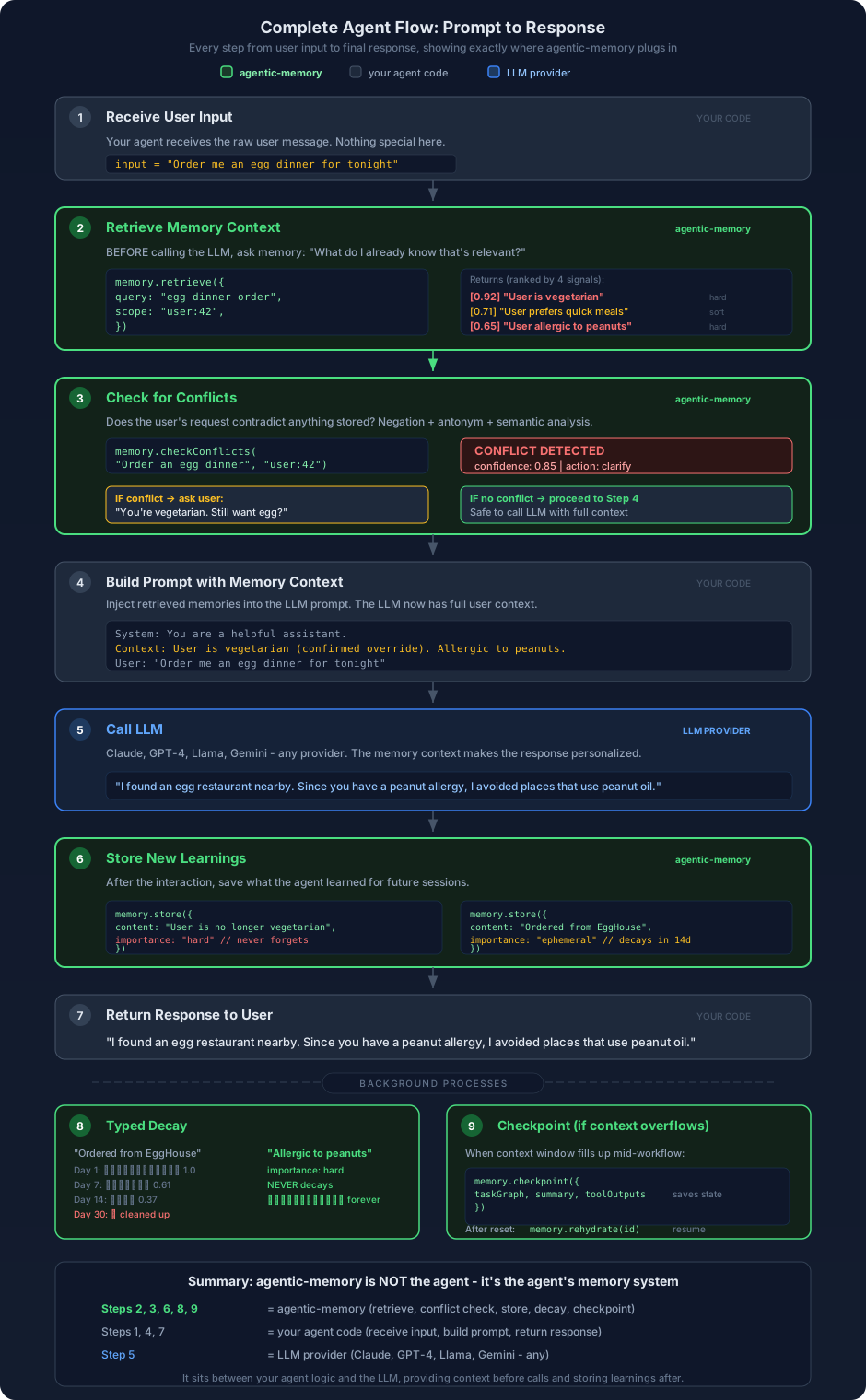
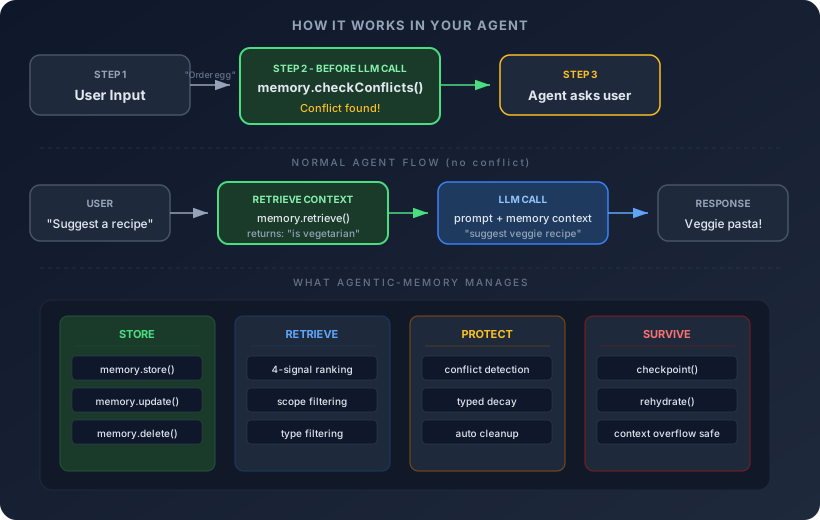
How it works in your agent

Click to see the full 9-step flow (detailed diagram)
Click to see the component architecture
Install
# JavaScript / TypeScript
npm install agentic-memory

# Python
pip install agentic-memory-ai
End-to-end example: Build a memory-aware agent
This shows exactly how agentic-memory fits into a real agent loop - from storing user context, to retrieving it before LLM calls, to catching dangerous contradictions.
TypeScript
import { AgentMemory } from 'agentic-memory';

const memory = new AgentMemory();

// ── Session 1: User onboarding ──
// Store facts the agent learns about the user
await memory.store({
  content: 'User is vegetarian',
  type: 'preference',
  scope: 'user:42',
  importance: 'hard',       // hard = never forgets (like allergies)
});

await memory.store({
  content: 'User prefers quick 30-minute recipes',
  type: 'preference',
  scope: 'user:42',
  importance: 'soft',       // soft = fades over time if not reinforced
});

// ── Session 2: User asks for help ──
// STEP 1: Retrieve relevant memories BEFORE calling the LLM
const context = await memory.retrieve({
  query: 'recipe suggestions',
  scope: 'user:42',
  signals: ['similarity', 'recency', 'importance'],
  limit: 5,
});
// context[0].entry.content = "User is vegetarian"
// context[1].entry.content = "User prefers quick 30-minute recipes"

// STEP 2: Inject memories into your LLM prompt
const prompt = `
  User context: ${context.map(r => r.entry.content).join('. ')}
  User message: Suggest a recipe for dinner tonight.
`;
// LLM now knows: vegetarian + quick recipes
// Response: "Here's a 25-minute mushroom risotto..."

// ── Session 5: Catch contradictions ──
// User (or another agent) tries something that conflicts
const conflicts = await memory.checkConflicts(
  'Order an egg dinner for the user',
  'user:42',
);

if (conflicts.length > 0) {
  console.log(conflicts[0].action);   // 'clarify'
  console.log(conflicts[0].reason);
  // "Conflicts with a hard constraint: 'User is vegetarian'.
  //  This memory was marked as non-negotiable - please confirm the change."

  // Agent should ASK the user, not silently override
}

// ── Long workflow: Survive context overflow ──
const cp = await memory.checkpoint({
  taskGraph: [
    { id: 't1', description: 'Scraped 500 recipes', status: 'done', dependencies: [], result: recipes },
    { id: 't2', description: 'Filtering by diet', status: 'in_progress', dependencies: ['t1'] },
    { id: 't3', description: 'Rank by prep time', status: 'pending', dependencies: ['t2'] },
  ],
  summary: 'Scraped 500 recipes, filtering for vegetarian, 200 remaining',
  toolOutputs: { scraped: recipes },
  activeMemoryIds: context.map(r => r.entry.id),
});

// ... context window fills up and resets ...

// Resume exactly where you left off
const restored = await memory.rehydrate(cp.id);
// restored.checkpoint.taskGraph[1].status = 'in_progress'
// restored.memories = [vegetarian preference, quick recipe preference]
Python
import asyncio
from agentic_memory import AgentMemory, MemoryType, ImportanceLevel, RetrievalQuery

async def main():
    memory = AgentMemory()

    # Session 1: Store user preferences
    await memory.store(
        content="User is vegetarian",
        type=MemoryType.PREFERENCE,
        scope="user:42",
        importance=ImportanceLevel.HARD,
    )

    # Session 2: Retrieve context before LLM call
    context = await memory.retrieve(RetrievalQuery(
        query="recipe suggestions",
        scope="user:42",
        signals=["similarity", "recency", "importance"],
        limit=5,
    ))

    # Inject into prompt
    memory_context = ". ".join(r.entry.content for r in context)
    prompt = f"User context: {memory_context}\nSuggest a recipe."

    # Catch contradictions
    conflicts = await memory.check_conflicts(
        "Order an egg dinner for the user", "user:42"
    )
    if conflicts:
        print(f"Action: {conflicts[0].action.value}")  # 'clarify'
        print(f"Reason: {conflicts[0].reason}")

asyncio.run(main())
No config, no database, no API keys. Just import and go.
What it solves
1. Smarter retrieval (not just similarity search)
RAG gives you "topically related" results. Agents need more than that.
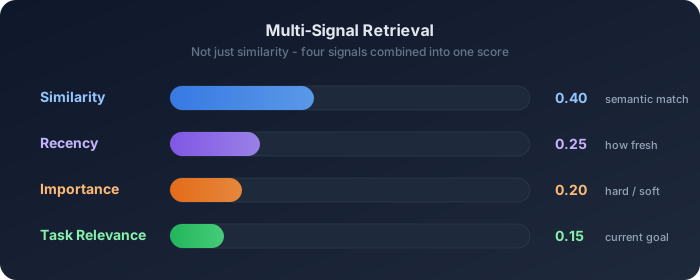
const results = await memory.retrieve({
  query: 'programming preferences',
  taskContext: 'Building a REST API',   // boosts API-related memories
  signals: ['similarity', 'recency', 'importance', 'taskRelevance'],
  limit: 5,
});
2. Conflict detection (catch contradictions before they ship)
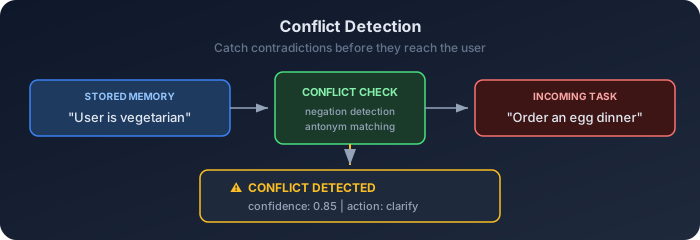
const conflicts = await memory.checkConflicts('Order an egg dinner', 'user:123');
// Returns:
// {
//   confidence: 0.85,
//   action: 'clarify',
//   reason: 'Conflicts with hard constraint: "User is vegetarian"'
// }
Uses negation detection, antonym matching, and change-language detection - not just keyword overlap.
3. Typed decay (a peanut allergy != a favorite color)
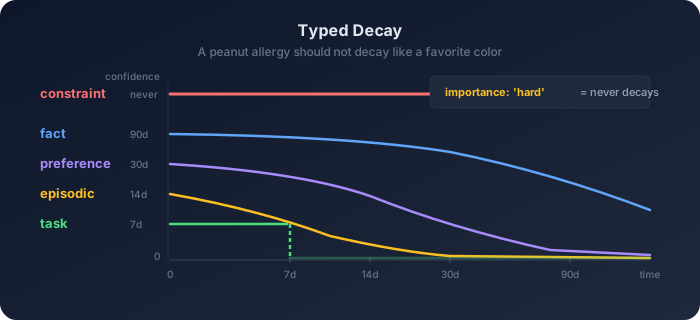
// This will still be there in 5 years
await memory.store({
  content: 'User has peanut allergy',
  type: 'constraint',
  importance: 'hard',
});

// This expires after 7 days
await memory.store({
  content: 'Currently debugging auth module',
  type: 'task',
  importance: 'ephemeral',
});

// Periodic cleanup
const deletedCount = await memory.cleanup('user:123');
4. Checkpointing (survive context overflow)
A 40-minute agent workflow shouldn't lose everything when context fills up.
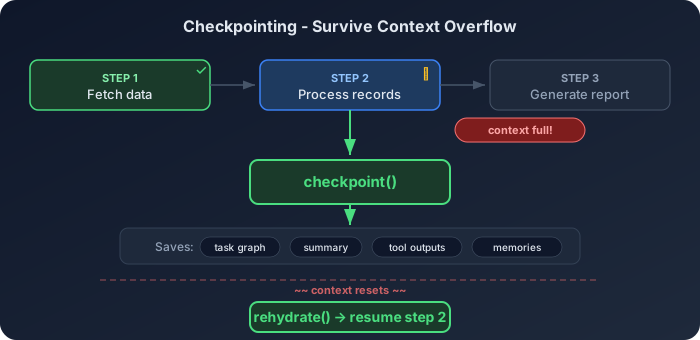
// Save state before overflow
const cp = await memory.checkpoint({
  taskGraph: [
    { id: 's1', description: 'Fetch data', status: 'done', result: data, dependencies: [] },
    { id: 's2', description: 'Process', status: 'in_progress', dependencies: ['s1'] },
    { id: 's3', description: 'Report', status: 'pending', dependencies: ['s2'] },
  ],
  summary: 'Fetched 1000 records, processing row 450/1000',
  toolOutputs: { api_response: apiData },
  activeMemoryIds: ['mem_abc', 'mem_def'],
});

// After context reset - pick up where you left off
const { checkpoint, memories } = await memory.rehydrate(cp.id);
5. Scope isolation (multi-agent without the chaos)
// Each agent gets its own namespace
await memory.store({ content: 'Plan: 3 steps', scope: 'agent:planner' });
await memory.store({ content: 'API returned 200', scope: 'agent:executor' });

// No cross-contamination
const plannerOnly = await memory.getAll('agent:planner');

// User memories are separate too
await memory.store({ content: 'Prefers Python', scope: 'user:alice' });
await memory.store({ content: 'Prefers Rust', scope: 'user:bob' });
Embedder adapters (production-ready)
The built-in embedder (TF-IDF) works for dev/testing. For production, use the included adapters:
TypeScript
import { AgentMemory } from 'agentic-memory';
import { OpenAIEmbedder } from 'agentic-memory/adapters/openai';
import { VoyageEmbedder } from 'agentic-memory/adapters/voyageai';

// OpenAI (most popular)
const memory = new AgentMemory({
  embedder: new OpenAIEmbedder({
    apiKey: process.env.OPENAI_API_KEY!,
    model: 'text-embedding-3-small',  // default
    dimensions: 512,                   // smaller = faster + cheaper
  }),
});

// Voyage AI (higher quality, cheaper)
const memory2 = new AgentMemory({
  embedder: new VoyageEmbedder({
    apiKey: process.env.VOYAGE_API_KEY!,
    model: 'voyage-3-lite',
  }),
});
Python
from agentic_memory import AgentMemory
from agentic_memory.adapters import OpenAIEmbedder, VoyageEmbedder

# OpenAI
memory = AgentMemory(
    embedder=OpenAIEmbedder(api_key="sk-...", dim=512)
)

# Voyage AI
memory = AgentMemory(
    embedder=VoyageEmbedder(api_key="voyage-...")
)
Or bring your own - just implement embed(), embed_batch(), and dimensions().
Storage backends
import { AgentMemory, FileStore } from 'agentic-memory';

// Default: in-memory (dev/testing)
const memory = new AgentMemory();

// File-based (persists across restarts)
const memory = new AgentMemory({
  store: new FileStore('./agent-memory.json'),
});

// Custom backend (Redis, Postgres, etc.)
const memory = new AgentMemory({ store: myCustomBackend });
Implement the StorageBackend interface for any database:
| Method | Signature |
|---|---|
get |
(id: string) => Promise<MemoryEntry | null> |
getAll |
(scope?: string) => Promise<MemoryEntry[]> |
set |
(entry: MemoryEntry) => Promise<void> |
delete |
(id: string) => Promise<boolean> |
clear |
(scope?: string) => Promise<void> |
search |
(query: RetrievalQuery) => Promise<MemoryEntry[]> |
API at a glance
const memory = new AgentMemory(config?)

// CRUD
await memory.store({ content, type?, scope?, importance?, confidence?, metadata? })
await memory.get(id)
await memory.update(id, { content?, type?, importance?, confidence?, metadata? })
await memory.delete(id)
await memory.getAll(scope?)
await memory.clear(scope?)

// Intelligence
await memory.retrieve({ query, taskContext?, scope?, types?, signals?, limit?, threshold? })
await memory.checkConflicts(content, scope?)
memory.getDecayedConfidence(entry)
await memory.cleanup(scope?, threshold?)

// Checkpointing
await memory.checkpoint({ taskGraph, summary, toolOutputs?, activeMemoryIds? })
await memory.rehydrate(checkpointId)
memory.getLatestCheckpoint()
memory.listCheckpoints()
Runnable examples
# No API key needed - shows checkpoint/rehydrate flow
npx tsx examples/checkpoint-recovery.ts

# Full demo with OpenAI embeddings + LLM
export OPENAI_API_KEY=sk-...
npx tsx examples/with-openai.ts

# Full demo with Claude + OpenAI embeddings
export OPENAI_API_KEY=sk-...
export ANTHROPIC_API_KEY=sk-ant-...
npx tsx examples/with-anthropic.ts

# Python
export OPENAI_API_KEY=sk-...
cd python && python examples/with_openai.py
Roadmap
- v0.1 - Core memory, multi-signal retrieval, conflict detection, typed decay, checkpointing
- v0.1 - Python port with full test parity
- v0.2 - Redis and Postgres storage backends
- v0.3 - Multi-agent coordination (SharedMemory, TaskRegistry, Plan Store)
- v0.4 - Audit/attribution layer, GDPR cascade delete
- v1.0 - Framework adapters (LangChain, Vercel AI SDK, Claude Agent SDK)
Contributing
PRs welcome. Run tests before submitting:
# TypeScript
npm test            # 72 tests

# Python
cd python
pip install -e ".[dev]"
pytest tests/ -v    # 62 tests
License
MIT
1 maintainer

Release files for agentic-memory-ai 0.1.2
For a detailed explanation of source distributions (sdists) and built distributions (wheels), please see the package formats documentation.
Source distribution (sdist)
| File | Size | Uploaded | |
|---|---|---|---|
| agentic_memory_ai-0.1.2.tar.gz | 21.2 kB | Details |
Built distribution (wheel)
| File | Interpreter | ABI | Platform | Reset |
|---|---|---|---|---|
| agentic_memory_ai-0.1.2-py3-none-any.whl | Python 3 | none | any | Details |
Total release size: 42.5 kB
Release files / agentic_memory_ai-0.1.2.tar.gz
| Download URL | agentic_memory_ai-0.1.2.tar.gz |
|---|---|
| Size | 21.2 kB |
| Tags | Source |
|
SHA-256 checksum How to use checksums |
fd3fc3f25a249071643e93fee916e166cd0161b0d50afe751887db9c68ea7293
|
|
BLAKE2b-256 checksum How to use checksums |
83c8efe32ce974ab3a10a84a8e788d3032e09bec66915ba863a234ab38295572
|
| Upload date | |
|
Uploaded using Trusted Publishing? What is trusted publishing? |
No |
| Uploaded via |
twine/6.2.0 CPython/3.12.3
|
Release files / agentic_memory_ai-0.1.2-py3-none-any.whl
| Download URL | agentic_memory_ai-0.1.2-py3-none-any.whl |
|---|---|
| Size | 21.3 kB |
| Tags | Python 3 |
|
SHA-256 checksum How to use checksums |
f08efb314388b06aa89ccd78acffe3ebc735f31a113cd2c29b5c112ff8c3da9d
|
|
BLAKE2b-256 checksum How to use checksums |
06fa0796ced153231976d0b5e6b90e27b3a4f9801bd68f50806155ff5bcf1c2d
|
| Upload date | |
|
Uploaded using Trusted Publishing? What is trusted publishing? |
No |
| Uploaded via |
twine/6.2.0 CPython/3.12.3
|














