
Framework-agnostic memory layer for AI agents. Multi-signal retrieval, conflict detection, typed decay, checkpointing. Zero dependencies.

Project description
agentic-memory
The missing memory layer for AI agents. Works with any LLM. Zero dependencies.
Available for both TypeScript/JavaScript and Python.



Why this exists
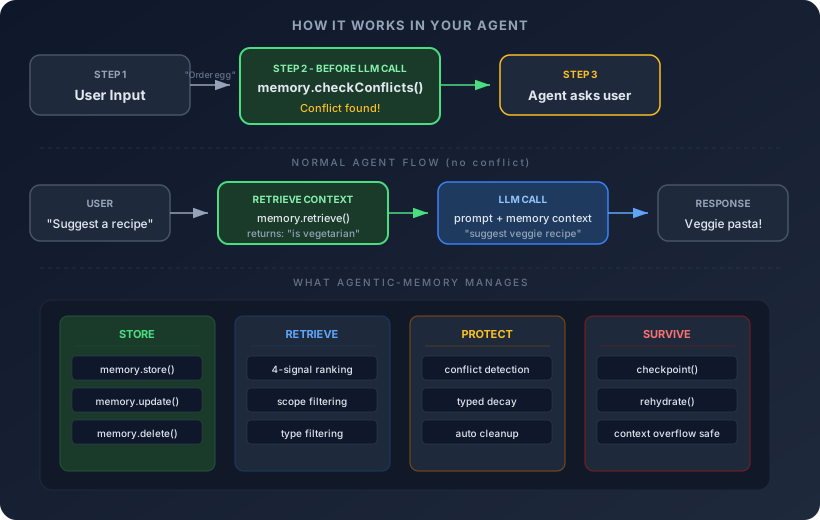
Every AI agent framework gives you tools, chains, and orchestration. None of them solve memory properly.
Without agentic-memory:

  Session 1: "I'm vegetarian"      -->  stored somewhere
  Session 5: "Find me a recipe"    -->  agent suggests steak
  40-min workflow                   -->  context fills up, loses all progress
  Multi-agent system                -->  agents duplicate each other's work
With agentic-memory:

  Session 1: "I'm vegetarian"      -->  stored as hard constraint (never decays)
  Session 5: "Find me steak"       -->  conflict detected, agent asks to confirm
  40-min workflow                   -->  checkpoint saves state, resumes after overflow
  Multi-agent system                -->  scoped memory, no cross-contamination
Where it fits
Install
# JavaScript / TypeScript
npm install agentic-memory

# Python
pip install agentic-memory
End-to-end example: Build a memory-aware agent
This shows exactly how agentic-memory fits into a real agent loop - from storing user context, to retrieving it before LLM calls, to catching dangerous contradictions.
TypeScript
import { AgentMemory } from 'agentic-memory';

const memory = new AgentMemory();

// ── Session 1: User onboarding ──
// Store facts the agent learns about the user
await memory.store({
  content: 'User is vegetarian',
  type: 'preference',
  scope: 'user:42',
  importance: 'hard',       // hard = never forgets (like allergies)
});

await memory.store({
  content: 'User prefers quick 30-minute recipes',
  type: 'preference',
  scope: 'user:42',
  importance: 'soft',       // soft = fades over time if not reinforced
});

// ── Session 2: User asks for help ──
// STEP 1: Retrieve relevant memories BEFORE calling the LLM
const context = await memory.retrieve({
  query: 'recipe suggestions',
  scope: 'user:42',
  signals: ['similarity', 'recency', 'importance'],
  limit: 5,
});
// context[0].entry.content = "User is vegetarian"
// context[1].entry.content = "User prefers quick 30-minute recipes"

// STEP 2: Inject memories into your LLM prompt
const prompt = `
  User context: ${context.map(r => r.entry.content).join('. ')}
  User message: Suggest a recipe for dinner tonight.
`;
// LLM now knows: vegetarian + quick recipes
// Response: "Here's a 25-minute mushroom risotto..."

// ── Session 5: Catch contradictions ──
// User (or another agent) tries something that conflicts
const conflicts = await memory.checkConflicts(
  'Order a steak dinner for the user',
  'user:42',
);

if (conflicts.length > 0) {
  console.log(conflicts[0].action);   // 'clarify'
  console.log(conflicts[0].reason);
  // "Conflicts with a hard constraint: 'User is vegetarian'.
  //  This memory was marked as non-negotiable - please confirm the change."

  // Agent should ASK the user, not silently override
}

// ── Long workflow: Survive context overflow ──
const cp = await memory.checkpoint({
  taskGraph: [
    { id: 't1', description: 'Scraped 500 recipes', status: 'done', dependencies: [], result: recipes },
    { id: 't2', description: 'Filtering by diet', status: 'in_progress', dependencies: ['t1'] },
    { id: 't3', description: 'Rank by prep time', status: 'pending', dependencies: ['t2'] },
  ],
  summary: 'Scraped 500 recipes, filtering for vegetarian, 200 remaining',
  toolOutputs: { scraped: recipes },
  activeMemoryIds: context.map(r => r.entry.id),
});

// ... context window fills up and resets ...

// Resume exactly where you left off
const restored = await memory.rehydrate(cp.id);
// restored.checkpoint.taskGraph[1].status = 'in_progress'
// restored.memories = [vegetarian preference, quick recipe preference]
Python
import asyncio
from agentic_memory import AgentMemory, MemoryType, ImportanceLevel, RetrievalQuery

async def main():
    memory = AgentMemory()

    # Session 1: Store user preferences
    await memory.store(
        content="User is vegetarian",
        type=MemoryType.PREFERENCE,
        scope="user:42",
        importance=ImportanceLevel.HARD,
    )

    # Session 2: Retrieve context before LLM call
    context = await memory.retrieve(RetrievalQuery(
        query="recipe suggestions",
        scope="user:42",
        signals=["similarity", "recency", "importance"],
        limit=5,
    ))

    # Inject into prompt
    memory_context = ". ".join(r.entry.content for r in context)
    prompt = f"User context: {memory_context}\nSuggest a recipe."

    # Catch contradictions
    conflicts = await memory.check_conflicts(
        "Order a steak dinner for the user", "user:42"
    )
    if conflicts:
        print(f"Action: {conflicts[0].action.value}")  # 'clarify'
        print(f"Reason: {conflicts[0].reason}")

asyncio.run(main())
No config, no database, no API keys. Just import and go.
What it solves
1. Smarter retrieval (not just similarity search)
RAG gives you "topically related" results. Agents need more than that.
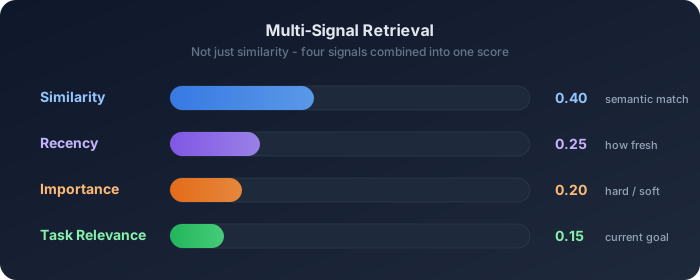
const results = await memory.retrieve({
  query: 'programming preferences',
  taskContext: 'Building a REST API',   // boosts API-related memories
  signals: ['similarity', 'recency', 'importance', 'taskRelevance'],
  limit: 5,
});
2. Conflict detection (catch contradictions before they ship)
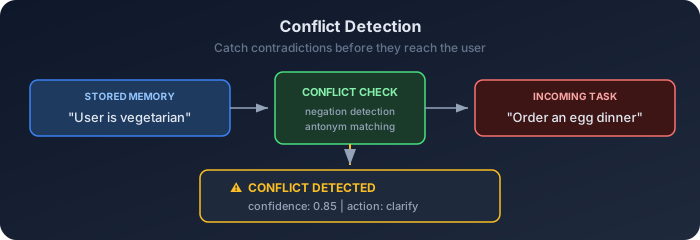
const conflicts = await memory.checkConflicts('Order a steak dinner', 'user:123');
// Returns:
// {
//   confidence: 0.85,
//   action: 'clarify',
//   reason: 'Conflicts with hard constraint: "User is vegetarian"'
// }
Uses negation detection, antonym matching, and change-language detection - not just keyword overlap.
3. Typed decay (a peanut allergy != a favorite color)
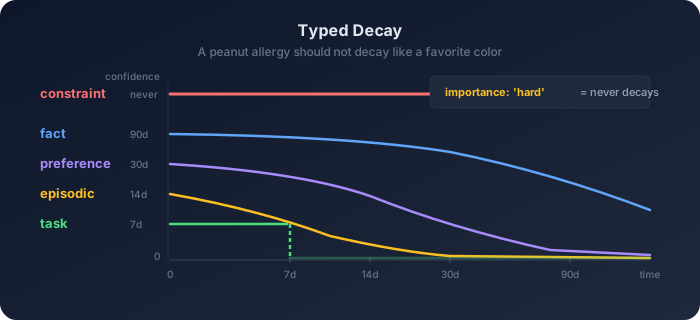
// This will still be there in 5 years
await memory.store({
  content: 'User has peanut allergy',
  type: 'constraint',
  importance: 'hard',
});

// This expires after 7 days
await memory.store({
  content: 'Currently debugging auth module',
  type: 'task',
  importance: 'ephemeral',
});

// Periodic cleanup
const deletedCount = await memory.cleanup('user:123');
4. Checkpointing (survive context overflow)
A 40-minute agent workflow shouldn't lose everything when context fills up.
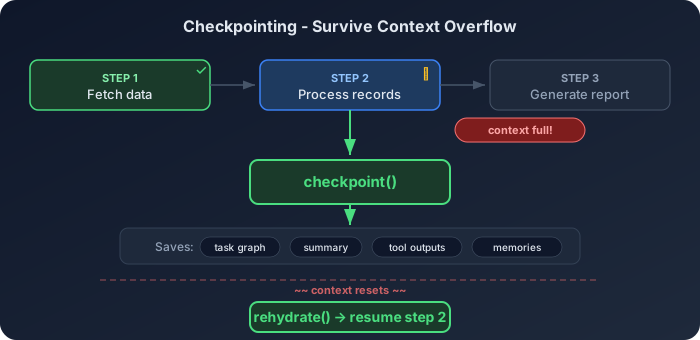
// Save state before overflow
const cp = await memory.checkpoint({
  taskGraph: [
    { id: 's1', description: 'Fetch data', status: 'done', result: data, dependencies: [] },
    { id: 's2', description: 'Process', status: 'in_progress', dependencies: ['s1'] },
    { id: 's3', description: 'Report', status: 'pending', dependencies: ['s2'] },
  ],
  summary: 'Fetched 1000 records, processing row 450/1000',
  toolOutputs: { api_response: apiData },
  activeMemoryIds: ['mem_abc', 'mem_def'],
});

// After context reset - pick up where you left off
const { checkpoint, memories } = await memory.rehydrate(cp.id);
5. Scope isolation (multi-agent without the chaos)
// Each agent gets its own namespace
await memory.store({ content: 'Plan: 3 steps', scope: 'agent:planner' });
await memory.store({ content: 'API returned 200', scope: 'agent:executor' });

// No cross-contamination
const plannerOnly = await memory.getAll('agent:planner');

// User memories are separate too
await memory.store({ content: 'Prefers Python', scope: 'user:alice' });
await memory.store({ content: 'Prefers Rust', scope: 'user:bob' });
Embedder adapters (production-ready)
The built-in embedder (TF-IDF) works for dev/testing. For production, use the included adapters:
TypeScript
import { AgentMemory } from 'agentic-memory';
import { OpenAIEmbedder } from 'agentic-memory/adapters/openai';
import { VoyageEmbedder } from 'agentic-memory/adapters/voyageai';

// OpenAI (most popular)
const memory = new AgentMemory({
  embedder: new OpenAIEmbedder({
    apiKey: process.env.OPENAI_API_KEY!,
    model: 'text-embedding-3-small',  // default
    dimensions: 512,                   // smaller = faster + cheaper
  }),
});

// Voyage AI (higher quality, cheaper)
const memory2 = new AgentMemory({
  embedder: new VoyageEmbedder({
    apiKey: process.env.VOYAGE_API_KEY!,
    model: 'voyage-3-lite',
  }),
});
Python
from agentic_memory import AgentMemory
from agentic_memory.adapters import OpenAIEmbedder, VoyageEmbedder

# OpenAI
memory = AgentMemory(
    embedder=OpenAIEmbedder(api_key="sk-...", dim=512)
)

# Voyage AI
memory = AgentMemory(
    embedder=VoyageEmbedder(api_key="voyage-...")
)
Or bring your own - just implement embed(), embed_batch(), and dimensions().
Storage backends
import { AgentMemory, FileStore } from 'agentic-memory';

// Default: in-memory (dev/testing)
const memory = new AgentMemory();

// File-based (persists across restarts)
const memory = new AgentMemory({
  store: new FileStore('./agent-memory.json'),
});

// Custom backend (Redis, Postgres, etc.)
const memory = new AgentMemory({ store: myCustomBackend });
Implement the StorageBackend interface for any database:
| Method | Signature |
|---|---|
get |
(id: string) => Promise<MemoryEntry | null> |
getAll |
(scope?: string) => Promise<MemoryEntry[]> |
set |
(entry: MemoryEntry) => Promise<void> |
delete |
(id: string) => Promise<boolean> |
clear |
(scope?: string) => Promise<void> |
search |
(query: RetrievalQuery) => Promise<MemoryEntry[]> |
API at a glance
const memory = new AgentMemory(config?)

// CRUD
await memory.store({ content, type?, scope?, importance?, confidence?, metadata? })
await memory.get(id)
await memory.update(id, { content?, type?, importance?, confidence?, metadata? })
await memory.delete(id)
await memory.getAll(scope?)
await memory.clear(scope?)

// Intelligence
await memory.retrieve({ query, taskContext?, scope?, types?, signals?, limit?, threshold? })
await memory.checkConflicts(content, scope?)
memory.getDecayedConfidence(entry)
await memory.cleanup(scope?, threshold?)

// Checkpointing
await memory.checkpoint({ taskGraph, summary, toolOutputs?, activeMemoryIds? })
await memory.rehydrate(checkpointId)
memory.getLatestCheckpoint()
memory.listCheckpoints()
Runnable examples
# No API key needed - shows checkpoint/rehydrate flow
npx tsx examples/checkpoint-recovery.ts

# Full demo with OpenAI embeddings + LLM
export OPENAI_API_KEY=sk-...
npx tsx examples/with-openai.ts

# Full demo with Claude + OpenAI embeddings
export OPENAI_API_KEY=sk-...
export ANTHROPIC_API_KEY=sk-ant-...
npx tsx examples/with-anthropic.ts

# Python
export OPENAI_API_KEY=sk-...
cd python && python examples/with_openai.py
Roadmap
- v0.1 - Core memory, multi-signal retrieval, conflict detection, typed decay, checkpointing
- v0.1 - Python port with full test parity
- v0.2 - Redis and Postgres storage backends
- v0.3 - Multi-agent coordination (SharedMemory, TaskRegistry, Plan Store)
- v0.4 - Audit/attribution layer, GDPR cascade delete
- v1.0 - Framework adapters (LangChain, Vercel AI SDK, Claude Agent SDK)
Contributing
PRs welcome. Run tests before submitting:
# TypeScript
npm test            # 72 tests

# Python
cd python
pip install -e ".[dev]"
pytest tests/ -v    # 62 tests
License
MIT
Release history Release notifications | RSS feed


Download files
Download the file for your platform. If you're not sure which to choose, learn more about installing packages.
Source Distribution
Built Distribution
Filter files by name, interpreter, ABI, and platform.
If you're not sure about the file name format, learn more about wheel file names.
Copy a direct link to the current filters
File details
Details for the file agentic_memory_ai-0.1.0.tar.gz.
File metadata
- Download URL: agentic_memory_ai-0.1.0.tar.gz
- Upload date:
- Size: 21.1 kB
- Tags: Source
- Uploaded using Trusted Publishing? No
- Uploaded via: twine/6.2.0 CPython/3.12.3
File hashes
| Algorithm | Hash digest | |
|---|---|---|
| SHA256 |
405ce5c6ff691ee9a7b5976cfbe13b92b8d3f62f220195a1235db36efcb364f1
|
|
| MD5 |
951661c1073f5ab419d6312b007ecf21
|
|
| BLAKE2b-256 |
8ecdd41ea8865fdcc69b38737e1feadd6483a2d35586f55e2ffcbf3de83161e2
|
File details
Details for the file agentic_memory_ai-0.1.0-py3-none-any.whl.
File metadata
- Download URL: agentic_memory_ai-0.1.0-py3-none-any.whl
- Upload date:
- Size: 21.1 kB
- Tags: Python 3
- Uploaded using Trusted Publishing? No
- Uploaded via: twine/6.2.0 CPython/3.12.3
File hashes
| Algorithm | Hash digest | |
|---|---|---|
| SHA256 |
8585788cffb89b693749f2aff8c2f982ba8b8b67ff353fc5fde9ada62ffd6f14
|
|
| MD5 |
c2168a2a309c809eb5c8f7e1ced08ed3
|
|
| BLAKE2b-256 |
cf0b3f5151216a3de1c3ee5f1705fd46e9391a0938f2964bda867281f6b2a867
|






