
Measure-first testing for non-deterministic LLM agents
Verified details
These details have been verified by PyPIProject links
GitHub Statistics
Maintainers

Project description
agentverity
Does your agent test suite actually test anything, or is it lying to you?






agentverity is a measure-first testing framework for non-deterministic LLM agents. Before running any test relation, it answers two questions that ordinary pass-rate reports leave unresolved:
- Is the agent's verdict stable enough to test against? (verdict-stochasticity meter)
- Is the test suite trivially satisfied by an indifferent agent? (constant-gate-blindness detector)
The meter recommends an oracle. The skew scan warns when green relation results may be vacuous. Neither substitutes for a correctness specification.
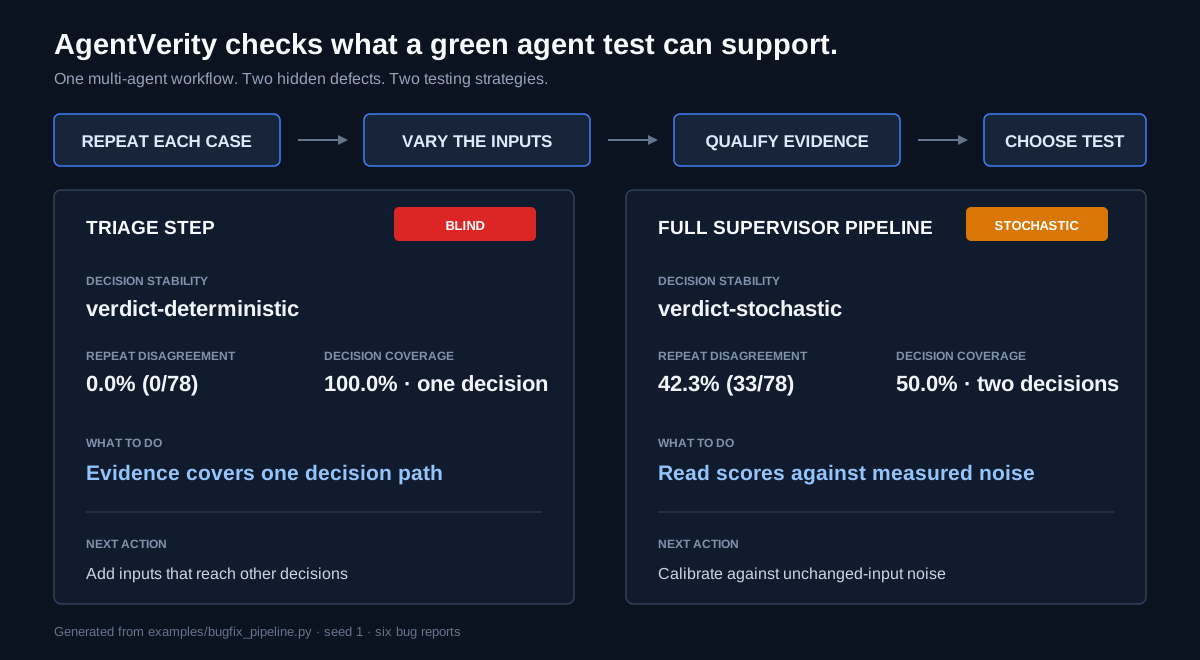
Generated from the executable
bugfix_pipeline.py
example. The image is
regenerated from its current results, not maintained by hand.
Why does this exist?
Testing LLM agents is hard because they are non-deterministic: the same input can produce different outputs on different runs. Existing frameworks handle this by running the agent N times and reporting pass rates with confidence intervals. That is necessary but not sufficient. It misses two failure modes:
Failure mode 1: the verdict is stable but you are using noise-tolerant tests. If the agent's categorical decision (allow/block, safe/unsafe, tool A/tool B) never flips across reruns and a trusted reference is available, frozen-baseline diffing is the more sensitive change detector. Metamorphic violations are a subset of the verdict changes that diffing can expose. Relations still express useful requirements when no reference exists.
Failure mode 2: the agent is near-constant and your suite may pass vacuously. If the agent returns the same verdict on 96% of a diverse input set, many relations can hold without exercising a decision boundary. That pass says little about whether the agent reasons correctly.
agentverity detects both failure modes before running any test relation, and tells you which oracle to use.
How is this different from existing tools?
| DeepEval | promptfoo | CheckList | AgentAssay | agentrial | agentverity | |
|---|---|---|---|---|---|---|
| Repeated trials | Yes | Yes | No | Yes | Yes | Yes |
| Uncertainty or calibration | Repeat scores | Repeat scores | No | Trial calibration | Wilson pass-rate CIs | Wilson CI over disjoint verdict pairs |
| Verdict-layer oracle choice | No | No | No | No | No | Yes |
| Probe-set skew warning | No | No | No | No | No | Yes |
| Metamorphic relations | No | No | INV/DIR (owns it) | Yes | No | Yes (inherited) |
| License | Apache-2.0 | MIT | MIT | AGPL | MIT | Apache-2.0 |
What we borrowed (and from where):
- Metamorphic relations from Chen et al. (1998) and the CheckList/LLMORPH tradition — the escape from the oracle problem for non-deterministic systems.
- Semantic-invariance transforms (normalisation, casing, whitespace) from CheckList.
- Wilson confidence intervals from AgentAssay and agentrial — but we use them for a different purpose: certifying verdict stability across reruns, not pass-rate CIs.
The narrow gap agentverity fills:
-
Verdict-layer oracle selection. Existing tools can repeat cases, estimate pass rates, and mutate suites. agentverity asks a different question first: is the categorical decision stable enough that a frozen baseline is stronger than a metamorphic relation? The answer is tri-state rather than guessed from a few identical runs.
-
Constant-gate-blindness detector. A gate that returns
"allow"on 96% of a probe set can satisfy many invariance relations without exercising a boundary. agentverity measures that skew and flags the green report as potentially vacuous. -
Evidence-gated snapshots. AgentVerity refuses to freeze a reference unless the exact observation layer is deterministic at the configured epsilon, every call completed, the probes cross a decision boundary, and a human explicitly approves the outputs. Stability is necessary, but it does not make an answer correct.
-
Diagnostics before relations. The primary output is not another pass rate. It is an oracle recommendation and a warning about whether the probe set can make the agent change its mind. Relation results come afterwards.
Metamorphic relations are the vehicle. The diagnostics are the product.
Quickstart
Install
pip install agentverity
For Strands agent support:
pip install "agentverity[strands]"
The core has zero runtime dependencies and supports Python 3.10 to 3.14.
Use in Python
from agentverity import run, from_callable

def my_gate(text: str) -> dict:
    verdict = "block" if "secret" in text.lower() else "allow"
    return {"text": f"decision: {verdict}", "verdict": verdict}

agent = from_callable(my_gate)
result = run(agent, inputs=["hello", "a secret", "world", "foo"])
print(result.summary())
Output (captured from an actual run, not hand-written):
============================================================
agentverity — suite-quality report
============================================================

  TRUSTWORTHY - the verdict held across every identical
  rerun and the probes cross a decision boundary. 2
  relations tested nothing and are marked n/a.

1. VERDICT-STOCHASTICITY METER
   call:        verdict-deterministic
   flip rate:   0.0% (0/76 pairs)
   Wilson CI:   [0.000, 0.048] at epsilon=0.05
   inputs:      4, repeats: 38, layer: verdict
   advice:      verdict is stable: prefer frozen-baseline diffing when a trusted reference is available.

2. CONSTANT-GATE-BLINDNESS DETECTOR
   call:        ok
   skew:        75.0% ('allow' on 4 inputs)
   distinct:    2 verdicts

3. ORACLE GUIDANCE
   STABLE — prefer frozen-baseline diffing when a reference is available.

4. RELATION RESULTS
   relation                     type         held violated skipped errors    rate
   ---------------------------- ----------- ----- -------- ------- ------ -------
   normalisation-invariance     invariant       0        0       4      0     n/a
   case-invariance              invariant       4        0       0      0    0.0%
   whitespace-invariance        invariant       4        0       0      0    0.0%
   tool-selection-invariance    invariant       0        0       4      0     n/a

   NOT EXERCISED: normalisation-invariance, tool-selection-invariance.
   The transform returned every input unchanged, so the agent was never
   asked a different question. Rows marked n/a are not evidence of
   anything. Add inputs the transform actually changes.
Three things in that report are the whole point of the library.
The first line is the answer. You should not have to assemble a verdict out of four numbered sections to learn whether your suite means anything.
The repeat count was chosen for you. Certifying a flip rate takes more repeats than most people guess, so k is sized from the precision you asked for: 38 repeats here, 76 disjoint pairs, enough to clear a 5% threshold. Set budget= to cap the spend, precision="cheap" or "strict" to move the threshold, or k= to take the wheel.
Two relations report n/a rather than a green 0.0%. Their transform normalises accents and whitespace, and these four inputs are plain ASCII with ordinary spacing, so the follow-up string was byte-identical to the source every time. The agent was never asked a different question. Counting that as a pass would be exactly the vacuous green result the library exists to catch, so it is reported as skipped instead.
For a complete supervisor-pattern example with both failure modes planted,
run examples/bugfix_pipeline.py.
CLI
agentverity run --agent mymod:build_agent --inputs seeds.txt
The --agent argument is a Python dotted path module:func to a callable that returns an agent function. The --inputs argument is a text file with one input per line.
Use diagnostics without relations, write a versioned JSON report, and process distinct inputs concurrently:
agentverity run \
  --agent mymod:build_agent \
  --inputs seeds.txt \
  --no-relations \
  --format json \
  --output report.json \
  --max-workers 8 \
  --progress
Concurrency is opt-in. AgentVerity parallelises distinct inputs only and keeps
repeated calls for one input sequential. Leave --max-workers 1 for stateful
or non-thread-safe agents. --error-policy record retains failures as
incomplete evidence instead of turning them into verdicts.
Exit codes are 0 for clean, 1 for blind, violated, or changed behaviour,
and 2 for incomplete or unsupported evidence.
Evidence-gated snapshots
Create a baseline only after reviewing the current outputs:
agentverity snapshot \
  --agent mymod:build_agent \
  --inputs seeds.txt \
  --output baseline.json \
  --accept-reference
AgentVerity refuses this command when the meter is stochastic or undecided, the probe set is blind, any call failed, or approval is absent. The snapshot stores SHA-256 input fingerprints rather than raw prompts.
What certification costs
Defaults size the repeats for you, so this normally just works. The numbers matter when you are picking a precision or capping a budget. Certifying determinism means driving the Wilson upper bound below epsilon, which takes more repeats than most people guess. Even with zero observed flips:
| precision | epsilon | pairs needed | 20 inputs | agent calls |
|---|---|---|---|---|
strict |
0.01 | 381 | k=40 | 800 |
| 0.02 | 189 | k=20 | 400 | |
balanced (default) |
0.05 | 73 | k=8 | 160 |
cheap |
0.10 | 35 | k=4 | 80 |
Each input contributes floor(k / 2) pairs, so pairs come from inputs and
repeats together and you can trade one against the other. On a paid model the
gap between cheap and strict is 80 calls against 800, which is why the
default is balanced rather than the tightest available. Cap the spend with
--budget, and a run that still cannot decide says exactly how far short it
fell.
pairs_for_deterministic_call(epsilon) returns these numbers if you want to
budget in code. Pass flip_rate= to account for flips already seen, and note
it returns None when the observed rate has already met epsilon, because more
pairs cannot rescue that case.
agentverity snapshot refuses an impossible configuration before running the
agent, so a probe set that mathematically cannot reach the bound costs nothing.
Check the same approved cases later:
agentverity check \
  --agent mymod:build_agent \
  --inputs seeds.txt \
  --snapshot baseline.json
The check first re-runs the admission diagnostics. It compares outputs only if the current evidence still supports snapshot testing.
Strands adapter
from strands import Agent
from agentverity.adapters.strands import from_strands
from agentverity import run

strands_agent = Agent(model="...", system_prompt="you are a gate")
agent = from_strands(strands_agent)
result = run(agent, inputs=["should I share this?", "is this safe?"])
print(result.summary())
The Strands adapter extracts the final response text, structured-output verdict (if any), and the ordered tool-call sequence from the agent's message content blocks. The adapter is an optional import — the core installs without strands-agents.
Custom relations
from agentverity import run, from_callable, Relation

my_relation = Relation(
    name="escalation-monotone",
    rtype="monotone",
    transform=lambda s: s + " URGENT",
    check=lambda src, fol: (
        {"allow": 0, "review": 1, "block": 2}[src.verdict]
        <= {"allow": 0, "review": 1, "block": 2}[fol.verdict]
    ),
)

result = run(agent, inputs=my_inputs, relations=[my_relation])
Relations are typed INVARIANT, MONOTONE, or DIRECTIONAL because equality checks are often more noise-sensitive than ordered or one-sided checks. The type is reported so you can interpret violations against the meter rather than treating every relation as equally reliable.
API surface
from agentverity import (
    run,                # main entry: run(agent, inputs, relations=..., config=...) -> RunResult
    from_callable,      # adapter: wrap fn(input)->str|dict|Observation
    measure,            # meter only: measure(agent, inputs, k=5, ...) -> MeterResult
    detect,             # blindness only: detect(agent, inputs, threshold=0.9) -> BlindnessResult
    Observation,        # dataclass: text, verdict, tools, raw
    Relation,           # dataclass: name, rtype, transform, check
    builtin_relations, # normalisation, case, whitespace, tool-selection
    RunConfig,          # diagnostics, bounded concurrency, and error policy
    create_snapshot,    # admit a reviewed baseline only when evidence supports it
    compare_snapshot,   # re-admit current evidence, then compare
    run_result_to_dict, # versioned JSON report without raw input text
    pairs_for_deterministic_call,  # budget the snapshot gate before spending calls
    plan_repeats,       # the k a precision needs for a given probe set
)

from agentverity.adapters.strands import from_strands  # optional, needs strands-agents
RunResult
The return of run() carries the full diagnostic picture:
| Property | Type | Description |
|---|---|---|
result.meter |
MeterResult | None |
Verdict-stochasticity meter result |
result.blindness |
BlindnessResult | None |
Constant-gate-blindness result |
result.relation_results |
list[RelationResult] |
Per-relation held/violated/skipped counts |
result.complete |
bool |
False when any requested call or check failed |
result.errors |
tuple[RunError, ...] |
Structured failures retained under the record policy |
result.is_stochastic |
bool |
True if meter says verdict-stochastic |
result.is_blind |
bool |
True if blindness detector fires |
result.vacuous_relations |
list[RelationResult] |
Relations whose transform never changed any input |
result.suite_is_meaningful |
bool |
False when a blindness warning, or a catalogue that never changed an input, makes green relation results vacuous |
result.summary() |
str |
Human-readable report, diagnostics-first |
RelationResult
| Property | Description |
|---|---|
.total |
Number of inputs the relation was offered |
.held, .violated |
Outcomes over exercised pairs only |
.skipped |
Inputs where the transform returned the input unchanged |
.exercised |
held + violated, the pairs that genuinely tested something |
.violation_rate |
Violations over exercised pairs, or None if nothing ran |
.is_vacuous |
True when the transform was the identity on every input |
MeterResult
| Property | Description |
|---|---|
.flip_rate |
Observed flip rate over independent, disjoint repeat pairs |
.ci_low, .ci_high |
Wilson CI bounds |
.call |
"verdict-stochastic" / "verdict-deterministic" / "undecided" |
.advice |
Human-readable recommendation |
Architecture
flowchart TD
    Agent["Your agent<br/>(Strands · LangGraph · any callable)"]
    Adapter["adapter<br/>normalise to Observation"]
    Obs["Observation<br/>text · verdict · tools · raw"]

    Agent --> Adapter --> Obs

    subgraph Core["agentverity.core — runner.py orchestrates diagnostics before relations"]
        direction TB
        Meter["1 · meter.py<br/>verdict-stochasticity meter<br/><b>headline diagnostic</b>"]
        Blind["2 · blindness.py<br/>constant-gate-blindness detector<br/><b>headline diagnostic</b>"]
        Rel["3 · relations.py<br/>typed metamorphic relations<br/>the vehicle, not the innovation"]
        Meter --> Blind --> Rel
    end

    Obs --> Meter
    Rel --> Result["RunResult<br/>text or versioned JSON"]
    Result --> Gate{"evidence supports<br/>a snapshot?"}
    Gate -->|yes + human approval| Snapshot["approved snapshot"]
    Gate -->|no| Refuse["refuse to freeze"]

    style Meter fill:#e8f4fd,stroke:#0056b3,stroke-width:2px
    style Blind fill:#e8f4fd,stroke:#0056b3,stroke-width:2px
    style Rel fill:#f5f5f5,stroke:#888
cli.py exposes the same flow through run, snapshot, and check.
Three layers of Observation
Every agent call produces an Observation with four fields:
| Field | Description |
|---|---|
text |
The agent's final response string (always present) |
verdict |
An optional extracted categorical decision ("allow"/"block", "safe"/"unsafe") |
tools |
The ordered tool names the agent called (its trajectory) |
raw |
The underlying result object, for custom relations |
The meter and relations can assert on any layer: verdict (default), text, or tools. This lets you measure stochasticity at the layer that matters — the verdict level, not the token level.
Built-in relations
| Name | Type | What it checks |
|---|---|---|
normalisation-invariance |
invariant | Accent stripping and whitespace normalisation must not change the verdict |
case-invariance |
invariant | Inverting letter case must not change the verdict |
whitespace-invariance |
invariant | Leading newline and trailing spaces must not change the verdict |
tool-selection-invariance |
invariant | Normalising the request must not change which tool the agent calls |
The first three follow the CheckList/LLMORPH tradition and apply to any text-in/text-out system. The fourth is agent-native: it asserts over the tool trajectory, not the text, and is the relation that makes agentverity an agent framework rather than an NLP model framework.
A transform can be a no-op on your inputs. Normalisation strips accents and
collapses whitespace, so on plain ASCII with ordinary spacing it returns the
input unchanged. The two relations built on it then have no metamorphic pair to
test. agentverity counts those inputs as skipped, reports the rate as n/a,
and names the relation under NOT EXERCISED, rather than recording a pass the
agent never earned. Feed the probe set inputs the transform actually changes,
or write a relation whose transform bites on your domain.
How it works
1. Meter (headline #1)
The meter calls the agent k times on each unchanged input and compares consecutive outputs in disjoint pairs. A Wilson confidence interval on those independent pair outcomes determines a tri-state call. It deliberately avoids treating all combinations among the same repeated calls as independent evidence.
verdict-stochastic— the CI lower bound is above epsilon. The verdict varies. Use noise-robust relations and compare violations to a measured baseline, not zero.verdict-deterministic— the CI upper bound is below epsilon. The verdict is stable. Prefer frozen-baseline diffing when a trusted reference is available.undecided— the interval straddles epsilon. Not enough evidence. Raisekor input count.
The meter refuses to call an underpowered probe "deterministic" — a bare deterministic would conflate real stability with a too-small sample.
2. Blindness detector (headline #2)
The detector calls the agent once on each input and measures the verdict distribution. If a single verdict accounts for at least threshold (default 90%) of inputs, the gate is flagged as blind. This does not prove the agent is wrong. It warns that many relation passes may be vacuous because the probe set rarely exercises a decision boundary.
3. Relations (the vehicle)
Relations run source and follow-up inputs through the agent and check whether a structural law holds between the two outputs. When the meter calls the verdict stochastic, the report tells you to establish an unchanged-input noise baseline before treating a non-zero violation rate as a regression. Baseline estimation is not automated in this release.
An input whose transform returns it unchanged is skipped rather than tested. Re-asking the agent a byte-identical question measures rerun stability, which is the meter's job, and scoring it as a relation pass would inflate a green report.
4. Snapshot admission
A stable verdict is not necessarily a correct verdict. Snapshot creation therefore requires both statistical evidence and explicit reference approval. Checking is symmetric: current evidence must still be complete, deterministic-at-epsilon, and non-blind before output differences are treated as regressions.
Agent calls per run
Agent calls dominate the cost of a real run, so every phase reuses what the
meter already drew. With n inputs, k repeats, and r relations whose
transform actually changes the input:
n * (k + r)     with reuse (the default)
n * (k + 1 + 2r) without it
The meter's first draw per input serves as the blindness scan's sample and as
the source side of every relation. On the four-input Quickstart above that is
28 calls instead of 40. Set RunConfig(reuse_unchanged_calls=False) to give
each phase an independent draw.
Set max_workers to overlap work across distinct inputs. AgentVerity never
overlaps repeated calls for the same input, preserving the order of each
meter series and avoiding concurrent re-entry on one probe.
Data handling
Machine reports and snapshots identify prompts by SHA-256 fingerprint rather
than storing their raw text. This avoids plaintext retention but does not
hide low-entropy prompts from dictionary guessing. Snapshot outputs are
retained because they are the approved reference, and exception messages are
retained to diagnose failed providers. Treat both files as potentially
sensitive when the observation layer is text or provider errors echo
request data.
Tests
124 tests, all passing.
pip install -e ".[dev]"
python -m pytest tests/ -v
ruff check .
Coverage includes observation construction, Wilson intervals, independent-pair meter detection, blindness, relation execution, bounded concurrency, partial failures, versioned reports, snapshot admission and drift, both adapters, the CLI, and README image generation.
Status
Alpha. Public APIs may change before 1.0. The Strands adapter is verified. Pytest helpers, JUnit output, noise calibration, and a LangGraph adapter are planned.
License
Contributions are welcome through the branch-and-pull-request workflow in CONTRIBUTING.md.
Project details
Verified details
These details have been verified by PyPIProject links
GitHub Statistics
Maintainers
Release history Release notifications | RSS feed


Download files
Download the file for your platform. If you're not sure which to choose, learn more about installing packages.
Source Distribution
Built Distribution
Filter files by name, interpreter, ABI, and platform.
If you're not sure about the file name format, learn more about wheel file names.
Copy a direct link to the current filters
File details
Details for the file agentverity-0.5.0.tar.gz.
File metadata
- Download URL: agentverity-0.5.0.tar.gz
- Upload date:
- Size: 68.5 kB
- Tags: Source
- Uploaded using Trusted Publishing? Yes
- Uploaded via: twine/6.1.0 CPython/3.13.14
File hashes
| Algorithm | Hash digest | |
|---|---|---|
| SHA256 |
cf52968fbb0657236a9e3e45503765d631517ea731238079ede0d6443584fcd5
|
|
| MD5 |
5ed913fadb0c63d881ab1e577fe3e622
|
|
| BLAKE2b-256 |
7fc36dbd94a5f65c4b69a5a5d10f98d9585855c69a2125fc8f7eb95f8a736f03
|
Provenance
The following attestation bundles were made for agentverity-0.5.0.tar.gz:
Publisher:
release.yml on mrwersa/agentverity
-
Statement:
-
Statement type:
https://in-toto.io/Statement/v1 -
Predicate type:
https://docs.pypi.org/attestations/publish/v1 -
Subject name:
agentverity-0.5.0.tar.gz -
Subject digest:
cf52968fbb0657236a9e3e45503765d631517ea731238079ede0d6443584fcd5 - Sigstore transparency entry: 2250833182
- Sigstore integration time:
-
Permalink:
mrwersa/agentverity@6ad5603b00b26df4b43ce6988ab4ac5cc804ef2e -
Branch / Tag:
refs/tags/v0.5.0 - Owner: https://github.com/mrwersa
-
Access:
public
-
Token Issuer:
https://token.actions.githubusercontent.com -
Runner Environment:
github-hosted -
Publication workflow:
release.yml@6ad5603b00b26df4b43ce6988ab4ac5cc804ef2e -
Trigger Event:
release
-
Statement type:
File details
Details for the file agentverity-0.5.0-py3-none-any.whl.
File metadata
- Download URL: agentverity-0.5.0-py3-none-any.whl
- Upload date:
- Size: 48.2 kB
- Tags: Python 3
- Uploaded using Trusted Publishing? Yes
- Uploaded via: twine/6.1.0 CPython/3.13.14
File hashes
| Algorithm | Hash digest | |
|---|---|---|
| SHA256 |
a562e0bdff651a6dcaf07c3fd88ac8b2bfd3c54c4163d72a55b65742401b6792
|
|
| MD5 |
400aa20d589a43c831da8a2a29a5e22c
|
|
| BLAKE2b-256 |
5e9e6c2837eb1c69a13c727d702024e0eb2da1ddb1144fd05397b68d3015d5fb
|
Provenance
The following attestation bundles were made for agentverity-0.5.0-py3-none-any.whl:
Publisher:
release.yml on mrwersa/agentverity
-
Statement:
-
Statement type:
https://in-toto.io/Statement/v1 -
Predicate type:
https://docs.pypi.org/attestations/publish/v1 -
Subject name:
agentverity-0.5.0-py3-none-any.whl -
Subject digest:
a562e0bdff651a6dcaf07c3fd88ac8b2bfd3c54c4163d72a55b65742401b6792 - Sigstore transparency entry: 2250833449
- Sigstore integration time:
-
Permalink:
mrwersa/agentverity@6ad5603b00b26df4b43ce6988ab4ac5cc804ef2e -
Branch / Tag:
refs/tags/v0.5.0 - Owner: https://github.com/mrwersa
-
Access:
public
-
Token Issuer:
https://token.actions.githubusercontent.com -
Runner Environment:
github-hosted -
Publication workflow:
release.yml@6ad5603b00b26df4b43ce6988ab4ac5cc804ef2e -
Trigger Event:
release
-
Statement type:






