
Measure-first testing for non-deterministic LLM agents
Verified details
These details have been verified by PyPIProject links
GitHub Statistics
Maintainers

Project description
agentverity
Can you trust this green agent test?




AgentVerity is a pre-flight testing library for non-deterministic agents. It checks whether the verdict is stable across identical reruns and whether the probe set can move the decision at all. Then it tells you which test result is safe to trust.
It does not replace DeepEval, promptfoo, AgentCore Evaluations, or your quality metrics. It catches two conditions that can make their result misleading before you read the score.
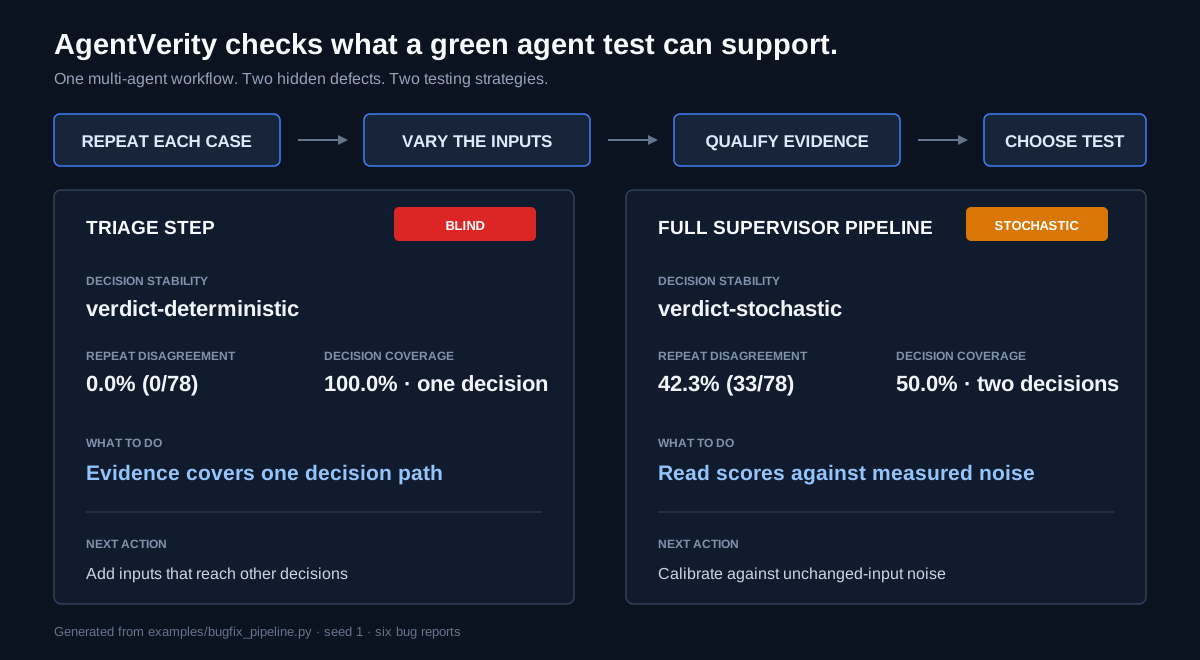
This report is regenerated from the executable
bugfix_pipeline.py
example and tested against
its current results.
Try it
pip install agentverity
from agentverity import from_callable, run

def route(ticket: str) -> dict:
    # Deliberate defect: the input is ignored.
    return {"text": "route: general", "verdict": "general"}

agent = from_callable(route)
result = run(agent, inputs=[
    "my card was charged twice",
    "the app crashes on login",
    "where is my refund",
    "the checkout button is the wrong colour",
])

print(result.headline)
NOT TRUSTWORTHY - the agent answered 'general' on 100% of the probes,
so a pass says more about the probe set than about the agent.
The default balanced precision sizes the repeat count automatically. A
default run answers rather than leaving a deterministic function as
undecided.
From a repository checkout, the same example is directly runnable:
python examples/support_router.py

agentverity run \
  --agent examples/support_router.py:build_agent \
  --inputs examples/support_tickets.txt
What it catches
| Condition | Why the green result is unsafe | AgentVerity's action |
|---|---|---|
| Blind probes | One verdict dominates, so relations can pass without crossing a decision boundary | Repair the probe set |
| Stochastic verdict | Identical reruns disagree, so zero-tolerance checks confuse noise with regressions | Use repeated rates against measured noise |
| Stable, varied verdict | The decision is suitable for a reviewed reference | Prefer an evidence-gated snapshot or targeted relations |
| Unexercised relation | The transform returned the original input, so no test happened | Report n/a, never a false pass |
The meter reports deterministic, stochastic, or undecided from a Wilson
interval over disjoint repeat pairs. The skew scan separately checks whether
varied inputs produce varied verdicts. Stability is not correctness, so
snapshots still require explicit human approval.
Where it fits
agent or workflow
       |
       v
AgentVerity pre-flight ----> quality evaluator
       |                    DeepEval / promptfoo / AgentCore Evaluations
       |
       +---- text for people
       +---- JSON for code
       +---- JUnit XML for CI
       +---- OTEL span for CloudWatch / Phoenix / LangSmith
AgentVerity is deliberately small at this boundary. The core has no runtime dependencies, no hosted account, and no dashboard to adopt.
CI reporting
Write a report that Jenkins, GitLab, Azure DevOps, and JUnit collectors already understand:
agentverity run \
  --agent examples/support_router.py:build_agent \
  --inputs examples/support_tickets.txt \
  --format junit \
  --output agentverity.xml
Exit codes and JUnit carry the same interpretation:
0: interpretable evidence and no relation violation1: blind or vacuous probes, a relation violation, or snapshot drift2: incomplete, undecided, or unsupported evidence
Monitoring
Use the host application's OpenTelemetry pipeline:
pip install "agentverity[otel]"
from agentverity import record_otel_run

result = run(agent, inputs=canary_probes)
record_otel_run(result)
The summary span contains low-cardinality agentverity.* attributes. It
excludes prompts, outputs, fingerprints, relation names, and exception
messages. OTLP can carry the span into Amazon Bedrock AgentCore Observability
and CloudWatch, Phoenix, LangSmith, or another collector.
Run this in CI, before deployment, or as a scheduled canary. AgentVerity is not an online evaluator and should not repeat every customer request.
Integration examples and the AgentCore validation plan
Evidence-gated snapshots
Create a baseline only after reviewing the outputs:
agentverity snapshot \
  --agent mymod:build_agent \
  --inputs seeds.txt \
  --output baseline.json \
  --accept-reference
AgentVerity refuses to freeze a reference if calls failed, the verdict remains
undecided or stochastic, the probes are blind, or approval is absent. It also
rejects a mathematically impossible k before spending model calls.
Check the same approved cases later:
agentverity check \
  --agent mymod:build_agent \
  --inputs seeds.txt \
  --snapshot baseline.json
Current evidence must pass the same admission checks before differences are reported as regressions. Snapshot files store SHA-256 input fingerprints rather than raw prompts.
Observation layers
Every call becomes one Observation:
from agentverity import Observation

Observation(
    text="Escalating this case",
    verdict="escalate",
    tools=("lookup_order", "create_case"),
)
Measure the layer the test protects:
verdictfor routing, policy, and categorical decisionstoolsfor the ordered tool trajectorytextwhen wording itself is the contract
Token variation does not have to become verdict instability, and a stable answer can still hide a changed tool path.
Configuration
Most runs need two knobs:
from agentverity import RunConfig

config = RunConfig(
    precision="balanced",  # cheap=10%, balanced=5%, strict=1%
    budget=None,           # optional cap on meter calls
    max_workers=4,         # distinct inputs only
    error_policy="record",
)
k= and epsilon= remain exact overrides. Repeated calls for one input stay
sequential, while distinct inputs can run concurrently. Recorded provider
failures mark evidence incomplete and never become passing verdicts.
Examples
support_router.py: the smallest blind-agent examplebugfix_pipeline.py: blind triage plus a stochastic supervisorstrands_example.py: optional Strands adapterotel_monitoring.py: one diagnostic span through OTEL
For Strands:
pip install "agentverity[strands]"
Plain LangGraph, remote APIs, and other frameworks can use from_callable by
returning an Observation from their invocation wrapper.
Scope
AgentVerity is:
- a pre-flight check for the evidence behind an agent test
- an evidence gate for reviewed snapshots
- a small CI and telemetry citizen
It is not:
- a correctness oracle or LLM judge
- a benchmark or leaderboard
- a trace store, dashboard, or production monitoring service
- a claim that metamorphic relations or Wilson intervals are new
The distinctive part is their ordering: measure verdict stability and probe coverage before interpreting the ordinary test result.
Documentation
- Integrations and AgentCore validation
- API guide
- Design decisions
- Security and data handling
- Contributing
- Release process
Development
pip install -e ".[dev]"
python -m pytest -q
ruff check .
CI covers Python 3.10 through 3.14, lint, package construction, and the generated README diagnostic.
Status and licence
Alpha. Public APIs may change before 1.0.
Apache-2.0. Contributions are welcome through the pull-request workflow.
Project details
Verified details
These details have been verified by PyPIProject links
GitHub Statistics
Maintainers
Release history Release notifications | RSS feed


Download files
Download the file for your platform. If you're not sure which to choose, learn more about installing packages.
Source Distribution
Built Distribution
Filter files by name, interpreter, ABI, and platform.
If you're not sure about the file name format, learn more about wheel file names.
Copy a direct link to the current filters
File details
Details for the file agentverity-0.6.0.tar.gz.
File metadata
- Download URL: agentverity-0.6.0.tar.gz
- Upload date:
- Size: 72.1 kB
- Tags: Source
- Uploaded using Trusted Publishing? Yes
- Uploaded via: twine/6.1.0 CPython/3.13.14
File hashes
| Algorithm | Hash digest | |
|---|---|---|
| SHA256 |
4207b51626d6389e3de536c82069f73de7347afd8fd80dcb2ad2aa34a95f938c
|
|
| MD5 |
9db38583813aee1bebd42c90b297c2f2
|
|
| BLAKE2b-256 |
5b2e44a34ea9ad5387c513782789af4884ef523b1c5e903c0df095ad503172d8
|
Provenance
The following attestation bundles were made for agentverity-0.6.0.tar.gz:
Publisher:
release.yml on mrwersa/agentverity
-
Statement:
-
Statement type:
https://in-toto.io/Statement/v1 -
Predicate type:
https://docs.pypi.org/attestations/publish/v1 -
Subject name:
agentverity-0.6.0.tar.gz -
Subject digest:
4207b51626d6389e3de536c82069f73de7347afd8fd80dcb2ad2aa34a95f938c - Sigstore transparency entry: 2251223343
- Sigstore integration time:
-
Permalink:
mrwersa/agentverity@4d5428623a84209695c24e8bc6437e65667d799d -
Branch / Tag:
refs/tags/v0.6.0 - Owner: https://github.com/mrwersa
-
Access:
public
-
Token Issuer:
https://token.actions.githubusercontent.com -
Runner Environment:
github-hosted -
Publication workflow:
release.yml@4d5428623a84209695c24e8bc6437e65667d799d -
Trigger Event:
release
-
Statement type:
File details
Details for the file agentverity-0.6.0-py3-none-any.whl.
File metadata
- Download URL: agentverity-0.6.0-py3-none-any.whl
- Upload date:
- Size: 46.0 kB
- Tags: Python 3
- Uploaded using Trusted Publishing? Yes
- Uploaded via: twine/6.1.0 CPython/3.13.14
File hashes
| Algorithm | Hash digest | |
|---|---|---|
| SHA256 |
96b9115452de16089c97023dbb033d2ff3286a0697192439f42757dc988cb3f4
|
|
| MD5 |
36e75ede76d9a9c412749e6c6fa6dad6
|
|
| BLAKE2b-256 |
34a86f5662fc9ae402be23f576d79b13a5a9bbb3a5d4aa253491dee9c33b79ec
|
Provenance
The following attestation bundles were made for agentverity-0.6.0-py3-none-any.whl:
Publisher:
release.yml on mrwersa/agentverity
-
Statement:
-
Statement type:
https://in-toto.io/Statement/v1 -
Predicate type:
https://docs.pypi.org/attestations/publish/v1 -
Subject name:
agentverity-0.6.0-py3-none-any.whl -
Subject digest:
96b9115452de16089c97023dbb033d2ff3286a0697192439f42757dc988cb3f4 - Sigstore transparency entry: 2251223746
- Sigstore integration time:
-
Permalink:
mrwersa/agentverity@4d5428623a84209695c24e8bc6437e65667d799d -
Branch / Tag:
refs/tags/v0.6.0 - Owner: https://github.com/mrwersa
-
Access:
public
-
Token Issuer:
https://token.actions.githubusercontent.com -
Runner Environment:
github-hosted -
Publication workflow:
release.yml@4d5428623a84209695c24e8bc6437e65667d799d -
Trigger Event:
release
-
Statement type:






