
agxai




Explainability for AI agents: what ran, why it was decided, and what each audience may see.
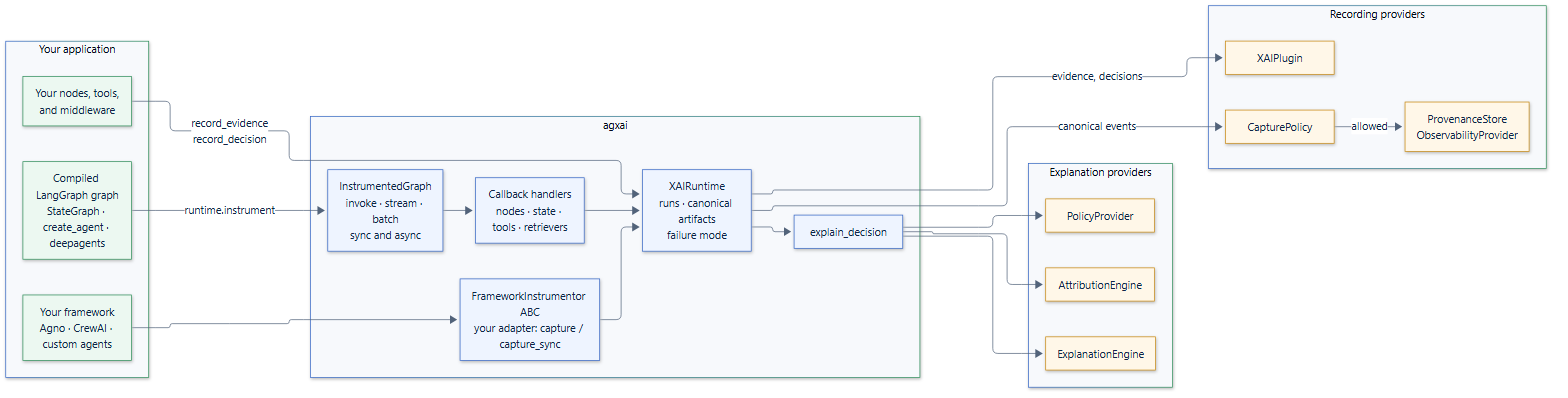
agxai provides a framework-agnostic runtime for structured, versioned
execution records and explanations. Its optional LangGraph/LangChain integration
captures nodes, state changes, tools, retrievers, and human-in-the-loop interrupts
automatically. Your code records the
evidence it relied on and the decisions it made. From those records it builds
explanations for developers, auditors, business owners, or end users, filtered
by a disclosure policy you control.
Features
- Optional LangGraph/LangChain instrumentation.
runtime.instrument(graph)recordsinvoke,stream,batch,astream_events, and the other Runnable entry points, sync and async, without changing inputs, outputs, or exceptions. It works withStateGraph, the functional API,create_agent,deepagents, subgraphs, and MCP tools. - Human-in-the-loop aware. Interrupts and resumes are recorded with the reviewer's answer. For a graph with a checkpointer, each run is linked to its checkpoints, and a resumed run points back to the run it continues, even across processes.
- Evidence, decisions, and provenance as data. Explanations are built from recorded facts, never from model reasoning.
- Audience-aware explanations. Attribution shows how much each factor and piece of evidence contributed. A per-audience policy decides what each reader sees, and withheld sections are announced.
- Safe by default. Credentials are redacted before anything is stored, explanations fail closed, LLM phrasing needs two explicit opt-ins, and instrumentation failures never break your graph unless you ask them to.
- Pluggable. Records are kept in memory by default. Subclass
ProvenanceStorefor your database; a complete PostgreSQL store is included as an example. Events can be forwarded to LangSmith, Langfuse, or any OpenTelemetry backend. - Extend to your framework. Subclass
FrameworkInstrumentorto wrap Agno, CrewAI, or your own agent loop usingcapture()/capture_sync()and the runtime's public recording methods. No built-in Agno or CrewAI adapter is claimed or required. See the custom-framework example and integration guide.
Install
pip install agxai
Requires Python 3.12+ and Pydantic 2.x. The core installs no agent framework.
For the LangGraph quickstart below, install the langgraph extra, which adds
LangGraph 1.x (1.2.20 or newer) and LangChain Core 1.x (1.7.6 or newer).
LangGraph and LangChain are distinct projects supported by the same integration.
Integrations are optional extras:
pip install "agxai[langgraph]"  # LangGraph graphs and LangChain Runnables
pip install "agxai[langsmith]"   # LangSmithObservability
pip install "agxai[langfuse]"    # LangfuseObservability
pip install "agxai[otel]"        # OpenTelemetryObservability
pip install "agxai[llm-openai]"  # LLM-phrased explanations with langchain-openai
LangGraph quickstart
import asyncio
from typing import TypedDict

from langgraph.graph import END, START, StateGraph

from agxai import Audience, DecisionType, EvidenceType, XAIRuntime

runtime = XAIRuntime(application_id="payments", tenant_id="acme-bank", graph_id="fraud-review")


class Review(TypedDict, total=False):
    amount: float
    risk_score: float
    route: str


async def score_risk(state: Review) -> Review:
    risk_score = 0.91 if state["amount"] > 5000 else 0.12
    await runtime.record_evidence(
        EvidenceType.TOOL_RESULT,
        summary=f"Fraud model scored the transaction {risk_score:.2f}.",
        confidence=0.97,
    )
    return {"risk_score": risk_score}


async def route(state: Review) -> Review:
    run = runtime.current_run  # the run of the instrumented call executing this node
    assert run is not None
    selected = "HUMAN_REVIEW" if state["risk_score"] >= 0.8 else "AUTO_APPROVE"
    await runtime.record_decision(
        selected,
        decision_type=DecisionType.ROUTING,
        candidate_actions=["AUTO_APPROVE", "HUMAN_REVIEW"],
        evidence_ids=[item.id for item in run.evidence],
        confidence=0.93,
    )
    return {"route": selected}


builder = StateGraph(Review)
builder.add_node("score_risk", score_risk)
builder.add_node("route", route)
builder.add_edge(START, "score_risk")
builder.add_edge("score_risk", "route")
builder.add_edge("route", END)
graph = runtime.instrument(builder.compile())


async def main() -> None:
    with runtime.collect_runs() as runs:
        result = await graph.ainvoke({"amount": 9200.0})
    (run,) = runs

    print(result)
    print([f"{node.node_id}: {node.status}" for node in run.execution.nodes])

    explanation = await runtime.explain_decision(
        run.decisions[0], audience=Audience.AUDITOR, run=run
    )
    print(explanation.summary)
    print(explanation.reasons)


asyncio.run(main())
Output:
{'amount': 9200.0, 'risk_score': 0.91, 'route': 'HUMAN_REVIEW'}
['score_risk: completed', 'route: completed']
The routing decision selected 'HUMAN_REVIEW'.
['Selected action: HUMAN_REVIEW.', 'Alternatives considered: AUTO_APPROVE.', 'Decision confidence: 0.93.']
The fraud review example goes further: it explains one decision to an auditor, with attribution and evidence, and to a customer, with internal scores withheld and the withholding disclosed.
How it relates to tracing
LangSmith, Langfuse, and OpenTelemetry show what ran: run trees, spans,
latency, tokens. agxai records why it was decided and who may
see the explanation. The two work together, and the bundled adapters send
agxai events to the tracing backend you already use.
Documentation
Full documentation: agxai.readthedocs.io
agxai 1.x follows semantic versioning: minor releases add features
without breaking your code or your stored records. Changes are listed in the
changelog.
An Agent Skill
teaches coding agents such as Claude Code, Codex, Cursor, and GitHub Copilot to
integrate agxai correctly.
Contributing
Contributions are welcome. See CONTRIBUTING.md for the development setup and checks, and SECURITY.md to report a vulnerability.
License
Apache License 2.0. See LICENSE.
1 maintainer

Metadata
1 maintainer
Release files for agxai 1.0.0
For a detailed explanation of source distributions (sdists) and built distributions (wheels), please see the package formats documentation.
Source distribution (sdist)
| File | Size | Uploaded | Provenance | Actions |
|---|---|---|---|---|
| agxai-1.0.0.tar.gz | 68.3 kB | Without provenance | Details for agxai-1.0.0.tar.gz |
Built distribution (wheel)
| File | Interpreter | ABI | Platform | Actions Reset |
|---|---|---|---|---|
| agxai-1.0.0-py3-none-any.whl | Python 3 | none | any | Details for agxai-1.0.0-py3-none-any.whl |
Total release size: 144.4 kB
Release files / agxai-1.0.0.tar.gz
| Download URL | agxai-1.0.0.tar.gz |
|---|---|
| Size | 68.3 kB |
| Tags | Source |
|
SHA-256 checksum How to use checksums |
61e3bb579eeb70a1b5e41c3d4ea70beb7601173f137705b8da374d1bbe011b47
|
|
BLAKE2b-256 checksum How to use checksums |
c301476a0f4e41f91624f7c44015e26b74caf8a68f742d7fb6747480d0dc03dd
|
| Upload date | |
|
Uploaded using Trusted Publishing? What is trusted publishing? |
No |
| Uploaded via |
uv/0.13.6 {"installer":{"name":"uv","version":"0.13.6","subcommand":["publish"]},"python":null,"implementation":{"name":null,"version":null},"distro":null,"system":{"name":null,"release":null},"cpu":null,"openssl_version":null,"setuptools_version":null,"rustc_version":null,"ci":null}
|
Release files / agxai-1.0.0-py3-none-any.whl
| Download URL | agxai-1.0.0-py3-none-any.whl |
|---|---|
| Size | 76.1 kB |
| Tags | Python 3 |
|
SHA-256 checksum How to use checksums |
b15dd97572df118cbd5b6a2517ba2a042634bc0aa8ded9f2b0bdd0ba41297ada
|
|
BLAKE2b-256 checksum How to use checksums |
d6a02049fdc7628e8934d77077ce3d43fbb8af60fd4f009d4f38ed9661296193
|
| Upload date | |
|
Uploaded using Trusted Publishing? What is trusted publishing? |
No |
| Uploaded via |
uv/0.13.6 {"installer":{"name":"uv","version":"0.13.6","subcommand":["publish"]},"python":null,"implementation":{"name":null,"version":null},"distro":null,"system":{"name":null,"release":null},"cpu":null,"openssl_version":null,"setuptools_version":null,"rustc_version":null,"ci":null}
|
Security for agxai 1.0.0
Provenance
Provenance describes where a file came from. On PyPI, provenance is shared via attestations, which provide a verifiable record of the build or publishing details. View details, limitations and caveats.
No provenance found
None of the files in this release were uploaded with provenance metadata.
A note on package security
PyPI is a repository for distributing packages, not a service for auditing them. While third-party security researchers and our staff do their best to detect and remove malicious packages, PyPI cannot guarantee the quality, security or suitability of any given package.
To learn more about protecting yourself from malicious actors, visit our package security documentation.














