

agxai


Recorded evidence, decisions, and audience-safe explanations for AI agents.
agxai records what your agent ran, the evidence it used and the decisions it made, then explains each decision to the reader asking: in full for an auditor, with internal scores withheld for a customer. It works with LangGraph and LangChain out of the box, and with any other framework through one ABC.
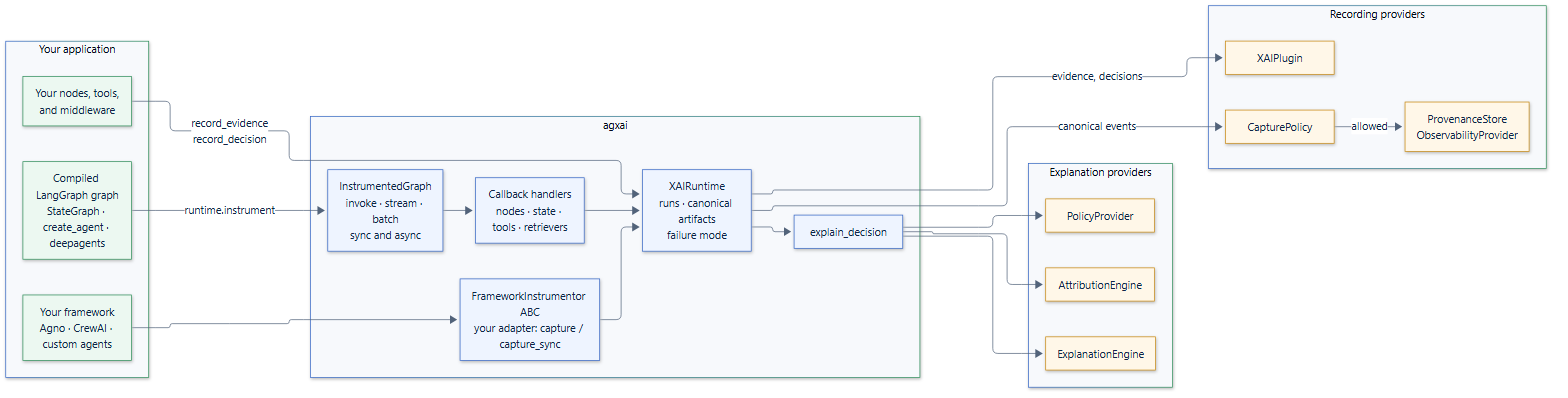
Why agxai
An agent routes a payment to human review. The customer asks why, and so does an auditor. Today the usual answers fall short:
- Traces show what ran, not why. LangSmith, Langfuse and OpenTelemetry record spans, latency and tokens. They don't record which evidence a decision rested on, or which alternatives were rejected.
- Asking the model to explain itself gives a story, not evidence. A rationale written after the fact can't be traced back to recorded facts.
- Different readers need different answers. An auditor needs the fraud score and its source; a customer must not see it. Redacting by hand in each endpoint is easy to get wrong.
- Explainability code ends up tied to one framework. Moving from LangGraph to another framework means rewriting it.
How agxai addresses each one:
| Problem | What agxai does |
|---|---|
| Traces don't say why | Records evidence, decisions, alternatives and provenance as typed, versioned data, next to the execution it captures automatically |
| Self-explanations aren't evidence | Builds explanations only from those records; it never records or invents a model's private reasoning |
| Audiences need different views | A disclosure policy decides what each audience sees, and withheld sections are announced, never silently dropped |
| Code tied to one framework | A framework-neutral core; LangGraph and LangChain are an optional extra, and other frameworks plug in through FrameworkInstrumentor |
agxai doesn't replace your tracing. Its events can be sent to LangSmith, Langfuse or any OpenTelemetry backend, joined to your traces by run and trace ID.
Highlights
- Drop-in LangGraph and LangChain capture.
runtime.instrument(graph)recordsinvoke,stream,batch,astream_eventsand the other Runnable entry points, sync and async, with inputs, outputs and exceptions unchanged. It works withStateGraph, the functional API,create_agent,deepagents, subgraphs and MCP tools. - Human-in-the-loop aware. Interrupts and resumes are recorded with the reviewer's answer, and a resumed run is linked to the checkpoint and run it continues, even across processes.
- Explanations from records. Attribution shows how much each factor and piece of evidence contributed; every statement traces back to a record.
- Per-audience disclosure. Developers, auditors, business owners and end users each get what their policy allows.
- Safe by default. Credentials are redacted before anything is stored, explanations fail closed, LLM phrasing needs two explicit opt-ins, and instrumentation failures never break your graph unless you ask them to.
- Extensible through ABCs. Subclass
FrameworkInstrumentorfor Agno, CrewAI or your own loop, andProvenanceStorefor your database. A complete PostgreSQL store is included as an example. - Small and typed. The core depends only on Pydantic, ships type hints, and is tested on Python 3.12 to 3.15 with 100% statement and branch coverage.
Installation
pip install "agxai[langgraph]"   # with LangGraph and LangChain
pip install agxai                # core only, for any other framework
Optional extras:
| Extra | Adds |
|---|---|
langgraph |
LangGraph 1.x and LangChain Core 1.x instrumentation |
langsmith |
LangSmithObservability |
langfuse |
LangfuseObservability |
otel |
OpenTelemetryObservability |
llm-openai |
LLM-phrased explanations with langchain-openai |
all |
Every extra above |
Quickstart
A payment-review node records the fraud score as evidence and routes the payment to human review. The same decision is then explained to an auditor and to the customer, whose policy withholds the score:
import asyncio
from typing import TypedDict

from langgraph.graph import START, StateGraph

from agxai import (
    Audience,
    DecisionFactor,
    DecisionType,
    EvidenceType,
    PolicyDecision,
    PolicyProvider,
    XAIRuntime,
)


class HideScoresFromCustomers(PolicyProvider):
    async def evaluate(self, context, action):
        hidden = {"contributing_factors", "supporting_evidence"}
        return PolicyDecision(
            context=context.execution.context,
            policy_id="hide-scores",
            action=action,
            allowed=True,
            audience=context.audience,
            denied_fields=hidden if context.audience == Audience.END_USER else set(),
        )


runtime = XAIRuntime(application_id="payments")
runtime.register(PolicyProvider, HideScoresFromCustomers())


class Payment(TypedDict, total=False):
    amount: float
    route: str


async def review(state: Payment) -> Payment:
    score = await runtime.record_evidence(
        EvidenceType.TOOL_RESULT, summary="Fraud model scored 0.91."
    )
    await runtime.record_decision(
        "HUMAN_REVIEW",
        decision_type=DecisionType.ROUTING,
        candidate_actions=["AUTO_APPROVE", "HUMAN_REVIEW"],
        factors=[DecisionFactor(name="fraud_score", value=0.91, evidence_ids=[score.id])],
        evidence_ids=[score.id],
    )
    return {"route": "HUMAN_REVIEW"}


graph = runtime.instrument(StateGraph(Payment).add_node(review).add_edge(START, "review").compile())


async def main() -> None:
    with runtime.collect_runs() as runs:
        await graph.ainvoke({"amount": 9200.0})
    (run,) = runs
    for audience in (Audience.AUDITOR, Audience.END_USER):
        explanation = await runtime.explain_decision(run.decisions[0], audience=audience, run=run)
        print(f"[{audience}]", *explanation.reasons, *explanation.disclosure, sep="\n  ")


asyncio.run(main())
Output:
[auditor]
  Selected action: HUMAN_REVIEW.
  Alternatives considered: AUTO_APPROVE.
  Factor fraud_score was 0.91.
[end_user]
  Selected action: HUMAN_REVIEW.
  Alternatives considered: AUTO_APPROVE.
  Contributing factors are withheld by policy.
  Supporting evidence is withheld by policy.
The quickstart builds a two-node version step by step.
Your own framework
The core has no framework dependency. Wrap your agent's entry point in
capture() and record evidence and decisions as above:
from agxai import FrameworkInstrumentor


class AgentInstrumentor(FrameworkInstrumentor[Agent, Agent]):
    def instrument(self, target: Agent) -> Agent:
        async def call(amount: float) -> str:
            async with self.capture():
                return await target(amount)

        return call


agent = AgentInstrumentor(runtime).instrument(review)
See the custom framework guide.
Your own database
Records are kept in memory by default. Subclass ProvenanceStore and register
it; agxai.testing.ProvenanceStoreContract checks your store against the
contract:
from agxai import ProvenanceStore


class MyStore(ProvenanceStore):
    async def write(self, item): ...
    async def get(self, entity_id, *, context): ...
    def query(self, query): ...
    async def children(self, entity_id, *, context): ...
    async def parents(self, entity_id, *, context): ...
    async def delete_run(self, context): ...


runtime.register(ProvenanceStore, MyStore())
See the PostgreSQL store example.
Benchmarks
A five-node LangGraph graph, 500 runs per scenario, with the default in-memory store:
| Scenario | p50 ms | p95 ms | Added at p50 |
|---|---|---|---|
| Without agxai | 6.68 | 7.81 | |
| agxai, no provider | 7.99 | 9.62 | +1.3 ms |
| agxai + OpenTelemetry | 11.02 | 14.93 | +4.3 ms |
| agxai + Langfuse | 20.57 | 29.16 | +13.9 ms |
Measured on one machine; see Benchmarks for the method, memory use and how to reproduce.
Examples
Complete programs in examples/,
each run in CI with its output checked:
- Fraud review: full explanation
- Human-in-the-loop
- Multi-agent retries and correlation
- Disclosure matrix
- Custom framework
- PostgreSQL store
Documentation
Full documentation: agxai.readthedocs.io
Two Agent Skills teach
coding agents such as Claude Code, Codex, Cursor and GitHub Copilot to use
agxai correctly. agxai integrates it into your application, and
agxai-extend writes instrumentors for other frameworks and stores for your
database:
npx skills add smuniharish/agxai
agxai 1.x follows semantic versioning: minor releases add features without breaking your code or your stored records. Changes are listed in the changelog.
Contributing
Contributions are welcome. See CONTRIBUTING.md for the development setup and checks, and SECURITY.md to report a vulnerability.
License
Apache License 2.0. See LICENSE.
1 maintainer

Metadata
1 maintainer
Release files for agxai 1.0.1
For a detailed explanation of source distributions (sdists) and built distributions (wheels), please see the package formats documentation.
Source distribution (sdist)
| File | Size | Uploaded | Provenance | Actions |
|---|---|---|---|---|
| agxai-1.0.1.tar.gz | 70.8 kB | Without provenance | Details for agxai-1.0.1.tar.gz |
Built distribution (wheel)
| File | Interpreter | ABI | Platform | Actions Reset |
|---|---|---|---|---|
| agxai-1.0.1-py3-none-any.whl | Python 3 | none | any | Details for agxai-1.0.1-py3-none-any.whl |
Total release size: 148.2 kB
Release files / agxai-1.0.1.tar.gz
| Download URL | agxai-1.0.1.tar.gz |
|---|---|
| Size | 70.8 kB |
| Tags | Source |
|
SHA-256 checksum How to use checksums |
5561f4bd2a919ed3e0f219c1d67c55d353e83794bf4348c3a36d7a09be96c487
|
|
BLAKE2b-256 checksum How to use checksums |
43b706d39d7b97df782079bd3c10ae885f853c38f5c8703cdca54e03e18ab8f6
|
| Upload date | |
|
Uploaded using Trusted Publishing? What is trusted publishing? |
No |
| Uploaded via |
uv/0.13.6 {"installer":{"name":"uv","version":"0.13.6","subcommand":["publish"]},"python":null,"implementation":{"name":null,"version":null},"distro":null,"system":{"name":null,"release":null},"cpu":null,"openssl_version":null,"setuptools_version":null,"rustc_version":null,"ci":null}
|
Release files / agxai-1.0.1-py3-none-any.whl
| Download URL | agxai-1.0.1-py3-none-any.whl |
|---|---|
| Size | 77.3 kB |
| Tags | Python 3 |
|
SHA-256 checksum How to use checksums |
e79a78168437cabb412193cff68df0608a4f5c6483b6639120a3bee3edf9edce
|
|
BLAKE2b-256 checksum How to use checksums |
bf197a5fec0a559f04095bef403a506c64cf4c99b84b84d5ccf8c1989b5595c4
|
| Upload date | |
|
Uploaded using Trusted Publishing? What is trusted publishing? |
No |
| Uploaded via |
uv/0.13.6 {"installer":{"name":"uv","version":"0.13.6","subcommand":["publish"]},"python":null,"implementation":{"name":null,"version":null},"distro":null,"system":{"name":null,"release":null},"cpu":null,"openssl_version":null,"setuptools_version":null,"rustc_version":null,"ci":null}
|
Security for agxai 1.0.1
Provenance
Provenance describes where a file came from. On PyPI, provenance is shared via attestations, which provide a verifiable record of the build or publishing details. View details, limitations and caveats.
No provenance found
None of the files in this release were uploaded with provenance metadata.
A note on package security
PyPI is a repository for distributing packages, not a service for auditing them. While third-party security researchers and our staff do their best to detect and remove malicious packages, PyPI cannot guarantee the quality, security or suitability of any given package.
To learn more about protecting yourself from malicious actors, visit our package security documentation.














