
WebSocket relay that bridges AI coding agent CLIs (Claude Code, Codex, Gemini CLI, Snowflake Cortex) to any web interface — stream reasoning, tool calls, and file changes in real time.

Project description
ai-relay
WebSocket relay that bridges AI coding agent CLIs (Claude Code, Codex, Gemini CLI, Snowflake Cortex, and more) to any web interface — stream reasoning, tool calls, and file changes in real time.
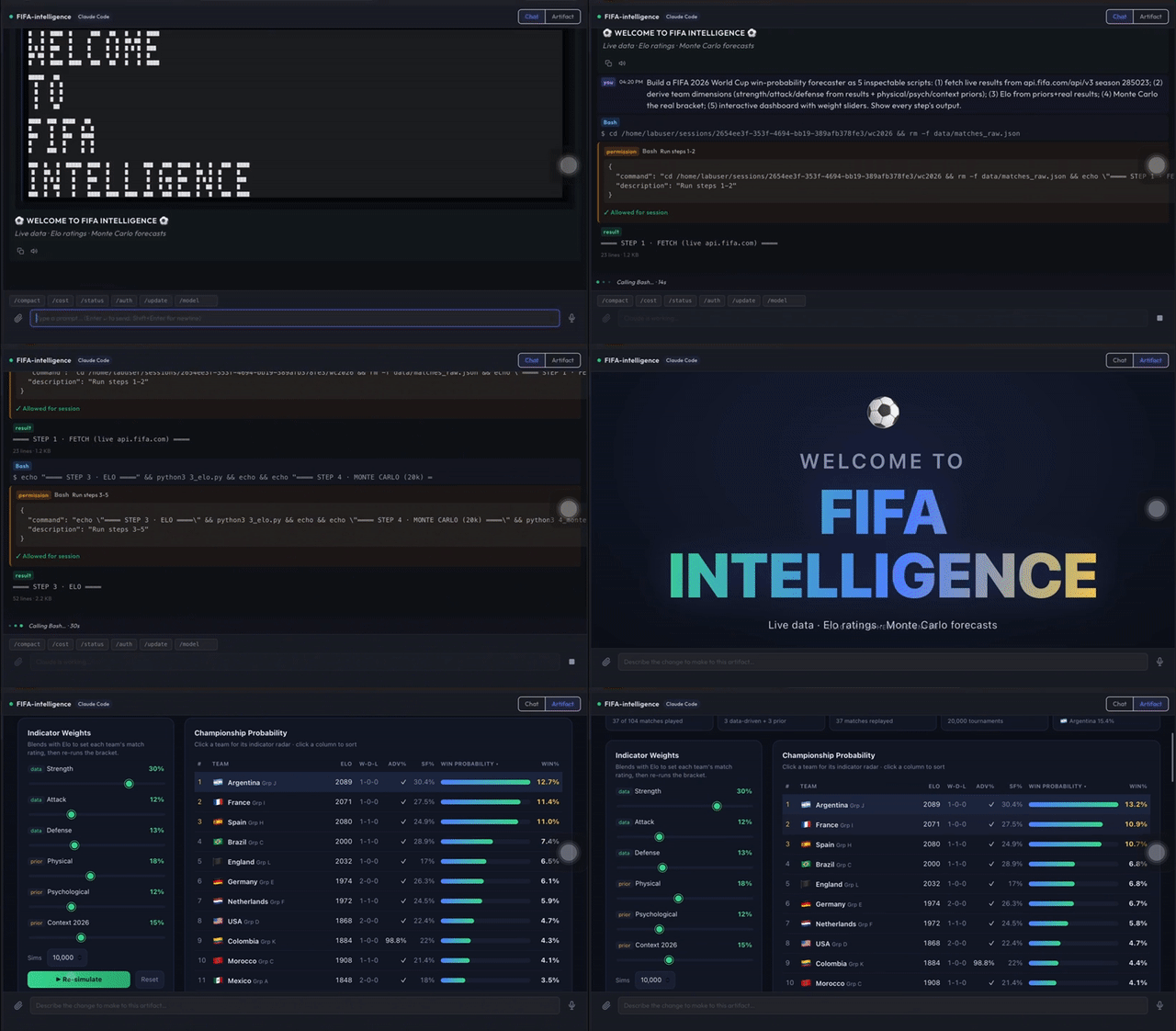
Above: Claude Code, driven through ai-relay, builds and renders a live interactive dashboard in a browser — reasoning, tool calls, and the finished artifact streamed in real time.
Install
pip install ai-relay
Quick start
One-shot mode (local dev)
# Start the relay server (default: ws://0.0.0.0:8765)
ai-relay --port 8765
Server mode (container / daemon)
# Persistent server — each WebSocket connection becomes one independent agent session
ai-relay serve --port 9000
Then connect from OhWise Lab (or any WebSocket client) and send a handshake:
{"tool": "claude", "folder": "/path/to/project", "model": "claude-sonnet-4-6"}
The relay streams structured JSON events over WebSocket and forwards your messages to the selected backend. Claude Code and Gemini use native JSONL process protocols, Codex uses the app-server JSON-RPC protocol, and Snowflake Cortex uses HTTP/SSE. The PTY bridge is retained only for generic/legacy CLI tools.
Running in a container
ai-relay serve is designed to run inside a Docker container as a persistent daemon:
FROM python:3.11-slim
RUN pip install ai-relay
# Install your AI CLI here (e.g. npm install -g @anthropic-ai/claude-code)
CMD ["ai-relay", "serve", "--port", "9000"]
Each incoming WebSocket connection spawns an independent agent session. Multiple clients can connect simultaneously.
Recommended architecture (enterprise-grade SaaS)
For a multi-tenant, production SaaS, the recommended design is:
- One isolated compute boundary per tenant/user (the isolation boundary) — use whatever fits your needs: a VM, pod, container, serverless/Lambda sandbox, dedicated server, or on-prem host. Each runs one
ai-relay servethat multiplexes all of that tenant's sessions — one WebSocket connection persession_id. Never share one runtime across tenants, and do not start one process per session. - A server-side orchestrator/hub in front (never expose ai-relay to the browser): it holds one WebSocket per session to the relay, fans out to N browser tabs, enforces auth/RBAC, persists conversation history + state in a database, and keeps the connection open so in-progress turns survive a browser refresh.
- Per-tenant filesystem isolation + dropped capabilities + internal-only networking.
ai-relay is the stateless streaming engine; durability and multi-tenancy live in your orchestrator. Full reference architecture and rationale: docs/architecture.md → Session multiplexing model / Recommended architecture.
Event types
| Type | Description |
|---|---|
session_start |
Process spawned |
session_end |
Process exited (includes exit_code) |
stdout / stderr |
Raw output lines |
reasoning |
Agent thinking/planning text |
tool_call |
Agent invoking a tool (Read, Edit, Bash…) |
tool_result |
Result of a tool call |
file_diff |
File created or edited |
response |
Final answer text |
assistant_message |
Native structured assistant message |
user_message |
Native structured user/tool-result message |
stream_event |
Native streaming event |
status |
Native status/control event |
permission_request |
Tool permission prompt from a structured backend |
permission_cancelled |
Pending permission prompt was cancelled |
control_response |
Native control response acknowledgment |
tool_progress |
Native tool progress event |
quota_warning |
API quota / rate limit detected |
context_warning |
Context window nearing limit (includes context_pct) |
context_compacted |
Context was compacted |
error |
Relay or process error |
input_ack |
Relay confirms your message was sent to the process |
Sending commands
Send JSON over WebSocket:
{"text": "refactor the authentication module to use JWT"}
Claude Code also accepts structured web-client messages:
{"type": "user_message", "content": "refactor the authentication module to use JWT"}
Permission responses:
{"type": "permission_response", "request_id": "req", "behavior": "allow", "updatedInput": {"command": "git status"}}
Codex permission responses can also use:
{"type": "permission_response", "request_id": "req", "allow": true}
Interrupt the active structured turn:
{"type": "interrupt"}
Relay-handled slash commands (Claude per-turn runtime)
In --print / stream-json mode the CLI has no interactive TUI, so the relay
intercepts a few commands and answers them itself (they are never forwarded to
the subprocess):
| Command | Effect |
|---|---|
/status |
Current model, conversation id, turns, last-turn context tokens, cumulative cost |
/cost |
Cumulative cost + input/output tokens + turn count |
/new (alias /clear) |
Drop the resume pointer — the next turn starts a fresh conversation. Use this to recover a bloated/stuck session. |
Auto-reset safeguards (resume durability)
Claude Code resumes a conversation by reloading its on-disk transcript each turn.
A very large transcript makes --resume slow or hang. The relay guards against
this automatically:
- Transcript-size rotation — before resuming, if the transcript exceeds
AI_RELAY_TRANSCRIPT_ROTATE_BYTES(default 5 MB) the relay starts a fresh conversation and emits aresponse(metadata.source = "auto_rotate"). - Resume-hang watchdog — if a resumed turn emits
system/initthen stalls forAI_RELAY_RESUME_HANG_TIMEOUTseconds (default 90) with no result, the relay kills the subprocess and retries once without--resume(metadata.source = "resume_hang_retry").
Earlier conversation history shown in your own UI is unaffected — rotation only resets the CLI's resume context, not your application's stored history.
Codex uses codex app-server --listen stdio:// and keeps a persistent thread behind the WebSocket session:
{"tool": "codex", "folder": "/path/to/project", "model": "gpt-5.2"}
Gemini CLI uses ACP (Agent Communication Protocol) mode. Each text message starts one Gemini turn:
{"tool": "gemini", "folder": "/path/to/project", "model": "gemini-2.5-flash"}
Gemini-specific behavior — per-turn process lifecycle
Unlike Claude Code (persistent process +
--resume) and Codex (persistent app-server), Gemini CLI ACP mode (≥ 0.40.x) exits the subprocess after everysession/promptturn completes (exit code 0). This is by design in the Gemini CLI implementation.The relay handles this transparently:
- On the first turn the relay calls
session/newand saves the returnedsessionIdto.gemini_acp_sessionin the session working folder.- On each subsequent reconnect the relay calls
session/loadwith that ID so Gemini restores conversation context in the new process.- If
session/loadfails (session expired or folder was wiped) the relay falls back tosession/newautomatically.Implication for permission approvals: because the process exits after each turn, permission responses must be sent while the current turn's process is still alive (i.e. before the
session/promptRPC completes). The defaultsession/prompttimeout is 5 minutes, which covers typical interactive permission dialogs.
Snowflake Cortex uses API configuration in the handshake.
Cortex chat mode:
{
  "tool": "cortex",
  "mode": "chat",
  "model": "claude-sonnet-4-5",
  "snowflake": {
    "account_url": "https://<account>.snowflakecomputing.com",
    "token_env": "SNOWFLAKE_PAT"
  }
}
Cortex Analyst mode:
{
  "tool": "cortex",
  "mode": "analyst",
  "snowflake": {
    "account_url": "https://<account>.snowflakecomputing.com",
    "token_env": "SNOWFLAKE_PAT",
    "semantic_view": "DB.SCHEMA.VIEW"
  }
}
To send CLI commands (e.g. /compact, /clear):
{"text": "/compact"}
Supported tools
| Tool | Adapter | tool value |
|---|---|---|
| Claude Code | ClaudeCodeAdapter |
"claude" / "claude-code" |
| OpenAI Codex | CodexAdapter |
"codex" |
| Gemini CLI | GeminiAdapter |
"gemini" |
| Snowflake Cortex | CortexAdapter |
"cortex" |
| Any CLI | GenericAdapter |
"generic" |
Configuration reference (ohwise-lab-ctrl)
When using ohwise-lab alongside ai-relay, all settings are controlled via environment variables — nothing is hardcoded:
| Variable | Default | Description |
|---|---|---|
LAB_MODE |
single |
single = subprocesses in lab-ctrl; multi = per-user Docker containers |
LAB_WORKSPACE_ROOT |
/var/ohwise-lab-workspaces |
Host path for user workspace volumes |
LAB_IMAGE |
ohwise-lab-ctrl:local |
Docker image for user containers (must have ai-relay + CLIs installed) |
LAB_NETWORK |
lab-network |
Docker network user containers join. For Compose: <project>_default |
LAB_CONTAINER_PORT |
9000 |
Internal port ai-relay serve listens on inside user containers |
LAB_CONTAINER_USER |
labuser |
OS user inside user containers |
LAB_CONTAINER_HOME |
/home/<LAB_CONTAINER_USER> |
Home dir inside user containers |
LAB_CONTAINER_STARTUP_DELAY |
1.5 |
Seconds to wait for ai-relay to be ready after container start |
LAB_CONTAINER_WS_TIMEOUT |
15 |
Seconds to wait for WebSocket connection to user container |
LAB_IDLE_TIMEOUT_SECS |
1800 |
Seconds of inactivity before a user container is eligible for cleanup |
Python API
from ai_relay import RelayServer

server = RelayServer(host="0.0.0.0", port=8765)
server.run()
Documentation
- Architecture & Developer Guide — internals, event system, auth, turn lifecycle, reconnect handling, adding providers, containerised deployment
Changelog
See CHANGELOG.md for release notes.
License
Apache-2.0
Release history Release notifications | RSS feed


Download files
Download the file for your platform. If you're not sure which to choose, learn more about installing packages.
Source Distribution
Built Distribution
Filter files by name, interpreter, ABI, and platform.
If you're not sure about the file name format, learn more about wheel file names.
Copy a direct link to the current filters
File details
Details for the file ai_relay-0.4.44.tar.gz.
File metadata
- Download URL: ai_relay-0.4.44.tar.gz
- Upload date:
- Size: 60.0 kB
- Tags: Source
- Uploaded using Trusted Publishing? No
- Uploaded via: twine/6.2.0 CPython/3.14.0
File hashes
| Algorithm | Hash digest | |
|---|---|---|
| SHA256 |
30076de2450572962f033eeeb1904535a8088adda3a0edb220b25d3ce69839c1
|
|
| MD5 |
2112f111a51489c871d91c2df746d68b
|
|
| BLAKE2b-256 |
cdaaf4a5b38dd54851ac115084811845f85af59d7607d412a0876988a1634c16
|
File details
Details for the file ai_relay-0.4.44-py3-none-any.whl.
File metadata
- Download URL: ai_relay-0.4.44-py3-none-any.whl
- Upload date:
- Size: 65.1 kB
- Tags: Python 3
- Uploaded using Trusted Publishing? No
- Uploaded via: twine/6.2.0 CPython/3.14.0
File hashes
| Algorithm | Hash digest | |
|---|---|---|
| SHA256 |
58694d86a3dc567427c8890951818cd713cc46cdecec2105f2631913f53793ac
|
|
| MD5 |
e565c7a6a54f82c1fc60fb7b02b7cf33
|
|
| BLAKE2b-256 |
d97b258ea7aebe5c5e3d75d283bd3d3494446e82ee412cdf378737b5181adc40
|






