
Evidence-based static analyzer for detecting AI-generated code quality issues with context-aware validation

Project description
AI-SLOP Detector









Catches the slop that AI produces — before it reaches production.
Not a style linter. A structural-risk scanner for AI-assisted code.
The problem isn't that AI writes code.
The problem is the specific class of defects AI reliably introduces:
unimplemented stubs, disconnected pipelines, phantom imports, and buzzword-heavy noise.
The code speaks for itself.
Navigation: What Is It? • Quick Start • How It Works • What It Detects • Scoring • Key Features • Claude Code Skill • Security • CI/CD • Config • VS Code • Changelog • Release Notes
What Is AI-SLOP Detector?
AI-SLOP Detector is an evidence-based static analyzer purpose-built to catch the specific class of defects that AI code generation reliably introduces — before they reach production.
Unlike general linters that flag style and convention, it targets AI slop: structurally plausible code that is functionally empty, disconnected, or misleading.
- 27 adversarial pattern checks — stubs, phantom imports, disconnected pipelines, buzzword inflation, clone clusters
- 4D scoring model — LDR (logic density), ICR (inflation), DDC (dependency coupling), Purity (critical severity) combined via geometric mean
- Self-calibrating — every scan is recorded per-project; after 10 files have been re-scanned the tool automatically tunes its weights using project-scoped, domain-anchored grid search (no manual command required)
- Git-aware noise filter — uses commit SHA to distinguish real improvements from measurement noise
- Domain-aware bootstrap —
--initauto-detects project domain (8 profiles:web_frontend,data_science,ml_research,backend_api, …) and pre-seeds weights accordingly; override with--domain - JS/TS analysis — optional
[js]extra activates JSAnalyzer v2.8.0 with tree-sitter AST + regex fallback for.js/.jsx/.ts/.tsxfiles - Go analysis — optional
[go]extra activates GoAnalyzer v1.0.0 with regex-based detection for.gofiles; detects empty funcs, panic-as-error, fmt.Print debug, ignored errors - CI/CD gates — soft / hard / quarantine modes; GitHub Actions ready
- VS Code extension — real-time inline diagnostics, debounced lint-on-type, ML score in status bar
Quick Start
pip install ai-slop-detector

slop-detector --init                       # bootstrap .slopconfig.yaml + .gitignore
slop-detector mycode.py                    # single file
slop-detector --project ./src             # entire project
slop-detector mycode.py --json            # machine-readable output
slop-detector --project . --ci-mode hard --ci-report  # CI gate

# Optional extras
pip install "ai-slop-detector[js]"       # JS/TS tree-sitter analysis
pip install "ai-slop-detector[go]"       # Go tree-sitter analysis
pip install "ai-slop-detector[ml]"       # ML secondary signal

# No install required
uvx ai-slop-detector mycode.py

How It Works
flowchart LR
    A[📄 Source File] --> R[FileRole\nClassifier]
    R --> B[AST Parser]
    B --> C[27 Pattern Checks]
    B --> D[LDR · ICR · DDC\n+ Purity Metrics]
    C --> E[GQG Scorer\nWeighted Geometric Mean]
    D --> E
    E --> F{deficit_score}
    F -->|< 30| G[✅ CLEAN]
    F -->|30–50| H[⚠️ SUSPICIOUS]
    F -->|50–70| I[🔶 INFLATED_SIGNAL]
    F -->|≥ 70| J[🚨 CRITICAL_DEFICIT]
    E --> H2[history.db]
    H2 --> K[Self-Calibrator\nauto-tune weights]
Every file goes through four independent measurement axes (LDR, ICR, DDC, Purity) and 27 pattern checks. Results are combined via a weighted geometric mean — a near-zero in any single dimension pulls the overall score down regardless of other dimensions. Every scan is recorded to history (per project); weights auto-tune when 10 files have been re-scanned in the same project.
Full specification: docs/HOW_IT_WORKS.md · docs/MATH_MODELS.md
What It Detects
27 patterns across 5 categories. Full catalog: docs/PATTERNS.md
| Category | Patterns | Signal |
|---|---|---|
| Placeholder | empty_except, not_implemented, pass_placeholder, ellipsis_placeholder, return_none_placeholder, return_constant_stub, todo_comment, fixme_comment, hack_comment, xxx_comment, interface_only_class |
Unfinished / scaffolded code |
| Structural | bare_except, mutable_default_arg, star_import, global_statement |
Anti-patterns |
| Cross-Language | js_push, java_equals, ruby_each, go_print, csharp_length, php_strlen |
Wrong-language syntax |
| Python Advanced | god_function, dead_code, deep_nesting, lint_escape, function_clone_cluster, placeholder_variable_naming |
Structural complexity + evasion |
| Phantom | phantom_import |
Hallucinated packages |
Four metric axes per file:
| Metric | What it measures |
|---|---|
| LDR (Logic Density Ratio) | logic_lines / total_lines — code vs. whitespace/comments |
| ICR (Inflation Check) | jargon_density × complexity_modifier — buzzword weight |
| DDC (Dependency Check) | used_imports / total_imports — import utilization |
| Purity | exp(-0.5 × n_critical_patterns) — AND-gate on critical pattern severity |
Scoring Model
purity        = exp(-0.5 × n_critical_patterns)
quality (GQG) = exp( Σ wᵢ·ln(dimᵢ) / Σ wᵢ )   — weighted geometric mean
deficit_score = 100 × (1 − quality) + pattern_penalty
| Score | Status |
|---|---|
| ≥ 70 | CRITICAL_DEFICIT |
| ≥ 50 | INFLATED_SIGNAL |
| ≥ 30 | SUSPICIOUS |
| < 30 | CLEAN |
Default weights: ldr=0.40 · inflation=0.30 · ddc=0.30 · purity=0.10 — sum is 1.10; GQG divides by total_w so exact normalization is not required (all four calibrated via --self-calibrate in v3.2.0+)
Project aggregation uses SR9 conservative weighting: 0.6 × min + 0.4 × mean
Full specification: docs/MATH_MODELS.md
Key Features
Bootstrap — domain-aware, one command to start
slop-detector --init                   # auto-detect domain, generate .slopconfig.yaml
slop-detector --init --domain web_frontend  # explicit domain override
--init detects your project domain from file patterns (8 built-in profiles:
general, web_frontend, data_science, cli_tool, library,
ml_research, backend_api, scientific) and pre-seeds the weight profile
accordingly. Also secures .slopconfig.yaml in .gitignore by default.
JS/TS Analysis — optional tree-sitter path
pip install "ai-slop-detector[js]"
slop-detector --project ./src         # now includes .js/.jsx/.ts/.tsx files
Activates JSAnalyzer v2.8.0 with tree-sitter AST (regex fallback when not installed).
Results appear under js_file_results in ProjectAnalysis and JSON output.
Go Analysis — regex-based, optional tree-sitter-go path
pip install "ai-slop-detector[go]"
slop-detector --project ./src         # now includes .go files
Activates GoAnalyzer v1.0.0. Detects: empty function stubs, panic() as error handling,
fmt.Println/Printf debug prints, _ = ignored errors, TODO/FIXME comments, god functions
(> 60 lines). Results appear under go_file_results in JSON output.
Self-Calibration — the tool learns your codebase
slop-detector . --self-calibrate               # see what your history recommends
slop-detector . --self-calibrate --apply-calibration  # write to .slopconfig.yaml
4D grid-search (ldr / inflation / ddc / purity) over your run history. Optimizes all four weight dimensions simultaneously.
- Project-scoped —
history.dbtags every record with aproject_id(sha256 of cwd); calibration signal never mixes across different projects - Domain-anchored — grid search is constrained to ±0.15 around the current domain weights, preventing drift outside the domain's meaningful weight region
- Drift warnings —
CalibrationResult.warningsflags any dimension that shifted > 0.25 from the anchor - Only applies when confidence gap between top two candidates exceeds 0.10
- Milestone is triggered by files re-scanned (not raw record count), avoiding false triggers on first-time project scans
History Tracking — longitudinal quality analysis
slop-detector mycode.py --show-history   # per-file trend
slop-detector --history-trends           # 7-day project aggregate
slop-detector --export-history data.jsonl
Every run auto-recorded to ~/.slop-detector/history.db. The history database is
the training signal for ML self-calibration.
docs/HISTORY_TRACKING.md →
Claude Code Skill
Turn AI-SLOP Detector into a persistent quality loop inside Claude Code — same scan criteria, same output shape, same gate logic, every session.
# Install
cp -r claude-skills/slop-detector ~/.claude/skills/
# then restart Claude Code
Four commands:
| Command | What it does |
|---|---|
/slop |
Full project scan — interprets findings, prioritizes fixes |
/slop-file [path] |
Single-file analysis with per-pattern fix guidance |
/slop-gate |
CI hard gate — PASS/FAIL with blocking file list |
/slop-spar |
Adversarial validation — catches calibration drift |
The loop:
/slop -> review findings -> patch -> /slop-file <path> -> /slop-gate
"It felt like the missing piece in my workflow — code quality tightened up almost immediately."
A real user built this loop around the skill and reported: context burn dropped, review criteria held across sessions, and code quality improved immediately. The win was not that the agent became smarter — it was that the review loop stopped drifting.
Skill source: claude-skills/slop-detector/SKILL.md · Full documentation →
Security Considerations
.slopconfig.yaml sensitivity
Your .slopconfig.yaml contains domain_overrides — a precise map of which functions
are exempt from complexity rules. This is effectively a codebase weakness surface:
it reveals which areas are too complex to refactor right now.
Best practice:
- Run
slop-detector --initto generate.slopconfig.yamland auto-add it to.gitignore - To share governance config with your team, explicitly remove
.slopconfig.yamlfrom.gitignore - Open-source repos committing it is fine (transparency over obscurity — see this project's own
.slopconfig.yaml)
history.db
History is stored at ~/.slop-detector/history.db (your home directory, outside all repos).
It is never committed and accumulates across all projects you scan.
Adversarial Validation (SPAR-Code) — ground-truth regression guard
fhval spar          # 3-layer adversarial check
fhval spar --layer a   # known-pattern anchors
fhval spar --layer c   # existence probes
Verifies each metric is measuring what it claims. Catches calibration drift before it reaches production.
Structural Coherence — project-level signal
project = detector.analyze_project("./src")
print(project.structural_coherence)  # 0.0 – 1.0
Experimental. Use for longitudinal comparison within a project, not as an absolute gate. docs/ARCHITECTURE.md →
CI/CD Integration
pre-commit (runs on every commit):
# .pre-commit-config.yaml
repos:
  - repo: https://github.com/flamehaven01/AI-SLOP-Detector
    rev: v3.5.0
    hooks:
      - id: slop-detector
GitHub Actions (runs on every PR):
# .github/workflows/quality-gate.yml
- name: AI-SLOP Gate
  run: |
    pip install ai-slop-detector
    slop-detector --project . --ci-mode hard --ci-report
Enforcement modes:
--ci-mode soft        # informational, never fails build
--ci-mode hard        # fails at deficit_score >= 70 or critical_patterns >= 3
--ci-mode quarantine  # escalates repeat offenders after 3 violations
Full CI/CD Integration Guide →
Configuration
# .slopconfig.yaml
weights:
  ldr: 0.40
  inflation: 0.30
  ddc: 0.30
  purity: 0.10

patterns:
  god_function:
    domain_overrides:
      - function_pattern: "check_node"   # AST walker — complex by design
        complexity_threshold: 30
        lines_threshold: 200

ignore:
  - "tests/**"
  - "**/__init__.py"
Full Configuration Guide → · Config Examples →
VS Code Extension
Real-time inline diagnostics, debounced lint-on-type, ML score and Clone Detection in status bar.
Commands: Analyze File · Analyze Workspace · Auto-Fix · Show Gate Decision · History Trends
Install from the VS Code Marketplace or build locally:
cd vscode-extension && npm install && npx vsce package
Release Highlights
| Version | Highlights |
|---|---|
| v3.6.0 | Claude Code Skill (/slop, /slop-file, /slop-gate, /slop-spar); docs: Purity row added to metric axes, weight normalization note, [go] extra in Quick Start; stale test artifacts removed; 311 tests GREEN |
| v3.5.0 | Domain-aware --init (8 profiles, --domain flag); JS/TS analysis via JSAnalyzer v2.8.0 + [js]; Go analysis via GoAnalyzer v1.0.0 + [go]; self-calibration patches: project-scoped history (project_id), re-scan milestone trigger, domain-anchored grid search (±0.15), CalibrationResult.warnings (drift > 0.25); 308 tests GREEN |
| v3.4.1 | FileRole.STUB (Protocol/ABC stubs skip ldr+patterns); auto-discover .slopconfig.yaml; Python 3.8 CI compat; mypy attr-defined fix |
| v3.4.0 | Per-rule FP rate tracking (LEDA Phase 2A); purity weight ceiling MAX_PURITY_WEIGHT=0.25 (Phase 2B) |
| v3.3.0 | File role classifier (SOURCE/INIT/RE_EXPORT/TEST/MODEL/CORPUS); DDC annotation-only import fix; # noqa: F401 + __all__ re-export recognition |
| v3.2.1 | Auto-calibration at every 10-scan milestone (no manual cmd); P2 git noise filter; P3 per-class thresholds (5+5); calibrate() min_events bugfix; 11/11 e2e GREEN |
| v3.2.0 | 4D calibration (purity dimension); --init bootstrap; auto-calibration hints; 44/44 self-scan CLEAN |
| v3.1.2 | data_collector refactor; slopconfig gap fill; 43/43 self-scan CLEAN |
| v3.1.1 | Clone Detection in Core Metrics table; table style unification; VS Code UX |
| v3.1.0 | 3 new adversarial patterns (function_clone_cluster, placeholder_variable_naming, return_constant_stub); GQG calibrator alignment; fhval SPAR-Code |
| v3.0.2 | Phantom import 3-tier classification; __init__.py LDR fix; god_function LOW demotion |
| v3.0.0 | Geometric mean scorer (GQG); purity dimension; DCF per-file; structural coherence |
| v2.9.3 | Self-calibration engine; weight grid-search from usage history |
| v2.9.0 | phantom_import CRITICAL detection; history auto-tracking |
Full Release Notes → · Changelog →
Development
git clone https://github.com/flamehaven01/AI-SLOP-Detector.git
cd AI-SLOP-Detector
pip install -e ".[dev]"
pytest tests/ -v --cov
black src/ tests/
ruff check src/ tests/
Download Stats
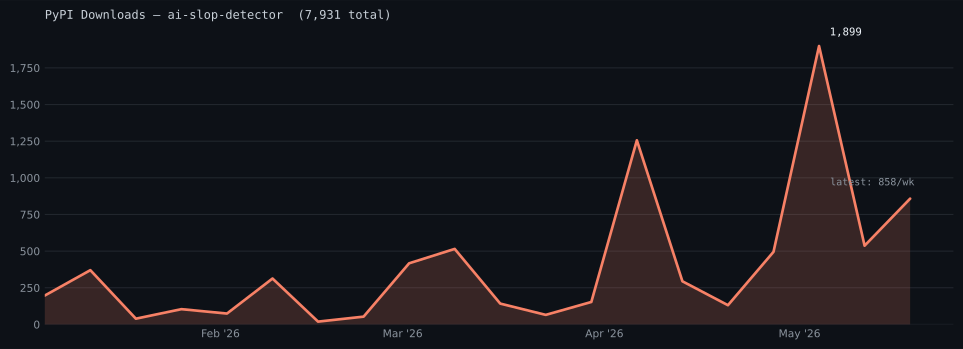

Chart updated weekly via GitHub Actions. Monthly installs: pypistats.org (mirrors excluded). Total: pepy.tech (incl. mirrors)
License
MIT — see LICENSE.
Flamehaven Labs • Issues • Discussions • Docs
Release history Release notifications | RSS feed


Download files
Download the file for your platform. If you're not sure which to choose, learn more about installing packages.
Source Distribution
Built Distribution
Filter files by name, interpreter, ABI, and platform.
If you're not sure about the file name format, learn more about wheel file names.
Copy a direct link to the current filters
File details
Details for the file ai_slop_detector-3.6.0.tar.gz.
File metadata
- Download URL: ai_slop_detector-3.6.0.tar.gz
- Upload date:
- Size: 201.9 kB
- Tags: Source
- Uploaded using Trusted Publishing? Yes
- Uploaded via: twine/6.1.0 CPython/3.13.12
File hashes
| Algorithm | Hash digest | |
|---|---|---|
| SHA256 |
f872ff4b5b863e716115a7b51fbcd43819cfef4b806f4c34fb1cb96016ea570a
|
|
| MD5 |
730507f9b60cf09be8ef3aa4cc5d1a0a
|
|
| BLAKE2b-256 |
2c8984169143e2c58a138d4069c41f0443b10e9d6e7a0c87ca30c3e828be4e2d
|
Provenance
The following attestation bundles were made for ai_slop_detector-3.6.0.tar.gz:
Publisher:
workflow.yml on flamehaven01/AI-SLOP-Detector
-
Statement:
-
Statement type:
https://in-toto.io/Statement/v1 -
Predicate type:
https://docs.pypi.org/attestations/publish/v1 -
Subject name:
ai_slop_detector-3.6.0.tar.gz -
Subject digest:
f872ff4b5b863e716115a7b51fbcd43819cfef4b806f4c34fb1cb96016ea570a - Sigstore transparency entry: 1393622687
- Sigstore integration time:
-
Permalink:
flamehaven01/AI-SLOP-Detector@73f1b5e8164241f4db985438cc64a6c56dbd29e1 -
Branch / Tag:
refs/tags/v3.6.0 - Owner: https://github.com/flamehaven01
-
Access:
public
-
Token Issuer:
https://token.actions.githubusercontent.com -
Runner Environment:
github-hosted -
Publication workflow:
workflow.yml@73f1b5e8164241f4db985438cc64a6c56dbd29e1 -
Trigger Event:
release
-
Statement type:
File details
Details for the file ai_slop_detector-3.6.0-py3-none-any.whl.
File metadata
- Download URL: ai_slop_detector-3.6.0-py3-none-any.whl
- Upload date:
- Size: 192.7 kB
- Tags: Python 3
- Uploaded using Trusted Publishing? Yes
- Uploaded via: twine/6.1.0 CPython/3.13.12
File hashes
| Algorithm | Hash digest | |
|---|---|---|
| SHA256 |
4a4befaaa67e14969f1c42211c4ca3b2e8b827f92775e96defb38fd2c1acf1de
|
|
| MD5 |
a2db60ded7eb4e3f618661be911d806f
|
|
| BLAKE2b-256 |
f00ddc59bf44cb8971bda21fc9550d80040d09ba034302e9430b68224a124d0d
|
Provenance
The following attestation bundles were made for ai_slop_detector-3.6.0-py3-none-any.whl:
Publisher:
workflow.yml on flamehaven01/AI-SLOP-Detector
-
Statement:
-
Statement type:
https://in-toto.io/Statement/v1 -
Predicate type:
https://docs.pypi.org/attestations/publish/v1 -
Subject name:
ai_slop_detector-3.6.0-py3-none-any.whl -
Subject digest:
4a4befaaa67e14969f1c42211c4ca3b2e8b827f92775e96defb38fd2c1acf1de - Sigstore transparency entry: 1393622696
- Sigstore integration time:
-
Permalink:
flamehaven01/AI-SLOP-Detector@73f1b5e8164241f4db985438cc64a6c56dbd29e1 -
Branch / Tag:
refs/tags/v3.6.0 - Owner: https://github.com/flamehaven01
-
Access:
public
-
Token Issuer:
https://token.actions.githubusercontent.com -
Runner Environment:
github-hosted -
Publication workflow:
workflow.yml@73f1b5e8164241f4db985438cc64a6c56dbd29e1 -
Trigger Event:
release
-
Statement type:






