
Evidence-based static analyzer for detecting AI-generated code quality issues with context-aware validation

Project description
AI-SLOP Detector







Not a style linter. A structural-risk scanner for AI-assisted code.
Detects unimplemented stubs, phantom imports, disconnected pipelines, clone clusters, and inflated documentation.
File-level evidence. Machine-readable output. No LLM in the scoring path.
Release track
- Stable tag:
v3.7.9 - Previous stable tag:
v3.7.8 v3.7.9adds the fail-closed governance verification gate and formalizes the math / enforcement boundary in the docs.
Navigation: What Is It? • Quick Start • Verification • Boundaries • How It Works • Document Map • What It Detects • Scoring • Key Features • Calibration • Security • CI/CD • Config • VS Code • Changelog • Release Notes • Schema Validation
What Is AI-SLOP Detector?
AI-SLOP Detector is an evidence-based static analyzer that targets the specific defect class AI code generation reliably produces: structurally plausible code that is functionally empty, disconnected, or misleading.
General linters flag style and convention. This tool flags structural risk.
- 27 adversarial pattern checks — stubs, phantom imports, disconnected pipelines, buzzword inflation, clone clusters
- 4D scoring model — LDR (logic density), ICR (inflation), DDC (dependency coupling), Purity (critical severity) combined via geometric mean
- Self-calibrating — every scan is recorded per-project; at every 10 multi-run files milestone the calibration check fires automatically; weights update only when 5 improvement events and 5 fp_candidate events have accumulated per class (project-scoped, domain-anchored grid search, no manual command required)
- Git-aware noise filter — uses commit SHA to distinguish real improvements from measurement noise
- Domain-aware bootstrap —
--initauto-detects project domain (8 profiles:general,scientific/ml,scientific/numerical,web/api,library/sdk,cli/tool,bio,finance) and pre-seeds weights accordingly; override with--domain - JS/TS analysis — optional
[js]extra activates JSAnalyzer v2.8.0 with tree-sitter AST + regex fallback for.js/.jsx/.ts/.tsxfiles - Go analysis — optional
[go]extra activates GoAnalyzer v1.0.0 with regex-based detection for.gofiles; detects empty funcs, panic-as-error, fmt.Print debug, ignored errors - CI/CD gates — soft / hard / quarantine modes; GitHub Actions ready
- VS Code extension — real-time inline diagnostics, debounced lint-on-type, ML score in status bar
60-Second First Run
No project-side config needed. Run it against any folder of Python:
pip install "ai-slop-detector>=3.7.9"
slop-detector --project . --json --output slop.json
python -c "import json; d=json.load(open('slop.json',encoding='utf-8')); print(d['overall_status'], d['weighted_deficit_score'])"
Expected output for a healthy project: clean 0.0 to clean 30.0. Anything
above 30.0 is a real finding worth reading in slop.json. The --output
form writes UTF-8 (no BOM) directly to disk, so it is safe under Windows
PowerShell — prefer it to > slop.json redirection.
Quick Start
pip install "ai-slop-detector>=3.7.9"

slop-detector --init                       # bootstrap .slopconfig.yaml + .gitignore
slop-detector mycode.py                    # single file
slop-detector --project ./src             # entire project
slop-detector --project . --json --output slop.json   # machine-readable output (Windows-safe)
slop-detector --project . --ci-mode hard --ci-report  # CI gate

# Optional extras
pip install "ai-slop-detector[js]"       # JS/TS tree-sitter analysis
pip install "ai-slop-detector[go]"       # Go tree-sitter analysis

# No install required
uvx ai-slop-detector mycode.py
Windows / PowerShell tip: PowerShell
>redirection writes UTF-16 LE or UTF-8 with BOM by default, which breaksjson.load(..., encoding='utf-8'). Use--output <path>instead — it writes UTF-8 bytes (no BOM) directly, skipping the shell.

Verification Path
Use the same verification surface the repository exposes in CI:
pip install -e ".[dev]"
python -m pytest -q
ruff check src tests
python -m build
Governance verification is a separate enforcement gate:
slop-detector verify-governance ./.cr-ep
See docs/GOVERNANCE.md for the artifact contract and policy checks.
Scope And Boundaries
- This repository measures static code and documentation signals. It does not prove runtime correctness.
- The default scoring path is deterministic; it does not require an LLM or external API.
- JS/TS and Go support are optional extras with language-specific analyzers and fallbacks.
- A low deficit score is evidence of cleaner structure, not a guarantee that the code is complete or safe.
How It Works
flowchart LR
    A[📄 Source File] --> R[FileRole\nClassifier]
    R --> B[AST Parser]
    B --> C[27 Pattern Checks]
    B --> D[LDR · ICR · DDC\n+ Purity Metrics]
    C --> E[GQG Scorer\nWeighted Geometric Mean]
    D --> E
    E --> F{deficit_score}
    F -->|< 30| G[✅ CLEAN]
    F -->|30–50| H[⚠️ SUSPICIOUS]
    F -->|50–70| I[🔶 INFLATED_SIGNAL]
    F -->|≥ 70| J[🚨 CRITICAL_DEFICIT]
    E --> H2[history.db]
    H2 --> K[Self-Calibrator\nauto-tune weights]
Every file goes through four independent measurement axes (LDR, ICR, DDC, Purity) and 27 pattern checks. Results are combined via a weighted geometric mean — a near-zero in any single dimension pulls the overall score down regardless of other dimensions. Every scan is recorded to history (per project); at every 10 multi-run files milestone the calibrator fires — weights apply only when >= 5 improvement events and >= 5 fp_candidate events per class have accumulated.
Full specification: docs/HOW_IT_WORKS.md · docs/MATH_MODELS.md
Document Map
Use the docs by task, not by chronology:
Core behavior
Verification and operations
Calibration and history
- docs/SELF_CALIBRATION.md
- docs/LEDA_CALIBRATION.md
- docs/LEDA_TURBO_PROTOCOL_DOGFOODING.md
- docs/HISTORY_TRACKING.md
- docs/GOVERNANCE.md
Interfaces
What It Detects
27 patterns across 5 categories. Full catalog: docs/PATTERNS.md
| Category | Patterns | Signal |
|---|---|---|
| Placeholder | empty_except, not_implemented, pass_placeholder, ellipsis_placeholder, return_none_placeholder, return_constant_stub, todo_comment, fixme_comment, hack_comment, xxx_comment, interface_only_class |
Unfinished / scaffolded code |
| Structural | bare_except, mutable_default_arg, star_import, global_statement |
Anti-patterns |
| Cross-Language | javascript_array_push, java_equals_method, ruby_each, go_print, csharp_length, php_strlen |
Wrong-language syntax |
| Python Advanced | god_function, dead_code, deep_nesting, lint_escape, function_clone_cluster, placeholder_variable_naming |
Structural complexity + evasion |
| Phantom | phantom_import |
Hallucinated packages |
Four metric axes per file:
| Metric | What it measures |
|---|---|
| LDR (Logic Density Ratio) | logic_lines / total_lines — code vs. whitespace/comments |
| ICR (Inflation Check) | jargon_density × complexity_modifier — buzzword weight |
| DDC (Dependency Check) | used_imports / total_imports — import utilization |
| Purity | exp(-0.5 × n_critical_patterns) — AND-gate on critical pattern severity |
Scoring Model
purity        = exp(-0.5 × n_critical_patterns)
quality (GQG) = exp( Σ wᵢ·ln(max(1e-4, dimᵢ)) / Σ wᵢ )   — weighted geometric mean
deficit_score = 100 × (1 − quality) + pattern_penalty
max(1e-4, ...) prevents log(0) = -inf from collapsing the entire score (v3.7.2 __post_init__ guards enforce upstream range invariants on metric results).
| Score | Status |
|---|---|
| ≥ 70 | CRITICAL_DEFICIT |
| ≥ 50 | INFLATED_SIGNAL |
| ≥ 30 | SUSPICIOUS |
| < 30 | CLEAN |
Default weights: ldr=0.40 · inflation=0.30 · ddc=0.20 · purity=0.10 — sum is 1.00; GQG divides by total_w so exact normalization is not required (all four calibrated via --self-calibrate in v3.2.0+)
Project aggregation uses SR9 conservative weighting: 0.6 × min + 0.4 × mean
Full specification: docs/MATH_MODELS.md
Per-file deficit_breakdown (v3.7.6)
Every per-file result in the JSON output also carries a deficit_breakdown
that attributes the score back to its source dimensions. This answers
"why is my clean-status file not 0.0?" without drilling into raw findings:
| Field | Meaning |
|---|---|
ldr_penalty |
Points of deficit attributable to low logic density |
inflation_penalty |
Points from buzzword / docstring inflation |
ddc_penalty |
Points from low import-usage ratio |
purity_penalty |
Points from critical-severity pattern hits via GQG |
pattern_hits |
Additive pattern penalty (post-cap) |
total |
Equals deficit_score (sum of the above when not capped at 100) |
GQG-dimension shares are computed via log-loss attribution — the sum of the
five penalty fields equals total within 0.01 when deficit_score < 100.
Structural Coherence Level
coherence_level in project-level JSON output reports how the
structural_coherence value was derived:
| Value | Meaning | When emitted |
|---|---|---|
vr_structural |
Vietoris-Rips H0 persistence over file DCFs (MST max edge) | At least two parsed Python files with non-empty DCFs |
vr_structural_approx |
Deterministic approximation of the same signal above the exact topology ceiling | At least two parsed Python files, with file count above advanced.exact_topology_ceiling |
none |
No coherence computed | Empty project, single file, or all files unparseable |
mst_persistence and not_applicable are not emitted — they were
proposed in the v3.7.5 audit but never wired in. Verify the actual value
from the JSON output rather than guessing.
Key Features
Bootstrap — domain-aware, one command to start
slop-detector --init                   # auto-detect domain, generate .slopconfig.yaml
slop-detector --init --domain web/api       # explicit domain override
--init detects your project domain from file patterns (8 built-in profiles:
general, scientific/ml, scientific/numerical, web/api,
library/sdk, cli/tool, bio, finance) and pre-seeds the weight profile
accordingly. Also secures .slopconfig.yaml in .gitignore by default.
JS/TS Analysis — optional tree-sitter path
pip install "ai-slop-detector[js]"
slop-detector --project ./src         # now includes .js/.jsx/.ts/.tsx files
Activates JSAnalyzer v2.8.0 with tree-sitter AST (regex fallback when not installed).
Results appear under js_file_results in ProjectAnalysis and JSON output.
Go Analysis — regex-based, optional tree-sitter-go path
pip install "ai-slop-detector[go]"
slop-detector --project ./src         # now includes .go files
Activates GoAnalyzer v1.0.0. Detects: empty function stubs, panic() as error handling,
fmt.Println/Printf debug prints, _ = ignored errors, TODO/FIXME comments, god functions
(> 60 lines). Results appear under go_file_results in JSON output.
Self-Calibration — the tool learns your codebase
slop-detector . --self-calibrate               # see what your history recommends
slop-detector . --self-calibrate --apply-calibration  # write to .slopconfig.yaml
4D grid-search (ldr / inflation / ddc / purity) over your run history. Optimizes all four weight dimensions simultaneously.
- Project-scoped —
history.dbtags every record with aproject_id(sha256 of cwd); calibration signal never mixes across different projects - Domain-anchored — grid search is constrained to ±0.15 around the current domain weights, preventing drift outside the domain's meaningful weight region
- Drift warnings —
CalibrationResult.warningsflags any dimension that shifted > 0.25 from the anchor - Only applies when confidence gap between top two candidates exceeds 0.10
- Milestone is triggered by files re-scanned (not raw record count), avoiding false triggers on first-time project scans
History Tracking — longitudinal quality analysis
slop-detector mycode.py --show-history   # per-file trend
slop-detector --history-trends           # 7-day project aggregate
slop-detector --export-history data.jsonl
Every run auto-recorded to ~/.slop-detector/history.db. The history database is
the training signal for ML self-calibration.
docs/HISTORY_TRACKING.md →
Claude Code Integration
cp -r claude-skills/slop-detector ~/.claude/skills/
# restart Claude Code, then use /slop, /slop-file, /slop-gate, /slop-delta, /slop-spar
Adds a persistent scan → diagnose → patch → re-scan → gate → calibrate quality loop inside Claude Code.
| Command | What it does |
|---|---|
/slop |
3-Phase: Triage table → Confidence-Routed deep-dive → Action Plan with → Next: guidance |
/slop-file [path] |
Single file: status, 4D metrics, per-pattern fix guidance |
/slop-gate |
CI-style PASS/FAIL — Path A (SNP gate) or Path B (hard CI mode) |
/slop-delta |
Before/after comparison table against session baseline; flags regressions |
/slop-spar |
Adversarial calibration validation via fhval spar (3 layers) |
Confidence Routing (controls Phase 2 depth in /slop):
| Status | Score | Action |
|---|---|---|
CRITICAL_DEFICIT |
≥ 70 | Immediate deep-dive — full patch guidance |
INFLATED_SIGNAL |
50–70 | Full deep-dive — action required before merge |
SUSPICIOUS |
30–50 | Run /slop-file on top 2 files first; confirm before escalating |
CLEAN |
< 30 | Skip Phase 2 — report clean, propose gate |
Empirical Weight Calibration (LEDA)
Most static analyzers ship with hand-tuned thresholds — or none at all. AI-SLOP Detector's 4D weights are empirically synthesized, not guessed. The oracle is human git behavior: a developer committing a flagged fix is an improvement signal; ignoring a flag is a false-positive candidate. Because LDR, DDC, and cyclomatic complexity are AST-derived structural facts, the calibration loop cannot hallucinate its way to a better score — AI measures, the human judges.
flowchart TD
    A[External Repositories\nDogfooding] --> B[LEDA Turbo Protocol\nScan → Auto-Fix → Rescan]
    B --> C{Measure Delta}
    C -->|Git Commit Accepted| D[Improvement Event]
    C -->|Flagged but Ignored| E[False Positive Candidate]
    D --> F[Self-Calibrator\n4D Grid Search]
    E --> F
    F --> G{Confidence Gap ≥ 0.10?}
    G -->|Yes| H[Global Injector\nSynthesizes Weights]
    H --> I[DOMAIN_PROFILES Updated]
- Dogfooding —
leda_turbo.batruns aScan → Auto-Fix → Rescanloop over diverse external codebases, safely applying patterns likebare_exceptandmutable_default_arg. - Event Labeling — deficit drop + git commit =
improvement_event; flagged and ignored =fp_candidate. - Self-Calibration — 4D grid search (±0.15 domain-anchored). Weights update only when the
confidence_gapbetween improvement events and FP candidates exceeds 0.10. - Global Synthesis —
global_injector.pyharvests signals across all dogfooding repos, synthesizes a vote-weighted optimal profile, and injects it intoDOMAIN_PROFILES["general"].
LEDA Calibration Docs → · Turbo Protocol →
Security Considerations
.slopconfig.yaml sensitivity
Your .slopconfig.yaml contains domain_overrides — a precise map of which functions
are exempt from complexity rules. This is effectively a codebase weakness surface:
it reveals which areas are too complex to refactor right now.
Best practice:
- Run
slop-detector --initto generate.slopconfig.yamland auto-add it to.gitignore - To share governance config with your team, explicitly remove
.slopconfig.yamlfrom.gitignore - Open-source repos committing it is fine (transparency over obscurity — see this project's own
.slopconfig.yaml)
history.db
History is stored at ~/.slop-detector/history.db (your home directory, outside all repos).
It is never committed and accumulates across all projects you scan.
Adversarial Validation (SPAR-Code) — ground-truth regression guard
fhval spar          # 3-layer adversarial check
fhval spar --layer a   # known-pattern anchors
fhval spar --layer c   # existence probes
Verifies each metric is measuring what it claims. Catches calibration drift before it reaches production.
Structural Coherence — project-level signal
project = detector.analyze_project("./src")
print(project.structural_coherence)  # 0.0 – 1.0
Experimental. Use for longitudinal comparison within a project, not as an
absolute gate. Exact MST topology is used up to
advanced.exact_topology_ceiling (default 300 files); above that the engine
switches to a deterministic approximation and reports
coherence_level = "vr_structural_approx". docs/ARCHITECTURE.md →
CI/CD Integration
pre-commit (runs on every commit):
# .pre-commit-config.yaml
repos:
  - repo: https://github.com/flamehaven01/AI-SLOP-Detector
    rev: v3.7.3
    hooks:
      - id: slop-detector          # hard gate — fails on CRITICAL_DEFICIT >= 70
      # - id: slop-detector-warn   # soft mode — reports only, never blocks
      # - id: slop-detector-patterns  # fast per-file pattern scan
GitHub Actions (runs on every PR):
# .github/workflows/quality-gate.yml
- name: AI-SLOP Gate
  run: |
    pip install "ai-slop-detector>=3.7.3"
    slop-detector --project . --ci-mode hard --ci-report
Enforcement modes:
--ci-mode soft        # informational, never fails build
--ci-mode hard        # fails: deficit_score >= 70, critical_patterns >= 3, inflation >= 1.5, ddc < 0.5
--ci-mode quarantine  # escalates repeat offenders after 3 violations
Full CI/CD Integration Guide →
Configuration
# .slopconfig.yaml
weights:
  ldr: 0.40
  inflation: 0.30
  ddc: 0.20
  purity: 0.10

patterns:
  god_function:
    domain_overrides:
      - function_pattern: "check_node"   # AST walker — complex by design
        complexity_threshold: 30
        lines_threshold: 200

ignore:
  - "tests/**"
  - "**/__init__.py"

advanced:
  exact_topology_ceiling: 300
  topology_mode_above_ceiling: deterministic_approximate
  analysis_cache_enabled: true
  analysis_cache_db: ""
  churn_commit_window: 200
  coverage_data_file: ".coverage"
  hotspot_limit: 10
  hotspot_weights:
    deficit: 0.50
    churn: 0.30
    coverage_gap: 0.20
Full Configuration Guide → · Config Examples →
Inline Suppression
Use inline suppression when a specific local exception is intentional and should remain visible in audit output:
# slop-disable-next-line bare_except
except:
    pass

# slop-disable all
def compatibility_layer():
    ...
# slop-enable all
# slop-disable-next-line <pattern_id|all># slop-disable <pattern_id|all># slop-enable <pattern_id|all>
Suppressed findings are removed from scoring, but they are still recorded in the suppression ledger so reviewers can see which lines were muted.
Repeated-Run Cache
Repeated Python-file analysis can reuse prior results through the SQLite-backed metadata cache:
advanced:
  analysis_cache_enabled: true
  analysis_cache_db: ""  # empty = default user cache under ~/.slop-detector/
- Cache keys include file path, size,
mtime, content hash, engine version, and config fingerprint. - A changed file or changed config invalidates only the affected entries.
- Current scope is Python file analysis reuse; project aggregation still recomputes from the live file set.
Priority Hotspots
Project scans now rank repair order instead of only printing static scores. The hotspot layer combines:
- deficit score
- recent git churn
- coverage gap from
.coverage
When present, the report highlights files that are both sloppy and risky to change because they churn often or remain under-tested. If git metadata or coverage data is missing, the prioritization layer degrades gracefully instead of failing the scan.
Agent Surface
The FastAPI server exposes an agent-native contract alongside the existing
human-oriented /analyze/* routes:
GET /agent/schemaPOST /agent/filePOST /agent/project
These routes return structured snapshots with summary metrics, suppression metadata, hotspot ranking, and the raw analysis payload so tools can consume the results without scraping text output.
VS Code Extension
Real-time inline diagnostics, debounced lint-on-type, ML score and purity signal in status bar. v3.7.1 rebuilt from a single 855-line monolith into eight focused modules.
What you see:
| Surface | Detail |
|---|---|
| Status bar | $(error) SLOP 45.2 — severity icon + deficit score, updates on save |
| Inline diagnostics | Pattern issues with line references — phantom imports, god functions, lint escapes |
| TreeView sidebar | Activity bar panel: files sorted by deficit score, metric rows (LDR/DDC/Purity/Inflation), issue list with click-to-navigate |
| CodeLens | Line 0: file summary (SLOP 45.2 — 3 CRITICAL); per-function: top severity icon + pattern IDs |
| QuickFix (CodeAction) | Lightbulb on phantom_import/god_function/lint_escape diagnostics — show output or add to .slopconfig.yaml ignore |
| ML signal | ML: 73% [slop] in summary diagnostic when [ml] extra is installed |
Commands (Ctrl+Shift+P > "SLOP"):
| Command | Description |
|---|---|
| Analyze Current File | On-demand single-file scan |
| Analyze Workspace | Project-wide scan, populates TreeView |
| Auto-Fix Detected Issues | Apply (or dry-run preview) auto-fixable patterns |
| Show Gate Decision (SNP) | PASS/HALT with sr9/di2/jsd/ove metrics |
| Run Cross-File Analysis | Dependency + clone graph across project |
| Show File History | Per-file deficit score trend |
| Show History Trends | 7-day project-wide daily trend table |
| Export History to JSONL | Dump history.db records for external analysis |
| Bootstrap .slopconfig.yaml | Domain-aware config generation (--init) |
| Run Self-Calibration | LEDA 4D weight optimizer with one-click Apply |
Install from the VS Code Marketplace or build locally:
cd vscode-extension
npm install
npx vsce package          # produces vscode-slop-detector-3.7.3.vsix
code --install-extension vscode-slop-detector-3.7.3.vsix
Settings (slopDetector.*): pythonPath, lintOnSave, lintOnType,
failThreshold (default 50), warnThreshold (default 30), recordHistory, enableCodeLens (default true).
Release Highlights
| Version | Highlights |
|---|---|
| v3.7.9 | Governance gate: verify-governance fail-closed CLI, deterministic governance-record verification, and a formal split between scoring math and enforcement |
| v3.7.3 | Hotfix: pydantic import wrapped in try/except ImportError — package imports cleanly in stripped environments; test_api_models.py guard corrected to fastapi; CI Docker login continue-on-error, quality gate pinned to >=3.7.3 |
| v3.7.2 | Core schema validation: config.py Pydantic guards catch bad .slopconfig.yaml at load time (wrong weight types, domain_overrides non-int thresholds); LDRResult / DDCResult / InflationResult __post_init__ clamps protect GQG math.log(); HistoryEntry sanitises all LEDA calibration inputs + validates fired_rules JSON; VS Code: schema.ts ISlopReport interfaces + parseSlopReport() handwritten discriminated-union guard — schema mismatch surfaces exact field path before silent NaN |
| v3.7.1 | LintEscapePattern docstring FP fix; self-scan avg_deficit 13.85 → 9.80; global_injector.py Patch 1 removed; .slopconfig.yaml domain_overrides expanded; Skill: 3-Phase Pipeline (Triage → Deep-Dive → Action Plan), /slop-delta before/after comparison, Confidence Routing by status band, → Next: guidance per command; VS Code: P1 monolith → 8 focused modules, P2 SlopCodeActionProvider (QuickFix for phantom_import/god_function/lint_escape), P3 TreeView sidebar (3-level hierarchy), P4 SlopCodeLensProvider (file summary + per-function hints) |
| v3.7.0 | Dogfooding calibration + SKILL.md OSOT repair (10 violations); cli_renderer.py split (730 lines → 4 renderer modules); python_advanced.py split (1150 lines → 5 modules); BUG-1 ddc weight 0.30→0.20; BUG-2 findings filter threshold fix; BUG-3 AST-accurate test counts; BUG-5 block-scoped YAML rewrite in self_calibrator; 314 tests GREEN |
| v3.6.0 | Claude Code Skill (/slop, /slop-file, /slop-gate, /slop-spar); CI gate bugfix (--ci-mode hard now exits non-zero without --ci-report); pre-commit hooks rewritten (python -m entry, 3 hook variants); VS Code Extension v3.6.0 VSIX; docs: Purity row, weight normalization note, [go] extra; 311 tests GREEN |
| v3.5.0 | Domain-aware --init (8 profiles, --domain flag); JS/TS analysis via JSAnalyzer v2.8.0 + [js]; Go analysis via GoAnalyzer v1.0.0 + [go]; self-calibration patches: project-scoped history (project_id), re-scan milestone trigger, domain-anchored grid search (±0.15), CalibrationResult.warnings (drift > 0.25); 308 tests GREEN |
| v3.4.1 | FileRole.STUB (Protocol/ABC stubs skip ldr+patterns); auto-discover .slopconfig.yaml; Python 3.8 CI compat; mypy attr-defined fix |
| v3.4.0 | Per-rule FP rate tracking (LEDA Phase 2A); purity weight ceiling MAX_PURITY_WEIGHT=0.25 (Phase 2B) |
| v3.3.0 | File role classifier (SOURCE/INIT/RE_EXPORT/TEST/MODEL/CORPUS); DDC annotation-only import fix; # noqa: F401 + __all__ re-export recognition |
| v3.2.1 | Auto-calibration at every 10-scan milestone (no manual cmd); P2 git noise filter; P3 per-class thresholds (5+5); calibrate() min_events bugfix; 11/11 e2e GREEN |
| v3.2.0 | 4D calibration (purity dimension); --init bootstrap; auto-calibration hints; 44/44 self-scan CLEAN |
| v3.1.2 | data_collector refactor; slopconfig gap fill; 43/43 self-scan CLEAN |
| v3.1.1 | Clone Detection in Core Metrics table; table style unification; VS Code UX |
| v3.1.0 | 3 new adversarial patterns (function_clone_cluster, placeholder_variable_naming, return_constant_stub); GQG calibrator alignment; fhval SPAR-Code |
| v3.0.2 | Phantom import 3-tier classification; __init__.py LDR fix; god_function LOW demotion |
| v3.0.0 | Geometric mean scorer (GQG); purity dimension; DCF per-file; structural coherence |
| v2.9.3 | Self-calibration engine; weight grid-search from usage history |
| v2.9.0 | phantom_import CRITICAL detection; history auto-tracking |
Full Release Notes → · Changelog →
Development
git clone https://github.com/flamehaven01/AI-SLOP-Detector.git
cd AI-SLOP-Detector
pip install -e ".[dev]"
pytest tests/ -v --cov
black src/ tests/
ruff check src/ tests/
Download Stats
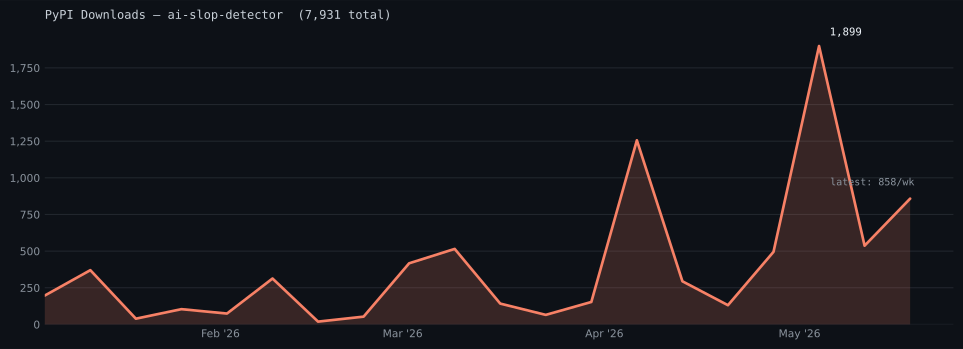

Chart updated weekly via GitHub Actions. Monthly installs: pypistats.org (mirrors excluded). Total: pepy.tech (incl. mirrors)
License
MIT — see LICENSE.
Flamehaven Labs • Issues • Discussions • Docs
Release history Release notifications | RSS feed


Download files
Download the file for your platform. If you're not sure which to choose, learn more about installing packages.
Source Distribution
Built Distribution
Filter files by name, interpreter, ABI, and platform.
If you're not sure about the file name format, learn more about wheel file names.
Copy a direct link to the current filters
File details
Details for the file ai_slop_detector-3.7.9.tar.gz.
File metadata
- Download URL: ai_slop_detector-3.7.9.tar.gz
- Upload date:
- Size: 246.0 kB
- Tags: Source
- Uploaded using Trusted Publishing? Yes
- Uploaded via: twine/6.1.0 CPython/3.13.12
File hashes
| Algorithm | Hash digest | |
|---|---|---|
| SHA256 |
2e1c6870c7a50c359dd7ec6f53391889c622fa6538c2c645d5dcd084322a9bbd
|
|
| MD5 |
591a52e7614423d37c1cdcdbfacbd1a5
|
|
| BLAKE2b-256 |
75a1c8facaedffb90f26ef96a6be93fc785534d80e34dca34c57840de409f17b
|
Provenance
The following attestation bundles were made for ai_slop_detector-3.7.9.tar.gz:
Publisher:
workflow.yml on flamehaven01/AI-SLOP-Detector
-
Statement:
-
Statement type:
https://in-toto.io/Statement/v1 -
Predicate type:
https://docs.pypi.org/attestations/publish/v1 -
Subject name:
ai_slop_detector-3.7.9.tar.gz -
Subject digest:
2e1c6870c7a50c359dd7ec6f53391889c622fa6538c2c645d5dcd084322a9bbd - Sigstore transparency entry: 1721042253
- Sigstore integration time:
-
Permalink:
flamehaven01/AI-SLOP-Detector@49a0c83e9c7ea7b931fddf57747354595e82e13f -
Branch / Tag:
refs/tags/v3.7.9 - Owner: https://github.com/flamehaven01
-
Access:
public
-
Token Issuer:
https://token.actions.githubusercontent.com -
Runner Environment:
github-hosted -
Publication workflow:
workflow.yml@49a0c83e9c7ea7b931fddf57747354595e82e13f -
Trigger Event:
release
-
Statement type:
File details
Details for the file ai_slop_detector-3.7.9-py3-none-any.whl.
File metadata
- Download URL: ai_slop_detector-3.7.9-py3-none-any.whl
- Upload date:
- Size: 218.3 kB
- Tags: Python 3
- Uploaded using Trusted Publishing? Yes
- Uploaded via: twine/6.1.0 CPython/3.13.12
File hashes
| Algorithm | Hash digest | |
|---|---|---|
| SHA256 |
f5b373e0a83bc4b174511c7091cc139dcc1d05d6f883809d09b6e597a1ee382a
|
|
| MD5 |
0dc5d9e51f63863f879b96ca90fd0e75
|
|
| BLAKE2b-256 |
844a93f6a37bd9cfe0b17ea454bb44148e72ae5b2ce551029fd6dafeb8261838
|
Provenance
The following attestation bundles were made for ai_slop_detector-3.7.9-py3-none-any.whl:
Publisher:
workflow.yml on flamehaven01/AI-SLOP-Detector
-
Statement:
-
Statement type:
https://in-toto.io/Statement/v1 -
Predicate type:
https://docs.pypi.org/attestations/publish/v1 -
Subject name:
ai_slop_detector-3.7.9-py3-none-any.whl -
Subject digest:
f5b373e0a83bc4b174511c7091cc139dcc1d05d6f883809d09b6e597a1ee382a - Sigstore transparency entry: 1721042343
- Sigstore integration time:
-
Permalink:
flamehaven01/AI-SLOP-Detector@49a0c83e9c7ea7b931fddf57747354595e82e13f -
Branch / Tag:
refs/tags/v3.7.9 - Owner: https://github.com/flamehaven01
-
Access:
public
-
Token Issuer:
https://token.actions.githubusercontent.com -
Runner Environment:
github-hosted -
Publication workflow:
workflow.yml@49a0c83e9c7ea7b931fddf57747354595e82e13f -
Trigger Event:
release
-
Statement type:






