
YAML-driven LLM + Python + shell pipelines, runnable from the CLI.
Verified details
These details have been verified by PyPIProject links
GitHub Statistics
Maintainers

Project description

aiorch
YAML-driven pipelines for LLMs, Python, and shell — runnable from the command line.



aiorch turns a YAML file into a runnable pipeline. Declare your steps — LLM prompts, Python snippets, shell commands — and aiorch run executes the DAG. No server, no scheduler, no database setup.
pip install aiorch
export OPENROUTER_API_KEY=sk-or-v1-...
aiorch run examples/llm/01-hello-llm.yaml
Works with any provider LiteLLM supports — OpenAI, Anthropic, Gemini, OpenRouter, Ollama, Bedrock, and more.
How it works
aiorch turns a YAML file into an executable DAG. The full lifecycle of aiorch run:
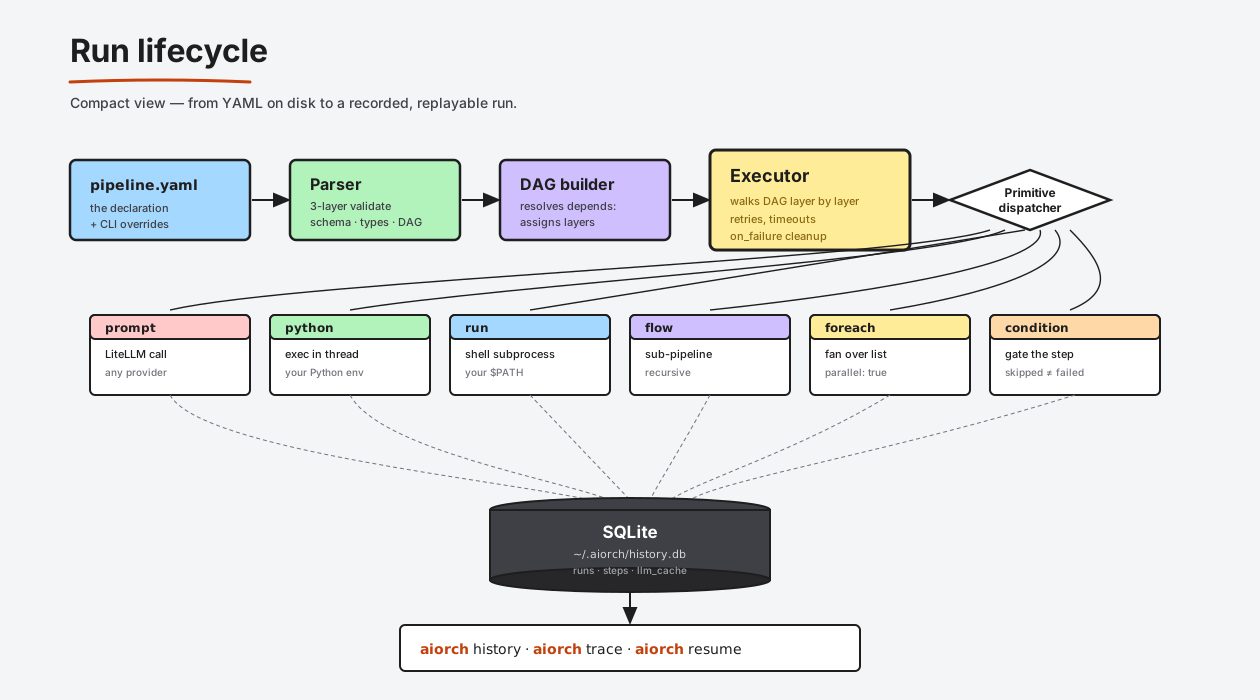
- Parse —
aiorch.core.parserreads your YAML into a typed pipeline object (steps, inputs, dependencies). - DAG build —
aiorch.core.dagresolvesdepends:andforeach:into a layered DAG. Independent steps land on the same layer so they run in parallel. - Execute — the runtime walks the DAG layer by layer. Each step is dispatched to its primitive handler.
- Primitives:
prompt— LLM calls via LiteLLM, response-cached by hash of(prompt, model, temperature, max_tokens).python— a Python body runs in an isolated subprocess withinputsandresultbindings.run— shell command viasubprocess, Jinja-resolved against the context.flow— invoke another pipeline as a single step.foreach— per-item fan-out with optionalparallel: true.condition— branch on a boolean expression.
- Persist — every run and step is logged to SQLite. LLM responses are cached so re-running a step with identical inputs is free.
- Replay —
aiorch history/aiorch trace <run-id>reads back exactly what happened.
A pipeline is a DAG, not a script
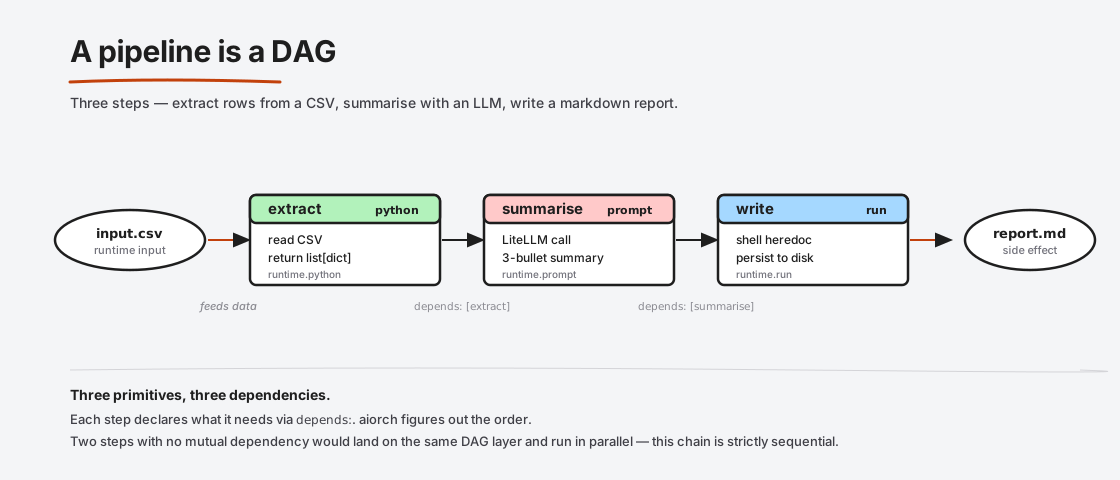
Three steps — extract data, summarise with an LLM, write to disk:
steps:
  extract:
    python: |
      import csv
      rows = list(csv.DictReader(open(inputs["file"])))
      result = [r["comment"] for r in rows]

  summarise:
    prompt: |
      Summarise these customer comments in 3 bullets:
      {% for c in extract %}- {{c}}
      {% endfor %}
    depends: [extract]

  write:
    run: cat > report.md <<EOF
{{summarise}}
EOF
    depends: [summarise]
Each step declares what it needs (depends:) and what it produces (implicit via its name). aiorch figures out the order, the parallelism, and the retries.
Features
- LLM primitives — prompt, schema-validated extraction, classify-and-branch, multi-model comparison.
- DAG shapes — chain, parallel + merge, foreach, diamond, conditional routing.
- LLM + Python hybrid — the LLM for reasoning, deterministic Python for side effects.
- Sub-pipeline composition — one pipeline invokes another via
flow:. - Cost tracking — prompt / completion tokens and USD per provider per run, persisted to
~/.aiorch/history.db. - Dry-run + validation — catch schema errors and unresolved templates before spending tokens.
Not in the CLI: real production connectors (Postgres / S3 / Kafka / SMTP / webhook), the
agent:primitive with function-calling + MCP tools, artifact storage, multi-tenant workspaces, scheduling, and Prometheus metrics. Those live in the commercial aiorch Platform — see §The commercial platform.
Quick start setup
1. Install
pip install aiorch                   # CLI — LLM / Python / shell primitives
pip install 'aiorch[validation]'     # + jsonschema input validation
Requires Python 3.11+.
2. Configure a provider
aiorch works with any model LiteLLM supports. Export the key for whichever provider you're using:
export OPENROUTER_API_KEY=sk-or-v1-...     # OpenRouter (multi-provider, recommended)
export OPENAI_API_KEY=sk-...                # direct OpenAI
export ANTHROPIC_API_KEY=sk-ant-...         # direct Anthropic
export GOOGLE_API_KEY=...                   # direct Google AI
Optionally, drop an aiorch.yaml alongside your pipelines to pin the provider, model, and storage backend:
# aiorch.yaml
llm:
  api_key: ${OPENROUTER_API_KEY}
  api_base: https://openrouter.ai/api/v1
  model: google/gemini-2.5-flash

storage:
  type: sqlite        # default — ~/.aiorch/history.db
Without aiorch.yaml, aiorch falls back to standard env vars (OPENAI_API_KEY, ANTHROPIC_API_KEY, OPENROUTER_API_KEY, etc.) and a sensible default model. aiorch auto-discovers aiorch.yaml by walking up from the current directory, so cd into the folder holding it before running.
3. Write a pipeline
# hello.yaml
name: hello
steps:
  answer:
    prompt: |
      In one sentence, what is aiorch?
    output: summary

  show:
    run: echo "{{summary}}"
    depends: [answer]
4. Run it
$ aiorch run hello.yaml
[answer]  aiorch runs declarative YAML pipelines...
[show]    aiorch runs declarative YAML pipelines...
Override inputs at runtime with -i KEY=VALUE (scalars), -i KEY=@./path (files), or --input file.json (bulk):
$ aiorch run examples/llm/20-csv-to-markdown-report.yaml \
    -i data=@./examples/llm/inputs/sample-projects.csv
5. Inspect the run
aiorch history                 # list recent runs
aiorch trace <run-id>          # step-by-step timeline for one run
aiorch run hello.yaml --dry    # show plan without executing (skips LLM calls)
aiorch run hello.yaml -v       # verbose — print each step's input and output
Every run is persisted to ~/.aiorch/history.db. LLM responses are cached by hash of (prompt, model, temperature, max_tokens) — re-running a step with identical inputs hits the cache and costs nothing.
CLI reference
| Command | Purpose |
|---|---|
aiorch run <file> |
Execute a pipeline |
aiorch validate <file> |
Schema + template lint, no execution |
aiorch list <file> |
List all steps in a pipeline |
aiorch visualize <file> |
ASCII DAG diagram |
aiorch plan <file> |
DAG layers + cost estimate |
aiorch init <template> |
Scaffold a new pipeline from a template |
aiorch history |
List recent runs and their status |
aiorch history <run-id> |
Show details of one run |
aiorch trace <run-id> |
Step-by-step trace for one run |
Run aiorch --help for the full list of flags.
Examples
72 runnable pipelines shipped under examples/, organized into two tracks:
| Directory | Count | What's inside |
|---|---|---|
examples/llm/ |
30 | LLM pipelines — prompts, extraction, chains, fan-out, hybrid LLM + Python |
examples/core/ |
42 | Zero-LLM pipelines — every primitive, every DAG shape, input types, developer utilities |
Each track has its own walkthrough:
examples/README.md— start here for the full guide on secrets, model selection, and passing inputs.examples/llm/README.md— LLM pipelines by tier (basic → DAG shapes → hybrid → developer workflows).examples/core/README.md— core pipelines by group (primitives → DAG shapes → DB access → production patterns → utilities).
# Core pipelines — no API key required
aiorch run examples/core/01-smoke-test.yaml

# LLM pipelines — provider config lives at examples/llm/aiorch.yaml
export OPENROUTER_API_KEY=sk-or-v1-...
cd examples/llm && aiorch run 01-hello-llm.yaml
Roadmap
This is v0.1 alpha — YAML schema and CLI flags may change. Pin an exact version in CI.
Planned:
- Additional LLM primitives (structured output schemas, streaming sinks).
- Richer
flow:composition (parameter forwarding, outputs passthrough). - First-class Windows support.
Contributing
Issues and pull requests welcome at github.com/ereshzealous/aiorch-cli.
The commercial platform
Everything above is the OSS CLI — LLM orchestration, YAML DAG, local SQLite history. For team-scale work you'll want the commercial aiorch Platform, which adds:
- Production connectors — Postgres, S3 / MinIO / R2 / GCS, Kafka, SMTP, webhook — with workspace-scoped secrets and audit logs.
agent:primitive with MCP — function-calling agents over stdio + Streamable HTTP, plus a session-pooled MCP registry for cross-replica agent orchestration.- Artifact store — content-addressed file storage (local disk or S3-compatible) with dedup, quotas, and UI download.
- Multi-tenant workspaces + RBAC — orgs, workspaces, roles (viewer / operator / editor / admin / owner), API keys, invitations.
- Scheduler + webhook triggers — cron, HMAC-verified webhooks, per-trigger rate limits, delivery history.
- Executor fleet — distributed, admission-controlled, Redis-coordinated run execution with per-workspace concurrency caps.
- Web UI — full-featured dashboard, pipeline editor, trace viewer, cost analytics, health page, and coordination observability.
- Prometheus metrics + /api/health — production observability for every runtime surface.
- Postgres storage — run history, audit trail, and query-able run metadata across a team.
Contact if that's you.
License
Apache 2.0 — see LICENSE.
Project details
Verified details
These details have been verified by PyPIProject links
GitHub Statistics
Maintainers
Release history Release notifications | RSS feed


Download files
Download the file for your platform. If you're not sure which to choose, learn more about installing packages.
Source Distribution
Built Distribution
Filter files by name, interpreter, ABI, and platform.
If you're not sure about the file name format, learn more about wheel file names.
Copy a direct link to the current filters
File details
Details for the file aiorch-0.1.2.tar.gz.
File metadata
- Download URL: aiorch-0.1.2.tar.gz
- Upload date:
- Size: 302.5 kB
- Tags: Source
- Uploaded using Trusted Publishing? Yes
- Uploaded via: twine/6.1.0 CPython/3.13.12
File hashes
| Algorithm | Hash digest | |
|---|---|---|
| SHA256 |
b071f78c8133fd0cd34fdbe87a7d7c451641ddf823966489f9f47d1dade9228f
|
|
| MD5 |
d32521045b2349f502ba96fac54d3a6c
|
|
| BLAKE2b-256 |
aed41df7be8a72bc2b23072ba68e1a68b3360156539e3e421dfc0104c92ba5a2
|
Provenance
The following attestation bundles were made for aiorch-0.1.2.tar.gz:
Publisher:
cd.yml on ereshzealous/aiorch-cli
-
Statement:
-
Statement type:
https://in-toto.io/Statement/v1 -
Predicate type:
https://docs.pypi.org/attestations/publish/v1 -
Subject name:
aiorch-0.1.2.tar.gz -
Subject digest:
b071f78c8133fd0cd34fdbe87a7d7c451641ddf823966489f9f47d1dade9228f - Sigstore transparency entry: 1342720649
- Sigstore integration time:
-
Permalink:
ereshzealous/aiorch-cli@213a1fc030ac86656ec9b875c1be34a6d2383cb4 -
Branch / Tag:
refs/heads/main - Owner: https://github.com/ereshzealous
-
Access:
public
-
Token Issuer:
https://token.actions.githubusercontent.com -
Runner Environment:
github-hosted -
Publication workflow:
cd.yml@213a1fc030ac86656ec9b875c1be34a6d2383cb4 -
Trigger Event:
workflow_dispatch
-
Statement type:
File details
Details for the file aiorch-0.1.2-py3-none-any.whl.
File metadata
- Download URL: aiorch-0.1.2-py3-none-any.whl
- Upload date:
- Size: 145.1 kB
- Tags: Python 3
- Uploaded using Trusted Publishing? Yes
- Uploaded via: twine/6.1.0 CPython/3.13.12
File hashes
| Algorithm | Hash digest | |
|---|---|---|
| SHA256 |
8cb384f49c541bc4d8206dd7e263ed29d72de78c60e5d4f66412407b19c284b2
|
|
| MD5 |
0f4ae004df3346af3343025d2f3284bb
|
|
| BLAKE2b-256 |
5665e38fdee3ec0ce8b8b91e670aca9110f10cf386a1d119b52052b015507008
|
Provenance
The following attestation bundles were made for aiorch-0.1.2-py3-none-any.whl:
Publisher:
cd.yml on ereshzealous/aiorch-cli
-
Statement:
-
Statement type:
https://in-toto.io/Statement/v1 -
Predicate type:
https://docs.pypi.org/attestations/publish/v1 -
Subject name:
aiorch-0.1.2-py3-none-any.whl -
Subject digest:
8cb384f49c541bc4d8206dd7e263ed29d72de78c60e5d4f66412407b19c284b2 - Sigstore transparency entry: 1342720659
- Sigstore integration time:
-
Permalink:
ereshzealous/aiorch-cli@213a1fc030ac86656ec9b875c1be34a6d2383cb4 -
Branch / Tag:
refs/heads/main - Owner: https://github.com/ereshzealous
-
Access:
public
-
Token Issuer:
https://token.actions.githubusercontent.com -
Runner Environment:
github-hosted -
Publication workflow:
cd.yml@213a1fc030ac86656ec9b875c1be34a6d2383cb4 -
Trigger Event:
workflow_dispatch
-
Statement type:






