
allen-circuit-dynamics




Latent-variable models of simultaneously recorded neural populations, run on open data from the Allen Institute and its collaborators, with a pipeline that runs end-to-end on synthetic data in under a minute. Independent work; not affiliated with or endorsed by the Allen Institute.
pip install allen-circuit-dynamics
acd demo --out outputs/demo          # both Neuropixels experiments on synthetic data, ~30 s, no downloads
from allen_circuit_dynamics import PopulationDataset, SharedPrivateFA, run_latent_experiment

ds = PopulationDataset.load("my_session.npz")          # x1, x2, behavior, blocks, bin_s
metrics = run_latent_experiment(ds)                    # held-out selection, partition, decoding
model = SharedPrivateFA(d_shared=3, d_private=(2, 2)).fit(ds.x1, ds.x2)
latents = model.transform(ds.x1, ds.x2)                # {"shared": ..., "private1": ..., "private2": ...}
One model sits underneath: a population's activity is a few shared latents, a few private latents, and per-neuron noise, possibly with linear dynamics on the latents. The four experiments score that model on three different output contracts, in the sense of asking what the model is for:
| Contract | Scored by | Data | |
|---|---|---|---|
| Exp 1 | Observations — reconstruct the recorded activity | held-out log-likelihood; shared / private / independent variance partition | Visual Coding Neuropixels, VISrl ↔ VISp |
| Exp 2 | State — predict the next latent state | held-out one-step R², with and without an anatomical prior | Visual Coding Neuropixels, five visual areas + Mouse Connectivity Atlas |
| Exp 3 | Action — predict the animal's output from the latents | held-out R² of lever displacement per subspace, lag profile, pre-registered | Klee et al. 2026 two-photon D1 / D2 striatum (Zenodo) |
| Exp 4 | Action, timing — does the activity come before the output? | per-unit and population lag against running speed, pre-registered | Lakunina et al. 2026 Neuropixels Opto, optotagged D1 / D2 striatum (AIND open data) |
A model that scores well on one contract need not score well on another; the
point of running all three is to say which one each dataset supports. Full
results, figures and limits: docs/results.md. (The
observation / state / action split is the agent–environment loop with the
latent as the state; the same three-way reading has been used to sort
"world models" by what they emit.)
What came out
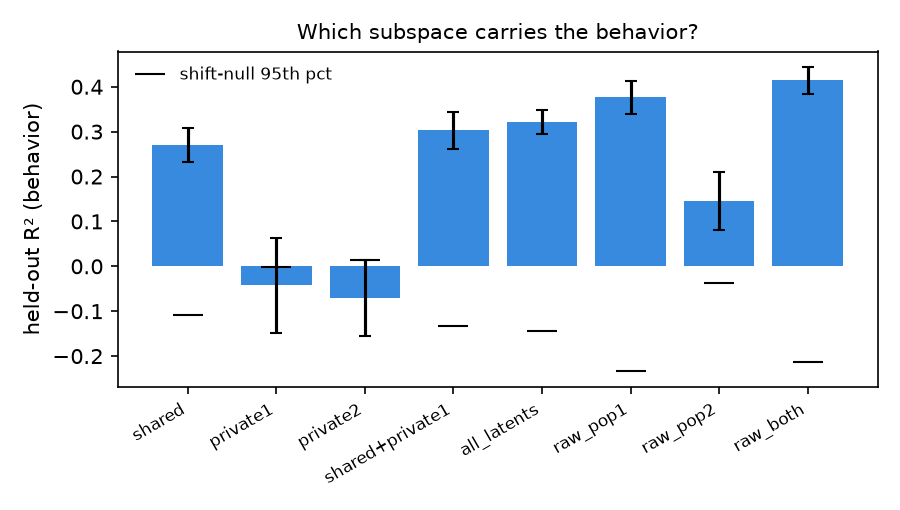
Experiment 1 — observations. Visual Coding session 715093703, VISrl ↔ VISp, 50 ms bins. Held-out likelihood selects 6 shared + 4 private dimensions. The shared subspace decodes running speed (R² 0.27, circular-shift null p95 −0.11); neither private subspace does; cross-area prediction is near zero (RRR ≤ 0.04). At this bin size the shared signal reads as slow common drive (locomotion / arousal), not communication.
Experiment 2 — state. Five visual areas, same session. The atlas prior does no better than a shuffled prior at any penalty strength, and unconstrained coupling norms do not track projection density (r = 0.38, permutation p = 0.075). A null, reported as one. The first real run exposed two bugs — a penalty that was not scale-free, and a correlation computed from the penalised fit (which had read r = 0.54, p = 0.016) — both fixed and kept in the record.
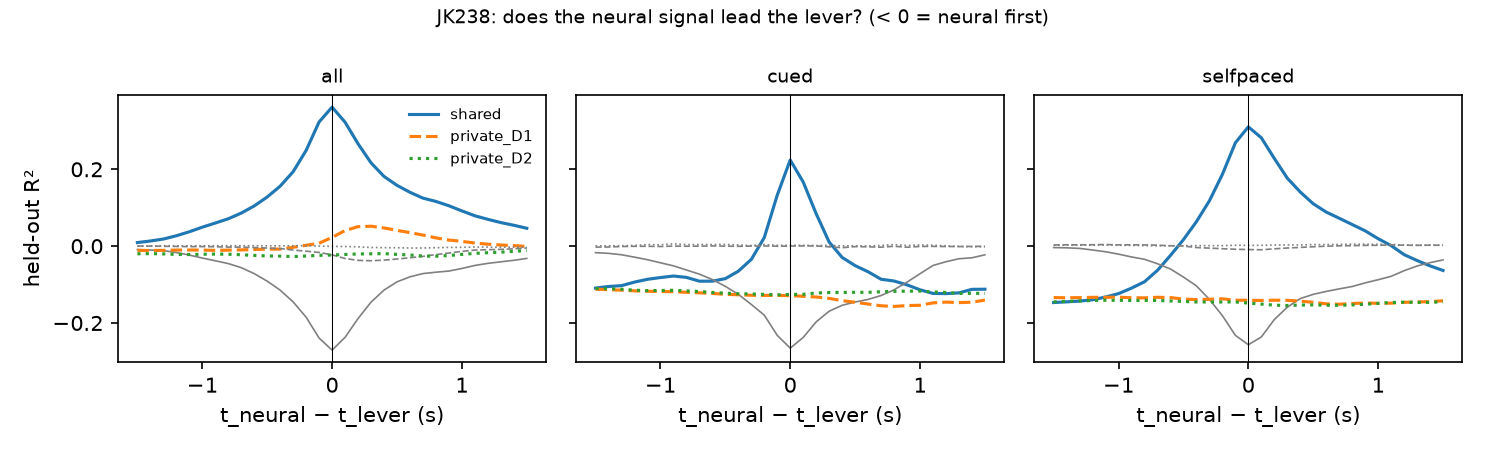
Experiment 3 — action. Klee et al. (2026), six mice, D1 and D2 striatal
neurons imaged together with a lever; pre-registered before the run
(docs/experiment3_preregistration.md).
Most of the correlated variance in either population is shared with the other
(shared fractions 0.16–0.26, 1–5 % population-specific), but a post hoc
control finds the same partition for random splits of the same neurons, so it
describes the striatal population, not a D1/D2 difference. The shared subspace
decodes the lever in two mice (R² 0.36, 0.17) and not in three; the predicted
neural lead does not appear at 30 fps. Three of six pre-registered predictions
were met; all six are scored against the written thresholds in
docs/results.md.
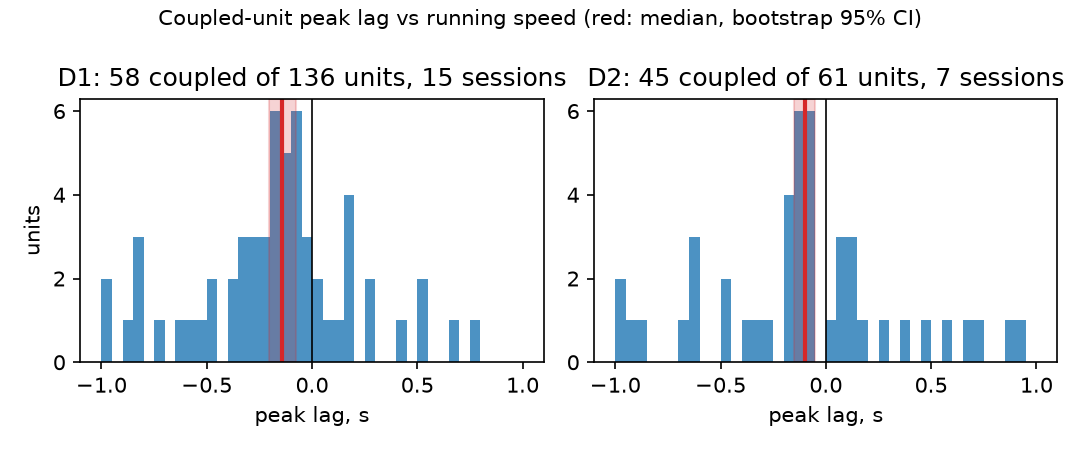
Experiment 4 — timing. Experiment 3 found no neural lead and blamed the
calcium indicator; this tests that on spikes. Lakunina et al. (2026)
Neuropixels Opto sessions, optotagged D1 and D2 units, read straight from
Allen's open bucket; pre-registered
(docs/experiment4_preregistration.md).
Across 31 sessions, speed-coupled D1 units lead running by a median 145 ms
and D2 units by 100 ms. The pre-registered bootstrap over units excludes zero;
a post hoc bootstrap over mice does not (D1 −360 to +70 ms, 7 mice; D2 −260
to +60 ms, 5 mice). The lead is negative in most mice (5 of 7, 4 of 5) but not
established for striatum. Two of four pre-registered predictions met;
the D1-vs-D2 comparison is under-powered, and the pre-registered population
metric could not see timing in these sessions — all reported as written.
Every result is a first pass, not a study: Experiments 1–3 use one session per
animal, Experiment 4 pools 31 sessions from 19 mice. Two post hoc checks added
in 0.3.1 narrow the Experiment 3 and 4 readings; both are in docs/results.md,
labelled as post hoc, with the scripts that reproduce them. The
limits are listed in docs/results.md.
Models
x1 = W1 z + V1 u1 + mu1 + e1        z  : shared latents        (both populations)
x2 = W2 z + V2 u2 + mu2 + e2        u1, u2 : private latents   (one population each)
                                    e  : independent per neuron
Block-sparse factor analysis fit by EM with the zero pattern enforced at every M-step — the static case of probabilistic CCA with explicit private subspaces (Bach & Jordan 2005) and of DLAG without delays (Gokcen et al. 2022). Dimensions by held-out log-likelihood under grouped cross-validation where every fold is a run of contiguous time. Benchmarks: reduced-rank regression (Semedo et al. 2019), CCA, per-population FA. Decoding by ridge against a circular-shift null that keeps the behavior's autocorrelation.
For the state contract, per-area latents are stacked and fit with
S[t+1] = S[t] A + b; the atlas enters as a penalty on each area-to-area block
of A proportional to how weak that projection is, scaled to the data
curvature so λ is dimensionless; the control is the same fit with a shuffled
atlas.
Run it
uv venv && source .venv/bin/activate
uv pip install -e ".[dev]"
acd demo --out outputs/demo_local  # both experiments, synthetic, ~30 s (outputs/demo/ is the committed run)
pytest
Real data (Visual Coding Neuropixels, public S3 bucket, no credentials):
uv venv --python 3.10 .venv-allen && uv pip install --python .venv-allen/bin/python -e ".[allen]"   # allensdk pins old scipy/pandas
.venv-allen/bin/acd fetch --session 715093703 --out data/ecephys    # areas chosen from the session (top VIS* by QC-passing units)
SESSION=715093703 bash scripts/run_experiments.sh                    # connectivity matrix + both experiments
scripts/bootstrap_linux.sh --fetch does all of the above on a fresh Linux or WSL box,
including a parallel ranged download of the 2.7 GB NWB from Allen's public S3
bucket (scripts/pdl.sh; allensdk's own download times out on slow links).
Experiment 3 (Klee et al. 2026, 246 MB, CPU only, ~45 min per mouse):
# Data Structures/Switching_2p_Struc_Main.mat from https://zenodo.org/records/16333867
acd force --mat Switching_2p_Struc_Main.mat --mouse all --out outputs/force_klee
Experiment 4 (Lakunina et al. 2026 Neuropixels Opto sessions, read straight from Allen's public bucket as NWB-zarr — no download step, ~100 MB per session, ~2 min each):
pip install "allen-circuit-dynamics[aind]"                  # or, in a clone: uv pip install -e ".[aind]"
acd lead --sessions all --out outputs/lead_aind --resume      # 40 sessions; --sessions a,b for a subset
python scripts/evaluate_prereg_exp4.py outputs/lead_aind      # H5–H7 verdict table from the metrics
What the loader does to the data
- Unit QC:
isi_violations < 0.5,amplitude_cutoff < 0.1,presence_ratio > 0.9. - Bins spikes at 50 ms inside the chosen stimulus epoch only (default
natural_movie_one); a bin never straddles two presentation windows. - Behavior = mean running speed per bin; bins with no speed samples are dropped and counted in the metadata.
- Units under 0.5 Hz are dropped and counted. Counts are square-root transformed, then z-scored with training-fold statistics inside every cross-validation loop.
- Twelve contiguous blocks define the CV groups.
Every metrics.json carries a provenance block: package version, git SHA,
library versions, config hash, and the dataset's own metadata.
Layout
src/allen_circuit_dynamics/
  dataset.py          PopulationDataset — the one container every stage uses
  synth.py            planted-structure generators (all three experiments)
  preprocess.py       unit filter, sqrt, fold-safe scaling
  models/shared_private.py   block-sparse FA by EM
  models/baselines.py        RRR, CCA, per-population FA
  models/coupling.py         connectivity-penalised linear dynamics + shuffle control
  decode.py           grouped-CV ridge decoding with a circular-shift null
  experiments.py      experiments 1 and 2 as pure functions → metrics dict
  report.py           figures from metrics, one function per experiment
  allen_data.py       AllenSDK loader (lazy import) + atlas projection matrix
  klee_data.py        Klee et al. 2026 two-photon loader (h5py; dF/F per the paper)
  lagged.py           lag pairing that never crosses CV blocks; within-block shift null
  experiments_force.py  Experiment 3 (count-matched draws, contexts, lag profile)
  aind_opto.py        Neuropixels Opto loader: NWB-zarr columns over HTTP from s3://aind-open-data
  experiments_lead.py Experiment 4 (per-unit and population lag vs running speed, pooled verdicts)
  cli.py              acd demo | fetch | latent | coupling | force | lead
docs/results.md                       full write-up, verdict tables, limits
docs/experiment3_preregistration.md   hypotheses, grid, controls, decision rules — committed before the run
docs/experiment4_preregistration.md   same for Experiment 4
tests/                23 tests (~15 s without the three marked slow), synthetic only
scripts/              bootstrap_linux.sh, run_experiments.sh, evaluate_prereg.py, evaluate_prereg_exp4.py, replot_force.py
                      posthoc_exp3_random_split.py, posthoc_exp4_hierarchical.py (post hoc, not pre-registered)
References
- Bach & Jordan (2005). A probabilistic interpretation of canonical correlation analysis.
- Semedo, Zandvakili, Machens, Yu & Kohn (2019). Cortical areas interact through a communication subspace. Neuron.
- Gokcen, Jasper, Semedo, Zandvakili, Kohn, Machens & Yu (2022). Disentangling the flow of signals between populations of neurons. Nature Computational Science.
- Siegle et al. (2021). Survey of spiking in the mouse visual system reveals functional hierarchy. Nature. (Visual Coding Neuropixels dataset)
- Oh et al. (2014). A mesoscale connectome of the mouse brain. Nature. (Mouse Connectivity Atlas)
- Klee, Fernando-Peiris, Athalye, Costa, Peterka & Sippy (2026). Shared striatal neurons exhibit context-specific dynamics for internally and externally driven actions. Science Advances. Data: Zenodo 10.5281/zenodo.16333867, CC BY 4.0. (Experiment 3 dataset)
- Athalye, Ganguly, Costa & Carmena (2017). Emergence of coordinated neural dynamics underlies neuroprosthetic learning and skillful control. Neuron. (shared vs. private variance vocabulary)
- Lakunina, Socha, Ladd, …, Siegle & Carandini (2026). Neuropixels Opto: combining high-resolution electrophysiology and optogenetics. Nature Methods. Data: Allen Institute for Neural Dynamics,
s3://aind-open-data, CC BY 4.0; Code Ocean capsule 1593868. (Experiment 4 dataset)
1 maintainer

Metadata
1 maintainer
Release files for allen-circuit-dynamics 0.3.1
For a detailed explanation of source distributions (sdists) and built distributions (wheels), please see the package formats documentation.
Source distribution (sdist)
| File | Size | Uploaded | Provenance | Actions |
|---|---|---|---|---|
| allen_circuit_dynamics-0.3.1.tar.gz | 58.1 kB | With provenance | Details for allen_circuit_dynamics-0.3.1.tar.gz |
Built distribution (wheel)
| File | Interpreter | ABI | Platform | Actions Reset |
|---|---|---|---|---|
| allen_circuit_dynamics-0.3.1-py3-none-any.whl | Python 3 | none | any | Details for allen_circuit_dynamics-0.3.1-py3-none-any.whl |
Total release size: 120.1 kB
Release files / allen_circuit_dynamics-0.3.1.tar.gz
| Download URL | allen_circuit_dynamics-0.3.1.tar.gz |
|---|---|
| Size | 58.1 kB |
| Tags | Source |
|
SHA-256 checksum How to use checksums |
0c7387d257bdc781aeb74dd3d890d421b43092c0147c7045ceb18d4665c5034a
|
|
BLAKE2b-256 checksum How to use checksums |
c8dbe8b88025436fa18a2c3f6bab67e25941c00bd1527a7a9cbbb110c8b16062
|
| Upload date | |
|
Uploaded using Trusted Publishing? What is trusted publishing? |
Yes |
| Uploaded via |
twine/7.0.0 CPython/3.13.16
|
Provenance
Provenance describes where a file came from. On PyPI, provenance is shared via attestations, which provide a verifiable record of the build or publishing details. View details, limitations and caveats.


PyPI Publish Attestation
PyPI verified that this artifact, at this checksum, originated from the publisher listed below.
Signed by GitHub Actions, verified by PyPI on Nov 1, 2026.
Transparency logRelease files / allen_circuit_dynamics-0.3.1-py3-none-any.whl
| Download URL | allen_circuit_dynamics-0.3.1-py3-none-any.whl |
|---|---|
| Size | 62.0 kB |
| Tags | Python 3 |
|
SHA-256 checksum How to use checksums |
14b3832b270b316587b653f20a294ffa817187b027ed79faa58c047684ee1ea3
|
|
BLAKE2b-256 checksum How to use checksums |
360f47948f3a7b5f4463da1e62e3462820c9a5699e00e79664f29b388f543c74
|
| Upload date | |
|
Uploaded using Trusted Publishing? What is trusted publishing? |
Yes |
| Uploaded via |
twine/7.0.0 CPython/3.13.16
|
Provenance
Provenance describes where a file came from. On PyPI, provenance is shared via attestations, which provide a verifiable record of the build or publishing details. View details, limitations and caveats.
PyPI Publish Attestation
PyPI verified that this artifact, at this checksum, originated from the publisher listed below.
Signed by GitHub Actions, verified by PyPI on Nov 1, 2026.
Transparency logSecurity for allen-circuit-dynamics 0.3.1
Provenance
Provenance describes where a file came from. On PyPI, provenance is shared via attestations, which provide a verifiable record of the build or publishing details. View details, limitations and caveats.
Full provenance
All 2 files in this release have been uploaded with provenance metadata.
Attestation for allen_circuit_dynamics-0.3.1.tar.gz
PyPI Publish Attestation
PyPI verified that this artifact, at this checksum, originated from the publisher listed below.
Signed by GitHub Actions, verified by PyPI on Nov 1, 2026.
Transparency logA note on package security
PyPI is a repository for distributing packages, not a service for auditing them. While third-party security researchers and our staff do their best to detect and remove malicious packages, PyPI cannot guarantee the quality, security or suitability of any given package.
To learn more about protecting yourself from malicious actors, visit our package security documentation.














