
Visual schema design for SQLModel and SQLAlchemy. Edit your database as a diagram, write it back as code.

Project description
Alter
Comprehension first, design second.
Visual schema design for SQLModel and SQLAlchemy. Edit your database as a diagram, write it back as code.
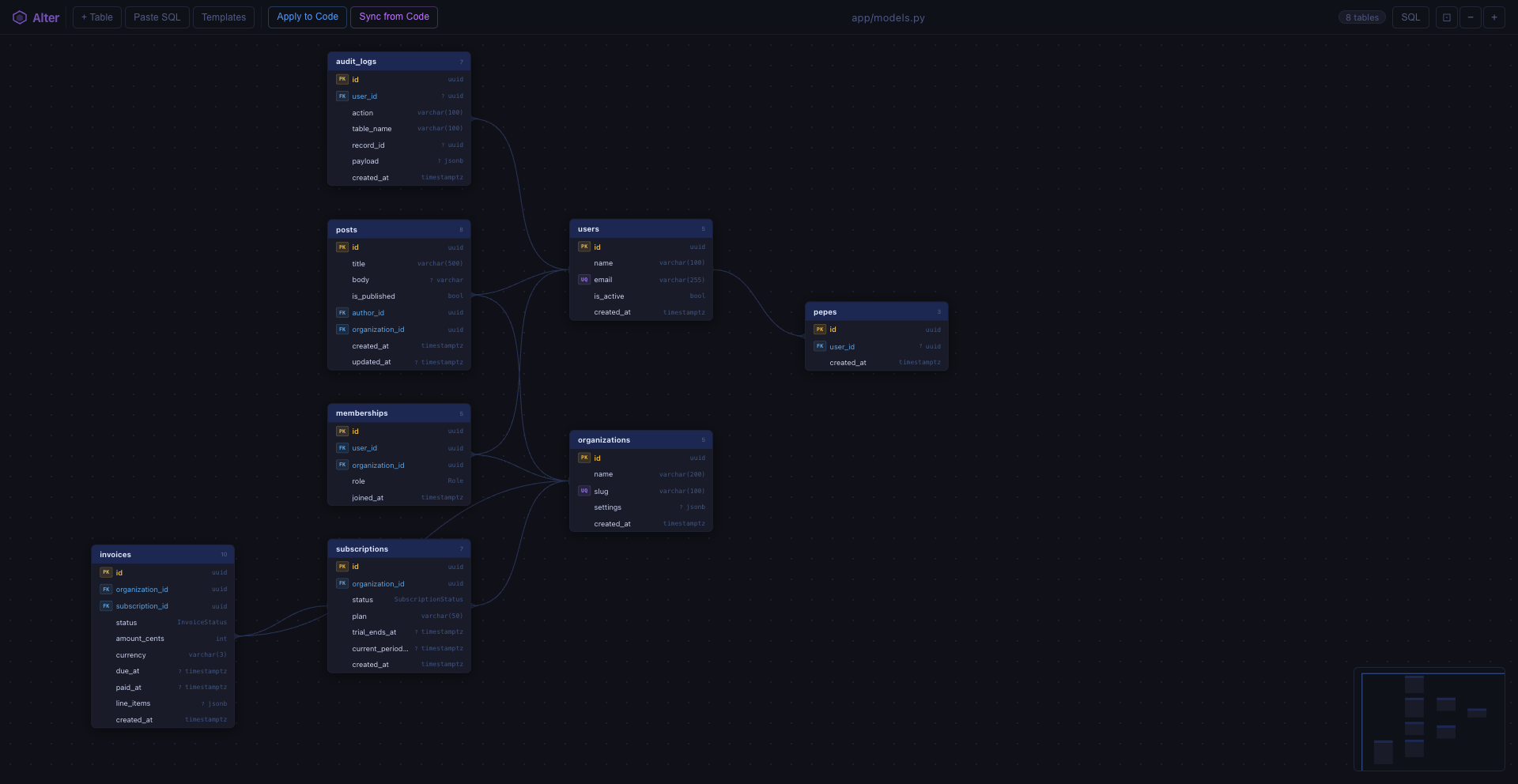
What is Alter?
Alter is a local-first schema tool that keeps your ORM models and a visual ERD canvas in sync — in both directions:
  ┌─────────────┐                       ┌───────────────┐
  │  Your Code  │  ── alter sync ─────► │    Canvas     │
  │ (models.py) │                       │ (visual ERD)  │
  │             │  ◄── alter apply ──── │               │
  └─────────────┘                       └───────────────┘
                    schema.alter
                  (keeps both in sync)
You design tables on the canvas, and Alter writes clean Python classes back to your files. You edit your models by hand, and Alter updates the canvas to match.
Everything runs locally. No cloud, no account, no data leaves your machine.
Installation
pip install alterdb
Or with uv:
uv add alterdb
Requirements: Python 3.11+
Dependency conflicts? If
alterdbclashes with packages already in your project, install it as an isolated CLI tool instead:uv tool install alterdbThis keeps Alter's dependencies completely separate from your project's virtual environment while making the
altercommand available on yourPATH.
Live database introspection (MCP
introspect_dbtool): requirespsycopg2-binary, install withpip install alterdb[db].
Quick Start
From existing models
alter init      # scan your ORM models → create schema.alter
alter canvas    # open the visual ERD in your browser
Your browser opens with an interactive diagram of every table, column, and relation in your project.
From an existing database
Export your database schema as SQL, then import it:
pg_dump --schema-only --no-owner mydb > schema.sql
alter import schema.sql     # parse DDL and merge tables into schema.alter
alter canvas                # open the visual editor
Or start the canvas first and use Paste SQL in the toolbar to paste your DDL directly.
Starting from scratch
No models yet? Start with a blank canvas or one of the built-in templates:
alter init      # creates an empty schema.alter
alter canvas    # open the canvas, click "Templates" to pick a starter
Choose from saas-base, auth, cms, or ecommerce — tables are proposed on the canvas so you can review and customize before committing anything.
What is schema.alter?
schema.alter is a JSON file that captures your table definitions, column types, relations, and
canvas layout positions. It sits between your Python code and the visual editor — a single source
of truth that's human-readable, git-diffable, and lives in your repo.
Think of it as a .lock file for your database schema, except you can open it in a browser and
edit it visually.
A minimal example:
{
  "version": 1,
  "orm": "sqlmodel",
  "tables": [
    {
      "name": "users",
      "file_path": "app/models.py",
      "position": { "x": 0, "y": 0 },
      "columns": [
        { "name": "id",    "type": "uuid",   "primary_key": true,  "default": "uuid4" },
        { "name": "email", "type": "string", "nullable": false,    "unique": true     },
        { "name": "name",  "type": "string", "nullable": false                        }
      ]
    }
  ]
}
The Two-Way Workflow
Two commands keep schema.alter synchronized with your code:
Canvas → Code
You add a table or modify a column on the canvas, then click Commit (or use the in-canvas Apply to Code button), or run from the terminal:
alter apply --preview   # see exactly what will change (unified diff)
alter apply             # write the changes to your model files
alter apply is surgical — it only modifies the classes that changed. Your docstrings,
Relationship() definitions, inline comments, and hand-written formatting are preserved.
For example, drawing a Payment table on the canvas and clicking Commit writes this to
app/models.py:
import uuid
from sqlmodel import Field, SQLModel


class Payment(SQLModel, table=True):
    __tablename__ = "payments"

    id: uuid.UUID = Field(default_factory=uuid.uuid4, primary_key=True)
    amount: int
    currency: str = Field(max_length=3)
    user_id: uuid.UUID = Field(foreign_key="users.id")
Enum changes are written to the correct file: if Role is defined in app/enums.py, edits on
the canvas update app/enums.py — not your model file.
Code → Canvas
You edit models.py by hand, then click the in-canvas Sync from Code button, or run:
alter sync # re-parse your models, update schema.alter
The canvas picks up the change automatically via live reload — no restart needed.
Preview changes before committing
alter diff                    # see what changed (text)
alter diff --format markdown  # PR-ready changelog
Complete Workflow Example
Here's the full story, from a fresh project to running migrations:
# 1. Initialise
alter init                            # scan models → schema.alter

# 2. Create the initial migration (one-time, with your migration manager)
#    Example with Alembic — see Migrations section below
alembic init alembic
alembic revision --autogenerate -m "initial schema"
alembic upgrade head                  # create tables in the database

# 3. Open the canvas and make changes
alter canvas

# — design on the canvas —
# add a "payments" table, click Commit
# the "Migrations" tab shows the SQL that needs to run

# 4. Apply canvas changes to code
alter apply --preview                 # see the unified diff
alter apply                           # write class Payments to models.py

# 5. Run the migration with your own tooling
#    Copy the SQL from the canvas Migrations tab, then:
alembic revision -m "add payments table"   # create revision file
# paste the SQL into the upgrade() function
alembic upgrade head
Migrations
Alter generates the SQL — you run it with whatever migration tool you already use.
The Migrations tab in the canvas shows the pending SQL at any time. The preview_migration
MCP tool returns the same SQL to AI assistants. Copy it into your migration manager of choice.
With Alembic (one-time setup)
alembic init alembic # creates alembic.ini + alembic/env.py + alembic/versions/
Edit alembic/env.py so Alembic knows about your models:
from sqlmodel import SQLModel
import app.models  # ensure all models are imported and registered

target_metadata = SQLModel.metadata   # required for autogenerate
Initial migration
Create all tables from scratch:
alembic revision --autogenerate -m "initial schema"
alembic upgrade head
Incremental migrations (canvas or MCP driven)
After the initial migration, use the canvas Migrations tab to see the SQL for any canvas or MCP change, then apply it with your tool:
# 1. Make changes on the canvas or via MCP
# 2. See the SQL in the canvas Migrations tab (or call preview_migration via MCP)
# 3. Create and apply the migration:
alembic revision -m "add payments table"   # create an empty revision
# paste the SQL into upgrade() in the new file
alembic upgrade head
With other tools (Django, Flyway, raw SQL, etc.) — the workflow is the same: copy the SQL from the canvas Migrations tab and apply it however your project requires.
Adding a File to an Existing Schema
Got a legacy module or a new plugin with its own models? Add it without touching your main schema:
alter add app/legacy/models.py        # parse and merge new tables into schema.alter
alter add lib/plugins/billing.py      # tables already in the schema are skipped
alter add parses the file, adds any new tables (and their enum types), and saves schema.alter.
Already-tracked tables are silently skipped — safe to run multiple times.
Cross-File Support
Alter understands multi-file projects out of the box:
- Enums in separate files — if
Roleis defined inapp/enums.py, Alter tracks itsfile_pathso thatalter applynever duplicates the enum class in your model file. - Base class inheritance — columns inherited from mixin classes (e.g.
UUIDBase,TimestampedBase) are tracked as inherited and never re-injected as explicit field definitions when applying to code. - Multi-file models — tables can live in different files;
alter applywrites each table to the correct file independently.
Enums on the Canvas
Enums are displayed on the canvas as read-only reference cards showing each enum's name and values. This lets you see which types are available when wiring up columns, but enums cannot be added, edited, or deleted from the canvas — the source file is the single source of truth.
To add or change an enum, edit the source file directly (e.g. app/enums.py), then sync:
alter sync # re-parse models → refresh schema.alter
Or click Sync from Code in the canvas toolbar. The updated enum appears immediately.
Templates
Alter ships four starter templates, accessible from the Templates button in the canvas toolbar or via the CLI:
| Template | Tables |
|---|---|
saas-base |
users, organizations, memberships, sessions |
auth |
users, sessions, tokens, oauth_accounts |
cms |
posts, categories, tags, media |
ecommerce |
products, orders, order_items, customers |
Import a template into an existing project:
alter import templates/ecommerce.alter
Tables already in your schema are skipped — no duplicates.
Commands
Quick reference
| Command | What it does |
|---|---|
alter init |
Create schema.alter from existing ORM model files |
alter canvas |
Open the interactive ERD in your browser |
alter apply |
Write schema changes to your ORM model files |
alter sync |
Update schema.alter from your ORM model files |
alter add |
Add tables from a model file to the schema |
alter diff |
Show pending changes between schema and code |
alter validate |
Check your schema for errors and warnings |
alter export |
Export as SQL DDL, Mermaid ERD, or .alter JSON |
alter import |
Import tables from a .sql or .alter file |
alter merge-driver |
Git merge driver for .alter files |
alter mcp |
Start the MCP server |
alter diff
Compare schema.alter with your ORM model files and show what has drifted:
alter diff                      # text summary (+ added, ~ modified, - removed)
alter diff --format markdown    # PR-ready markdown changelog
Useful before committing code changes or before opening a PR to make sure the canvas and the code are still in sync. Exits non-zero if there are differences.
alter validate
Check the schema for structural problems before applying or exporting:
alter validate
Reports errors (broken FK references, duplicate table names, unsupported type combinations), warnings, and info-level hints. Exits with code 1 if any errors are found — safe to use in CI.
alter export
Export the committed schema in different formats:
alter export                              # SQL DDL to stdout (default)
alter export --format mermaid             # Mermaid ERD diagram to stdout
alter export --format alter               # raw schema.alter JSON to stdout
alter export --output schema.sql          # write to a file instead of stdout
alter export --format mermaid --output erd.md   # write Mermaid to a file
alter export --proposed                   # export staged (uncommitted) changes
The Mermaid output can be pasted directly into GitHub Markdown, Notion, or any
tool that renders ```mermaid fences:
```mermaid
erDiagram
  users {
    uuid id PK
    string email
  }
  posts {
    uuid id PK
    uuid author_id FK
  }
  users ||--o{ posts : "author_id"
```
alter import
Merge tables from an external source into schema.alter. Tables already present
are skipped — safe to run multiple times:
alter import schema.sql             # import from a pg_dump or hand-written DDL
alter import other.alter            # import from another schema.alter file
alter import templates/saas.alter   # import a built-in template
Format is auto-detected from the file extension (.sql or .alter). You can
also override it with --format sql or --format alter.
alter merge-driver
A custom Git merge driver that merges schema.alter files structurally (by
table name) instead of line-by-line, which eliminates most merge conflicts when
two branches add different tables.
One-time setup (run once per machine):
git config --global merge.alter.name   "Alter schema merge driver"
git config --global merge.alter.driver "alter merge-driver %O %A %B"
Then add to your repo's .gitattributes:
*.alter merge=alter
After that, Git uses the driver automatically whenever a .alter file is
involved in a merge or rebase. No further action needed.
MCP Server
Alter exposes your schema to any MCP-compatible AI assistant (Claude Code, Cursor, Windsurf, etc.) so it can read, modify, and commit schema changes programmatically — all through natural language.
Setup
Step 1 — Initialize the schema file (if you haven't already):
alter init # scan your ORM models → create schema.alter
The MCP server requires schema.alter to exist before it can start.
Step 2 — Register the server in your editor.
Most editors use the same JSON config. Add this to your MCP settings file:
{
  "mcpServers": {
    "alter": {
      "command": "uv",
      "args": ["run", "--directory", "/path/to/project", "alter", "mcp"]
    }
  }
}
Replace /path/to/project with the absolute path to your project root.
| Editor | Config file |
|---|---|
| Claude Desktop | claude_desktop_config.json |
| Cursor | .cursor/mcp.json |
| Windsurf | .windsurf/mcp.json |
For Claude Code, you can also register via the CLI instead of editing JSON:
claude mcp add alter -- uv run --directory /path/to/project alter mcp
Why
uv run? It ensures the command runs inside your project's virtual environment, picking up the correctalterdbversion and dependencies — no manualsource .venv/bin/activateneeded.
Step 3 — Restart your editor (or open a new session) so the MCP server connects. Verify by asking:
"What tools do you have available from alter?"
What AI assistants can do through MCP
- Read your current schema (tables, columns, relations, enums)
- Propose changes — add/remove/rename tables and columns in a staging area
- Add a file — parse a model file and merge its tables into the schema
- Preview diffs before committing anything
- Preview migration SQL — see the DDL that needs to run for pending changes
- Undo/redo any staged change
- Commit approved changes to
schema.alter - Export as SQL, Mermaid, or JSON
- Validate the schema for errors
Example prompts
Once connected, just talk to your assistant:
Explore and understand:
- "Show me the current schema"
- "What tables reference the users table?"
- "How many columns does the orders table have? List them with their types"
- "Export the schema as a Mermaid diagram I can paste into our wiki"
Design and modify:
- "Add a
paymentstable withid,amount,currency, and a foreign key tousers" - "Add a
tagstable and a many-to-many join table linking it toposts" - "Rename the
namecolumn inuserstofull_name" - "Add
created_atandupdated_attimestamp columns to every table" - "Remove the
legacy_notescolumn fromorders"
Review and validate:
- "Show me the diff of what changed"
- "Preview the migration SQL for the pending changes"
- "Validate the schema — are there any broken foreign keys?"
- "Undo the last change"
Import and bootstrap:
- "Parse
app/legacy/models.pyand add its tables to the schema" - "I have a SQL dump — import it into the schema"
The assistant stages changes, shows you a diff, and only commits to schema.alter with your
approval — nothing is written to your model files until you also run alter apply.
Supported ORMs
- SQLModel — auto-detected from
from sqlmodel import ... - SQLAlchemy 2.0 (declarative) — auto-detected from
from sqlalchemy import ...
License
MIT
Release history Release notifications | RSS feed


Download files
Download the file for your platform. If you're not sure which to choose, learn more about installing packages.
Source Distribution
Built Distribution
Filter files by name, interpreter, ABI, and platform.
If you're not sure about the file name format, learn more about wheel file names.
Copy a direct link to the current filters
File details
Details for the file alterdb-0.1.4.tar.gz.
File metadata
- Download URL: alterdb-0.1.4.tar.gz
- Upload date:
- Size: 386.3 kB
- Tags: Source
- Uploaded using Trusted Publishing? No
- Uploaded via: uv/0.10.4 {"installer":{"name":"uv","version":"0.10.4","subcommand":["publish"]},"python":null,"implementation":{"name":null,"version":null},"distro":{"name":"macOS","version":null,"id":null,"libc":null},"system":{"name":null,"release":null},"cpu":null,"openssl_version":null,"setuptools_version":null,"rustc_version":null,"ci":null}
File hashes
| Algorithm | Hash digest | |
|---|---|---|
| SHA256 |
4ac2992d33a7b52a2a4315bda1947bc8ae495e672d08dabba1cbd4d753ffb902
|
|
| MD5 |
527bd4632cdcbd0d39ee2778ee195f33
|
|
| BLAKE2b-256 |
f3cf29dd7b99bc05a3ea3102a37d078971cdac554a4648fa23b6f5dca872937b
|
File details
Details for the file alterdb-0.1.4-py3-none-any.whl.
File metadata
- Download URL: alterdb-0.1.4-py3-none-any.whl
- Upload date:
- Size: 119.6 kB
- Tags: Python 3
- Uploaded using Trusted Publishing? No
- Uploaded via: uv/0.10.4 {"installer":{"name":"uv","version":"0.10.4","subcommand":["publish"]},"python":null,"implementation":{"name":null,"version":null},"distro":{"name":"macOS","version":null,"id":null,"libc":null},"system":{"name":null,"release":null},"cpu":null,"openssl_version":null,"setuptools_version":null,"rustc_version":null,"ci":null}
File hashes
| Algorithm | Hash digest | |
|---|---|---|
| SHA256 |
3457fbc10fcc2502012236640dc332daf20daeecb66d67c37ced1cbc1732e952
|
|
| MD5 |
fa4d1562b181f04e120a00638eb26edb
|
|
| BLAKE2b-256 |
ca33f528eb8c7711071b86a62a21c042fa6deebeb199dabf49966aa3de0f01c6
|






