
Add your description here

Project description






Coding agents repeat the same mistakes because they start fresh every session. Evolve gives agents memory — they learn from what worked and what didn't, so each session is better than the last.
Evolve is a system designed to help agents improve over time by learning from their trajectories. The Lite version is designed to effortlessly slot into existing agent assistants like Claude Code and Codex. It uses a combination of an MCP server for tool integration, vector storage for memory, and LLM-based conflict resolution to refine its knowledge base.
On the AppWorld benchmark, Evolve improved agent reliability by +8.9 points overall, with a 74% relative increase on hard multi-step tasks. Evolve is a system designed to help agents improve over time by learning from their trajectories. It uses a combination of an MCP server for tool integration, vector storage for memory, and LLM-based conflict resolution to refine its knowledge base.
[!IMPORTANT] ⭐ Star the repo: it helps others discover it.
Quick Start (Lite)
Quick Start (Evolve MCP Server)
Installation
Prerequisites:
- Python 3.12 or higher
uv(recommended) orpip
From Source
# Clone the repository and install dependencies
git clone https://github.com/agenttoolkit/altk-evolve.git
cd altk-evolve
uv venv --python=3.12 && source .venv/bin/activate
uv sync
# Build the UI
cd frontend/ui
npm ci && npm run build
cd ../..
From PyPI
pip install altk-evolve
Optional Backend Dependencies:
The default filesystem backend uses simple text matching and requires no additional dependencies. For semantic vector similarity search, install one of these backends:
For PostgreSQL with pgvector support (recommended for production):
uv sync --extra pgvector
For Milvus support (optimized for large-scale vector search):
uv sync --extra milvus
See the Backend Configuration Guide for detailed comparison and setup instructions.
Configuration
For direct OpenAI usage:
export OPENAI_API_KEY=sk-...
For LiteLLM proxy usage and model selection (including global fallback via EVOLVE_MODEL_NAME), see the configuration guide.
Running Services
Start the Web UI and MCP server
uv run evolve-mcp
The Web UI can be accessed from: http://127.0.0.1:8000/ui/
Starting the Web UI and MCP Server
If you only want to access the Web UI and API (without the MCP server stdio blocking the terminal), you can run the FastAPI application directly using uvicorn:
uv run uvicorn altk_evolve.frontend.mcp.mcp_server:app --host 127.0.0.1 --port 8000
Then navigate to http://127.0.0.1:8000/ui/.
Starting only the MCP Server
If you're attaching Evolve to an MCP client that requires a direct command (like Claude Desktop):
uv run evolve-mcp
Or for SSE transport:
uv run evolve-mcp --transport sse --port 8201
Verify it's running:
npx @modelcontextprotocol/inspector@latest http://127.0.0.1:8201/sse --cli --method tools/list
Available tools:
get_entities(task: str, entity_type: str = "guideline", include_public: bool = False): Get relevant entities for a specific task. Setinclude_public=Trueto merge in public entities from all other namespaces; those results are annotated with[public: {owner_id}].get_guidelines(task: str): Get relevant guidelines for a specific task (backward compatibility alias forget_entities).save_trajectory(trajectory_data: str, task_id: str | None, owner_id: str | None): Save a conversation trajectory and generate new guidelines.create_entity(content: str, entity_type: str, metadata: str | None, enable_conflict_resolution: bool, owner_id: str | None, visibility: str = "private"): Create a single entity. Passvisibility="public"andowner_idto make it immediately discoverable by other namespaces.publish_entity(entity_id: str, user_id: str | None): Make an entity publicly visible to all namespaces. Records the caller as owner and stampspublished_at.unpublish_entity(entity_id: str, user_id: str | None = None): Revert an entity to private visibility. Ownership is enforced server-side: if the entity has anowner_id,user_idmust match it.delete_entity(entity_id: str): Delete a specific entity by its ID.
Filter Migration Note
Entity search filters reserve bare keys for top-level schema columns only: id, type, content, and created_at.
If you need to filter on JSON metadata, use the metadata.<key> form. For example, use filters={"type": "trajectory", "metadata.task_id": "123"} instead of filters={"type": "trajectory", "task_id": "123"}.
Existing integrations that stored custom fields in entity metadata should update filter writers to add the metadata. prefix for those keys.
Features
- Proactive: Learns how to recognize problems and their solutions, and generates guidelines that get automatically applied to new tasks.
- Conflict Resolution: Update existing guidelines when new information contradicts them.
- On Command: An array of tools to manage guidelines whether in the agent or through a CLI
- Sharing: Publish individual entities so other agents can discover and retrieve them across namespaces.
Architecture
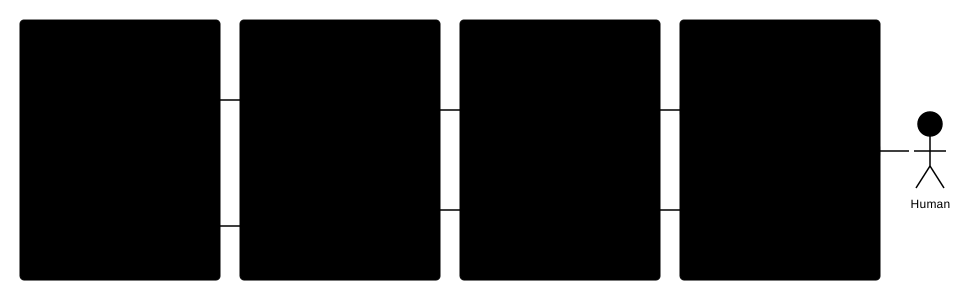
Evolve is built on a modular architecture which forms a feedback loop, taking conversation traces (trajectories) from an agent, extracting key insights into a database, feeding it back into the agent.
Lite Mode omits the Interaction layer. All activity is performed in-agent
Entity Sharing
Evolve supports sharing entities across namespaces using a simple public/private visibility model.
Visibility is stored in each entity's metadata and is private by default. Existing entities without a visibility field are unaffected.
| Metadata field | Description |
|---|---|
owner_id |
User ID who created or last published the entity |
visibility |
"private" (default) or "public" |
published_at |
ISO-8601 timestamp of the most recent publish |
MCP Tools
Publishing an entity:
publish_entity(entity_id="42", user_id="alice")
Sets visibility=public and records the owner and publish timestamp.
Unpublishing:
unpublish_entity(entity_id="42", user_id="alice")
Reverts the entity to private. The entity stays in its namespace — only its visibility changes.
Retrieving public entities from all namespaces:
get_entities(task="write safer code", include_public=True)
Merges results from the caller's namespace with public entities from all other namespaces. Public results are annotated with [public: {owner_id}].
Creating an entity with visibility:
create_entity(content="...", entity_type="guideline", visibility="public", owner_id="alice")
What's deferred (Phase 1C)
REST API endpoints (GET /api/entities/public, publish/unpublish routes) and UI controls are not yet implemented.
Guideline Provenance
Evolve automatically tracks the origin of every guideline it generates or stores. Every guideline entity contains metadata identifying its source:
creation_mode: Identifies how the guideline was created (auto-phoenixvia trace observability,auto-mcpvia trajectory saving tools, ormanual).source_task_id: The ID of the original trace or task that inspired the guideline, providing full auditability.
See the Low-Code Tracing Guide for more details.
Contributing, Community, and Feedback
Evolve is an active project, and real‑world usage helps guide its direction.
If you’re experimenting with Evolve or exploring on‑the‑job learning for agents, feel free to open an issue or discussion to share use cases, ideas, or feedback.
See the Contributing Guide to understand our development process, or how to submit changes, report bugs, or propose features.


Download files
Download the file for your platform. If you're not sure which to choose, learn more about installing packages.
Source Distribution
Built Distribution
Filter files by name, interpreter, ABI, and platform.
If you're not sure about the file name format, learn more about wheel file names.
Copy a direct link to the current filters
File details
Details for the file altk_evolve-1.1.2.tar.gz.
File metadata
- Download URL: altk_evolve-1.1.2.tar.gz
- Upload date:
- Size: 260.8 kB
- Tags: Source
- Uploaded using Trusted Publishing? Yes
- Uploaded via: twine/6.1.0 CPython/3.13.12
File hashes
| Algorithm | Hash digest | |
|---|---|---|
| SHA256 |
41f56c8122aa47d3a1a574d4db49321e31c9a1b0bab045dd797a94776aedffc3
|
|
| MD5 |
09774ed6b2f9723f5423e6f7479f3e56
|
|
| BLAKE2b-256 |
07354a3a0781866931bd692f51faffee6077a3c96d4a67e2d3a028ce44b87661
|
Provenance
The following attestation bundles were made for altk_evolve-1.1.2.tar.gz:
Publisher:
python-publish.yml on AgentToolkit/altk-evolve
-
Statement:
-
Statement type:
https://in-toto.io/Statement/v1 -
Predicate type:
https://docs.pypi.org/attestations/publish/v1 -
Subject name:
altk_evolve-1.1.2.tar.gz -
Subject digest:
41f56c8122aa47d3a1a574d4db49321e31c9a1b0bab045dd797a94776aedffc3 - Sigstore transparency entry: 1697085018
- Sigstore integration time:
-
Permalink:
AgentToolkit/altk-evolve@606e90609a805a08176726b1ef1b9f5ad6948503 -
Branch / Tag:
refs/tags/v1.1.2 - Owner: https://github.com/AgentToolkit
-
Access:
public
-
Token Issuer:
https://token.actions.githubusercontent.com -
Runner Environment:
github-hosted -
Publication workflow:
python-publish.yml@606e90609a805a08176726b1ef1b9f5ad6948503 -
Trigger Event:
release
-
Statement type:
File details
Details for the file altk_evolve-1.1.2-py3-none-any.whl.
File metadata
- Download URL: altk_evolve-1.1.2-py3-none-any.whl
- Upload date:
- Size: 276.5 kB
- Tags: Python 3
- Uploaded using Trusted Publishing? Yes
- Uploaded via: twine/6.1.0 CPython/3.13.12
File hashes
| Algorithm | Hash digest | |
|---|---|---|
| SHA256 |
e0a95cfe032c2bd0afb1c6600cfb2f030a8f274cc598483f1c7b3c196bf6e1f0
|
|
| MD5 |
36a71f1d6afcfb63e61c37ed50c00b03
|
|
| BLAKE2b-256 |
edbf3f0bc70c4cca1f60638de62661668c0d4c26fbab97dbbe5786a81af3d0b5
|
Provenance
The following attestation bundles were made for altk_evolve-1.1.2-py3-none-any.whl:
Publisher:
python-publish.yml on AgentToolkit/altk-evolve
-
Statement:
-
Statement type:
https://in-toto.io/Statement/v1 -
Predicate type:
https://docs.pypi.org/attestations/publish/v1 -
Subject name:
altk_evolve-1.1.2-py3-none-any.whl -
Subject digest:
e0a95cfe032c2bd0afb1c6600cfb2f030a8f274cc598483f1c7b3c196bf6e1f0 - Sigstore transparency entry: 1697085103
- Sigstore integration time:
-
Permalink:
AgentToolkit/altk-evolve@606e90609a805a08176726b1ef1b9f5ad6948503 -
Branch / Tag:
refs/tags/v1.1.2 - Owner: https://github.com/AgentToolkit
-
Access:
public
-
Token Issuer:
https://token.actions.githubusercontent.com -
Runner Environment:
github-hosted -
Publication workflow:
python-publish.yml@606e90609a805a08176726b1ef1b9f5ad6948503 -
Trigger Event:
release
-
Statement type:






