
     _____            .__                            __
    /  _  \    _____  |__|   ____    ____    ____  _/  |_
   /  /_\  \  /     \ |  |  / ___\ _/ __ \  /    \ \   __\
  /    |    \|  Y Y  \|  | / /_/  >\  ___/ |   |  \ |  |
  \____|__  /|__|_|  /|__| \___  /  \___  >|___|  / |__|
          \/       \/     /_____/       \/      \/

     complete remote control for a real Amiga, by AI or manually

Amigent connects your PC or Mac to your real Amiga over the home network. Then you can:
- let an AI agent do the work, for example Claude Code or Codex: install software, update programs, change settings, copy files, click through programs. Just tell it what you want.
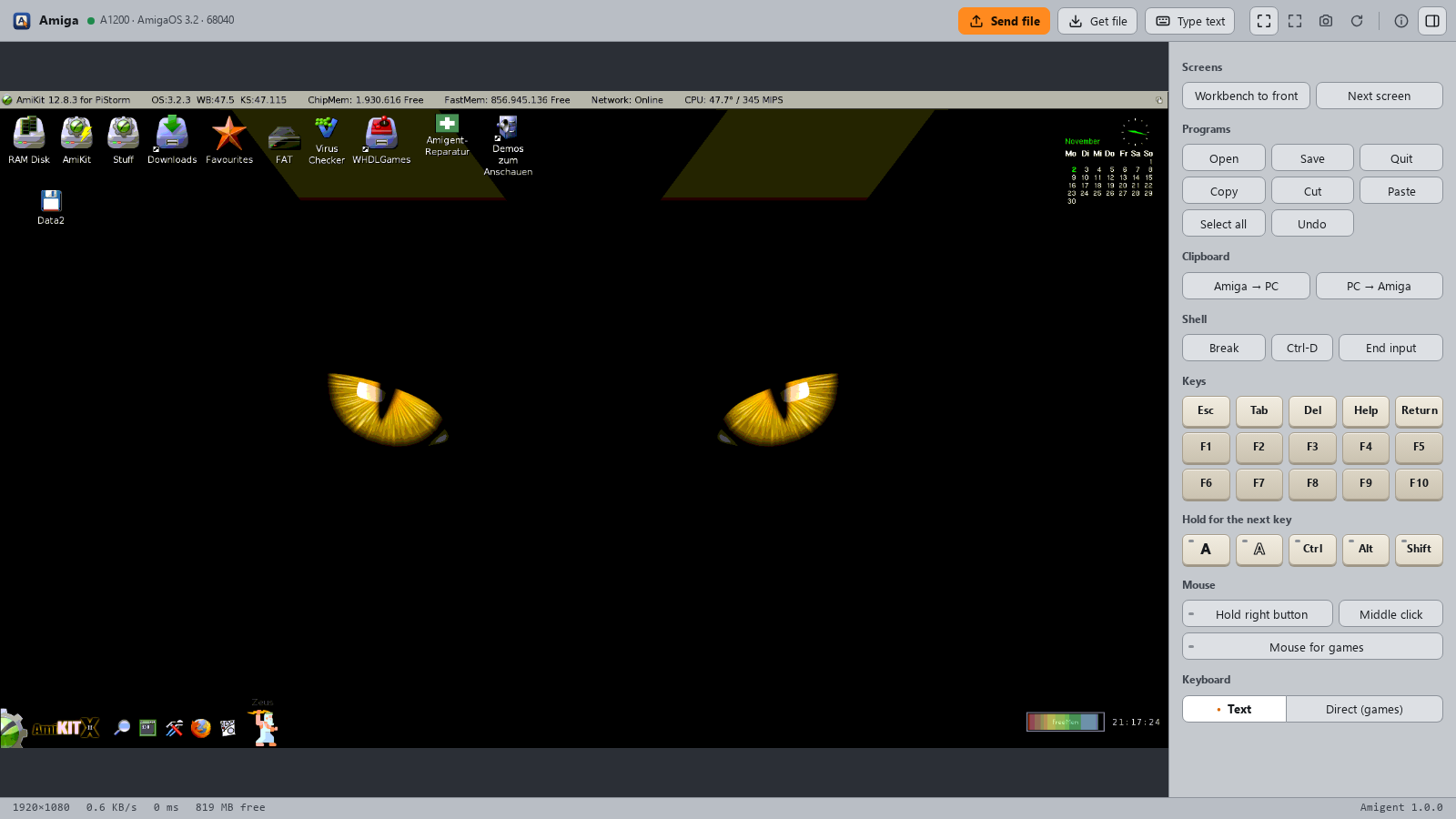
- use the Amiga yourself from your computer, as a remote desktop like TeamViewer or VNC: a window with the live screen, your own mouse and keyboard, file transfer and a shared clipboard.
Both at the same time: you see every click the agent makes and can take over at any moment.
Installation
On the Amiga
1. Copy amigentd to the Amiga (amigentd.000 on a
68000), or unpack the archive from the
releases.
2. Start it with amigentd SETUP in a Shell, or double-click its icon.
On the PC or Mac
3. Paste this into your AI agent:
Install Amigent for me: run "pipx install amigent" (if pipx or Python 3.10
or newer is missing, install them first: Windows winget, macOS Homebrew,
Linux the package manager). Then run amigent-setup; it finds my Amiga on
the network by itself. Register the MCP server "amigent" with the command
amigent-server, and run amigent-viewer --install so the remote desktop
shows up as a program. Tell me if you need to be restarted.
The agent sets up the Amiga over the network; from then on amigentd starts with it.
Windows: Amigent appears in the Start menu. For an encrypted connection
openssl is needed, which comes with Git for Windows.
macOS: Amigent appears in ~/Applications. On its first start, allow it
access to the local network, or it cannot reach the Amiga. Cmd is the right
Amiga key.
Linux: there is no program entry; start the remote desktop with
amigent-viewer.
Without an AI agent: see the manual installation.
What you need
- An Amiga with AmigaOS 3.x, any CPU from the 68000 on, a network connection (a plipbox on the parallel port is enough) and a TCP/IP stack such as Roadshow. The faster the CPU, the smoother the screen.
- A PC or Mac with Windows, macOS or Linux and Python 3.10 or newer.
What you can ask for
"Check which programs on the Amiga are outdated."
"Install the game from my Downloads folder and add it to the Games menu."
"Copy the demo to the Amiga and start it."
"Open the remote desktop."
Good to know
- Slow networks are fine. Only the parts of the screen that change are sent.
- New address after a restart? Amigent finds the Amiga again by itself. It takes only the one that proves to be yours.
- Several Amigas?
amigent-fleetshows them side by side with a preview. - After a big OS update,
amigent-repairputs back what the update removed. - Safe at home. A key keeps other computers on the network out, and the connection can be encrypted. Don't open the Amiga to the internet.
More in the guide and the FAQ.
Other projects
- amimcp by Thomas Luebker also lets an AI agent control a real Amiga, from OS 2.04 on, with amifleet as a native Mac app for several machines. Use it if your Amiga runs OS 2.x or you want nothing but Python's standard library on the PC.
- MCP-AmigaOS4 is for AmigaOS 4.1.
- For emulators such as WinUAE and Amiberry there are MCP servers of their own.
Amigent is the one to pick if you want to use the Amiga yourself as well, have a slow network, or want help keeping the machine in shape.
Thanks
tbdye for amigactld, Volker Barthelmann for vbcc, and the PiStorm, Emu68, AmiKit and Aminet people.
License
MIT, see LICENSE. By Andreas Wendorf (Akustikrausch). Changes are in the changelog.
1 maintainer

Metadata
1 maintainer
Release files for amigent 1.0.0
For a detailed explanation of source distributions (sdists) and built distributions (wheels), please see the package formats documentation.
Source distribution (sdist)
| File | Size | Uploaded | Provenance | Actions |
|---|---|---|---|---|
| amigent-1.0.0.tar.gz | 619.3 kB | With provenance | Details for amigent-1.0.0.tar.gz |
Built distribution (wheel)
| File | Interpreter | ABI | Platform | Actions Reset |
|---|---|---|---|---|
| amigent-1.0.0-py3-none-any.whl | Python 3 | none | any | Details for amigent-1.0.0-py3-none-any.whl |
Total release size: 1.2 MB
Release files / amigent-1.0.0.tar.gz
| Download URL | amigent-1.0.0.tar.gz |
|---|---|
| Size | 619.3 kB |
| Tags | Source |
|
SHA-256 checksum How to use checksums |
d87c16f1913c49cb5ca507f42c21581230d2b62e3e584eab9048d038aff6a29c
|
|
BLAKE2b-256 checksum How to use checksums |
8992be0ddd4ca2e6668b4b30fecc6f548370969491385ef716fe86b912f39306
|
| Upload date | |
|
Uploaded using Trusted Publishing? What is trusted publishing? |
Yes |
| Uploaded via |
twine/7.0.0 CPython/3.13.16
|
Provenance
Provenance describes where a file came from. On PyPI, provenance is shared via attestations, which provide a verifiable record of the build or publishing details. View details, limitations and caveats.


PyPI Publish Attestation
PyPI verified that this artifact, at this checksum, originated from the publisher listed below.
Signed by GitHub Actions, verified by PyPI on Nov 2, 2026.
Transparency logRelease files / amigent-1.0.0-py3-none-any.whl
| Download URL | amigent-1.0.0-py3-none-any.whl |
|---|---|
| Size | 619.8 kB |
| Tags | Python 3 |
|
SHA-256 checksum How to use checksums |
12a8af419a7f07b0ffbdd826626daf67b488cacca6068584c2cce02b71e7ad16
|
|
BLAKE2b-256 checksum How to use checksums |
48dc9a7b8dfcc1723bd2007b48b88e97c88e55406e5e74314fee00f0593eb091
|
| Upload date | |
|
Uploaded using Trusted Publishing? What is trusted publishing? |
Yes |
| Uploaded via |
twine/7.0.0 CPython/3.13.16
|
Provenance
Provenance describes where a file came from. On PyPI, provenance is shared via attestations, which provide a verifiable record of the build or publishing details. View details, limitations and caveats.
PyPI Publish Attestation
PyPI verified that this artifact, at this checksum, originated from the publisher listed below.
Signed by GitHub Actions, verified by PyPI on Nov 2, 2026.
Transparency logSecurity for amigent 1.0.0
Provenance
Provenance describes where a file came from. On PyPI, provenance is shared via attestations, which provide a verifiable record of the build or publishing details. View details, limitations and caveats.
Full provenance
All 2 files in this release have been uploaded with provenance metadata.
Attestation for amigent-1.0.0.tar.gz
PyPI Publish Attestation
PyPI verified that this artifact, at this checksum, originated from the publisher listed below.
Signed by GitHub Actions, verified by PyPI on Nov 2, 2026.
Transparency logA note on package security
PyPI is a repository for distributing packages, not a service for auditing them. While third-party security researchers and our staff do their best to detect and remove malicious packages, PyPI cannot guarantee the quality, security or suitability of any given package.
To learn more about protecting yourself from malicious actors, visit our package security documentation.














